Tuesday, October 7th at 1:00 PM, there will be a showing of Superman @ Seniors in the Park, in the Starin Community Building:
Action/Adventure Rated PG-13
2 hours, 9 minutes (2025)
The never ending battle for truth, justice and the human way. Superman faces innumerable challenges including arch nemesis Lex Luthor, Kaiju, pocket universes, Kryptonite and a totalitarian dictator. All in a superhero’s day’s work!
Thursday in Whitewater will be mostly sunny with a high of 82. Sunrise is 6:53 and sunset is 6:33, for 11 hours 40 minutes of daytime. The moon is a waxing gibbous with 74.7 percent of its visible disk illuminated.
On this day in 1766, the Nottingham Cheese Riot breaks out at the Goose Fair in Nottingham, UK, in response to the excessive cost of cheese.
In November 2022, a FREE WHITEWATER post assessed conditions in the city and listed What Ails, What Heals. Below is a summary of that post (with the full text linked above). This list of what ails, written in the fall of 2022 was, by intention, a look at conditions then and inthe generation before.
What ails:
Boosterism. The view that if one accentuates the positive, the community will reap economic gains.
Toxic Positivity. The view that every outlook should be a positive one.
Regulatory Capture. Government should be limited, responsible, and humble. Whitewater’s government is not by law, and never should be in practice, the private property of a few. The last generation has seen the special-interest manipulations of landlords, bankers, and public-relations men.
News Deserts. We don’t have a professional press in Whitewater, and that’s a huge loss.
Violence. Violence includes sexual harassment and assault, or unjustified use of official force, and the supportive reflex only to look the other way.
And what heals:
Free Markets. Voluntary transactions between people and groups uplift from poverty into a true prosperity.
Charity. Our small city is beautiful, yet beautiful while in need. Government, politics, business, journalism, and commentary have not been enough to alleviate all loss and suffering. (With reference to the historical example and importance of Dorothy Day: Waiting for Whitewater’s Dorothy Day.)
Open Government. Government is a mere instrumentality, established for limited purposes, constrained by law. It must be obvious and transparent to the people from whom its authority derives.
Impartial Government. Whitewater doesn’t have a few stakeholders — she has 14,889 residents.
A Professional Press. The city could use greater focus and respect for professional journalism.
Individual Rights. Each person is accorded by right an equal moral and legal status. No one forgotten, no one swept aside, no one by birth or birthplace greater than another.
If this was a look at conditions in 2022 and during the generation before, then has anything changed?
Yes, in these three years the municipal government has grown more open (by far), more professional (by far), and more empirical in its approach (again, by far). It’s not a close comparison between what Whitewater had before 2022 and what she’s had since. (There’s a difference between being a critic of government and being blind to genuine improvement.)
If this was a look at conditions in 2022 and in the generation before, then was anything missing from the list?
Looking at the list, residents in productive Wisconsin cities of similar size would have noticed that this libertarian blogger made no mention of ordinary development. A resident elsewhere might have said, “you mentioned free markets, but you left out any mention of development.”
That’s true. Whitewater before then was a place of regulatory capture that prevented normal development, and the best that one could expect was to juxtapose general principles (markets, impartiality) against a small, selfish cronyism that had this community in its grip. Whitewater has always been beautiful; she always deserved better than fifteen domineering over fifteen thousand.
The chance to live and flourish as a beautiful city of normal development is now before us. That’s a subject worth visiting many times in the months ahead.
A supermoon takes over the sky, the Draconid meteor shower peeks through, and the Orionid meteor shower shines bright. 0:00 Intro 0:13 Supermoon 0:51 International Observe the Moon Night 1:14 Draconid meteor shower 1:53 Orionid meteor shower 3:00 October Moon phases
Wednesday in Whitewater will be cloudy with a high of 77. Sunrise is 6:52 and sunset is 6:35, for 11 hours, 43 minutes of daytime. The moon is a waxing gibbous with 65.5 percent of its visible disk illuminated.
Chris Taylor is running for a seat on the Wisconsin Supreme Court, and after incumbent Rebecca Bradley decided against running for reelection, Maria Lazar declared her candidacy yesterday:
Lazar’s announcement came a month after Bradley said she wasn’t seeking reelection. In the statement announcing her decision, Bradley called on the conservative movement to “take stock of its failures, identify the problem, and fix it.”
Lazar, 61, has been on the Waukesha-based District 2 Court of Appeals since 2022. She previously served as a Waukesha County judge, an assistant attorney general under Republican Attorney General J.B. Van Hollen, and as an attorney in private practice.
She is entering an open race for a seat on the court that’s controlled 4-3 by liberals.
Taylor, who launched her bid in May, will have the support of Democrats. She is a judge on the Madison-based District 4 Court of Appeals.
It’s unclear whether other candidates will get in the race.
Taylor’s campaign has reported raising more than $1 million and was sitting on more than $500,000 by June 30. Lazar reported having only about $1,000 in her campaign account in her last report.
The spring general election for the court is in April 2026. While others might enter the race, Taylor and Lazar are likely to be the leading candidates.
It’s a nonpartisan race, yet it’s not. Taylor is the WisDems’ candidate and Lazar the WISGOP’s candidate.
Lazar will raise enough to get on television, as there are plenty of conservative donors inside and outside Wisconsin ready to spend.
Pending Wisconsin Supreme Court decisions will affect the April election, notably among them any final decisions on Act 10 and congressional district boundaries. Even so, we live in a nationalized political environment; national events are sure to play a significant role in voter turnout and preferences next year.
Best guess: this race favors Taylor, though not prohibitively so.
Chunk, a towering brown bear with a broken jaw, swept the competition Tuesday in the popular Fat Bear Week contest — his first win after narrowly finishing in second place three previous years.
Tuesday in Whitewater will be sunny with a high of 80. Sunrise is 6:51 and sunset is 6:37, for 11 hours, 46 minutes of daytime. The moon is a waxing gibbous with 55.8 percent of its visible disk illuminated.
On this day in 1947, the 1947 World Series begins. It is the first to be televised, to include a Black player, to exceed $2 million in receipts, to see a pinch-hit home run, and to have six umpires on the field. (The Yankees would go on to defeat the Brooklyn Dodgers in seven games.)
The Badger Hollow Wind Project in Iowa and Grant counties and the Whitewater Solar Project in Jefferson and Walworth counties received approval from the Public Service Commission of Wisconsin, or PSC, on Thursday.
The Badger Hollow Wind Project is a 118-megawatt wind farm that will be able to generate enough electricity to power more than 30,000 homes, while the Whitewater Solar Project is a 180-megawatt solar farm that will be able to generate enough electricity to power more than 21,000 homes, according to the developers.
…
Clean energy and environmental groups framed the approvals as wins for the renewable energy sector.
“Renewable energy generally is facing a lot of threats nationally. Our federal government is taking a lot of creative paths to putting up hurdles for renewables,” said Chelsea Chandler, climate, energy and air program director for the nonprofit Clean Wisconsin. “It’s encouraging to see that projects are still getting permitted here in Wisconsin.”
…
Andrew Kell, policy director for the nonprofit RENEW Wisconsin, said the projects approved by the PSC will be on private property, with farmers choosing to lease their land for solar or wind.
“It’s really an issue of private property and something that allows farmers to continue their businesses here in the state of Wisconsin,” he said.
About a determination meeting: Wisconsin law does not provide for public comment at such proceedings. There are opportunities for comment (both written and in person) earlier in the evaluation of a project. One should think of the determination meeting like an appellate court’s issuance of an opinion: while there may have been oral argument previously, on the day an opinion is handed down any remarks about a written opinion come from the appellate judges alone (if reading from a portion of an opinion, for example).
There’s nothing improper about the lack of public comment when a decision is handed down. (It’s mistaken to imply that in the Whitewater Solar determination “[t]heir opinions [of those objecting to the project] were not expressed, as there was no opportunity for public comment” at the determination meeting.) On the contrary, public remarks at that stage would only extend comment or oral argument at the expense of a discrete moment when a tribunal (administrative body in this case, appellate court by analogy) hands down a decision. There were opportunities beforehand as the Whitewater Solardocket shows. Public comment lawfully and sensibly closes on a date before the determination in Wisconsin Public Service Commission cases.
Private property: The Whitewater Solar project involves private landowners making arrangements with a private developer. Andrew Kell, policy director for the nonprofit RENEW Wisconsin, has it right when he observes that it’s “really an issue of private property.” While there are limits to private conduct, discussion of this issue too often ignores the property rights of landowners to contract with a developer.
(The next thing you know, someone will suggest that private landowners in Whitewater should be prevented from feeding squirrels in their own yards. Update, Tuesday afternoon: this aside about squirrel feeding was a reference to a city ordinance passed in 2021, during a prior municipal administration, and a prior council president. Current municipal initiatives are more serious.)
Monday in Whitewater will be sunny with a high of 84. Sunrise is 6:50 and sunset is 6:39, for 11 hours, 49 minutes of daytime. The moon is a waxing crescent with 45.9 percent of its visible disk illuminated.
Whitewater’s Urban Forestry Commission meets at 5:30 PM.
Two redistricting cases are now pending in Dane County Circuit Court: Wisconsin Business Leaders for Democracy v. Wisconsin Elections Commission, No. 2025CV002252 (Wis. Cir. Ct. Dane Cnty. July 8, 2025) and Elizabeth Bothfeld et al. v. Wisconsin Elections Commission, No. 2025CV002432 (Wis. Cir. Ct. Dane Cnty. July 21, 2025). The plaintiffs in those cases are asking for a three-judge panel to review the constitutionality of Wisconsin’s congressional maps.
The court issued its order in response to two requests asking justices to appoint a judicial panel to consider the constitutionality of Wisconsin’s congressional voting map ahead of the 2026 midterms.
The lawsuits were filed in circuit court in July by two liberal law firms. They asked the Supreme Court to appoint three-judge panels to decide whether Wisconsin’s congressional districts are unconstitutional. Until Thursday, the court hadn’t responded.
The three-judge panel concept was created by Republican state lawmakers in 2011 as a means to expedite redistricting challenges. Under that law, if parties in a circuit court case request the panel, the Supreme Court is required to appoint circuit court judges to sit on it. It also requires any appeal of the panel’s ruling to go directly to the Supreme Court.
This week, an attorney representing plaintiffs in one of those cases sent a letter to the Supreme Court stating a Dane County judge denied their request to set a briefing schedule in the case because doing so would violate the law passed by the Legislature more than a decade before.
On Thursday, the majority responded. Instead of appointing the judicial panel requested by the liberal firms, they ordered legal briefs arguing whether or not the lawsuits filed in Dane County constitute a valid “action to challenge the apportionment of a congressional or state legislative district.”
The Wisconsin gubernatorial field for the August 2026 primary saw some changes over the last week.
I’ll not venture a guess about how the Wisconsin Supreme Court might decide this question. It’s enough to see that they have agreed to address “whether Bothfeld’s complaint filed in the circuit court constitutes an ‘action to challenge the apportionment of a congressional or state legislative district’ under WIS. STAT. § 801.50(4m).”
See also Bothfeld v. Wis. Elections Comm’n, Order, 2025XX1438 (Wis. Sept. 25, 2025):
Karearea, the Indigenous Maori name for the New Zealand falcon, was crowned Bird of the Year on Monday. The majestic karearea can fly at speeds of more than 200 km (124 miles) per hour and swoops to capture its prey, often smaller birds.
Sunday in Whitewater will be sunny with a high of 79. Sunrise is 6:49 and sunset is 6:40, for 11 hours, 52 minutes of daytime. The moon is a waxing crescent with 36.9 percent of its visible disk illuminated.
Republican U.S. Rep. Tom Tiffany has officially entered Wisconsin’s 2026 race for governor, joining a field of GOP candidates hoping to win back control of the executive branch, held by Democratic Gov. Tony Evers since 2019.
During an appearance on WISN-AM’s Dan O’Donnell Show Tuesday, Tiffany laid any lingering doubts to rest.
“I’m here to announce on your show that I’m going to run for governor of the state of Wisconsin in the 2026 election,” Tiffany said. “It is a great challenge that is going to be before us, but it is also a great opportunity. And we are going to accept that challenge, and we’re in as of right now.”
See Rich Kremer, US Rep. Tom Tiffany enters race for Wisconsin governor (‘After months of teasing run, Tiffany makes his entrance into 2026 campaign official on conservative talk radio show’), Wisconsin Public Radio, September 24, 2025.
One of the candidates in the GOP primary for Wisconsin governor has dropped out of the race, days after it was reported that he once followed several authors of sexually explicit essays on social media.
New Berlin businessman Bill Berrien, who got into the race for governor in July, announced Friday that he was suspending his campaign.
…
When Berrien launched his campaign this summer, he began with an ad that framed himself as a businessman, ex-Navy SEAL and political outsider, not to mention a big supporter of President Donald Trump. Berrien financed his early ads with the help of a political action committee, whose biggest donors included the billionaire brothers known as the Winklevoss twins, made famous for their lawsuit against Facebook founder Mark Zuckerberg.
…
The ads also criticized Gov. Tony Evers’ record on transgender issues, pledging to “keep boys out of our daughters’ sports and locker rooms.” Evers has vetoed multiple bills aimed at restricting trans kids from joining K-12 girls’ or university women’s sports teams.
While Berrien’s position is common in GOP politics, it came under new light when his social media history became public. The Milwaukee Journal-Sentinel reported that Berrien used the social media platform Medium to follow a transgender porn star named Jiz Lee. Berrien also followed publications like “Sexography,” which calls itself “an inclusive place for people to talk about and explore sexuality from all orientations, cultures, and perspectives,” and “Polyamory Today,” which promotes relationships with multiple partners.
See Shawn Johnson, Republican Bill Berrien ends campaign for Wisconsin governor (‘Berrien’s decision comes days after news surfaced that he followed authors of sexually explicit essays on social media’), Wisconsin Public Radio, September 26, 2025.
A former Democratic state lawmaker from Madison who has been investigated for various incidents of alleged misconduct and known for pulling stunts that have angered his own party at times is launching a new campaign for governor.
Brett Hulsey, 66, announced Wednesday he would join the Democratic primary for governor. It’s his second time pursuing the governor’s office after coming in a distant third in 2014.
Tiffany is now the favorite in a WISGOP field that might still find (and needs) a younger and more dynamic candidate (as Tiffany is neither). Berrien was always a long shot, and the Winklevoss twins never had their fingers on the pulse of WISGOP trends in any event.1 While Brett Hulsey has entered the Democratic primary, no one without a microscope will be able to follow his campaign.
_____
Berrien’s embrace of WISGOP orthodoxy was hypocritically out of step with his own private reading. The WISGOP position makes that private reading publicly unacceptable. Yesterday’s complaints about ‘cancel culture’ have become today’s imposition of that same culture inside and outside the party. ↩︎
Saturday in Whitewater will be sunny with a high of 84. Sunrise is 6:48 and sunset is 6:42, for 11 hours, 55 minutes of daytime. The moon is a waxing crescent with 28 percent of its visible disk illuminated.
On this day in 1940, Germany, Japan and Italy sign the Tripartite Pact.
Screenshot via YouTube
These many years later, attorney discipline draws closer for Michael Gableman, former justice of the Wisconsin Supreme Court, former special counsel hired at the insistence of Robin Vos, and perpetual conspiracy theorist:
Former Supreme Court Justice Michael Gableman’s license to practice law in Wisconsin should be suspended for three years, a third-party referee wrote, agreeing with the state Office of Lawyer Regulation’s allegations that he violated standards for professional conduct during his much-maligned review of the 2020 presidential election.
The Wisconsin Supreme Court will have the final say in the matter, a Court spokesperson said Friday.
The suspension recommendation marks the conclusion of Gableman’s effort to fight attempts to hold him accountable for his conduct during the election investigation. The OLR found that while working on behalf of Assembly Speaker Robin Vos to look into alleged wrongdoing during the election, Gableman lied to a Waukesha County judge about conversations he had with other attorneys, lied to an Assembly committee, deliberately violated state open records laws, used his agreement with Vos to pursue his own political interests, violated his duty of confidentiality to his client and lied in an affidavit to the OLR as it was investigating him.
Gableman’s investigation ultimately cost the state more than $2.3 million without finding any evidence to confirm President Donald Trump’s baseless claims of fraud during the 2020 election.
Should never have been a Wisconsin Supreme Court justice, should never have been hired as a special counsel, and should have been disciplined sooner for his unethical performance as special counsel.
And yet, and yet, at least discipline draws closer.
Friday in Whitewater will be sunny with a high of 80. Sunrise is 6:47 AM and sunset is 6:44 PM, for 11 hours, 57 minutes of daytime. The moon is a waxing crescent with 19.8 percent of its visible disk illuminated.
On this day in 1777, British troops occupy Philadelphia. (The British evacuated Philadelphia in 1778, after 266 days of occupation.)
U.S. President Donald Trump on Thursday unveiled sweeping new import tariffs, including 100% duties on branded drugs and 25% levies on heavy-duty trucks, triggering fresh trade uncertainty after a period of comparative calm.
The latest salvo, which Trump said was to protect the U.S. manufacturing industry and national security, follows wide-ranging duties on trading partners of up to 50% and other targeted levies on imported products such as steel.
It’s the latest upheaval for global businesses already struggling with snarled supply chains, soaring costs and consumer uncertainty caused by Trump’s trade war. The barrage has cast a pall over global growth, while the Federal Reserve has said it is also contributing to higher U.S. consumer prices.
Tuesday, September 30th at 1:00 PM, there will be a showing ofEverything’s Going to Be Great @ Seniors in the Park, in the Starin Community Building:
Family/Comedy/Drama R (language)
1 hour 35 minutes (2025)
There’s no business like show business, for Buddy (Bryan Cranston) and Macy Smart (Allison Janney) and their unpredictable life in regional theatre, while trying to raise their two radically different teenage sons. A touching, quirky charmer of a film.
Thursday in Whitewater will be sunny with a high of 72. Sunrise is 6:45 and sunset is 6:46, for 12 hours, 1 minute of daytime. The moon is a waxing crescent with 12.7 percent of its visible disk illuminated.
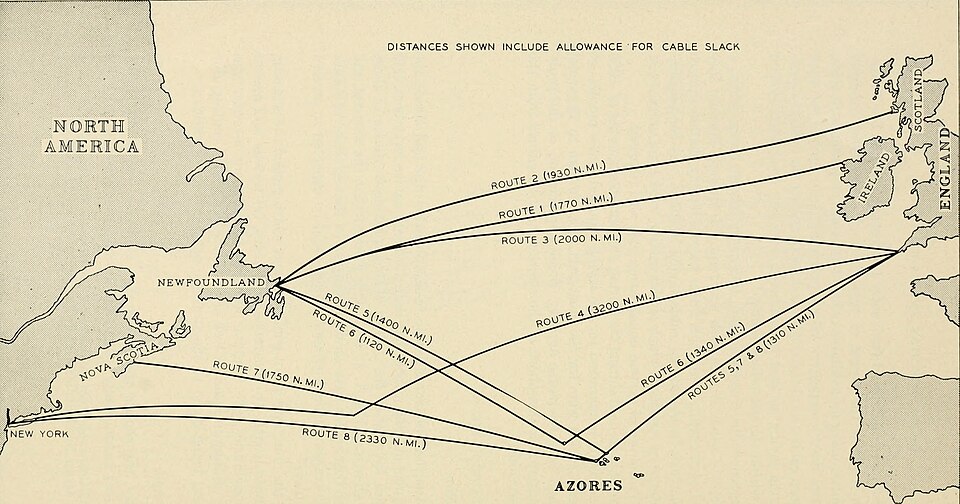
On this day in 1956, TAT-1, the first submarine transatlantic telephone cable system, is inaugurated.
Routes under study in early 1956. By American Telephone and Telegraph Company. No restrictions, Link
I’ll offer a few thoughts on meetings with complex topics by simple illustrations. It’s important to capture the course of a topical argument within a meeting so that one can refer to it, as easily as possible, and add more arguments later. (For former high school or college debaters, this is simply ‘flow.’ Some of the professions, including my own, rely on versions of flow in their work. There are software and recording combinations that can perform some of this work, but a legal pad and pen are more than adequate.)
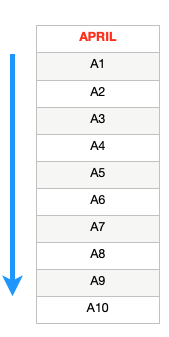
There’s a plain way to show how topics become complicated across several meetings. Consider, first, a one-column table, that represents the points made on the same topic, in a single meeting, from the initial point made descending down the column with lower rows representing points made subsequently in that same discussion:
This table is merely a simple representation of how one remembers a thorough newspaper story’s account of the sequential discussion from a meeting. If the story is comprehensive, then that story lists the major arguments and replies on a topic, in the chronological order that those arguments were made.
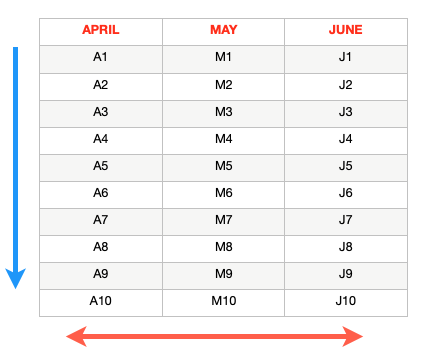
But what happens if the discussion on that same topic extends over several months? A table for a three-month-long discussion would look like this:
The argument flows downward chronologically within a single month, but must then be matched across time with points made in subsequent months. A point made in April (let’s say point A1) might be answered only in June (let’s say point J9). It’s not merely that there are more cells in the table (points made), but that one must link some points to others to grasp the strength and weakness of given claims. Merely looking at the cells, as it were, doesn’t reveal enough about the discussion. (Obvious point: refuting A1 by J9 lets a lot of misinformation to go unanswered for a long time.)
That’s what keeping track (and thorough reporting) offers — someone watching or reading carefully on each of these monthly discussions could recall that point J9 in June is a refutation of point A1 made in April. Someone reading might also note that some claims have been abandoned, others made more extreme, and yet others made more anodyne. Otherwise, too much of the discussion is unknown or forgotten.
And that’s what flow (or good reporting as a narrative facsimile of flow) gets a community: a catalog and by that catalog a way to evaluate the full range of arguments made on a policy topic over time.
Important discussions in a competitive American town deserve a clear catalog. There’s always more to do, and happily so.
Wednesday in Whitewater will be partly sunny with a high of 70. Sunrise is 6:44 and sunset is 6:48, for 12 hours, 4 minutes of daytime. The moon is a waxing crescent with 7.1 percent of its visible disk illuminated.
On this day in 1906, Pres. Theodore Roosevelt proclaims Devils Tower in Wyoming as the nation’s first National Monument.
At the September 16 session of the Whitewater Common Council, there was a presentation on economic development in the city. (SeeVideo at 15:13 and accompanying presentation.) In that presentation, Whitewater’s new Economic Development Director told the council members that the municipal administration would bring forward single-family, owner-occupied development proposals this fall.
There are many people in this city, not least this libertarian blogger, who would look forward to hearing about a new, comprehensive proposal.
The development discussion on the 16th was not, and discussions of development these last three years have not been, random non sequiturs. Many years in this city, and many local actions, brought us here. No one invented the need for a development discussion. The topic is not, so to speak, an invasive species placed in Whitewater. That which paved the way for a needed discussion didn’t begin in 2022. It began closer to 2002, truly. (More precisely: after the 2007-2009 recession at the latest.)
When one looks around, one sees (if one sees clearly) a town of fifteen thousand. Many of these residents arrived here in the last decade. Each of these thousands has dozens of encounters, experiences, and interactions each day. They are in motion, dynamically and productively.
This community is not — and should not be — approached as though it were a prehistoric creature in amber.
Tuesday in Whitewater will be windy with a high of 74. Sunrise is 6:43 and sunset is 6:49, for 12 hours, 6 minutes of daytime. The moon is a waxing crescent with 2.9 percent of its visible disk illuminated.
If nothing ever happened in a community, then there would be no need to record the passing of events. If only a few events took place, then only a little effort would be required to chronicle those events. In a community experiencing new dynamism, there’s a greater need to record developments accurately.
A news desert, with limited information, allows misinformation to spread.
Whitewater has become a place of increasing dynamism, and notably and undeniably of greater thoroughness in policy from the municipal government. This should be universally acknowledged (although it won’t be universally acknowledged): the city’s general municipal policy and community development policy are more thorough than those even of a few years ago, let alone a decade ago. (Failure to say as much may have many causes, including the stubborn pride of a few.)
Whether one supports or opposes, intellectual honesty should compel this acknowledgment.
A talented municipal government (comprised of capable officials) deserves from the many talented private residents of the community1 work as thorough as that municipal government’s2. That’s the loss (and the sadness) of a news desert: government work deserves consistent, thorough, accessible reporting on topics, as chronicle and as the basis for commentary. Whitewater has some of those qualities in its news reporting, but not all of them from one publication. Having all of those qualities from a single publication makes it easier to build a knowledgeable readership. (As yesterday and forever: FREE WHITEWATER is a site of commentary; it’s not a site of reporting the news, but of commenting on the news.)
Perhaps someday a Whitewater publication with all of these qualities will come along. Today is not that day.
In the meantime, as the community entertains policy discussions consistent with best practices elsewhere, there are a few steps possible to present proposals plainly and accurately.
First, there have been evident gains in communicating city initiatives on social media. That’s all to the good, reminding again and again about upcoming meetings. Press on.
Second, a written proposal in a memo or PowerPoint should offer reminders of where to look online for more information.
Third, although the city has begun to collect its website more nicely into categories (e.g., Economic Development, City Services and Government, etc.), presentations and memorandums should include a reminder to visit those links. A visual reminder on a slide, or even in a memorandum (e.g., “click here, then here, then here”) may seem too much, but it’s not. It’s a news desert, after all. It’s valuable to supply regularly what no one else does. Keep going.
Fourth, presentations should recap what’s been done on an initiative before, in a single sentence (at least) for each prior step in that initiative. (There was a solid, longer presentation like this on economic development at the 9.16.25 meeting of the Whitewater Common Council.) The government should continue these efforts even in shorter presentations, with a quick, 30-second reminder of past work. (One can say a lot, simply, in 30 seconds.)
Fifth, and critically, this city needs someone to play an ombudsman’s role when misinformation crops up at a municipal meeting, even if in public comment. Residents have a right to speak, they should and must be able to exercise that right should interrupted. Sometimes during those public comments, however, they offer statements that are simple, factual errors. Those errors should be (and undoubtedly are) known to everyone in the government (both elected and in the administration) and knowledgeable residents listening to the council session.
It is a mistake for the government to let others’ simple mistakes go uncorrected. Deference and politesse are not reasons to allow factual misstatements to go uncorrected.
I’ll offer two examples (and in both cases I’m sure the mistakes were made in good faith).
At the 6.17.25 council meeting, a resident spoke about a development project (remarks at 20:46):
But it’s kind of upsetting to me that we’ve sat through your very good presenters [through the winter and spring of 2025] that you gave, like five or six of them, whatever you had, and that’s great.
I got a lot of information. That’s what I came here for is to learn information. But when I see here on this here, this 128 units is gonna break ground already in June or July of this year. Is that what I’m assuming? That’s what I’m assuming is June and July of this year. So this was already a done deal way back when. So when did that all come out? Because I don’t remember ever seeing that until it came out in the public eye and that’s when I got that back in the beginning of this year. So this is already a done deal.
In fact, the development that the resident is describing was the subject of multiple public meetings, and commission and council approval in 2024 (at the Community Development Authority, Planning Commission, and Whitewater Common Council). These were publicly-noticed meetings. The presentations in 2025 were informational for future policy. They were not (obviously) a necessary preliminary to the 2024 lawful actions of three local public bodies.
Here’s a resident who’s specifically asking (“when did all that come out?”) and yet no one offers a simple answer at any point in the council session. A simple answer would have given her the information she sought, and dispelled the notion that the 2024 actions for the development were somehow surreptitiously advanced.
A second example comes from the remarks of a former Community Development Authority member following a development presentation (remarks at 40:43):
I think the other piece that I had on this is that something I heard tonight that I have not heard before. I know that the city council went on record approving homes on the Hoffman property with a fairly significant TIF increment plus 60 apartments, and taking $400,000, putting that into the program from the 75, the 25% housing money. I’ve never seen anything officially that that project has been canceled. I did hear tonight that there was no other apartments after this Pre-3 [a residential project]. And so it’d be very nice if you guys would take action, either rescind that major project, or at least to let the community know.
In fact, on two separate occasions (dated June 10th, part of the June 17th council packet and again as part of the Community Development Authority packet of July 17th) the Interim Economic Development Director did note plainly that “Neumann was considering a project on the Hoffman property; however, that deal did not go through.”
Perhaps the notice should have been more plain, but then perhaps a resident who had been on the old Whitewater CDA might have read the meeting packets more thoroughly. In any event, someone in the room on 9.16.25 might have pointed out the prior public written announcements about the end of this project.
Correcting errors during the meeting prevents them from echoing in chambers, recordings, and the wider community. Respectful, reasonable correction makes everyone more knowledgeable. If someone will not accept respectful, reasonable correction, then at least one knows with whom one is dealing.
There’s no reason to shy from making the effort. Something like a minimal ombudsman’s role, from someone.
In the inevitable interstices of a thorough but complex policy, the information gaps in a news desert make misunderstanding and misinformation more likely.
Residents and their government must manage as well as they can within the gaps of this news desert.
____
Whitewater is chock-a-block with sharp, talented residents. Not few — many. ↩︎
I’m writing here about the city government only. The local school district requires a separate discussion. ↩︎