
Author Archive for JOHN ADAMS
Faraway Places, Film, Travel
Film: seoul_wave
by JOHN ADAMS •
seoul_wave from Brandon Li on Vimeo.
Daily Bread
Daily Bread for 7.5.20
by JOHN ADAMS •
Good morning. 
Sunday in Whitewater will be partly sunny with a high of ninety-one. Sunrise is 5:23 AM and sunset 8:35 PM, for 15h 12m 24s of daytime. The moon is full with 99.9% of its visible disk illuminated.
On this day in 1775, the Second Continental Congress adopts the Olive Branch Petition.
Recommended for reading in full —
Mariana Atencio writes The America of Hamilton, not Trump, is the one I chose to become a citizen of this year:
My country of origin [Venezuela] was torn apart by corruption, division and lack of leadership. We cannot let that happen — let alone encourage it — here. You could say I come from the future and know what pandering and misleading tactics can do to a prosperous, democratic nation, like Venezuela used to be.
We don’t need a president who tosses paper towels and poses with a Bible, but one that provides precise information and solutions and promotes empathy. During my reporting trips, I’ve seen Trump be insensitive, like on his visit to Puerto Rico after Hurricane Maria, but I’ve also seen him be comforting, as he did in going to the Florida Panhandle after Hurricane Michael.
Now more than ever, we need that comfort — and a message of unity. That means not referring to COVID-19 as a “Chinese virus” or “kung flu,” since that term could encourage hate crimes against Asian Americans; surreptitiously enacting rules that will hurt refugees and immigrants; and calling protesters “thugs,” which literally means “ruffian” or “criminal” and is considered code for a racial slur.
Despite all of these actions and the crises this country is going through, I still decided to become an American because I know this nation is bigger than any of these ills. I am choosing to live under Trump, even though he’s so disparaging of immigrants, because we are more than four or eight years of turmoil. America is still very young!
Anne Applebaum writes Trump Is Turning America Into the ‘Sh-thole Country’ He Fears (‘The president’s mindless nationalism has come to this: Americans are not welcome in Europe or Mexico’):
more >>The numbers of American sick and dead are a source of wonder and marvel all over the world. They also inspire fear and anxiety. The European Union has decided to allow some foreigners to cross its borders now, but not Americans. Uruguayans and Rwandans can go to Italy and Spain, but not Americans. Moroccans and Tunisians can go to Germany and Greece, but not Americans. For the first time in living memory, Canada has kept its border closed with the United States. On July 3, the governor of the Mexican state of Sonora delivered the coup de grace: She announced the temporary closure of the border with Arizona and banned Americans from Sonoran beaches.
How will American nationalists cope with this new situation? I’m guessing many will pretend, like the president, that this isn’t happening: Months into the crisis, he has once again expressed the belief that the virus will magically “disappear.” But for some, it will be difficult to prevent the intrusion of reality: The stupid and pointless competition among nations continues in their heads—and they are losing. A major reckoning is coming. It can’t arrive too soon.
America, History, Holiday
Happy Independence Day 2020
by JOHN ADAMS •
Daily Bread
Daily Bread for 7.4.20
by JOHN ADAMS •
Good morning.
Saturday in Whitewater will be mostly sunny with a high of ninety. Sunrise is 5:22 AM and sunset 8:36 PM, for 15h 13m 22s of daytime. The moon is a waxing gibbous with 99.4% of its visible disk illuminated.
It’s the 244th year since America declared independence.
Recommended for reading in full —
Jonathan O’Connell reports Treasury, SBA appear to miss deadline to disclose small business loan data:
The Treasury Department and Small Businesses Administration appear unlikely to release information on hundreds of thousands of Paycheck Protection Program loans this week as planned, a setback in the Trump administration’s promises to be transparent about one of the largest economic stimulus packages ever created by the federal government.
After offering contradictory statements on how much information they would release about more than 4.8 million forgivable loans issued from the $660 billion program, Treasury Secretary Steven Mnuchin and SBA Administrator Jovita Carranza announced last week that they would release the names of borrowers who received at least $150,000 in funds before the holiday weekend.
But as of Friday afternoon — a government holiday — the Treasury Department and SBA did not indicate any plans to release the data. Congressional aides, speaking on the condition of anonymity because they weren’t authorized to brief the press, said they don’t expect the data to be released before Monday
David Rothkopf asks ‘The Most Ignorant and Unfit’: What Made America’s Worst Ever Leader?:
The worst among American presidents prior to Trump—Buchanan, Johnson, and Pierce, for example—were all produced by the Democratic Party of the nineteenth century—a party that sought to defend or forgive slavery, and that tolerated and promoted a divided nation. Since President Nixon’s “Southern Strategy,” the modern Republican Party increasingly taken on that mantle. Trump is often said to have commandeered the GOP. But properly viewed in historical terms, the reverse is also true: President Trump could not exist without the post-Nixonian GOP that has Mitch McConnell patrolling the Senate and Bill Barr providing legal cover for the virtually unlimited power of the “unitary executive.”
….
Ending Trump’s misrule and restoring confidence in the presidency demands the undoing of impediments to free and fair elections. That will entail root-and-branch campaign finance reform, an end to voter suppression, new defenses against foreign interference in elections, and reining in the digital disinformation engines. These are perhaps only the minimum demands for restoring American democracy.
Trump is a sign that we as a nation have lost our way. Just as Hamilton warned, a confusion of celebrity for leadership, fame for accomplishment, and popularity for genius has given us “a man unprincipled in private life desperate in his fortune.” Seizing the opportunity, unscrupulous “insolent men” have pandered to the lowest common denominators of fear and greed to win power and exploit it for a small elite. November’s election is a judgment day for this nation’s form of republican government. Or else, only “civil commotion” awaits us.
How ‘Hamilton’ Started Movement to Diversify Broadway:
more >>Coronavirus, Covidiocy, Mendacity, Public Health, Trump
‘Gaslighting on a massive scale’
by JOHN ADAMS •
“This is gaslighting on an enormous scale, and means until people eventually get sick or their family members get sick, the communities hit hard, they won’t believe it, and then it will be too late,” said [Dr. Celine] Grounder. “The problem is there’s a lag period from the time that somebody’s infected and starts to develop symptoms a couple days later. We don’t see people get severely sick and need to be hospitalized and in ICUs until a week into disease, and talking about probably one to two weeks of lag time from the time somebody’s exposed at least before you start to see hospitalizations and then another couple weeks before you start to see deaths.”
Via ‘Gaslighting on a massive scale’: Doctor warns Trump is lying us into a COVID disaster.
Architecture, Cats
Friday Catblogging: Cat Tower Project
by JOHN ADAMS •
Ekta Joshi writes This Japanese firm has created a functional four story luxury building for cats:
If you’re a cat parent and don’t mind pampering your furball silly, here’s what you need to lay your eyes on! The ultimate play toy cum lounge for your kitty – we’re talking about the mega-luxe “cat tower mansion” created by renowned Japanese construction firm – Mitsubishi Estate Residence.
Designed as a high-rise condo for a cat, the luxurious cat home is created by a team led by cat-lover and licensed architect Akiko Ishimaru. It features a tall scratching strip on one of the exterior walls and a window for your cat to peep out of. On the inside, it features several levels, each boasting a structure of its own.
Daily Bread
Daily Bread for 7.3.20
by JOHN ADAMS •
Good morning.
Friday in Whitewater will be mostly sunny with scattered afternoon thundershowers and a high of eighty-nine. Sunrise is 5:22 AM and sunset 8:36 PM, for 15h 14m 17s of daytime. The moon is waxing gibbous with 96.5% of its visible disk illuminated.
On this day in 1863, the Union is victorious on the final day of the Battle of Gettysburg.
Recommended for reading in full —
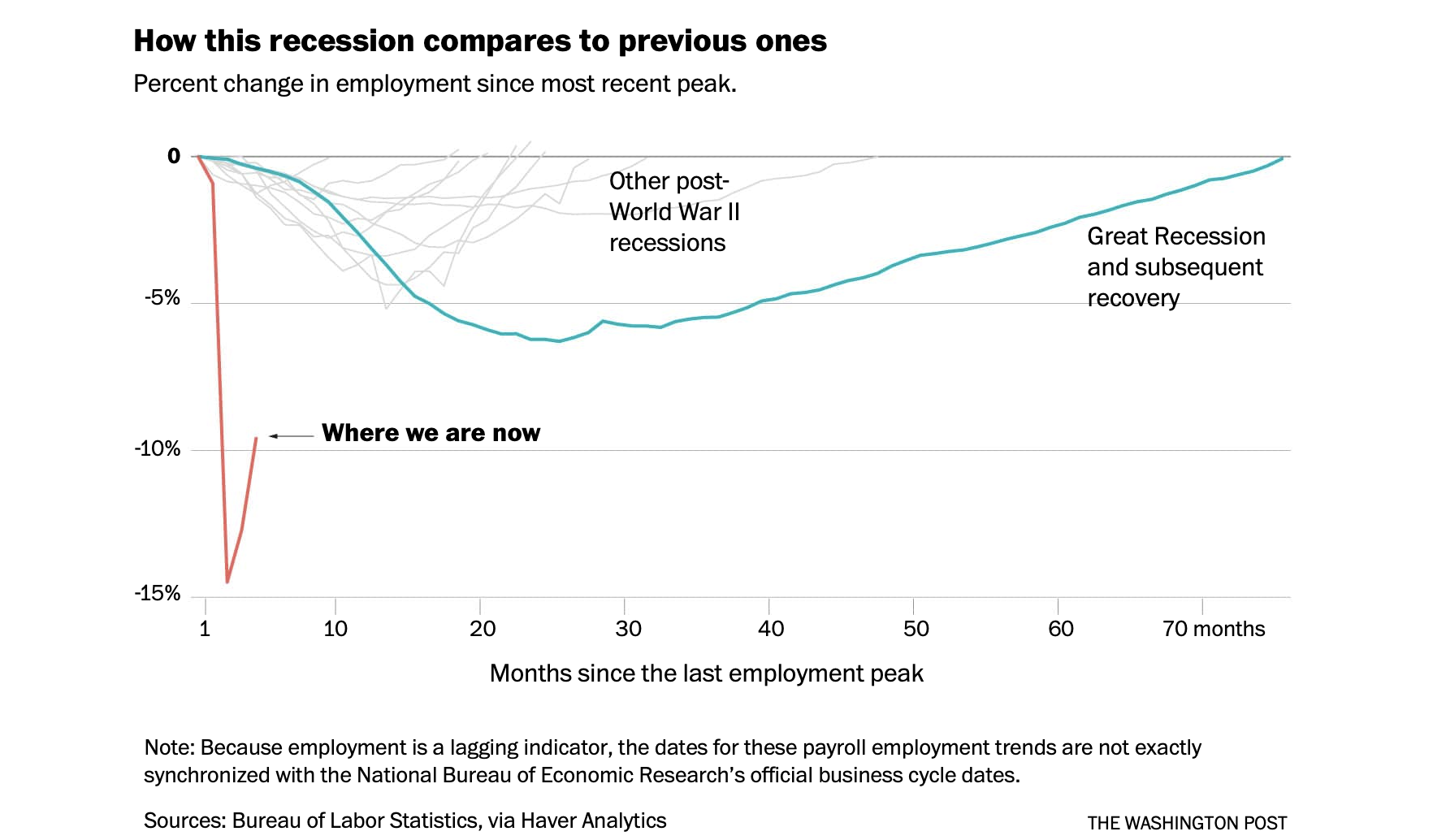
Catherine Rampell writes The U.S. job market is still in very bad shape. Just wait until the fiscal time bomb goes off:
First, even with these [June reported] gains, U.S. payrolls are still deeply in the hole. Second, these official government numbers are based on a snapshot from mid-June, and more recent data suggest the recovery has either stalled or deteriorated since then. And, third, a major fiscal time bomb is about to detonate.
You may have a sense that things are still quite bad, given that the unemployment rate remains higherthan it ever was during the Great Recession. To help visualize just how far in the red the country is, take a gander at the Scariest Jobs Chart You’ll See All Day. It plots the trajectory of job changes in this recession alongside those from previous postwar downturns (and subsequent recoveries).
The horizontal axis shows months since the most recent employment peak of a given business cycle. The teal line plots the Great Recession. Until recently, the depth, duration and sluggish recovery from the Great Recession had put all other postwar downturns to shame.
Now look at the red line, which represents the awful situation the country is experiencing.
Things are so much worse than even the Great Recession that the red line almost doesn’t fit on the same chart as the others. It starts with a near-vertical downward drop, followed by a short spike upward.
Again, it’s fantastic that the hiring trend has, in fact, turned upward. But there are still 14.7 million, or about 10 percent, fewer payroll jobs than there were at the start of the pandemic recession. And as you can see, even if job growth continues at what President Trump calls “rocket ship” pace, the economy still has a long way to go before reaching an acceptable altitude — that is, until U.S. payrolls are anywhere near pre-pandemic levels.
Jeremy Schwartz and Perla Trevizo report He Built a Privately Funded Border Wall. It’s Already at Risk of Falling Down if Not Fixed:
Tommy Fisher billed his new privately funded border wall as the future of deterrence, a quick-to-build steel fortress that spans 3 miles in one of the busiest Border Patrol sectors.
Unlike a generation of wall builders before him, he said he figured out how to build a structure directly on the banks of the Rio Grande, a risky but potentially game-changing step when it came to the nation’s border wall system.
Fisher has leveraged his self-described “Lamborghini” of walls to win more than $1.7 billion worth of federal contracts in Arizona.
But his showcase piece is showing signs of runoff erosion and, if it’s not fixed, could be in danger of falling into the Rio Grande, according to engineers and hydrologists who reviewed photos of the wall for ProPublica and The Texas Tribune. It never should have been built so close to the river, they say.
How Twitter Evolved From Startup To President Trump’s Megaphone:
more >>Foreign Affairs, Military, Putin, Trump, Trump-Russia
VoteVets.org: Don’t Thank Us
by JOHN ADAMS •
Demographics, Diversity
America Grows More Diverse, Integration as Important as Ever
by JOHN ADAMS •
William H. Frey writes that The nation is diversifying even faster than predicted, according to new census data:
The U.S. Census Bureau has just released its last batch of race-ethnic population estimates in advance of the 2020 census, with data indicating that the national headcount will reveal a more diverse nation than was previously expected. The new estimates show that nearly four of 10 Americans identify with a race or ethnic group other than white, and suggest that the 2010 to 2020 decade will be the first in the nation’s history in which the white population declined in numbers.
Over the decade’s first nine years, racial and ethnic minorities accounted for all of the nation’s population growth, and were responsible for population gains in many states, metropolitan areas, and counties that would have otherwise registered losses due to declines in their white populations. And while the U.S. and more than half of its states have shown absolute declines in populations under age 25, such declines were largely due to white losses among the youth population. These declines would have been even greater were it not for youthful gains among racial and ethnic minorities, especially the Latino or Hispanic population.
….
The new data shows that, by 2019, the white population share declined nearly nine more percentage points, to 60.1%. The Latino or Hispanic and Asian American population shares showed the most marked gains, at 18.5% and nearly 6%, respectively. While these groups fluctuated over the past 40 years, either upward (for Latinos or Hispanics and Asian Americans) or downward (for whites), the Black share of the population remained relatively constant.
These are big changes in a short time. The mere fact of these changes, and the mere acknowledgement of them, cannot possibly be all that is required in a just society. Karen Attiah’s observation that society should assure freedom of integration rather than simply acknowledging diversity remains a lodestone.
Daily Bread
Daily Bread for 7.2.20
by JOHN ADAMS •
Good morning.
Thursday in Whitewater will be partly sunny with a high of eighty-nine. Sunrise is 5:21 AM and sunset 8:36 PM, for 15h 15m 09s of daytime. The moon is waxing gibbous with 90.9% of its visible disk illuminated.
The Whitewater Fire Department meets at 6:30 PM via audiovisual conferencing.
On this day in 1863, the Battle of Gettysburg continues into a second day:
Union forces repulsed a series of attacks. That night, Union Major General George Meade held a council of leaders to decide what to do next. Lieutenant Frank Haskell, of Madison, was present when they voted to “allow the Rebel to come up and smash his head against [their position] to any reasonable extent he desired, as he had to-day. After some two hours the council dissolved, and the officers went their several ways.”
Recommended for reading in full —
Hannah Denham reports Top CEOs say business fallout from coronavirus will extend through 2021:
Business Roundtable surveyed 136 members about their projected sales, capital spending and hiring for the next six months. The CEO Economic Outlook Survey fell to 34.3 in the second quarter, the lowest reading for the composite index since the same three months of 2009, according to a report released Monday. But it’s well above the all-time low of -5.0, set during the first quarter of 2009 at the height of the Great Recession.
The group’s members include the CEOs of Apple, JPMorgan Chase and Chevron, among others. The poll, taken from June 1 to June 22, reflected the economic fallout of the novel coronavirus, which ushered the United States into recession as businesses and factories were forced to shut down or curtail operations to stem its spread. More than 47.3 million Americans have filed jobless claims since March.
Justin Lahart writes Brace for an Autumn of Discontent:
That much has become more clear over the past week, as new Covid-19 cases surged in several states that had been among the earliest to begin reopening their economies. The possibility that the novel coronavirus will be well enough contained by the end of the summer that there can be a general return to business-as-usual is looking slim.
Investors need to recalibrate their expectations of what the economy will look like through the end of the year. This goes beyond debating whether the recovery will be a V, a W or a U, and considering instead the details of what everyday life could look like. Consider what might happen across three dimensions: Work, school and social gatherings.
It is difficult for people in many jobs to work together safely, and that will still be true in the fall. Sitting cheek-to-jowl in an office, for example, is too risky now, and will likely be viewed as such by many employers and employees, possibly until there is a vaccine. So desks will be reconfigured, partitions will go up, and many business places won’t be able to accommodate as many workers as before, leading to staggered shifts and work-from-home arrangements where people will only come in a few times a week.
Wisconsin family saves a swimming bear who got its head stuck in a cheese ball tub:
more >>Fellow Traveler, Foreign Affairs, Military, Putin, Trump, Trump-Russia
Fellow Traveler
by JOHN ADAMS •
City, Culture, Politics
Barriers to Substantive Change in a Small Town
by JOHN ADAMS •
Several recent posts here are FREE WHITEWATER are, collectively, a cautionary series on the difficulty of effecting substantive change in Whitewater, Wisconsin. One might want change; realism demands a clear-eyed assessment of its likelihood. Other towns might have better (or even worse) odds; Whitewater is not, by definition, another town.
A listing of challenges, with selections from, and links to, the posts that describe them —
A Reliance on Commuting Professionals Who Choose to Live Elsewhere:
In effect, Whitewater has a focus group of hundreds of professionals who are telling government and business that they do not wish to live in Whitewater under status quo conditions. These hundreds aren’t buying what’s on offer….Community relations do not happen at a distance of fifteen miles – they happen at a distance of fifteen feet.
See The Commuter Class.
Most Mentoring Is Poorly Conducted:
Many will be less attached to the community (as they’ve freely chosen to live elsewhere for housing, activities, etc.). Some will see that they’re working in a community whose residents cannot fill all the available professional positions (and so come to see the community as dependent). Some will look on the community merely as a job opportunity and so come to look for other opportunities if any moment in the community goes poorly. Others will look on the community merely as a job opportunity and so bend easily to bad local ideas simply to retain employment.
See Mentoring.
Whitewater’s Leaders Haven’t Encouraged Substantive Change:
These last dozen years have seen a Great Recession, opioid epidemic, economic stagnation, repeated incidents of sexual harassment, a pandemic, and now another recession. Whitewater has been deeply affected during this time (over the last decade, she has more poverty than before), but her governmental approach has been mostly business as usual, with the occasional – and brief – rhetorical nod to national conditions and movements.
If most of the same policymakers haven’t ventured farther than rhetoric (if that far) after so many significant events, they’re not likely to do so now.
See Built Against Substantive Change.
Major Officials Have Not Been Hired as Agents of Significant Reform:
It’s likely that candidates are asked for no more than slight improvements, and a more polished approach, than their predecessors. There’s almost certainly an emphasis on not embarrassing the hiring body, while simultaneously fulfilling stakeholders’ wishes.
What’s improbable is that a candidate is asked to make substantive, root-and-branch changes. Changes like that would necessarily call into question longtime stakeholders’ own records.
Whitewater’s Demographics Leave the Notion of a Common Community Perspective Unlikely (for Now):
When one considers the cohort of traditional working age adults in the city, it’s both much smaller (24%), and – itself – heterogenous by race, ethnicity, and socio-economic status. In most places, including any town near Whitewater, the 25-64 age bracket would be a larger percentage of the community. For Whitewater, it’s only about a quarter of the town’s total population.
It’s fair to say that even a generation ago the city was significantly less diverse.
Many of Whitewater’s politicians and appointed officials erroneously speak and write about the town as though it were more homogeneous. It’s simply mistaken to speak to that smaller group (itself dissimilar in some fundamental characteristics) as though they, themselves, were the whole town.”
See Quick Observations on Whitewater’s Demographics.
It’s much easier to talk (or issue press releases) about change than to bring it about.
Daily Bread
Daily Bread for 7.1.20
by JOHN ADAMS •
Good morning.
Wednesday in Whitewater will be partly sunny with a high of eighty-eight. Sunrise is 5:21 AM and sunset 8:36 PM, for 15h 15m 56s of daytime. The moon is waxing gibbous with 83.4% of its visible disk illuminated.
On this day in 1863, the Battle of Gettysburg begins.
Recommended for reading in full —
Heather Long and Andrew Van Dam report Pay cuts for millions of U.S. workers worsen the pain of pandemic:
At least 4 million private-sector workers have had their pay cut during the pandemic, according to data provided to The Washington Post by economists who worked on a labor market analysis for the University of Chicago’s Becker Friedman Institute.
Workers are twice as likely to get a pay cut now than they were during the Great Recession, according to the group’s analysis of data from the payroll processor ADP. Salary cuts are spreading most rapidly in white-collar industries, which suggests a deep recession and slow recovery since white-collar workers are usually the last to feel financial pain.
Companies have also trimmed employee hours, leaving many hourly wage workers with leaner paychecks as well. More than 6 million workers have been forced to work part time during the pandemic even though they want full-time work, Labor Department data show.
“I have Fridays off but I would rather have the money,” said Iezzi, who has seen her weekly paycheck at a New Jersey air conditioning business fall from $720 to $576.
Widespread pay cuts are highly unusual. In downturns, firms typically lay off workers rather than dealing with the administrative challenges and morale effects of slashing pay across the board. But as the United States faces the worst economic crisis since the Depression era, some business leaders have tried to save jobs by cutting pay between 5 and 50 percent. The median wage reduction was 10 percent, economists who worked on the Becker Friedman Institute study found.
Lauren Bauer, Wendy Edelberg, Jimmy O’Donnell, and Jay Shambaugh write Who are the potentially misclassified in the Employment Report?:
more >>The potential misclassification issue has arisen because the number of workers who are “absent from work due to other reasons” has spiked in an unusual way since March 2020. Observers have noted that many of those people should probably have been recorded as “on temporary layoff” and thus be counted as among the unemployed. To the degree that is the case, a more accurate measure of the unemployment rate is higher than the official measure.
The Bureau of Labor Statistics (BLS) categorizes people as employed or unemployed based on how they answer questions about their work status during a single reference week. The agency counts people as employed if they worked during the week or were employed but absent from work due to vacations or illness or “other reasons.” In a typical month, a small fraction of people report being “absent from work due to other reasons.” The misclassification issue has arisen as the survey instruments deployed by BLS to collect data on labor market conditions have largely remained unchanged.
To improve the quality of the data, BLS has taken steps in recent months to improve the accuracy of recorded responses. However, it is important to note that historically, BLS has not edited responses post hoc and has always declined to reclassify respondents, which would amount to interference with the data.