Someone is, apparently, is placing parody ads for Rudolph Giuliani in the New York subway system:
A website linked to the parody, crazyrudylaw.com, offers Giuliani’s unscrupulous services in back channel deals and cable news appearances.
Better still, the firm offers to work for free:
In an effort to shield money from my wife during our divorce, I’m willing to work for FREE! I only ask that you pick up the bar tab at the end of our session.
President Trump said Wednesday that his controversial July call with his Ukrainian counterpart was transcribed “word-for-word, comma-for-comma,” an assertion that fueled growing questions about the nature and completeness of an official memorandum about the call released by the White House last week.
“This is an exact word-for-word transcript of the conversation, taken by very talented stenographers,” Trump said.
….
Current and former U.S. officials studying the document pointed to several elements that, they say, indicate that the document may have been handled in an unusual way.
Those include the use of ellipses — punctuation indicating that information has been deleted for clarity or other reasons — that traditionally have not appeared in summaries of presidential calls with foreign leaders, according to the current and former officials, who spoke on the condition of anonymity to describe the elaborate, non-public process.
….
The White House declined to comment Wednesday about the unusual markings or other apparent discrepancies. Shortly after the document’s release last week, a White House official had said that the ellipses did not indicate missing words but referred to “a trailing off of a voice or pause,” and called it standard practice for records of presidential phone calls.
Current and former officials said that would be slightly different from previous practice. They said when presidents simply trail off in a way that note-takers can’t hear, that point traditionally has been marked “[inaudible].” When fragments of sentences aren’t readily understood by note-takers, or when comments repeat a previous thought, they said, the transcripts had often been marked with dashes.
Trump, himself, claims there is a “word-for-word” transcript.
Thursday in Whitewater will be cloudy & windy with a high of sixty-one. Sunrise is 6:55 AM and sunset 6:32 PM, for 11h 37m 09s of daytime. The moon is a waxing crescent with 27.5% of its visible disk illuminated.
Whitewater’s Landmarks Commission meets at 6 PM, and the Fire Department board of directors meets at 6:30 PM.
A top GOP lawmaker is signaling he won’t help reimburse taxpayers for $200,000 in legal bills he and other Republicans racked up when a court found they had illegally blocked a liberal group on Twitter.
State officials in August agreed to pay for One Wisconsin Now’s legal bills after a federal judge determined Assembly Speaker Robin Vos and Rep. John Nygren violated the group’s First Amendment rights by preventing it from accessing and responding to their Twitter posts.
Vos and Nygren didn’t respond to questions about the settlement at the time and Nygren on Wednesday gave no sign he planned to pay the settlement.
“I’m not even answering that,” he said when asked if he would pay some of the settlement.
Last year, then-Rep. Dale Kooyenga paid the state $30,000 to cover a settlement in a lawsuit brought after he took a protest sign from a public area of the Capitol. Kooyenga, a Republican from Brookfield, won a seat in the state Senate in November.
President Trump and Republicans are excitedly drawing attention to a breaking story in the New York Times that reports that the whistleblower gave advance notice to Rep. Adam B. Schiff (D-Calif.) about the subject of his complaint, before filing it to the intelligence community’s inspector general.
….
But there’s nothing in the story that says anything about Schiff having any substantive input into the whistleblower’s complaint. It says Schiff’s aide reported to him some of what the whistleblower said, and that the aide told the whistleblower to get a lawyer and go to the inspector general.
In so doing, the aide advised the whistleblower on how to follow the law. That’s not “rigging” the process. It’s the opposite.
Indeed, the Times piece itself describes the significance of this news by claiming it shows “how determined” the whistleblower was to make his discovery known. This, by itself, does not raise doubts about his motives or truthfulness, or about the complaint itself, in any way. All it does is underscore how serious the whistleblower thought his discovery was, and how urgent he thought it was to get it to Congress.
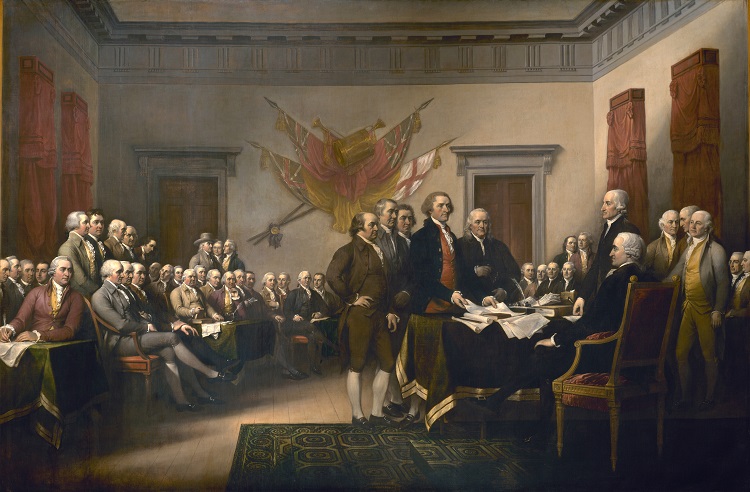
John Trumbull’s founding-era painting, Declaration of Independence, is one of the most famous in America. Recently, Ancestry.com commissioned the recreation of Trumball’s scene in a photograph with the descendants of the Declaration’s signers. The recreation is truly hopeful:
Adam Serwer, writing on Twitter in response to a series of distortions from the conservative Federalist website, states plainly the truth of Trump-supporting lies:
There is no incentive to correct because the targeted audience will believe anything pro-Trump they are told, whereas acknowledging error would signal weakness and insufficient devotion to the Great Leader.
Yes, and yes again.
They want to hear what they want to hear, and there are always people who will satisfy those wants.
It’s also possible – and this is true at the local level with boosterism – that often pride keeps people from admitting that they’re wrong.
Two examples (of many) in Whitewater would be the commissioning of three studies before the local government at last conceded that a waste-hauling scheme into a digester was infeasible. A councilman (Binnie) pushed for that third taxpayer-funded study when by contrast any reasonable person earlier would have seen that the plan was both impractical and destructive. Here he futilely held on in the hope of a justification that was never going to come. Even at the end, Whitewater’s city manager (Clapper) insisted that in ten years or so he’d be proved right, and the wastewater superintendent (Reel) tried to keep talking about what a fine idea he was sure this was (until at last someone cut him off).
At UW-Whitewater, the school publicizes on its website a so-called crime safety study that’s so unsound no educated man or woman could give it credence. SeeThe Marketing of Misinformation: UW-Whitewater’s Use of a Counterfeit ‘Campus Safety’ Study, For UW-Whitewater’s Administration, Talking Points Won’t Be Enough, and Truth-Telling and Tale-Weaving. It doesn’t matter enough to the chancellor (Watson) and his public relations team (Kuhl, Angileri) that the study is embarrassingly deficient – it says what they want to hear, and what they want to prospective students to hear. Watson undertook advanced studies and defended a dissertation, but now he advances claims that are unworthy of legitimate academic work at any accredited institution. Watson, Kuhl, and Angileri say what they want in support of what they want.
Whitewater, Wisconsin, and America can and should do better.
Wednesday in Whitewater will be rainy with a high of sixty-one. Sunrise is 6:53 AM and sunset 6:33 PM, for 11h 40m 01s of daytime. The moon is a waxing crescent with 18.4% of its visible disk illuminated.
On this day in 1958, 4,000 members of United Auto Workers Locals at Janesville’s two GM plants walked off the job as part of a national strike
U.S. manufacturing fell deeper into a contraction last month, erasing hope of a quick turnaround for the industry and handing a blow to President Trump’s promises that he would revive blue-collar jobs and companies.
September marked the worst month for U.S. manufacturing in more than a decade — since June 2009 — according to the closely watched Institute for Supply Management’s manufacturing index. Companies blamed Trump’s escalating trade war for many of their woes, putting pressure on the White House to show progress soon. Manufacturing remains a prominent industry in many swing states.
“Global trade remains the most significant issue, as demonstrated by the contraction in new export orders that began in July 2019. Overall, sentiment this month remains cautious regarding near-term growth,” said Timothy R. Fiore, chair of ISM.
….
Manufacturing fell into a technical recession in the first half of the year, and the latest ISM data indicates the situation appears to be getting worse.
Concerns are rising that the contraction in manufacturing could spill over into the rest of the U.S. economy. Stocks sold off quickly on the news that nearly every manufacturing sector reported trouble, with the Dow Jones industrial average ending the day with a 344-point loss.
“There is no end in sight to this slowdown, the recession risk is real,” said Torsten Slok, chief economist at Deutsche Bank Securities, in an email to clients.
President Donald Trump’s agriculture secretary said Tuesday he believes dairy farms can stay in business, but they may have to get bigger to do so.
“I think the 2018 farm bill will stem the flow of that” loss of dairy farms in recent years, Agriculture Secretary Sonny Perdue told reporters.
“Now what we see, obviously, is economies of scale having happened in America — big get bigger and small go out. … It’s very difficult on economies of scale with the capital needs and all the environmental regulations and everything else today to survive milking 40, 50, 60 or even 100 cows, and that’s what we’ve seen.”
Perdue made his comments after holding a town hall meeting with farmers and dairy industry officials at the kickoff of the annual World Dairy Expo at Madison’s Alliant Energy Center.
Grant County dairy farmer Jerry Volenec expressed frustration with Perdue’s comments.
“What I heard today from the secretary of agriculture was there’s no place for me,” said Volenec, who spoke at a news conference organized by the state Democratic Party.
Nearly 3,000 U.S. dairy farms folded in 2018, about a 6.5% decline, according to U.S. Department of Agriculture figures.
Wisconsin lost nearly 700 — almost two a day — as even dairy farmers used to enduring hard times called it quits in the fourth year of a downturn in milk prices.
Garry Kasparov (@Kasparov63), the former chess champion and longtime human rights activist, recently described the role of propaganda in creating fear, uncertainty, and doubt. The thread from Twitter is below (linked here from the first tweet) in the thread:
As you watch Trump’s defenders lie, deflect, and distract today and in the coming weeks, remember that they don’t care about being caught in obvious lies. Calling bullshit still means you’re talking about the bullshit, not the facts.
….
This is part of the “flood not dam” model. They want doubt. They can make up a dozen new lies and new distractions every day while there’s only one truth. Stop chasing them and keep repeating the facts.
….
Many thought it strange when Putin’s propaganda released many different “refutations” after Russian forces shot down MH17, some even on the same day. But they want to distract, not refute. To make it seem like the truth isn’t knowable.
….
They’ll attack the truth-tellers, accuse them of anything at all, because playing defense takes energy. They’ll use whataboutism to distract from their crimes. Keep following the money and repeating the truth.
Whitewater has a public school district, and so she has public schools, and those public schools have goals for the students under their care. On September 23rd, eight days ago, some of the district’s principals (and two administrators) presented the goals for their students. (Other presentations will follow, presumably in October.)
These goals are at the heart of education – the skeleton on which muscles and sinews cling. If these are not important – if these are not prominent at all times – then there is a misunderstanding about the very meaning of importance.
When a woman travels to the Louvre, for example, she goes – if she goes sensibly – to behold the works of human genius within. Her apartment might be sunny, her brioche delicious, and her driver courteous, but it is the exhibits within each wing that rightly mean more to her.
So it is with education: some matters – teaching, notably – are more important than others. What goals does a principal have for his or her teachers and students (and how will these goals – if worthy – be achieved?). That’s what’s important.
In the video above, five people (Mike Lovenberg, Andy Rowland, Kelly Seichter, Tom Grosinske, and Mary Kilar) present their 2019-2020 goals (with written presentations embedded below. They present on the video in the order and timestamps listed below:
Mike Lovenberg, Whitewater High School (beginning at 12:20).
Andy Rowland, Technology (beginning at 19:40).
Kelly Seichter, Curriculum (beginning at 23:37).
Tom Grosinske, Washington School (beginning at 37:50).
Tuesday in Whitewater will be rainy with a high of seventy-eight. Sunrise is 6:52 AM and sunset 6:35 PM, for 11h 42m 54s of daytime. The moon is a waxing crescent with 10.5% of its visible disk illuminated.
Attorney General William P. Barr has held private meetings overseas with foreign intelligence officials seeking their help in a Justice Department inquiry that President Trump hopes will discredit U.S. intelligence agencies’ examination of possible connections between Russia and members of the Trump campaign during the 2016 election, according to people familiar with the matter.
Barr’s personal involvement is likely to stoke further criticism from Democrats pursuing impeachment that he is helping the Trump administration use executive branch powers to augment investigations aimed primarily at the president’s adversaries.
….
The direct involvement of the nation’s top law enforcement official shows the priority Barr places on the investigation being conducted by John Durham, the U.S. attorney in Connecticut, who has been assigned the sensitive task of reviewing U.S. intelligence work surrounding the 2016 election and its aftermath.
The attorney general’s active role also underscores the degree to which a nearly three-year-old election still consumes significant resources and attention inside the federal government. Current and former intelligence and law enforcement officials expressed frustration and alarm Monday that the head of the Justice Department was taking such a direct role in reexamining what they view as conspiracy theories and baseless allegations of misconduct.
The rise of “a true opposition movement would take a systemic crisis — say, a real economic meltdown or a climate-induced catastrophe — that doesn’t yet seem likely,” Beijing-based journalist Ian Johnson noted. “And so, superficially at least, the Communist Party seems to go from strength to strength, relying on China’s capable civil service to make sure the high-speed trains run on time, the highways hum with new cars, and the aircraft carriers get built.”
But there’s a tension burrowed inside this seeming stability, Johnson concluded: “It is precisely this return to prosperity that has given people the opportunity to contemplate a century-old question: what exactly holds their country together other than brute force?”
Christopher “Tank” Murdoch, the first Wisconsin resident hired by Foxconn Technology Group and an honored figure at last year’s groundbreaking for the firm’s planned flat-screen factory, has left the company.
In a brief interview, Murdoch said he left voluntarily several weeks ago because of “a number of factors,” which he declined to specify. He said he had taken a position outside Wisconsin but would not disclose his employer.
Foxconn said its policy is not to comment “on its internal human resources decision making.”
“The eighth wonder of the world,” President Trump proclaimed when he kicked off construction with a golden shovel full of dirt.
Or perhaps not. As solid as the walls to the new factory might seem, the company behind them — Taiwan-based electronics giant Foxconn — has repeatedly backtracked on ambitious visions that attracted billions of dollars in state incentives. Foxconn assures that it will meet the original employment target for the project, but Gov. Tony Evers (D) has said he doesn’t think vows to hire thousands of new workers will ever be fulfilled. And experts maintain the entire strategy makes little sense.
….
Yet [Tom] Johnston, who owns an upscale gift shop on a struggling Main Street in the city of Racine, has little faith that Foxconn will bring salvation: “I hope to God it happens, but I think it’s all a crock.”
….
“Every couple of months there’s been a different plan,” said Steven Deller, an economist at the University of Wisconsin at Madison. “First it was 13,000 jobs. Now it might be 1,000 jobs. They’ve really scaled back on what they plan to do.”
Even the start of construction has raised doubts rather than allay them, he said. The structure now emerging bears little resemblance to the model of 21st-century, high-tech manufacturing that was promised.
“This was supposed to be the future,” he said, “but it just looks like a big warehouse.”
Monday in Whitewater will be partly sunny with a high of eighty-three. Sunrise is 6:51 AM and sunset 6:37 PM, for 11h 45m 46s of daytime. The moon is a waxing crescent with 4.2% of its visible disk illuminated.
There will be a Hwy 12/CTH N Intersection Public Meeting at 5 PM (an earlier closed session will run from 4:30 to 5 PM).
On this day in 1954, the USS Nautilus, the world’s first nuclear-powered submarine, is commissioned, under the command of Commander Eugene P. Wilkinson, USN.
From Donald Trump on down, prominent Republicans used part of their weekend to falsely accuse Trump’s hand-picked intelligence community inspector general (IC IG) of secretly changing the requirements for intelligence workers to submit whistleblower tips as part of a deep state plot to clear the way for the Aug. 12 complaint about Trump’s phone call to the president of Ukraine.
The smoking gun in the putative conspiracy is an obscure government form, IC IG ICWSP Form 401, also known as the Disclosure of Urgent Concern Form. The document is put out by the IC IG for intelligence workers who need to file urgent complaints that trigger special treatment under the Intelligence Community Whistleblower Protection Act.
According to the GOP and an army of conservative commentators, the old version of the form prohibited workers from submitting urgent complaints based on secondhand information; only misconduct witnessed personally could be reported. That changed in early August, the false claim goes, when ICIG Michael Atkinson snuck through a hasty revision to the complaint form that reversed long-standing policy.
….
The kernel of fact near the center of the conspiracy theory is that there is, indeed, a new version of Form 401 dated August 2019.
A question on the form explicitly anticipates tips based on secondhand information, and asks the whistleblower to check a box: “I have direct and personal knowledge,” or, “I heard about it from others.” The Federalist used a screenshot of that field to illustrate its story.
What the article didn’t mention or screenshot is a nearly identical field gracing Form 401 since at least May 2018, making it impossible that it was added as an easement for Trump’s whistleblower.
The National Rifle Association acted as a “foreign asset” for Russia in the period leading up to the 2016 election, according to a new investigation unveiled Friday by Sen. Ron Wyden, D-Ore.
Drawing on contemporaneous emails and private interviews, an 18-month probe by the Senate Finance Committee’s Democratic staff found that the NRA underwrote political access for Russian nationals Maria Butina and Alexander Torshin more than previously known — even though the two had declared their ties to the Kremlin.
Sunday in Whitewater will be rainy with a high of sixty-four. Sunrise is 6:50 AM and sunset 6:39 PM, for 11h 48m 39s of daytime. The moon is a waxing crescent with 1.0% of its visible disk illuminated.
Brooks County is the deadliest county in Texas for migrants trying to enter the United States—and it isn’t even directly along the border. Over the past few years, while American policy focus has lasered in on asylum-seeking Central American families and unaccompanied minors, there is another migration pattern 70 miles north of the border. Here in Brooks County, groups of almost exclusively adult migrants hike remote trails and look to evade the Border Patrol in their bid to enter the United States. Some are caught, and some make it through the county undetected. But at least 650 people have passed away on this Texas ranchland since 2009, only a few hours south of San Antonio and Austin. Each time a body is discovered on a ranch in Brooks County, a death report ends up in Benny Martinez’s office in a white three-ring binder like the one I saw on his desk in August 2018.
Emily Kassie writes Detained (‘How the United States created the largest immigrant detention system in the world’):
Children sleeping on floors, changing other children’s diapers. Families torn apart at the border. Migrants crammed into fetid detention centers. These have become familiar sights as people fleeing gang violence, domestic abuse and poverty arrive on the southern border of the United States. Many will join more than 52,000 immigrants confined in jails, prisons, tents and other forms of detention—most of them for profit.
The United States’ reliance on immigrant detention is not a new phenomenon, nor did it emerge with President Donald Trump (though its growth under his administration is staggering). Over the last four decades, a series of emergency stopgaps and bipartisan deals has created a new multi-billion dollar industry built on the incarceration of immigrants.
The people held in prison-like facilities across the country are not serving time for a crime. They’re waiting for a hearing to determine whether they can legally remain in the country while being kept in what is considered “civil detention,” intended to ensure that people show up for those hearings. Detention, once reserved only for those who threatened public safety or posed a flight risk, is now ubiquitous.
Immigrants, including asylum seekers and legal migrants, wait an average of more than four weeks to be released, though some have been held inside for years or even decades. Up to 2,500 are children and parents fleeing war and violence in their home countries. Thousands have alleged sexual and physical abuse inside the facilities.