
Playing at the National Zoo –
Tian Tian woke up this morning to a lot of snow, and he was pretty excited about it. ?? #blizzard2016 pic.twitter.com/GrhI9t1u7j
— National Zoo (@NationalZoo) January 23, 2016
Playing at the National Zoo –
Tian Tian woke up this morning to a lot of snow, and he was pretty excited about it. ?? #blizzard2016 pic.twitter.com/GrhI9t1u7j
— National Zoo (@NationalZoo) January 23, 2016
I’ve long argued that the application of continent-wide standards to local challenges offers better solutions for our small town than a hyper-localism that ignores best practices from across our country. See, What Standards for Whitewater?
We will achieve little, and leave less for the next generation, if we do less – if we reach lower – than this.
Consider the following results of a Google Search, from this morning:
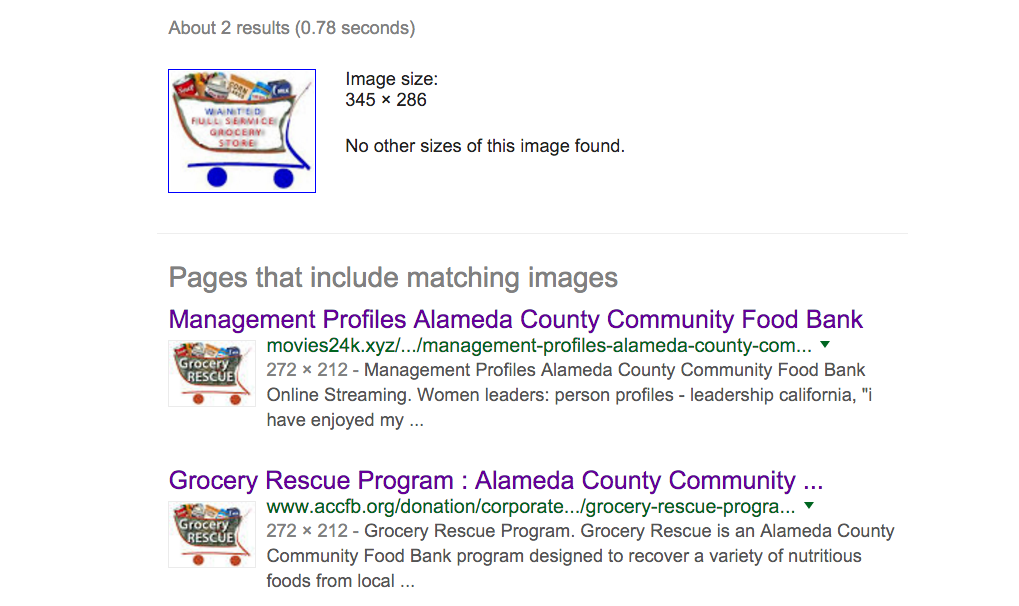
Our success will not be had by the apparent display of a crudely altered but unattributed image from, of all things, a California food bank. (It’s a food bank, by the way, that like many organizations has a terms of use policy regarding logos and attribution.)
The Alamadea County Food Bank has worked for over thirty years to feed needy people in that part of California. Here’s a description of their work:
Alameda County Community Food Bank has been in business since 1985 … with a vision toward a day when we can go out of business. We are the hub of a vast collection and distribution network that provides food for 240 nonprofit agencies in Alameda County. In 2014, the Food Bank distributed 25 million meals — more than half of the food was fresh fruits and vegetables. Our goal is to ensure every food insecure child, adult and senior in Alameda County knows where their next meal is coming from, by 2018.
Since moving into our permanent facility near the Oakland Airport in 2005 and leading the national food bank movement for a ban on the distribution of carbonated beverages, the Food Bank has ramped up distribution of fresh fruits and vegetables by more than 1,000%.
We can surely succeed, but only by some (rather than by any easy) means.
Good morning, Whitewater.
Sunday in town will be cloudy with a high of thirty-four. Sunrise is 7:16 and sunset 4:57, for 9h 41m 20s of daytime. We’ve a full moon again today.
In Friday’s FW poll, readers could pick the teams they thought would prevail (or the teams they wanted to prevail) in today’s NFL games. Respondents chose New England and Carolina, respectively.
Here’s schedule of posts for the week ahead, with other posts possible (if there are changes to these scheduled posts I’ll explain why):
How long did it take to get somewhere, a century ago? Here’s how long, for how far:
On this day in 1972, Shoichi Yokoi learns that the war is over:
After 28 years of hiding in the jungles of Guam, local farmers discover Shoichi Yokoi, a Japanese sergeant who was unaware that World War II had ended.
Guam, a 200-square-mile island in the western Pacific, became a U.S. possession in 1898 after the Spanish-American War. In 1941, the Japanese attacked and captured it, and in 1944, after three years of Japanese occupation, U.S. forces retook Guam. It was at this time that Yokoi, left behind by the retreating Japanese forces, went into hiding rather than surrender to the Americans. In the jungles of Guam, he carved survival tools and for the next three decades waited for the return of the Japanese and his next orders. After he was discovered in 1972, he was finally discharged and sent home to Japan, where he was hailed as a national hero. He subsequently married and returned to Guam for his honeymoon. His handcrafted survival tools and threadbare uniform are on display in the Guam Museum in Agana.
On this day in 1864, the 23rd Wisconsin moves through Texas:
1864 – (Civil War) Reconnaissance of the Matagorda Peninsula continues
The 23rd Wisconsin Infantry continued its reconnaissance mission on the Matagorda Peninsula, Texas.
Resourceful resident makes the best of it –
#Snowzilla is here and people are skiing in #Washington #DC… On the streets!! #jonas #blizzard pic.twitter.com/ZOVndL4C47
— Bricio Segovia (@briciosegovia) January 23, 2016
Good morning, Whitewater.
Saturday in town will be mostly cloudy, with a high of thirty. Sunrise is 7:17 and sunset 4:56. We’ve a full moon today, with 99.7% of its visible disk illuminated.
On this day in 1957, Wham-O acquires the rights to a flying disc:
Fred Morrison discovered a market for the modern-day flying disc[6] in 1938 when he and future wife, Lucile, were offered 25 cents for a cake pan that they were tossing back and forth on a beach in Santa Monica, California. “That got the wheels turning, because you could buy a cake pan for five cents, and if people on the beach were willing to pay a quarter for it, well – there was a business,” Morrison told The Virginian-Pilot newspaper in 2007.[7]
The Morrisons continued their business until World War II, when Morrison served in the Army Air Force, flying a P-47s, and then was a prisoner of war. Mustered out, Morrison sketched a design for anaerodynamically improved flying disc that he called the Whirlo-Way. By 1948, after design modifications and experimentation with several prototypes, Morrison and business partner Warren Franscioni began producing the first plastic discs, renaming them the Flyin-Saucer in the wake of reported unidentified-flying-object sightings.
“We worked fairs, demonstrating it,” Morrison told the Virginian-Pilot. The two of them once overheard someone saying the pair were using wires to make the discs hover, so they developed a sales pitch: “The Flyin-Saucer is free, but the invisible wire is $1.” “That’s where we learned we could sell these things,” he said, because people were enthusiastic about them.
Morrison and Franscioni ended their partnership in early 1950, and in 1954 Morrison formed his own company, called American Trends, to buy and sell Flyin-Saucers, which were by then being made of a flexible polypropylene plastic from Southern California Plastics, the original molder. After learning that he could produce his own disc more cheaply, in 1955 Morrison designed a new model, the Pluto Platter, the archetype of all modern flying discs. He sold the rights to Wham-O on January 23, 1957, and in 1958 Morrison was awarded U.S. Design Patent D183,626 for his product.
In June 1957, Wham-O co-founder Richard Knerr decided to stimulate sales by giving the discs the additional brand name Frisbee (pronounced “friz’-bee”), after learning that Northeastern college students were calling the Pluto Platter by that name,[8] the term “Frisbee” coming from the name of the Bridgeport, CT pie manufacturer Frisbie Pie Company.[9] “I thought the name was a horror. Terrible,” Morrison told The Press-Enterprise of Riverside in 2007.[10] In 1982, Morrison told Forbes magazine that he had received about US$2 million in royalty payments and said: “I wouldn’t change the name of it for the world.”[10]
There’s an alternative history of the flying disc, in which the inventor of that toy was Norville Barnes –
That, however, is another story …
Try this, Mary Poppins! Super-hydrophobic polycarbonate ping pong paddles and a water ball in space! #YearInSpace https://t.co/BB0Z35jbVa
— Scott Kelly (@StationCDRKelly) January 21, 2016
(Much as I like cats, I’d not spring for the eight-figure wildlife crossings mentioned in the video.)
See, for an accompanying article, Adorable mountain lion kittens found in California mountains @ USA TODAY.
On Sunday, it’s the Patriots v. Broncos @ 2:05 PM, and Cardinals v. Panthers @ 5:40 PM.
Of the four remaining teams, which do you like? (Multiple selections are possible.)
Good morning, Whitewater.
Our work week ends with a high of twenty-seven under cloudy skies. Sunrise is 7:17 and sunset 4:55, for 9h 37m 11s of daytime. The moon is a waxing gibbous with 97.5% of its visible disk illuminated.
It’s the birthday of Wilbur Scoville, born this day in 1865. Google has doodle to commemorate his birth, and in tribute to his creation of the Scoville scale:
…a measurement of the pungency (spicy heat) of chili peppers, such as the Jalapeno, Ghost peppers, and the world’s (current) hottest pepper—the Carolina Reaper, or other spicy foods as reported in Scoville heat units (SHU),[1]a function of capsaicin concentration. Capsaicin is one of many related chemicals, collectively called capsaicinoids. The scale is named after its creator, American pharmacist Wilbur Scoville. His method, devised in 1912, is known as the Scoville Organoleptic Test.[2]
On this day in 1965, Wisconsin claimed (for that time) a new world record:
1964 – World’s Largest Block of Cheese Produced
On this date The world’s largest cheese of the time was manufactured in Wisconsin. The block of cheddar was produced from 170,000 quarts of milk by the Wisconsin Cheese Foundation specifically for the 1964 New York World’s Fair. It weighed 34,665 pounds (17.4 tons). The cheese was consumed in 1965 at the annual meeting of the Wisconsin Cheesemakers Association at Eau Claire. A replica is displayed in Neilsville in the specially designed “Cheesemobile“, a semi-tractor trailer in which the original cheese toured. [Source: American Profile, December 16, 2001]
Here’s the last game in the Asia Fantasia series from Puzzability:
|
This Week’s Game — January 18-22
|
||||||||||||||
|
Asia Fantasia
|
||||||||||||||
|
We’re working on eastern time this week. For each day, we’ll give a three-by-three letter grid in which we’ve hidden the name of a major city in Asia, followed by its country, with a total of 11 or more letters. To find it, start at any letter and move from letter to letter by traveling to any adjacent letter—across, up and down, or diagonally. You may come back to a letter you’ve used previously, but may not stay in the same spot twice in a row. You will not always need all nine letters in the grid.
|
||||||||||||||
|
Example:
|
||||||||||||||
|
||||||||||||||
|
Answer:
|
||||||||||||||
|
Baghdad, Iraq
|
||||||||||||||
|
What to Submit:
|
||||||||||||||
|
Submit the city and country (as “Baghdad, Iraq” in the example) for your answer.
|
||||||||||||||
 |
||||||||||||||
|
Friday, January 22
|
||||||||||||||
|
Ecovative Design has made a mission of replacing synthetic plastic polymers with natural mushroom based polymers. After disrupting the packaging industry with a line of fully biodegradable mushroom packaging, they are now setting their sights on replacing manufactured wood products. (Video by Brandon Lisy, Justin Beach) (Music by Andy Clausen)
Via Bloomberg Business.
Whitewater’s an unusual town: most cities in Wisconsin don’t host a college campus. Nearby cities may have living there some faculty and staff from UW-Whitewater, but that economic boost pales in comparison with the presence of a campus along Main, with thousands of students attending.
Our infrastructure is different owing to the presence of the campus, the amount of public money flowing into the city is different (for the campus directly, in support of it indirectly), and our local economy is different from many other cities as demand here is markedly different from, let’s say, Milton or Fort Atkinson.
We often talk about Whitewater as though it were One WhitewaterTM, but that’s misguided, and leads to both confusion and error about fiscal and economic policy. Many small towns would come much closer to the concept of ‘one town’ – that is, one demographic – than Whitewater.
(About six years ago, I heard someone opine that the key to understanding Whitewater is to understand its three largest public institutions: university, school board, and municipal government. It’s not. Thinking about these institutions without much thought to the people who comprise them, let alone everyone else not a part of them, is myopic. If someone said that Whitewater had an office, a factory, and a farm, would anyone else think that an understanding of the city had been settled?)
We talk about infrastructure, about public spending, and about the private economy in a mistaken way when – despite our beautiful city’s small size – we talk about Whitewater as though it were one demographic.
Now, I don’t mind our character one bit – I like our city as she is, as a heterogeneous, diverse, evolving place. But even if I did mind, still there would be an obligation to assess so well as possible. That means recognizing existing heterogeneity. See, A Small But Diverse City, Seldom Described That Way.
It’s only by doing so that one can understand sensibly why some infrastructure spending succeeds, why some public spending succeeds, and why some (but not sadly not all) private ventures flourish. Infrastructure, spending, and private production of goods & services have to meet the actual demographics – the actual needs – of the city’s residents. See, The Meaning of Whitewater’s Not-Always-Mentioned Demographics.
But when we think of Whitewater as one entity, or as no more than an institutional troika, we’re left without an adequate explanation for Whitewater’s successes or failures. And when we think of Whitewater as one entity, or as no more than an institutional troika, we waste resources.
It’s bad to be without an adequate explanation; it’s far worse to waste resources. Having the explanation is a defense against waste, and an assurance that those who need something are the ones who receive something.
In this episode, Kyle Cherek and Jessica Bell explore the fine culinary delicacies of the Wisconsin State Fair. From maple-glazed pork belly wrapped in bacon to the iconic cream puff, explore all the fair has to offer.
Via Wisconsin Foodie.
Good morning, Whitewater.
Thursday in town will be cloudy, although noticeably warmer than yesterday, with a high of twenty-eight degrees. Sunrise is 7:18 and sunset 4:53, for 9h 35m 11s of daytime. The moon is a waxing gibbous with 92.7% of its visible disk illuminated.
There will be a Zoning Code Update meeting in the city tonight at 7 PM.
On this day in 1935, Janesville sees an example of temerity:
1935 – Five Janesville Youths Arrested
On this date five Janesville boys, ages 13-16, were arrested for a string of burglaries, including the thefts of cigarettes, whisky and blankets. While in the police station, one of the boys tried to crack the safe in the chief’s office. [Source: Janesville Gazette]
Ten years later, on this day, America recognizes an example of courage and tenacity:
1945 – Truman Olson of Cambridge Awarded WWII Medal of Honor
On this date the Medal of Honor was awarded posthumously to Sgt. Truman C. Olson of Cambridge, for almost single-handedly stopping a German counterattack on the beachhead in Anzio, Italy, on January 30, 1944. Twice wounded, Olson nevertheless manned his machine-gun for 36 hours. He killed 20 Germans and wounded many others. [Source: Janesville Gazette]
Here’s Thursday’s Puzzability game:
|
This Week’s Game — January 18-22
|
||||||||||||||
|
Asia Fantasia
|
||||||||||||||
|
We’re working on eastern time this week. For each day, we’ll give a three-by-three letter grid in which we’ve hidden the name of a major city in Asia, followed by its country, with a total of 11 or more letters. To find it, start at any letter and move from letter to letter by traveling to any adjacent letter—across, up and down, or diagonally. You may come back to a letter you’ve used previously, but may not stay in the same spot twice in a row. You will not always need all nine letters in the grid.
|
||||||||||||||
|
Example:
|
||||||||||||||
|
||||||||||||||
|
Answer:
|
||||||||||||||
|
Baghdad, Iraq
|
||||||||||||||
|
What to Submit:
|
||||||||||||||
|
Submit the city and country (as “Baghdad, Iraq” in the example) for your answer.
|
||||||||||||||
|
||||||||||||||
|
Thursday, January 21
|
||||||||||||||
|


