
Author Archive for JOHN ADAMS
Public Meetings
Fire & Rescue Task Force
by JOHN ADAMS •
Daily Bread
Daily Bread for 12.5.13
by JOHN ADAMS •
Good morning.
We’ll have a chance of flurries in the morning, then mostly sunny skies and temperatures falling into the twenties.
Whitewater’s Landmarks Commission meets at 6 PM, as will the Fire & Rescue Task Force (6 PM).
On this day in 1901, Walt Disney is born.
In the Wisconsin of December 5, 1879, a new organization:
1879 – Humane Society of Wisconsin Organized
On this date the Humane Society of Wisconsin was organized in Milwaukee. Inspired by Henry Bergh, a New York City philanthropist, and his Humane Movement, the state Humane Society was formed to protect both animals and children. However, with the formation of child protection laws in the early 1900s, the Humane Society of Wisconsin began to focus primarily on animal protection. [Source: Humane Society of Wisconsin]
Puzzability‘s Festival of Lights puzzles continue with their Thursday entry:
|
This Week’s Game — December 2-6
|
|||||
|
Festival of Lights
|
|||||
|
Here’s a bright idea for Hanukkah. The answer to each day’s trivia question this week is a two-word phrase, name, or title in which each word can be followed by the word “light” to make a compound word or phrase.
|
|||||
|
Example:
|
|||||
|
What was achieved for the first time by the Soviet Union in 1959 with an unmanned craft and by the U.S. 10 years later with a manned craft?
|
|||||
|
Answer:
|
|||||
|
Moon landing (moonlight, landing light)
|
|||||
|
What to Submit:
|
|||||
|
Submit the two-word trivia answer (as “Moon landing” in the example) for your answer.
|
|||||
 |
|||||
|
Thursday, December 5
|
|||||
|


Science/Nature, Technology
The World Outside My Window
by JOHN ADAMS •
Corporate Welfare, Government Spending, Planning, Politics
The People in the Room
by JOHN ADAMS •
Consider an invitation-only meeting, before a public one, in which appointed officials and perhaps a few corporate executives meet to discuss public financing of a deal mostly benefiting a few.
One can say two things, with reasonable confidence, about a meeting like that. First, no one attends a meeting of that kind to dissuade others from pursuing a deal. Those who attend typically expect others in the room to accede to their demands.
Second, as those who attend a ‘stakeholders’ meeting like this often learn later, there are no certainties of mutual aid no matter how reassuringly promised beforehand. One may attend with the idea that everyone in the room is ‘in this together,’ but afterward it becomes clear that some of the parties really don’t give a damn about others’ needs.
Similar to when parties form a cartel (in some ways, but different in others), some have an incentive to act against a supposed, mutual understanding. As the parties often have no true principle in common, and some believing that they are more important than others, the bigger ones have no reticence in cheating or otherwise betraying the smaller ones.
One can sit in that room, and try to make that deal, but one cannot do so with the assurance that it will be thereafter honored.
Whitewater’s last decade is littered with projects like this, where a few huddled privately, and everyone was so sure, and so supportive, until it became clear that the parties missed major steps, ignored fundamental tasks, and had no idea of the consequences of their ill-considered (but grandiose) plans.
City, Corporate Welfare, Government Spending
Janesville & Generac’s Bus: Requesting Reductions
by JOHN ADAMS •
At Whitewater’s mid-November council meeting, Generac declared it would pay considerably less for a transit bus than Janesville Transit had projected (seventy-two percent less), and the city and university agreed to pay fifty percent less than Janesville Transit requested of them. Note to the city administration: multi-billion-dollar Generac easily got the better of those figures.
(See, about that prior meeting, The Bus Discussion @ Council Last Night: A Fiasco by Any Definition.)
On Tuesday, 12.3.13, Council had to decide how to request possible changes in the schedule, as the bus now receives about forty-three thousand less than Janesville Transit expected. (That’s expected – as no one at that agency or in our city received firm commitments for costs that were projected.)
For 2013, the bus makes five trips on weekdays, three on Saturdays, and two on Sundays.
So, what to do?
One thing’s seems clear – this city administration will do what it can to keep this bus going. No one is attending meetings with so called ‘stakeholders’ so that he can wind down the program – that’s simply implausible. More likely, each meeting of this kind is one in which outside institutions and organizations are insisting and cajoling Whitewater’s administration to do more, and find a way to bolster the program (whatever its consequences).
About that data from Janesville Transit. Councilman Binnie wonders why the driver can’t record passenger trips more specifically. (He jokes that he can’t imagine the driver is so busy that trips cannot be recorded more specifically. Funny that – if it’s not busy, why fund?)
Here are two quick replies. First, the data from Janesville transit are double-counted, in any event, by that own agency’s admission. (See, Council Session of 11.5.13 Video Link: http://vimeo.com/78821732 at 2:27:16.)
If Mr. Binnie has confidence in new data collection – when there is an admission that previously published ridership data are deceivingly high – then I would ask him to contact me about some swamp land a Garden Paradise™ for sale.
Second, is it not likely that Janesville could have, but does not, collect accurate data on individual routes’ passenger totals because to do so would reveal that this is, truly, the publicly-funded tool of one big, private corporation? (Here, one assumes that the data would be accurate, as they have most certainly not been.)
Whitewater’s last administration had repeated problems with dodgy data, and we cannot now do better while simultaneously relying on other cities’ lower standards.
Whitewater’s merchants. It’s more than clear that a majority of Council either doesn’t understand, or refuses to believe, that growth in the bus would come at the expense of local businesses.
See, about this simple truth – one that a bus marketing study expressly concedes – The Bus: Bad for Whitewater Now, Far Worse for Whitewater Later.
Of those who supported continued 2014 funding for the bus, every vote came from those who are affiliated with a major institution or company. Not one favorable vote came from an independent business person who’s trying to make a go of a shop in Whitewater.
Not one.
Now, admittedly, some of those who voted for the bus sit on boards and committees that pass regulations over small businesses, or on boards that presume to evaluate merchants’ needs, yet not one voting in favor works in that trade, or feels those pressures directly.
Neither the city manager, nor the majority at Council, nor outside bureaucrats experience those daily conditions of small business owners.
Next: The People in the Room.
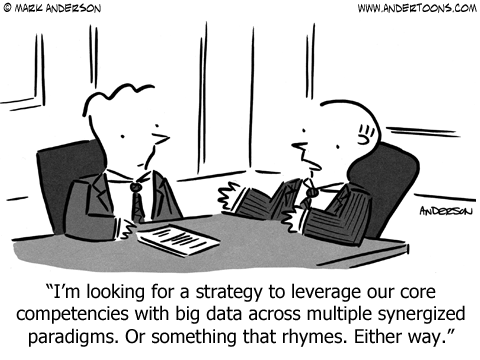
Anderson, Cartoons & Comics
Something that Rhymes
by JOHN ADAMS •
Daily Bread
Daily Bread for 12.4.13
by JOHN ADAMS •
Good morning.
Wednesday brings an even chance of rain and a high of forty-nine to Whitewater.
On this day in 1780, George Washington’s cousin successfully tricks the enemy:
A force of Continental dragoons commanded by Colonel William Washington–General George Washington’s second cousin once removed–corners Loyalist Colonel Rowland Rugeley and his followers in Rugeley’s house and barn near Camden, South Carolina, on this day in 1780.
After nearly a year of brutal backcountry conflict between Washington and the fierce British commander Lieutenant Colonel Banastre Tarleton (who was infamous for Tarleton’s Quarter, the murder of colonial POWs on May 29, 1780 at Waxhaws), Washington had retreated to North Carolina the previous October. Commanded to return to the South Carolina theater by Brigadier General Daniel The Old Wagoner Morgan, Colonel Washington still lacked the proper artillery to dislodge the Loyalists. He told his cavalrymen to dismount and surround the barn. While out of Rugeley’s sight, Washington’s men fabricated a pine log to resemble a cannon.
This Quaker gun trick, named so because Quakers used it to be intimidating without breaching their pacifist vow of non-violence, worked beautifully. Washington faced the cannon toward the buildings in which the Loyalists had barricaded themselves and threatened bombardment if they did not surrender. Shortly after, Rugeley surrendered his entire force without a single shot being fired.
On 12.4.1933, Janesville won’t take the end of Prohibition for an answer:
1933 – Janesville Council Denies Prohibition End
On this date the Janesville Council drafted a “drastic liquor control law” that prohibited serving liquor. The law prohibited distilled spirits, but not beer, at bars, and limited liquor service to tables. Backrooms and “blinds” (closed booths) were also prohibited. The only place where packaged liquor was allowed to be sold was at municipal dispensaries. Further, bars were prohibited from selling packaged liquor. The next day, the city was uncommonly quiet as the 18th Amendment was repealed. For nearly 14 years, the 18th Amendment (the Prohibition Amendment), outlawed the manufacture, transportation, and sale of alcoholic beverages within the U.S. [Source: Janesville Gazette, December 5, 1933, p.1]]
Here’s Puzzability‘s Wednesday entry:
|
This Week’s Game — December 2-6
|
|||||
|
Festival of Lights
|
|||||
|
Here’s a bright idea for Hanukkah. The answer to each day’s trivia question this week is a two-word phrase, name, or title in which each word can be followed by the word “light” to make a compound word or phrase.
|
|||||
|
Example:
|
|||||
|
What was achieved for the first time by the Soviet Union in 1959 with an unmanned craft and by the U.S. 10 years later with a manned craft?
|
|||||
|
Answer:
|
|||||
|
Moon landing (moonlight, landing light)
|
|||||
|
What to Submit:
|
|||||
|
Submit the two-word trivia answer (as “Moon landing” in the example) for your answer.
|
|||||
|
|||||
|
Wednesday, December 4
|
|||||
|

Film, Holiday
Film: Mr. Christmas
by JOHN ADAMS •
Education, Planning
Janesville Schools’ Reckless Plan
by JOHN ADAMS •
Months ago, someone told me about a Janesville School District plan to charge teenage students from China and east Asia to live and attend classes in Janesville’s schools.
I thought it was a joke. It took quite a bit to convince me that, actually, there was a nascent plan like this.
It’s hard to fathom the level of recklessness in enticing these students, from half the way around the world, to live far from their families, at a paying rate, for the privilege of a Janesville education, when so little has been considered carefully.
The truth is that desperate communities with middling leaders produce bad plans. One sometimes sees places that will throw anything at the wall, hoping something will stick.
It’s worse, though, when the plans involve a project this difficult, this sketchy, and involving minor children.
One may see more about the story online at the Gazette, in a story that – predictably – questions little.
See, ‘Janesville international education plans taking shape’ @ http://gazettextra.com/article/20131201/ARTICLES/131129711/1059.
Next up for that paper: Edsel taking shape as car of the century and Walter Mondale’s presidential campaign against Pres. Reagan shaping up nicely.
That the district would use its ‘chief information officer’ on a tour of east Asia (including ‘seven Cambodian schools in two days’) tells how shallow this effort is: selling paying families on the prospect of an education here without an established curriculum, without a plan for supervision of living conditions for minor children, etc. is astonishing. (Cambodian students, as it turns out, will not be initial prospects for the program.)
About living conditions, one reads that
Smiley [Robert Smiley, Janesville School District’s chief information officer] also met with a Chinese businessman who is remodeling the old Holiday Inn in South Beloit, Ill. Smiley said he had several meetings with Wang Zhibin and his investment group. Wang plans to house Chinese high school and college students in one wing of the hotel.
That’s not an established boarding program – it’s an ill-conceived idea that’s fraught with risks.
By the way, there’s sure to be a defensive, red-herring claim that to criticize the plan is to doubt the ability of Asian students to live in America – nothing could be farther from the truth. One shouldn’t doubt the ability of students from abroad (from Asia, Europe, etc.) – one should have every reason to question this slapdash domestic program to wring tuition from families with the hope of a high-quality American education.
There’s a reason that boarding programs are few and far between, and that the programs America has are often long-established and expensive: it’s very hard to do this safely and with academic success.
Daily Bread
Daily Bread for 12.3.13
by JOHN ADAMS •
Good morning.
Whitewater will have a forty percent chance of drizzle and rain today, with a high of forty-four.
Common Council meets tonight at 6:30 PM.
Koalas are small and benign-looking animals that are sometimes ornery and that are capable of making sounds far deeper than tiny animals should be able to make. Mary Bates writes about their vocalization at National Geographic, in a story entitled, Puzzle of Koalas’ Unusually Deep Voices Solved:
Koala bellows have a pitch about 20 times lower than they should be given the animals’ size—it’s actually more typical of an elephant-size animal. Male koala bellows, for instance, are so fearsome that sound designers used recordings of them to create the T. rex roars in the movie Jurassic Park.
For male koalas, this adaptation is essential to their love lives: A deep voice is attractive to female koalas choosing a mate.
So, how do they make such deep sounds? Bates continues:
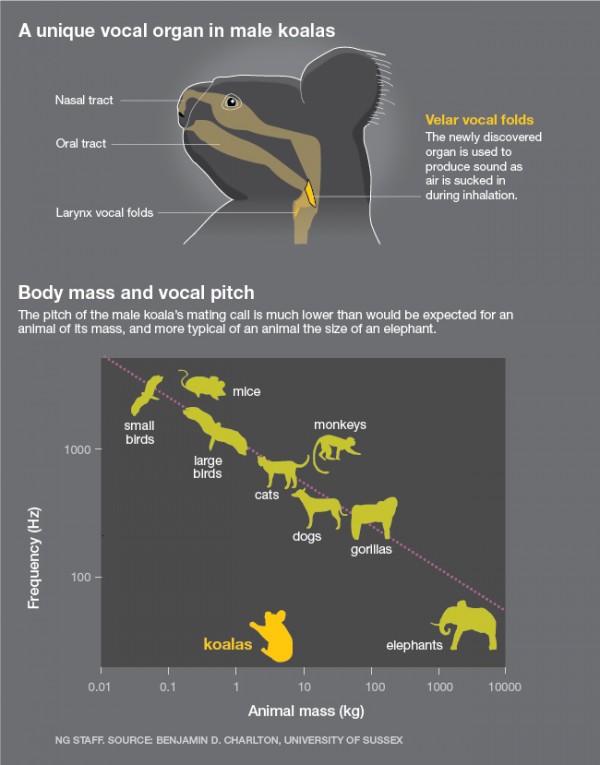
When scientists looked at the voice boxes of male koalas, they found their vocal cords weren’t large enough to create the animals’ extremely low-pitched mating bellows. But further examination revealed a second, much larger pair of vocal folds located outside of the larynx, where the oral and nasal cavities connect.
Charlton and his colleagues used a combination of physical, video, and acoustic analyses to demonstrate that the newly discovered vocal folds outside of the larynx are capable of producing extremely low-pitched sound as the koala inhales air through its nostrils.
Wisconsin has a first in 1947:
1947 – First TV Station in Wisconsin Established
On this date the first TV station in Wisconsin, WTMJ-TV in Milwaukee, was established. The seventeenth television station in the country, WTMJ-TV was the first in the Midwest. [Source: University of Wisconsin, Milwaukee Libraries]
Here’s Puzzability‘s Tuesday puzzle:
|
This Week’s Game — December 2-6
|
|||||
|
Festival of Lights
|
|||||
|
Here’s a bright idea for Hanukkah. The answer to each day’s trivia question this week is a two-word phrase, name, or title in which each word can be followed by the word “light” to make a compound word or phrase.
|
|||||
|
Example:
|
|||||
|
What was achieved for the first time by the Soviet Union in 1959 with an unmanned craft and by the U.S. 10 years later with a manned craft?
|
|||||
|
Answer:
|
|||||
|
Moon landing (moonlight, landing light)
|
|||||
|
What to Submit:
|
|||||
|
Submit the two-word trivia answer (as “Moon landing” in the example) for your answer.
|
|||||
|
|||||
|
Tuesday, December 3
|
|||||
|

Beautiful Whitewater, Holiday
Whitewater’s 2013 Holly Days Lighted Parade
by JOHN ADAMS •
Music
Monday Music: Pentatonix, Little Drummer Boy
by JOHN ADAMS •
Daily Bread
Daily Bread for 12.2.13
by JOHN ADAMS •
Good morning.
Monday begins with freezing fog in the morning, later to become cloudy with a high of thirty-nine.

On this day in 1804, Napoleon crowns himself emperor of France. Waterloo comes later.
On 12.2.1954, the United States Senate censures a Wisconsinite:
1954 – McCarthy Censured by Senate
On December 2, 1954, the United States Senate voted to censure Wisconsin Senator Joseph McCarthy. Declaring his behavior “contrary to senatorial traditions,” the 1954 Senate resolution officially condemned McCarthy.
Puzzability begins a new series, around a theme of light:
|
This Week’s Game — December 2-6
|
|||||
|
Festival of Lights
|
|||||
|
Here’s a bright idea for Hanukkah. The answer to each day’s trivia question this week is a two-word phrase, name, or title in which each word can be followed by the word “light” to make a compound word or phrase.
|
|||||
|
Example:
|
|||||
|
What was achieved for the first time by the Soviet Union in 1959 with an unmanned craft and by the U.S. 10 years later with a manned craft?
|
|||||
|
Answer:
|
|||||
|
Moon landing (moonlight, landing light)
|
|||||
|
What to Submit:
|
|||||
|
Submit the two-word trivia answer (as “Moon landing” in the example) for your answer.
|
|||||
|
|||||
|
Monday, December 2
|
|||||
|
