A mild and partly sunny Labor Day awaits, with a high of seventy-two and northwest winds at 5 to 10 mph. Sunrise was 6:21 AM and sunset will be 7:27 PM.
On this day in 1945, Japan formally surrenders to the Allies aboard the U.S.S. Missouri. The Associated Press reported the news:
Aboard The U.S.S. Missouri in Tokyo Bay, Sunday, Sept. 2–Japan surrendered formally and unconditionally to the Allies today in a twenty-minute ceremony which ended just as the sun burst through low-hanging clouds as a shining symbol to a ravaged world now done with war.
[A United Press dispatch said the leading Japanese delegate signed the articles at 9:03 A.M. Sunday, Tokyo time, and that General MacArthur signed them at 9:07 A.M.]
Twelve signatures, requiring only a few minutes to inscribe on the articles of surrender, ended the bloody Pacific conflict.
On behalf of Emperor Hirohito, Foreign Minister Mamoru Shigemitsu signed for the Government and Gen. Yoshijiro Umezu for the Imperial General Staff.
On this day in 1862, Wisconsinites express unfounded worries over a suspected tribal attack:
1862 – Rumored Indian Attack Panics Citizens
On this evening, Manitowoc settlers were awakened to the cry of “Indians are coming.” Messengers on horseback arrived from the Rapids, Branch, Kellnersville, and other nearby communities, announcing that Indians were burning everything in their path, starting what was known as the “Indian Scare of 1862.” Fire and church bells gave warning to frightened residents. Over the next few days, people from the surrounding areas fled to Manitowoc and other city centers.
Ox carts were loaded with women and children carrying their most valuable belongings. Men arrived with guns, axes, and pitchforks, anything with which to defend themselves and their community. A company of recruits from the Wisconsin 26th Regiment formed themselves into two scouting units, both of which returned to report that there was no threat of an Indian attack. Even after the excitement had subsided, many frightened farm families could not be persuaded to return home. [Source: Manitowoc County, Wisconsin Genealogy]
A new month begins, with high of eighty-three and an even chance of afternoon thunderstorms. Sunrise was 6:20 AM, and sunset will be 7:29 PM. The moon is a waning crescent with 14% of its visible disk illuminated.
The Friday Poll’s now closed, but on the question of whether it’s a good idea to call 9-1-1 over a spider on one’s sofa, the results are in: 80.77% said the call was unreasonable, and 19.23% thought it was reasonable. (See, Poll: Calling 9-1-1 Over a Spider.)
There’s a story at Gizmodo of a radio ad about extraterrestrials discussing Earth’s conquest that scared some children and led to police and school inquiries to radio station.
The ad’s hardly a Mercury Radio Theatre quality production:
The month ends on an initially cloudy day that will later grow sunnier, with a high of eighty, and northeast winds of 5 mph.
On this day in 1980, the Polish trade union Solidarity formally organizes, after weeks of labor strikes, to represent Polish workers in a Communist country that supposedly had no labor strife at all:
Solidarity ….full name: Independent Self-governing Trade Union “Solidarity” – …. is a Polish trade union federation that emerged on 31 August 1980 at the Gdansk Shipyard under the leadership of Lech Walesa. It was the first non–communist party-controlled trade union in a Warsaw Pact country. Solidarity reached 9.5 million members before its September 1981 Congress (up to 10 million[1][2]) that constituted 1/3 of the total working age population of Poland.[3] In its clandestine years, the United States provided significant financial support for Solidarity, estimated to be as much as 50 million US dollars.[4]
In the 1980s, Solidarity was a broad anti-bureaucratic social movement, using the methods of civil resistance to advance the causes of workers’ rights and social change.[5] The government attempted to destroy the union during the period of martial law in the early 1980s and several years of political repression, but in the end it was forced to negotiate with the union.
The Round Table Talks between the government and the Solidarity-led opposition led to semi-free elections in 1989. By the end of August a Solidarity-led coalition government was formed and in December 1990 Walesa was elected President of Poland. Since then it has become a more traditional, liberal trade union. 30 years after emerging its membership dropped to between just over 400,000[1] and 680,000.[2]
How about a plaque for the site of Walworth County’s parkland scheme, should it be completed?
DEDICATED TO ONE PRIVATE SELLER WHO FULFILLED HIS DREAM WITH MILLIONS OF YOUR TAX DOLLARS
Last Sunday saw another public-relations exercise in selling the residents of a rural county on purchasing private land, at a cost of millions in public money (all of which – state or local – comes from taxpayers’ earnings).
Candidly, the arguments for justifying the purchase are even weaker in this story than those described in an earlier newspaper story (June 9) and a subsequent Gazette editorial (June 15).
On the basis of these three attempts to hawk the deal, one could almost propose a Theory of Devolution: something can get successively smaller and more primitive over time.
A few responses to the latest arguments in favor, and some suggestions, too:
1. A private seller’s dream at others’ expense.
One reads that owner-seller Duane Clark has a dream, yes a dream:
It took a journey of 3900 miles for Duane Clark to reaffirm what he knew in his heart to be true.
The problem, and his quest, was to convince others that his nearly 200 acres in the town of Lyons should be preserved for the masses to enjoy.
The ‘masses’ – too funny, really: A seller has a dream that can be fulfilled for the little people – the unwashed, undifferentiated masses – not through his philanthropy or their voluntary contributions but only through their compulsory taxation.
Amazing, isn’t it, that Walworth County now has a new definition of philanthropy: the philanthropist donates a gift that’s entirely paid with other people’s tax money.
A seller’s dream, but on your dime. He’ll receive millions, from taxes collected, so that he can be a philanthropist.
Very, very few of the people taxed to fulfill one man’s supposed dream will ever receive millions from a land sale – yet here the private seller’s happy to build his dream on their backs.
That’s not genuine philanthropy – it’s an embarrassment.
2. About those supposedly few large pieces of land left.
The seller offers 200 acres, but the Kettle Moraine State Forest, Southern Unit, is already 22,000 acres of superior land with assuredly superior care. Our area does not lack for recreational land.
Still, these gentlemen would like common people to pay for an uncommonly selfish deal that adds only 0.9% to area parkland. That’s zero-point-nine, a number even less than one.
3. The price of an option to purchase.
One reads that an extension of the option to purchase from August to January was ‘free,’ and without additional change to the county. No, not really: the original cost of the option was $5,000, for a deal that these parties – at least professedly – would be willing to make with no one else.
The seller hasn’t asked for more toward an option on this scheme, but then who else would even consider this parkland idea?
Too funny: not only does the seller reportedly want his philanthropy at others’ ($1.9 million) expense, he wouldn’t even offer the original option without getting $5,000 for it.
That’s some philanthropy, I wouldn’t wonder.
4. The Walworth County Board Chairman Salutes a Dreamer (and would enrich him, too).
Nancy Russell, County Board Chairwoman, wants everyone to know why this matters:
The thing is that this has been a dream of Mr. Clark’s for a long time…”
I’m sure it has been, but I’m equally sure that there are many people in Chairwoman Russell’s county who dream about adequate food, clothing, and shelter, too.
Not one of those impoverished residents is asking that their dreams be fulfilled at a price of $1.9 million. No one (not otherwise obtuse) who has been fortunate in his or her life believes that Clark’s dream is as meaningful as the dream of mere sustenance that some unfortunate few have each night.
No one owes a dreaming private man these millions in public money.
5. “…but there are always reasons to say no to a project like this…”
Yes there are, and they’re more compelling than enriching one seller at others’ expense.
6. About that public hearing.
Another supervisor touts a public hearing response that was favorable to this sale. These are small-scale surveys, of those attending from among those who are able to attend, and aren’t slightly representative of the county’s demographics – and everyone in Walworth County government knows as much.
More to the point, the proper comparative measure isn’t this pricey deal among other land deals, but this deal specifically against all possible county expenditures.
Similarly, the proper popular survey would be among all people, legitimately sampled, rather than limited, unrepresentative surveys.
7. “…but if we don’t take advantage of it, the money will simply go somewhere else…”
Here one sees an appeal to gluttony.
What was once a deadly sin is now a principle of public policy.
It’s a contention both wrong and inefficient. It’s wrong because in conditions of restraint, appropriated money need not be spent. It’s simply inefficient because it signals demand even when there are better uses elsewhere.
Here’s what it really means, too: let’s spend it on a bad idea before someone in the state has a better idea.
Let’s spend it needlessly in Walworth County so no one elsewhere in Wisconsin will have the chance to spend it properly in their respective counties.
8. Ask way too much, settle for merely too much.
Here’s what Central Services Director Kevin Brunner has to say about the seller’s price:
But when we got involved in discussions he was asking well in excess of $3 million.
Well, thank you, Mr. Brunner, for admitting to the community that a supposed philanthropist was looking to grab even more from the public treasury. Much appreciated (even if the revelation comes at the expense of a story line – about how generous all this is – that he can’t keep straight.)
That’s some negotiating position Mr. Brunner has there, too: someone asks him to spend $50 on a can of Coke, and he feels feel satisfied if he pays only $30.
Funny thing, though: he’s not paying with his money, is he? Every big project is the same: he’s been a wheeler-dealer with someone else’s (tax) money. They earned it; he spends it.
9. About that Appraisal Price.
Now Mr. Brunner and others have had months to think of justifications for this scheme, but watch how easily it is to refute the argument in defense of the appraised price. Here’s what Mr. Brunner said about that price:
You can argue that $1.9 (million) or $2 million was too much, but that’s what the appraisal numbers say.
Here’s a quick reply:
A single mother walks into a car dealership, to buy a used car for herself and her three children. She’d like something for transportation to work and her children’s activities. She’s thinking about a hatchback or a small SUV.
The woman is stunned, and she asks why he thinks she could possibly afford a $386,295 automobile.
The salesman replies that he thinks she should because that’s the Kelley Blue Book Value and he might have asked even more for it.
There we are: Mr. Brunner hits on the idea of an appraised price, but he shows no willingness or ability to place that price in a proper context.
Those who want to leave a legacy should donate it freely, not charge others for the supposed privilege.
A few helpful suggestions:
1. Walworth County officials are really at sea on even simple economic justifications for their proposals. Someone needs to find and begin a remedial course on economics, at the simplest level.
2. Walworth County needs a better point-man for these ideas. The County Administrator must be able to find someone of strong reasoning, somewhere. It’s a county of over one-hundred thousand, after all.
It’s evident he’s not yet found someone of that ability.
3. Does County Administrator Bretl understand the residents of his county? I’m not sure. Best guess is that he’s working in a county echo-chamber, and consequently he has almost no feel for how his arguments sound when examined outside this group. (Without question, Kevin Brunner had this problem in Whitewater as city manager, too.)
“I’m home alone and there is a giant spider on the back of my couch, and I’m talking giant. I’ve never seen a spider this big and I have no idea what to do,” she told the slightly perplexed dispatcher, according to 911 records.
After she called, the dispatcher agreed to send an officer:
After the dispatcher pondered how to handle the situation, he agreed to have an officer contact her.
“Is that ridiculous?” she asked.
An officer did respond to the scene and estimated the spider was about 2 inches in diameter. Modern police equipment was not necessary to handle the eight-legged perp in this case.
The officer disposed of the spider with an old-fashioned rolled up newspaper, police said.
So, is this a legitimate issue for a 9-1-1 call with a subsequent dispatch to the scene? I’ll say no, but what do you think?
BONUS INFO: Admittedly, I’d feel differently if these were the spiders —
We’ve an even chance of thunderstorms this afternoon, with a high of ninety-one, and southwest winds five to fifteen mph.
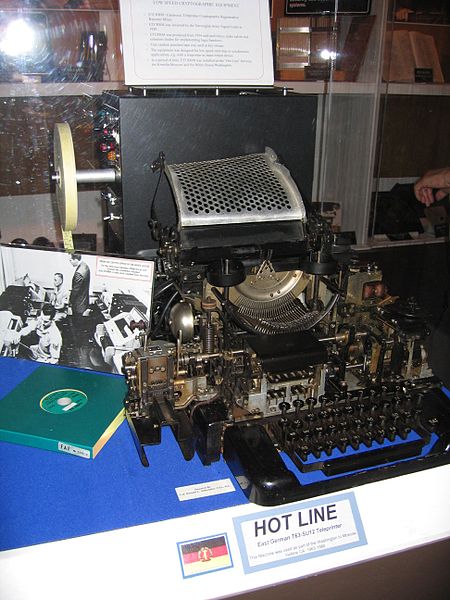
The Picture shows a East-German Teleprinter of Type T63-SU12 from Siemens (formerly Siemens & Halske).
This Teleprinter was used from 1963-1980 as a part of the special transatlantic Moscow–Washington hotline, also known as “The Red Line”. This Rotor machine is currently on display at the National Cryptologic Museum, located on the National Security Agency (NSA) campus at Fort Meade, Maryland.
On this day in 1963, a hotline between America and the Soviet Union:
Two months after signing an agreement to establish a 24-hour-a-day “hot line” between Moscow and Washington, the system goes into effect. The hot line was supposed to help speed communication between the governments of the United States and the Soviet Union and help prevent the possibility of an accidental war.
In June 1963, American and Russian representatives agreed to establish a so-called “hot line” between Moscow and Washington. The agreement came just months after the October 1962 Cuban missile crisis, in which the United States and Soviet Union came to the brink of nuclear conflict. It was hoped that speedier and more secure communications between the two nuclear superpowers would forestall such crises in the future. In August 1963, the system was ready to be tested. American teletype machines had been installed in the Kremlin to receive messages from Washington; Soviet teletypes were installed in the Pentagon. (Contrary to popular belief, the hot line in the United States is in the Pentagon, not the White House.)
Both nations also exchanged encoding devices in order to decipher the messages. Messages from one nation to another would take just a matter of minutes, although the messages would then have to be translated. The messages would be carried by a 10,000-mile long cable connection, with “scramblers” along the way to insure that the messages could not be intercepted and read by unauthorized personnel. On August 30, the United States sent its first message to the Soviet Union over the hot line: “The quick brown fox jumped over the lazy dog’s back 1234567890.” The message used every letter and number key on the teletype machine in order to see that each was in working order. The return message from Moscow was in Russian, but it indicated that all of the keys on the Soviet teletype were also functioning.
Puzzability concludes a back-to-school series entitled, Welcome, students:
Welcome, Students
For this week’s class act, we started each day with a word or phrase, added the seven letters in the word STUDENT, and rearranged all the letters to get a new phrase. Both pieces are described in each day’s clue, with the shorter one first. Example:
Skating venues; Tobey Maguire’s Spider-Man love interest Answer:
Rinks; Kirsten Dunst What to Submit:
Submit both pieces, with the shorter one first (as “Rinks; Kirsten Dunst” in the example), for your answer.
Here’s today’s puzzle:
Friday, August 30:
Preparing one’s hands for a gymnastics routine; ended a gymastics routine perfectly
The responsibility to interview a candidate should – and reasonably does – require that one interviews with one’s independent judgment. If the interviewer, himself or herself, is under someone’s else’s watch, then the interviewers aren’t truly independent (and candidates see that, too).
There’s a Police and Fire Commission meeting tonight, at 6 PM. The principal purpose of the meeting is an interview process for candidates for sergeant. The interview portion of the meeting is a closed session, with open sessions before and after.
Consideration of Discontinuing Chief and/or Command Staff Attendance at PFC Candidate Interviews.
This should be, in a politically well-ordered community, an easily resolved question: the civilian members of a Police & Fire Commission, at the very least, should conduct interviews independent of, and outside the presence of, leaders of the police department (“Chief and/or Command Staff”).
It should never have been otherwise. It is an expression of weakness and insecurity that it should continue otherwise.
Whitewater will see, tonight, how her Police & Fire Commission addresses the authority of civilian commissioners to conduct genuinely independent review.
We’ll have a sunny Thursday with a high of eighty-five and calm winds.
Those wishing to hear the School Board meeting of Monday, August 26th (during which the Board hired a new principal for the middle school, among other items) can do so via Whitewater Community Television. The program airs again today at Noon on cable, and is also available anytime on the Web at Vimeo. Alan Luckett of Whitewater Community Television has made available the audio that Chris Welch of the Daily Union kindly supplied. Many thanks to both for their efforts.
Whitewater’s Police Commission meets today at 6 PM.
What’s it like to fly in close air formation? It’s like this:
On this day in 2005, Hurricane Katrina hits the Gulf Coast:
Hurricane Katrina makes landfall near New Orleans, Louisiana, as a Category 4 hurricane on this day in 2005. Despite being only the third most powerful storm of the 2005 hurricane season, Katrina was the worst natural disaster in the history of the United States. After briefly coming ashore in southern Florida on August 25 as a Category 1 hurricane, Katrina gained strength before slamming into the Gulf Coast on August 29. In addition to bringing devastation to the New Orleans area, the hurricane caused damage along the coasts of Mississippi and Alabama, as well as other parts of Louisiana….
The storm also set off 36 tornadoes in Mississippi, Alabama, Georgia, Pennsylvania, and Virginia, resulting in one death.
For the week of August 26 to 30, Puzzability continues a back-to-school series entitled, Welcome, students:
Welcome, Students
For this week’s class act, we started each day with a word or phrase, added the seven letters in the word STUDENT, and rearranged all the letters to get a new phrase. Both pieces are described in each day’s clue, with the shorter one first. Example:
Skating venues; Tobey Maguire’s Spider-Man love interest Answer:
Rinks; Kirsten Dunst What to Submit:
Submit both pieces, with the shorter one first (as “Rinks; Kirsten Dunst” in the example), for your answer.
Here’s today’s puzzle:
Thursday, August 29
Steinbeck novel set in Monterey; music genre with singers like Reba McEntire and Randy Travis
Welcome to Whitewater, Wisconsin. I’m sure our city will be better for your presence.
In these weeks and months ahead, so very many helpful people will offer advice and guidance to you. A few others, unhelpfully, will draw close and whisper ever so softly about how you should think, feel, and act to be a proper part of Whitewater.
I’m part of neither group. I’ve no interest in the private and personal; it’s the public and political that concerns me.
Having chosen Whitewater, I hope for your success. More precisely, I hope for your success as you wish it to be, a success that’s sure to be different and better than anything I could imagine for you.
It makes sense to try to fit in; it’s even better to shape the city in ways more creative than those we’ve yet devised.
I may have no advice of my own to offer, but I am reminded that a noted twentieth-century philosopher once advised that one should always let ‘your conscience be your guide.’
My late father told me a story, a lifetime ago, of a widow and her disabled son. I’ll share that story today.
The boy’s name was Charlie Schadler, and he was born with a condition that caused his eyes to discharge incessantly. That family was poor, and Mrs. Schadler had money for neither nurse nor nanny; it was she alone who cared for her child. Day after day, without fail or complaint, she dutifully dabbed away the fluid that ran from her small son’s eyes onto his cheeks.
I received the story from my father, intelligent and serious, well-read and thoughtful. Years later, I shared the same story with someone, intelligent but mercurial, well-read but socially-motivated.
For my father, the story was one of patient devotion, of love: the widow had nothing but a disabled son, yet in him she rightly believed that she had everything. Attending to the child’s affliction was her loving duty. Charlie was altogether a blessing to his mother; his mother was altogether a model of parental love to others.
For the woman to whom I told the story, by contrast, it was a tale of disturbing misfortune, not principally of the boy, but for her mother: how sad that the mother had been consigned to that role, to caring for her child without additional support. Worse, in the woman’s eyes, was Mrs. Schadler’s condition, itself, as an unwitting victim of her son’s circumstances.
You, of course, may choose to think of the story as you wish. Perhaps, you’ll choose one view or another, or instead reject both.
Regardless, one cannot with sincerity hold both views with equal conviction. One view precludes the equal embrace of the other.
In your work, you’ll likely encounter children with circumstances nearly as difficult. What you think upon encountering them is your decision alone.
Yet, this much is already decided: our community will be stronger or weaker, depending on your choice.
1928 – Babe Ruth Cracks Homer in Milwaukee
On this date Babe Ruth hit a towering game-winning home run in the ninth inning to give his team a 5-4 victory in a baseball exhibition at Borchert Field in Milwaukee. Lou Gehrig also played at this event. [Source: Milwaukee Journal Sentinel]
For the week of August 26 to 30, Puzzability offers a back-to-school series entitled, Welcome, students:
Welcome, Students
For this week’s class act, we started each day with a word or phrase, added the seven letters in the word STUDENT, and rearranged all the letters to get a new phrase. Both pieces are described in each day’s clue, with the shorter one first. Example:
Skating venues; Tobey Maguire’s Spider-Man love interest Answer:
Rinks; Kirsten Dunst What to Submit:
Submit both pieces, with the shorter one first (as “Rinks; Kirsten Dunst” in the example), for your answer.
Here’s today’s puzzle:
Wednesday, August 28
Very close friends; agency responsible for making American coins