All one’s life one has probably heard stories about the possibility of flying cars, with some of those accounts insisting that the flying car would be just around the corner. CNN has a story about another company, Terrafugia, that claims it’s now got flying automobiles.
The company has a promotional video for their product, of course:
Dan Gross’s post, though, is more cautious than its bold title. He explains that “the Woburn, Massachussetts-based aerospace company announced it has begun feasibility studies on a car capable of vertical takeoffs and landings. The TF-X would be a four-seat, plug-in hybrid electric vehicle, according to the company.”
That sugests to me that a flying car is farther away than a bold headline would suggest, and that flying out of one’s driveway is much further away, still.
But what do you think? Is Terrafugia’s design at last the car for which so many have hoped?
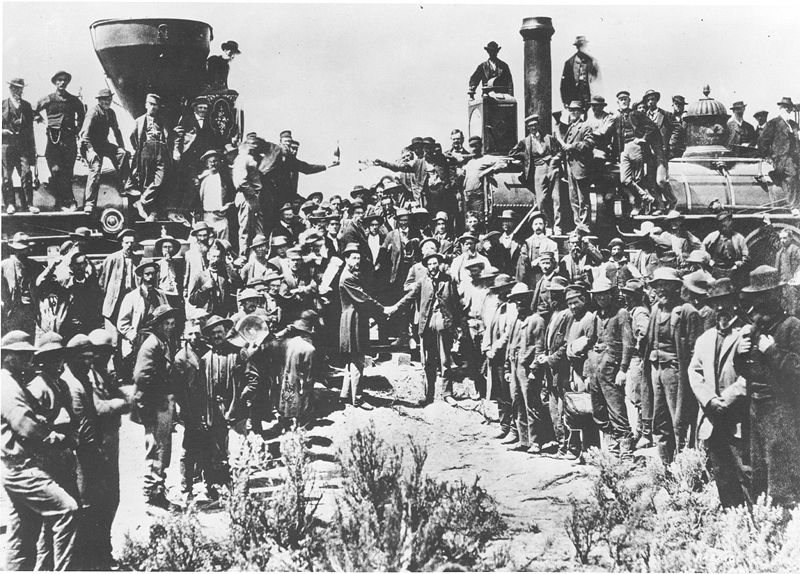
…the presidents of the Union Pacific and Central Pacific railroads meet in Promontory, Utah, and drive a ceremonial last spike into a rail line that connects their railroads. This made transcontinental railroad travel possible for the first time in U.S. history. No longer would western-bound travelers need to take the long and dangerous journey by wagon train, and the West would surely lose some of its wild charm with the new connection to the civilized East.
Since at least 1832, both Eastern and frontier statesmen realized a need to connect the two coasts. It was not until 1853, though, that Congress appropriated funds to survey several routes for the transcontinental railroad. The actual building of the railroad would have to wait even longer, as North-South tensions prevented Congress from reaching an agreement on where the line would begin.
One year into the Civil War, a Republican-controlled Congress passed the Pacific Railroad Act (1862), guaranteeing public land grants and loans to the two railroads it chose to build the transcontinental line, the Union Pacific and the Central Pacific. With these in hand, the railroads began work in 1866 from Omaha and Sacramento, forging a northern route across the country. In their eagerness for land, the two lines built right past each other, and the final meeting place had to be renegotiated….
On this day in 1865, the Wisconsin 1st Cavalry helps capture Jefferson Davis:
1865 – (Civil War) Confederacy President Jefferson Davis Captured
The 1st Wisconsin Cavalry was one of the first units sent to search for Jefferson Davis, the president of the Confederacy, after the surrender of General Robert E. Lee. A Michigan unit, also sent to find Davis, accidentally attacked the cavalry before dawn. A few hours later, both units captured the Confederate president in Irwinville, Georgia.
Google asks today about a nation’s father: “Who is known as the “father” of the country whose national drink is a strong alcoholic beverage made from pomace?
We’ll have showers and thunderstorms this afternoon in Whitewater, with a high of sixty-eight. New rainfall may amount range from a quarter to half of an inch.
On this day in 1874, Howard Carter, the British archaeologist who discovered the Egyptian tomb of King Tutankhamen, is born.
1950 – First Sporting Event Held at Milwaukee Arena
On this date, in the first sporting event at the new Milwaukee Arena, Rocky Graziano scored a fourth-round TKO over Vinnie Cidone in a middleweight fight that drew 12,813 fans. The new Milwaukee Arena actually opened on April 9, 1950, but with a civic celebration rather than a sports event. [Source: Milwaukee Journal]
For today’s daily question from Google, something about naval tradition: “What is the term for the traditional ritual by which officers in the UK’s Royal Navy are retired?”
Scientists have now built a tiny robot that flies…like a fly:
Ingenious.
On this day in 1891 DePere,
1891 – Arthur J. Altmeyer [is] Born, ‘Father of Social Security’
On this date Arthur J. Altmeyer, the “father of social security,” was born in DePere. Altmeyer was one of the seminal figures of the Social Security program in America. He was part of the President’s Committee on Economic Security that drafted the original legislative proposal in 1934. He was a member of the three-person Social Security Board created to run the new program, and he was Chairman of the Board or Commissioner for Social Security from 1937-1953. Altmeyer died on October 19, 1972 and is buried in Madison’s Forest Hill Cemetery. [Source: Social Security Adminsitration]
Google-a-Day has a soap opera question: “On the soap, ‘General Hospital,’ on January 23, Robin finally admitted to Patrick that she was away in what city?”
I’ve no idea of the answer, but I do know that soap operas look like they’re becoming an endangered species. Wait long enough, a Google may be able to ask, “On the last-remaining soap…”
Here’s a colorful animated film from a series (‘Hello, Again’) that the Lincoln Motor Company (yes, the car company) is funding. There’s creativity in big-corporate America, if only one would look. Enjoy.
Inspired by the drawn-on-film pieces by Norman Mclaren, Len Lye, and Man Ray, Becky & Joe collaborated with musicians Delicate Steve to create the charming and beautiful “Tallest Heights.” This work is part of the “Hello, Again” series presented by the Lincoln Motor Company, which asks filmmakers to reimagine the familiar into something fresh and new. The animation is made from a combination of ink, paint, bleach, and scratching into different film sizes. The final images are high-resolution scans of super 8, 16, and 35mm film strips and acetate sheets.
On this day in 1945, war in Europe ends with Nazi Germany’s unconditional surrender.
In London, V-E celebrations swept the city:
On this day in 1932 in Janesville, another episode from a failed Prohibition:
1932 – Illegal Distillery Discovered in Janesville
On this date Rupert E. Fessenden, Rock County’s chief deputy, discovered the largest ever illegal liquor distillery in southern Wisconsin. The distillery was found on the old Frances Willard estate south of the Wisconsin School for the Blind. Ironically, Willard was one of the founders of the Women’s Christian Temperance Union. [Source: Janesville Gazette].
Google has a question about coyotes: “What is the source of the pressure that has caused coyotes, which were once essentially diurnal, to adjust to a more nocturnal behavior?”
Like yesterday, Monday will be mostly sunny, the temperature in the low seventies, with light winds. We’ll have 14h 18m of sunlight, 15h 21m of daylight, and three minutes more light tomorrow.
You may have been hungry for breakfast today, but probably not this enthusiastic:
It’s on this day in 1937 that the hydrogen-filled Hindenburg dirigible explodes in Lakehurst, New Jersey.
On this date George Orson Welles was born in Kenosha. The name George was soon dropped. The family moved to Chicago in 1919, and two years later, Welles’ parents separated. After his mother’s death in 1924, he travelled the world with his father, only to lose him in 1928. Welles turned down the chance at college in 1931, choosing instead to go on a sketching trip to Ireland. In 1934, Welles made his New York debut, playing Tybalt in Katherine Cornell’s staging of Romeo and Juliet.
In the mid 1930s, he established himself as a radio actor on The March of Time and The Shadow, among other shows. He began working with John Houseman and together they formed the Mercury Theatre in 1937. Their program, The Mercury Theatre on Air, became famous for the notorious events surrounding their version of The War of the Worlds in 1938, in which they provoked mass panic among listeners.
A renowned actor, writer, producer, and director, Welles is known best for his roles in such films as Citizen Kane (1941), Jane Eyre (1944), MacBeth (1948), Moby Dick (1956), A Man for all Seasons (1966), and Catch 22 (1970). Welles was awarded an Honorary Oscar in 1971 and a Lifetime Achievement Award from the American Film Institute in 1975.
Despite his lack of commercial success, the Directors Guild of America awarded him their highest award, the D.W. Griffith Award, in 1984. Welles was briefly married to Hollywood actress Rita Hayworth from 1943 to 1948, with whom he had one daughter. Orson Welles died on October 9, 1985. [Source: Wisconsin Film Office].
Google’s daily quiz wonders about geography: “The expansion of the earth’s surface is demonstrated by what U.S. state that is believed to be increasing by 1.2 “nanostrains” per year?”
Beautiful Sunday weather is ahead for Whitewater. We’ll have partly sunny skies, a high of seventy-two, and light winds at five to ten miles per hour.
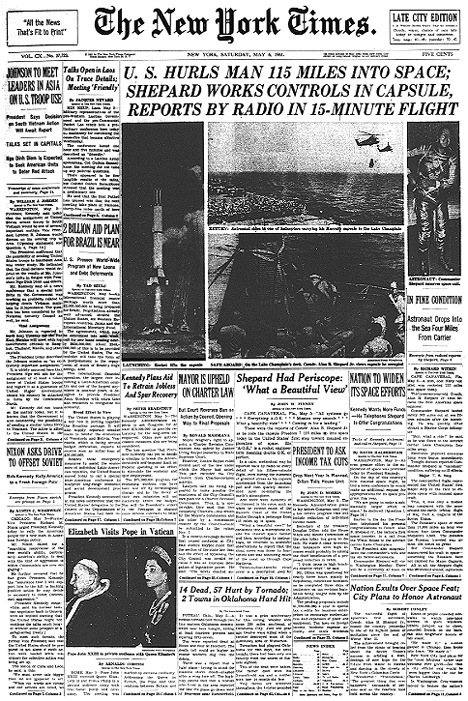
On this day in 1961, “astronaut Alan B. Shepard Jr. became America’s first space traveler as he made a 15-minute suborbital flight in a capsule launched from Cape Canaveral, Fla.”
Shepard wasn’t the first man in space, but Americans yet had reason to be proud of his accomplishment.
On 5.5.1862, Wisconsin soldiers fought in Virginia:
1862 – (Civil War) Battle of Williamsburg, Virginia
The Battle of Williamsburg was a key engagement in the Peninsular Campaign that began on March 17, 1862. The 5th Wisconsin Infantry and Company G of the 1st U.S. Sharpshooters participated in this battle. Outnumbered Confederate forces held off the Union advance long enough for the bulk of the Confederate army to continue its withdrawal toward the capital at Richmond.
Google’s daily question isn’t just about art, but an art collector: “In 1861, Louis-Napoléon Bonaparte bought 11,835 artworks for the Louvre, including 641 paintings from what Italian art collector?”
A Saturday of isolated, afternoon thunderstorms and a high of sixty-nine awaits. Whitewater will enjoy 14h 13m of sunlight, 15h 16m of daylight, with a waning crescent moon.
On this day in 1864, Wisconsin soldiers take part in the Wilderness Campaign:
1864 – (Civil War) Wilderness Campaign opens in Virginia
Union forces crossed the Rapidan River in Virginia and prepared to fight at the Wilderness the next day. The resulting series of battles between May 5 and June 12, 1864, is called the Wilderness Campaign, or Grant’s Overland Campaign.
The 2nd, 5th, 6th, 7th, 19th, 36th and 38th Wisconsin Infantry regiments and the 4th Wisconsin Light Artillery participated in this series of bloody battles. The initial Battle of the Wilderness on May 5-7, 1864, produced nearly 30,000 casualties without giving either side a clear victory.
Google poses a question about French design: “Of what type of architecture is the Paris Cathedral that in 1970 was the site of Charles de Gaulle’s funeral?”