
Author Archive for JOHN ADAMS
Public Meetings
Planning Commission
by JOHN ADAMS •
Daily Bread
Daily Bread for 11.9.12
by JOHN ADAMS •
Good morning.
Our work week in Whitewater ends with a 30% chance of afternoon showers and a high of fifty-two.
On this day in 1872, a widespread Boston fire kills over a dozen and destroys hundreds of buildings:
In the aftermath, the city established an entirely new system of firefighting and prevention. The fire also led to the creation of Boston’s financial district.
The fire began in the basement of a warehouse at the corner of Kingston and Summer streets. At the time, this area of the city contained a mix of residences and light industry. Its buildings and most area roofs were made mainly of wood, allowing the blaze to spread quickly as the wind blew red hot embers from rooftop to rooftop. In addition, as Boston streets were narrow, large flames from one structure could literally leap across them to nearby buildings.
Firefighting units from Maine to New Haven, Connecticut, arrived to help, but efforts to fight the fire were plagued by difficulties. There was not enough water on hand to get the fire under control; the hydrant system did not work well because much of the equipment was not standardized; and even when firefighters got their hands on an adequate supply of water, the height of the buildings and the narrowness of the streets made it difficult to direct the water at the blaze from the optimum angle. Because a local equine epidemic had struck the city fire department’s horses, it was difficult to get the fire engines to the correct locations at the right times. In addition, some of the efforts were counter-productive. Explosions were used to attempt fire breaks, but this high-risk strategy was not executed with enough precision and served only to further spread the fire.
In Wisconsin on this day in 1968, an earthquake:
1968 – Earthquake Shakes Wisconsin
On this date one of the strongest earthquakes in the central United States occurred in south-central Illinois. Measured at a magnitude of 5.3, press reports from LaCrosse, Milwaukee, Port Washington, Portage, Prairie Du Chien, and Sheboygan indicated that the shock was felt in these cities. [Source:United States Geological Survey]
From Google’s daily puzzle, a question on geography: “On what river will you find the only inland municipality of the four direct-controlled municipalities in China?”
Libertarians, Politics, Presidential race 2012
Libertarian Nick Gillespie on Why the GOP Lost in 2012
by JOHN ADAMS •
Gillespie gives a quick – but representative – expression of libertarian thinking on where the GOP went wrong. There was much about which to disagree over Pres. Obama’s policies, but in the three areas Gillespie mentions, a decidedly more libertarian direction (truly smaller, less intrusive government) would have helped Republicans.
As for social conservatism, profound conservative opposition to liberal social policy isn’t going away. For it all, though, a political party during a long economic downturn should ask itself: what’s the leading issue before the voters?
There’s a fourth area where a few Republicans went wildly wrong, too: unbelievable theories about where Obama was born, his faith, whether he has a secret agenda, or that all the major state polls were somehow skewed in his favor.
It’s impossible to think that Goldwater, Reagan, or Kemp would ever have spent time on theories like those, or that they had anything like the opposition to immigration that’s now so powerful within the GOP.
I’ve no idea what the Republican Party will look like four years on. Republicans will craft a platform of their own design.
I do know what libertarianism looks like now, what it will continue to look like, and the positive outlook it offers all Americans.
Posted also at Daily Adams.
Animals
Pug Glides Up the Stairs
by JOHN ADAMS •
Something for dog lovers: a very graceful pug, in a video that seems almost too good to be true. Enjoy.
43rd Assembly District
The Boundaries of the New 43rd Assembly District
by JOHN ADAMS •
The new 43rd Assembly District covers parts of four counties – Rock, Jefferson, Walworth, and Dane. The district stretches from Whitewater and Cold Spring in the east to the Town of Rutland and near Oregon in the west; south to Milton and Edgerton and around the City of Janesville.
A description of the district or results from it that lists only three counties’ totals is inaccurate in both geography and in actual outcome. The Journal Sentinel‘s webpage helpfully lists the accurate totals for the district.
Here’s a map of the full, new 43rd:

City, Daily Bread, Open Government
Daily Bread for 11.8.12
by JOHN ADAMS •
Good morning.
Thursday in the Whippet City brings a cloudy morning with gradual clearing thereafter, and a high of forty-nine. We’ll have 9h, 58m of sunshine and 10h, 58m of daylight.
Today in Whitewater, will will be a joint meeting of Downtown Whitewater, the Chamber of Commerce, and Tourism Commission at 6:45 PM. It follows a meeting yesterday of Downtown Whitewater, and these meetings are part of longstanding, sporadic attempts to consolidate services between the different business-advocacy groups.
Today’s meeting is held this evening at First Citizens Bank, on Main. (A public meeting – and at least one of these three groups reasonably falls under the Open Meetings Law — may be held at a private site, so long as it’s easily accessible, as this one will be. Wis. Stat. § 19.81(2)-(3).)
Although efforts of this kind are typically mentioned during Whitewater’s annual budgeting, this is the most robust effort the city has yet seen, at city government’s behest. How it will go, I’ve no idea. (These are not the first meetings along these lines this season, by the way.)
Embedded below for easy reference is the posted document for tonight’s meeting, and thereafter the documents for the 11.7.12 Downtown Whitewater, Inc. meeting.
Also tonight, at 6:30 PM, there’s a Common Council meeting, with ongoing budget presentations.
On this day in 1960, Sen. Kennedy defeated VP Richard Nixon to become president. Here’s how James Reston at the New York Times reported the news:
Senator John F. Kennedy of Massachusetts finally won the 1960 Presidential election from Vice President Nixon by the astonishing margin of less than two votes per voting precinct.
Senator Kennedy’s electoral vote total stood yesterday at 300, just thirty-one more than the 269 needed for election. The Vice President’s total was 185. Fifty-two additional electoral votes, including California’s thirty-two, were still in doubt last night.
But the popular vote was a different story. The two candidates ran virtually even. Senator Kennedy’s lead last night was little more than 300,000 in a total tabulated vote of about 66,000,000 cast in 165,826 precincts.
That was a plurality for the Senator of less than one-half of 1 per cent of the total vote–the smallest percentage difference between the popular vote of two Presidential candidates since 1880, when James A. Garfield outran Gen. Winfield Scott Hancock by 7,000 votes in a total of almost 9,000,000.
In Wisconsin history from this day in 1870,
First National Weather Forecast [Was] Published
On this date Increase Lapham recorded the first published national weather forecast, calling for “high winds and falling temperatures for Chicago, Detroit and the Eastern cities.” [Source: History Just Ahead: A Guide to Wisconsin’s Historical Markers edited by Sarah Davis McBride]
Google’s daily puzzle asks a history question: “Only one man was twice honored with the “Thanks of Congress” during the Civil War. To what rank was this individual promoted after the war?”
Elections, Music
Post-Election Music
by JOHN ADAMS •
On this day after a hard-fought election, something unusual yet unifying: the Fifth Dimension’s rendition of words from the Declaration of Independence.
Moving words, whether spoken or sung. Enjoy.
Posted also at Daily Adams.
43rd Assembly District
A Libertarian’s View of the WI 43rd Assembly Race: Results
by JOHN ADAMS •
A few thoughts on the New 43rd’s results:
1. A Big Margin. Historically, the Old 43rd saw close races between Republicans and Democrats. No more: this was a 58-42% contest between the winning Democrat Andy Jorgensen and defeated Republican Evan Wynn. How’s that stack up against past races? Andy Jorgensen won the New 43rd with a bigger margin in 2012 than anyone in recent years won the Old 43rd:
2012
Andy Jorgensen 17,600 58%
Evan Wynn 12,883 42%
2010
Kim Hixson 9,448 47.5%
Evan Wynn 10,449 52.5%
2008
Kim Hixson 15,303 51.2%
Debi Towns 14,581 48.8%
2006
Kim Hixson 10,330 50.02%
Debi Towns 10,292 49.83%
2004
Matt McIntyre 12,796 44.4%
Debi Towns 15,960 55.4%
The old 43rd was a swing district; the new one is more solidly Democratic (as is Rock County).
2. Fewer Individual Endorsements. When candidate Wynn ran in 2010, his website listed a fair number of prominent City of Whitewater Republicans as backers. This time around, he listed only one businessman and one officeholder living within the city.
That wasn’t this year’s oversight: some former supporters weren’t as supportive this time around. If they changed their minds on principle, well, that was their reasoned choice. If they withheld their open support because they feared Wynn would be unsuccessful (as I think was true for some of his former supporters), it speaks volumes about how self-interested those former supporters really are.
3. Signs. Whitewater was chock-a-block with signs for Wynn, presumably to create the illusion of widespread support. It was an ineffective strategy, and almost counter-productive. There was no one in the city who thought Wynn would carry Whitewater, and those weren’t ordinary people’s yard signs anyway.
Yard signs would have created the illusion of support, not the much larger Wynn signs, stylish and expensively printed, that appeared on so many commercial properties in the city. The Wynn campaign’s signage strategy was ill-considered, and too fancy by half, so to speak.
In any event, I’d guess that advocacy on the Web has a greater influence.
4. Negative mailers. Wynn did himself no favors with a series of negative mailers describing Jorgensen as though he were a soccer hooligan. No ordinary voter not drunk or disordered thinks of Jorgensen that way – he has a reputation for being friendly and accessible. Wynn would have had a hard slog in any event, but his negative mailers (and his use of the same line-of-attack during a Whitewater debate) did him no good (and probably considerable harm).
Everyone behind the slogans Wynn used in those mailers should reassess his or her suitably for effective political advice. They were both false and embarrassingly stupid.
A Republican could still win in this bluer district, but not that way.
5. Redistricting. Wynn supported not merely redistricting, but secretive redistricting. What he got from the GOP leadership for all his troubles on election night was a new 43rd with a 16 point Democratic advantage. It was a bad deal, on principle and (for him) in consequence.
6. The ‘Sons and Daughters of Wisconsin.’ During an October 30th debate with Jorgensen in Whitewater, Wynn declared that principal Wisconsin college benefits should go only to the ‘sons and daughters of Wisconsin.’ It was a brazen phrase, applied as it was against equal support for minor children who might have resided here nearly their whole lives. He delivered that line boldly, and I’d say with considerable self-assurance of the policy behind it.
This unreconstructed nativism proved unavailing: a decisive majority of actual, voting-age ‘sons and daughters of Wisconsin’ rejected Rep. Wynn’s candidacy.
7. Repositioning. One should run as what one is – no one is fooled by claims of bipartisanship that are false. These have been partisan times. Pretending otherwise convinced no one; hiding one’s political affiliation in mailings did no good at all. An elephant in chiffon is still an elephant. Better to run as what one is, than to insist otherwise.
One can hope, though, that from Tuesday’s result the 43rd will receive accessible, forthright representation. Now, if only everyone would stop worrying about free trade; it’s a good thing…
Daily Bread
Daily Bread for 11.7.12
by JOHN ADAMS •
Good morning.
Wednesday in the Whippet City will be cloudy with a high of forty five.
On this day in 1944, FDR won an unprecedented fourth term:
By the time Roosevelt was elected to his fourth term, the war had taken a turn in favor of the Allies, but FDR’s health was already on the decline. His arteriosclerosis (hardening of the arteries) had been worsened by the stress of serving as a war-time president. In April 1945, seven months before the war finally ended in an Allied victory, FDR died of a stroke at his vacation home in Warm Springs, Georgia.
In 1947, with President Harry Truman, Roosevelt’s vice president, in office, Congress proposed a law that would limit presidents to two consecutive terms. Up to that time, presidents had either voluntarily followed George Washington‘s example of serving a maximum of two terms, or were unsuccessful in winning a third. (In 1912, Theodore Roosevelt ran for a third non-consecutive term, but lost.) In 1951, the 22nd Amendment to the Constitution was passed, officially limiting a president’s tenure in office to two terms of four years each.
Google’s daily puzzle asks about literature: “Which nobel prize winning author explored philosophy through the point of view of English literature’s earliest monster?”
Beautiful Whitewater, City, Elections
Beautiful Whitewater
by JOHN ADAMS •
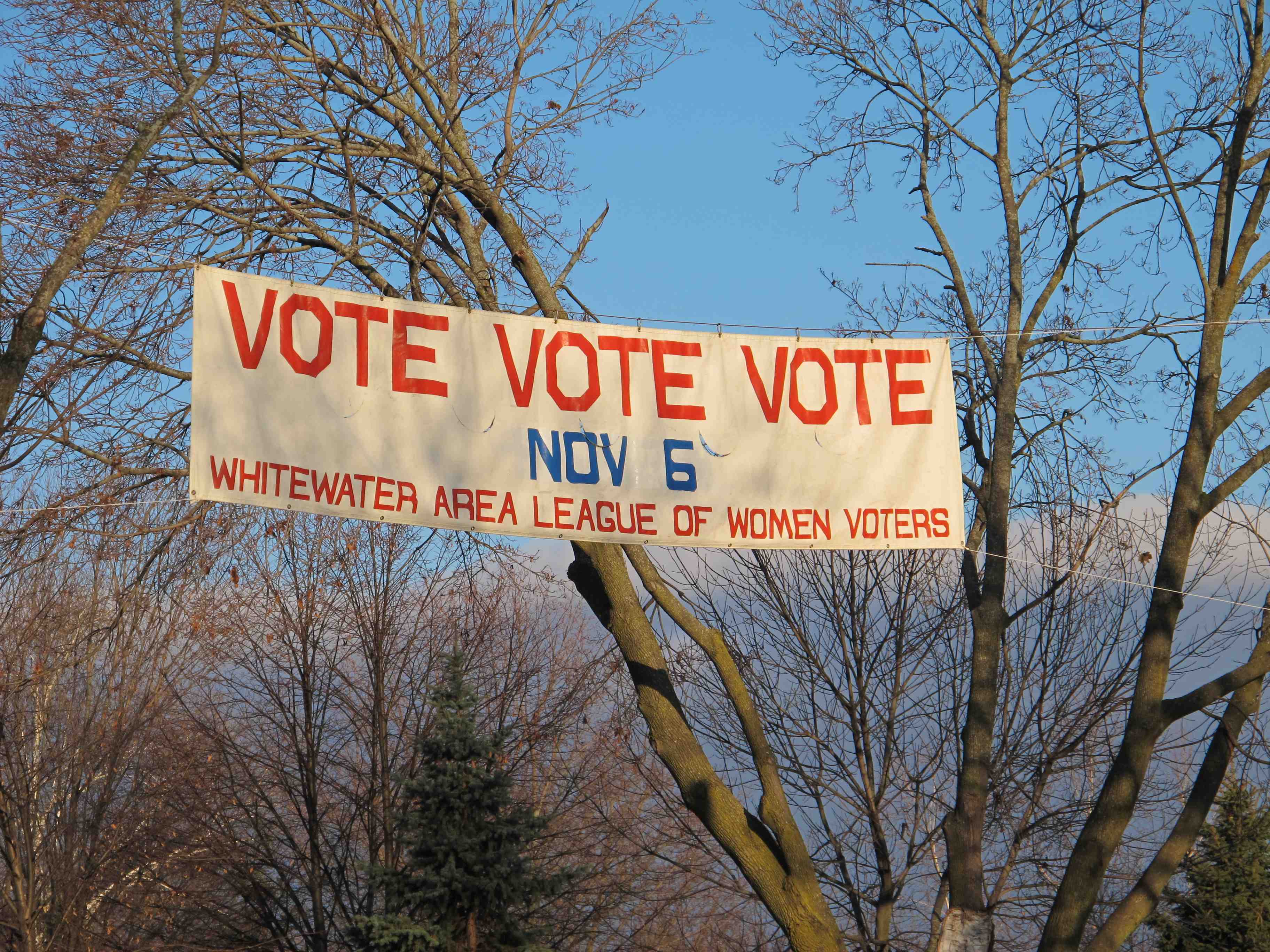
Daily Bread
Daily Bread for 11.6.12
by JOHN ADAMS •
Good morning.
It’s an election day of occasional rain – or snow – for Whitewater, with no accumulation expected, and a high of forty-two by the afternoon. We’ll have 10h, 4m of sunlight, and 11h, 4m of daylight. Tomorrow will be 2m shorter.
On this day in 1860, the United Staes elected Abraham Lincoln her 16th president. The New York Times reported the news to its readers:
The canvass for the Presidency of the United States terminated last evening, in all the States of the Union, under the revised regulation of Congress, passed in 1845, and the result, by the vote of New-York, is placed beyond question at once. It elects ABRAHAM LINCOLN of Illinois, President, and HANNIBAL HAMLIN of Maine, Vice-President of the United States, for four years, from the 4th March next, directly by the People.
The election, so far as the City and State of New-York are concerned, will probably stand, hereafter as one of the most remarkable in the political contests of the country; marked, as it is, by far the heaviest popular vote ever cast in the City, and by the sweeping, and almost uniform, Republican majorities in the country.
Google’s daily puzzle asks about film and pop culture: “What was the relationship of the winner of the 2009 Oscar for Best Director to the nominee for “Avatar” in the same category?”
Nature, Weird Tales
Did Hiker Film Bigfoot, Black Bear or Blobsquatch?
by JOHN ADAMS •
My guesses in order of greatest likelihood: prank, bear, Bigfoot.
Via Did Hiker Film Bigfoot, Black Bear or Blobsquatch? | LiveScience.
City, Film
Wednesday, 11.7.12, Seniors in the Park Film: A Separation
by JOHN ADAMS •
This Wednesday at 12:30 PM, there’s a free showing (with complimentary popcorn & beverage) of A Separation, an Academy Award & Golden Globe winner!

This film, in Farsi with English subtitles, speaks in a universal language about family, and the ties that bind and rein us in. A woman in Iran seeks a divorce from her husband because he refuses to emigrate because he must tend to his Alzheimer’s-afflicted father. The decisions each makes after that leads to tragedy. Set in a country we only know from the headlines, there is nothing alien about the customs or habits, or the urban environment where this story takes place.
A Separation is rated PG-13, with a run time of 2 hr. 3 min., showing at the Starin Park Community Building.