
Author Archive for JOHN ADAMS
Recent Tweets, 10.28 to 11.3
by JOHN ADAMS •
http://storify.com/DailyAdams/recent-tweets-10-28-to-11-3
Daily Bread
Daily Bread for 11.5.12
by JOHN ADAMS •
Good morning.
Monday in Whitewater will be a mostly sunny day, with a high of forty-five.
Whitewater’s Parks & Rec Board meets this afternoon at 5 PM.
On this day in 1862, Pres. Lincoln removes a hesitant general:
….a tortured relationship ends when President Abraham Lincoln removes General George B. McClellan from command of the Army of the Potomac. McClellan ably built the army in the early stages of the war but was a sluggish and paranoid field commander who seemed unable to muster the courage to aggressively engage Confederate General Robert E. Lee’s Army of Northern Virginia.
After Lee defeated Pope at the Second Battle of Bull Run in late August, 1862 he invaded Maryland. With the Confederates crashing into Union territory, Lincoln had no choice but to turn to McClellan to gather the reeling Yankee forces and stop Lee. On September 17, 1962, McClellan and Lee battled to a standstill along Antietam Creek near Sharpsburg, Maryland. Lee retreated back to Virginia and McClellan ignored Lincoln’s urging to pursue him. For six weeks, Lincoln and McClellan exchanged angry messages, but McClellan stubbornly refused to march after Lee. In late October, McClellan finally began moving across the Potomac in feeble pursuit of Lee, but he took nine days to complete the crossing. Lincoln had seen enough. Convinced that McClellan could never defeat Lee, Lincoln notified the general on November 5 of his removal. A few days later, Lincoln named General Ambrose Burnside to be the commander of the Army of the Potomac.
After his removal, McClellan battled with Lincoln once more–for the presidency in 1864. McClellan won the Democratic nomination but was easily defeated by his old boss.
Paranoid seems harsh as a description of McClellan, but frequently and unjustifiably nervous does the trick.
In Wisconsin on this day in 1912, a suffrage amendment fails:
1912 – Women’s Suffrage Referendum
On this date Wisconsin voters (all male) considered a proposal to allow women to vote. When the referendum was over, Wisconsin men voted women’s suffrage down by a margin of 63 to 37 percent. The referendum’s defeat could be traced to multiple causes, but the two most widely cited reasons were schisms within the women’s movement itself and a perceived link between suffragists and temperance that antagonized many German American voters. Although women were granted the vote in 1920 by the 19th Amendment to the U.S. Constitution, Wisconsin’s own constitution continued to define voters as male until 1934. [Source: Turning Points in Wisconsin History]
Google’s daily puzzle asks about American rivers: “What is the location of the confluence of the two rivers that create the largest tributary to the Mississippi River?”
Daily Bread
Daily Bread for 11.4.12
by JOHN ADAMS •
Good morning.
Sunday in Whitewater brings sunny skies and a high of forty-five.
On this day in 1922, the entrance to King Tut’s tomb was discovered:
British archaeologist Howard Carter and his workmen discover a step leading to the tomb of King Tutankhamen in the Valley of the Kings in Egypt.
When Carter first arrived in Egypt in 1891, most of the ancient Egyptian tombs had been discovered, though the little-known King Tutankhamen, who had died when he was 18, was still unaccounted for. After World War I, Carter began an intensive search for “King Tut’s Tomb,” finally finding steps to the burial room hidden in the debris near the entrance of the nearby tomb of King Ramses VI in the Valley of the Kings. On November 26, 1922, Carter and fellow archaeologist Lord Carnarvon entered the interior chambers of the tomb, finding them miraculously intact.
Thus began a monumental excavation process in which Carter carefully explored the four-room tomb over several years, uncovering an incredible collection of several thousand objects. The most splendid architectural find was a stone sarcophagus containing three coffins nested within each other. Inside the final coffin, which was made out of solid gold, was the mummy of the boy-king Tutankhamen, preserved for more than 3,000 years. Most of these treasures are now housed in the Cairo Museum.
From Wisconsin, over a century ago today, a business first:
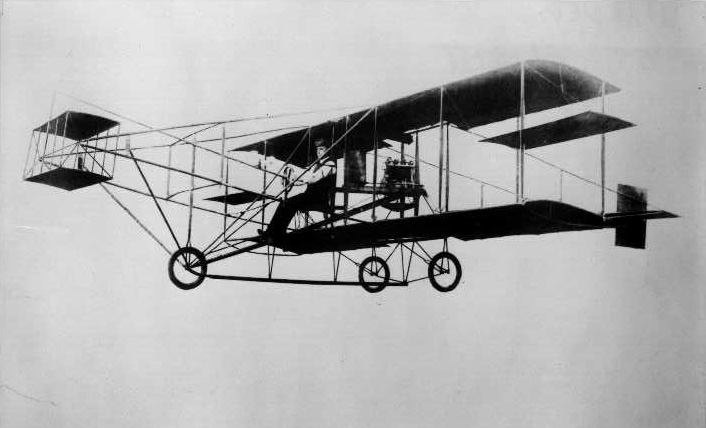
1909 – Nation’s First Commercially Built Airplane
On this date in Beloit, a plane was assembled and built by Wisconsin’s first pilot, Arthur P. Warner. This self-taught pilot was the 11th in the U.S. to fly apowered aircraft and the first in the U.S. to buy an aircraft for business use. Warner used it to publicize his automotive products.[Source: History Just Ahead: A Guide to Wisconsin’s Historical Markers]
Google’s daily puzzle is a sports-entertainment mix: “Who is the only NFL player married to a former million-dollar winner of “Survivor”?”
Daily Bread
Daily Bread for 11.3.12
by JOHN ADAMS •
Good morning.
Our Saturday before election day will be mostly cloudy, with a high near 45, and calm north winds.
On this day in 1948, the Chicago Tribune makes a famous mistake:
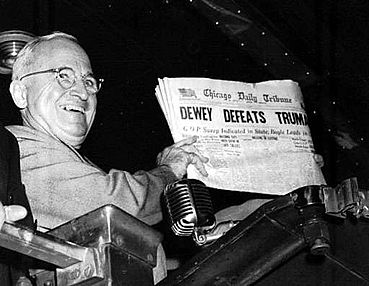
…the Chicago Tribune jumps the gun and mistakenly declares New York Governor Thomas Dewey the winner of his presidential race with incumbent Harry S. Truman in a front-page headline: “Dewey Defeats Truman.”
Many of America’s major newspapers had predicted a Dewey victory early on in the campaign. A New York Times article editorialized that “if Truman is nominated, he will be forced to wage the loneliest campaign in recent history.” Perhaps not surprisingly then, Truman chose not to use the press as a vehicle for getting his message across. Instead, in July 1948, he embarked on an ambitious 22,000-mile “whistle stop” railroad and automobile campaign tour. At every destination, Truman asked crowds to help him keep his job as president. His eventual success in the election of 1948 has been largely attributed to this direct interaction with the public and his appeal to the common voters as the political “underdog.” At the end of one of his campaign speeches, voices in the crowd could be heard yelling “Give ’em Hell, Harry!” It didn’t take long for the phrase to catch on and become Truman’s unofficial campaign slogan.
In a now famous photograph snapped in the early morning hours after the election, a beaming and bemused Truman is shown holding aloft the Chicago Tribune issue that had wrongly predicted his political downfall. Truman defeated Dewey by 114 electoral votes.
In Wisconsin history, on this day in 1804, a treaty with the Fox and Sauk:
1804 – Treaty at St. Louis
On this date Fox and Sauk negotiators in St. Louis traded 50 million acres of land in southern Wisconsin and northern Illinois for an annuity of $1,000. The treaty allowed the tribes to remain on the land until it was sold to white settlers. However, Chief Black Hawk and others believed that the 1804 negotiators had no authority to speak for their nation, so the treaty was invalid. U.S. authorities, on the other hand, considered it binding and used it justify the Black Hawk War that occurred in the spring and summer of 1832. [Source: Along the Black Hawk Trail by William F. Stark, p. 32-33]
Google’s daily puzzle asks about the world’s tallest mountain, measured a certain way: “When measured from its base rather than from sea level, this mountain is the world’s tallest. Where is it located?”
Cats
Friday Catblogging: Cat Runs for Virginia Senate
by JOHN ADAMS •
Hank the Maine Coon Cat is running for the Virginia Senate, but even a cat’s campaign faces negative advertising:
Poll
Friday Poll: When Will You Vote (Early, Election Day, Not at All)?
by JOHN ADAMS •
Four days until election day, and there’s been more than one way to cast a ballot. How will you have voted, if you’re voting: early or election day?
Daily Bread
Daily Bread for 11.2.12
by JOHN ADAMS •
Good morning.
Whitewater’s week ends with mostly sunny skies and a high of forty-five.
On this day in 1947, the Hughes Flying Boat actually flew:
The Hughes Flying Boat—the largest aircraft ever built—is piloted by designer Howard Hughes on its first and only flight. Built with laminated birch and spruce, the massive wooden aircraft had a wingspan longer than a football field and was designed to carry more than 700 men to battle.
Howard Hughes was a successful Hollywood movie producer when he founded the Hughes Aircraft Company in 1932. He personally tested cutting-edge aircraft of his own design and in 1937 broke the transcontinental flight-time record. In 1938, he flew around the world in a record three days, 19 hours, and 14 minutes.
Following the U.S. entrance into World War II in 1941, the U.S. government commissioned the Hughes Aircraft Company to build a large flying boat capable of carrying men and materials over long distances. The concept for what would become the “Spruce Goose” was originally conceived by the industrialist Henry Kaiser, but Kaiser dropped out of the project early, leaving Hughes and his small team to make the H-4 a reality. Because of wartime restrictions on steel, Hughes decided to build his aircraft out of wood laminated with plastic and covered with fabric. Although it was constructed mainly of birch, the use of spruce (along with its white-gray color) would later earn the aircraft the nickname Spruce Goose. It had a wingspan of 320 feet and was powered by eight giant propeller engines.
Development of the Spruce Goose cost a phenomenal $23 million and took so long that the war had ended by the time of its completion in 1946. The aircraft had many detractors, and Congress demanded that Hughes prove the plane airworthy. On November 2, 1947, Hughes obliged, taking the H-4 prototype out into Long Beach Harbor, CA for an unannounced flight test. Thousands of onlookers had come to watch the aircraft taxi on the water and were surprised when Hughes lifted his wooden behemoth 70 feet above the water and flew for a mile before landing.
Despite its successful maiden flight, the Spruce Goose never went into production, primarily because critics alleged that its wooden framework was insufficient to support its weight during long flights. Nevertheless, Howard Hughes, who became increasingly eccentric and withdrawn after 1950, refused to neglect what he saw as his greatest achievement in the aviation field. From 1947 until his death in 1976, he kept the Spruce Goose prototype ready for flight in an enormous, climate-controlled hangar at a cost of $1 million per year. Today, the Spruce Goose is housed at the Evergreen Aviation Museum in McMinnville, Oregon.
Google’s daily puzzle offers a sports question: “What was the birthplace of the 1972 Olympian credited with popularizing the running craze in the U.S.? (City)”
43rd Assembly District, Law, Open Government, Politics
Choosing Wrongly
by JOHN ADAMS •
A new legislator starts out with a promise of independent thinking, and with a clean slate before him. One hears that he’ll represent only his constituents, regardless of party, buck his own party whenever necessary, and stand only on principle. He’s photographed signing the legislator’s book, attending some civic events, and touts some (but not all) of his actions in a legislative newsletter.
The legislator comes to office after the decennial census, and so during a time of redistricting. There is no more public act than the design of legislative districts, through which citizens may elect their representatives.
The redistricting process is controversial, even more so than usual.
During the course of reapportioning districts, the majority party hires a private law firm, to help that party craft new legislative districts to its liking. It’s the most public of responsibilities, but that majority chooses a private firm, meeting at a private location outside the Capitol. The firm drafts and presents to the legislator and others a document to sign, promising that one of the most public, deliberative acts of government “shall remain confidential and that you agree not to disclose the fact and/or contents of such discussions or any draft documents within your possession related to the subject of the Representation with persons outside of the [attorney-client] privilege.”
What was by rights a public matter would become, for anyone signing, a secretive private one, between the legislator and a private law firm of one party’s choosing.
In that moment, the legislator and others confront a choice between the public interest and private partisanship. All the talk of independence, of bucking one’s party, and putting principle before party is then and there tested. Will they choose rightly, upholding the public interest, or wrongly, and succumb to the enticements of private parties?
Some choose wrongly.
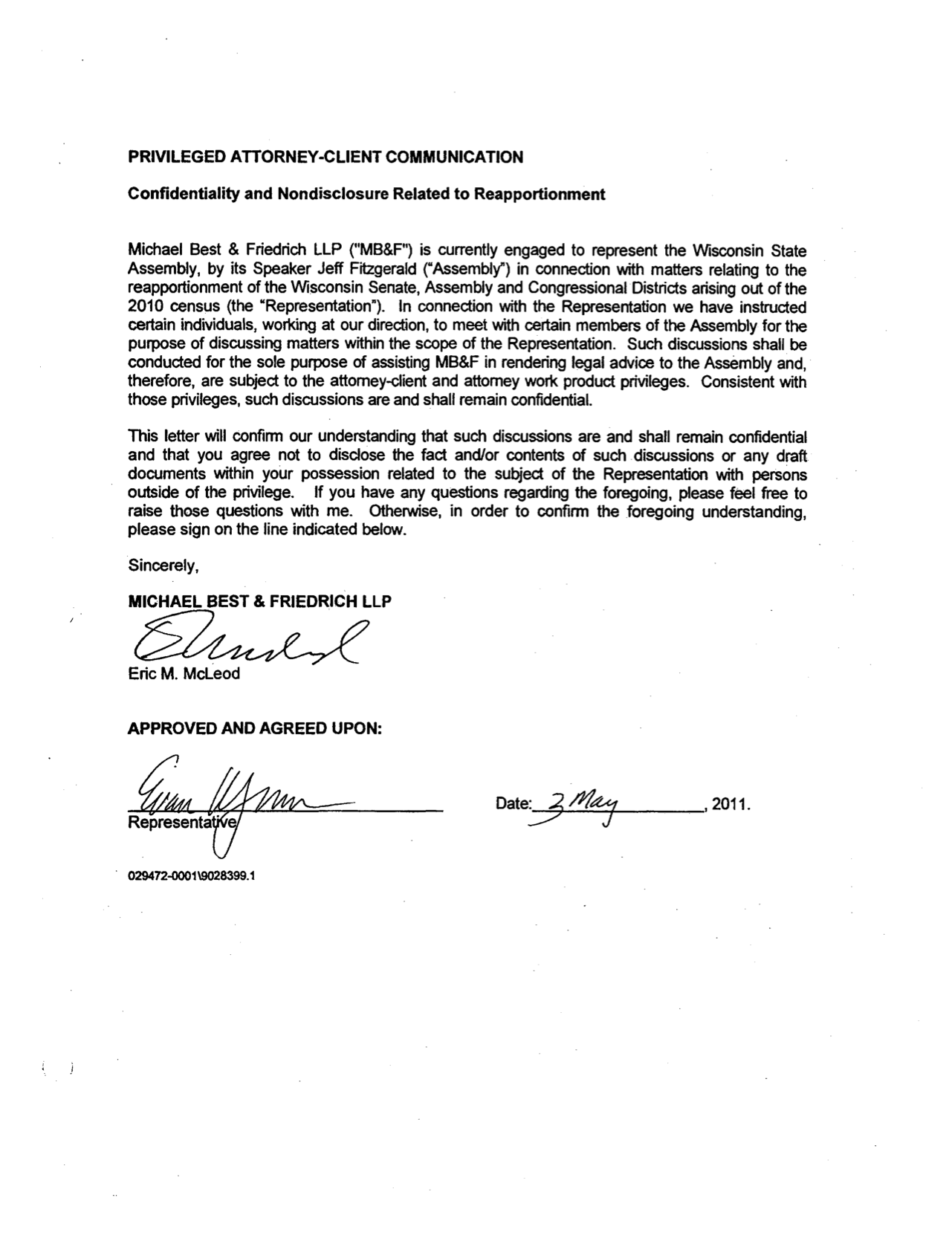
A full account is available from the Milwaukee Journal Sentinel.
Daily Bread
Daily Bread for 11.1.12
by JOHN ADAMS •
Good morning.
November comes to Whitewater with partly sunny skies and a high of forty-seven.
Whitewater’s Landmarks Commission meets tonight at 6 PM.
On this day in 1952, America exploded the first hydrogen bomb, at Eniwetok in the Marshall Islands:
On this day in 1902, a disappointment for the Badgers, after a long string of successes:
1902 – UW Winning Streak Snapped
On this date the University of Wisconsin football team had a 17-game winning streak snapped by the University of Michigan’s infamous “Point-A-Minute Machine” who defeated the Badgers 6-0. The game drew over 20,000 fans to Marshall Field in Chicago. [Source: Milwaukee Journal Sentinel]
Google’s daily puzzle asks about geography: “If you take Bus #919 from Deshengmen, travel to Donggou Village, Badaling Town, Yanqing County and purchase a ticket, to what would you gain entry?”
Public Meetings
Common Council
by JOHN ADAMS •
Public Meetings
Parks & Recreation
by JOHN ADAMS •
Holiday
Boo! Scariest Things in Whitewater, 2012
by JOHN ADAMS •

Here’s the FREE WHITEWATER list of the scariest things in Whitewater for 2012. The 2007, 2008, 2009, 2010, and 2011 editions are available for comparison.
The list runs in reverse order, from mildly frightening to super scary.
10. On Time. It’s been a challenge these last years for simple road projects to finish on time. Here’s hoping that next year is better. Rome wasn’t built in a day, but Whitewater’s roads and bridges should be finished within the same year.
9. Modernization. It won’t hurt us one bit to adopt best practices from other cities, but there are still needless worries about this. Those who are looking at model ordinances, and comparing our policies with those of other cities, are making life here better for everyone. The world should be our oyster.
8. ‘Out of Control’ Behavior. Oh, please – when your politics is one of accusing your opponents of wild behavior, yet all the people of your area know better, you’ve simply embarrassed yourself.
7. State Educational Testing. Last year we saw federal No Child Left Behind stats for Whitewater, this year it’s a state report card (in lieu of NCLB). Madison’s closer than the District of Columbia, but we could do even better with more innovative approaches that mostly ignore a simple score for ideas from successful communities wherever they might be.
6. Diligence. The more up-front analysis there is, and the more of that analysis that gets posted online, the better our politics will be. An open approach is good for everyone, including officeholders.
There’s a value not merely to stability, but stable progress and growth.
5. Revisionist History. A perennial. One still hears a powerful nostalgia for the past as a golden age, the reinterpretation of past mistakes as successes, or insistence that ideas only recently advanced were, truly, the accomplishments of someone from a decade ago.
Listening to these contentions, one feels as though one fell into an alternative reality:
4. Snow. Last year was mild. That won’t last. At least there’ll be some good snowshoeing.
3. Tax Incremental Districts. Anchor, albatross, millstone: take your pick.
2. Emerald Ash Borer. If they arrive in numbers and destroy hundreds or thousands of area trees, they’ll have left the city less attractive, less pleasant. So many dead trees will cost dearly for removal, and no expense for replacement trees will restore the same natural look.
1. Snakes. A silly ending to the list. Boa constrictors, anacondas, pythons, whatever. They own this place now. We’re all just passing through. Only bright side – they’ll get rid of our overabundance of squirrels.
Wait a few years, and this won’t be a movie trailer; it’ll be a local documentary:
43rd Assembly District, Politics, Press
Gazette Endorses Rep. Andy Jorgensen in 43rd Assembly Race
by JOHN ADAMS •
In today’s Janesville Gazette, one finds that the paper endorses Andy Jorgensen for the 43rd Assembly District. That’s a change from the 2010 election, when Wynn received the paper’s endorsement.
The endorsement is in the print edition; I’d encourage readers to purchase a copy to read the full text. Here’s just a part, that describes Jorgensen well:
He might be the most accessible lawmaker we’ve ever seen. He attends many local functions. He wants to be known as someone who’s always there to listen, and it shows. He has held more than 500 listening sessions, some of which spurred ideas for legislation, including ways to help small businesses.
‘I don’t have all the answers, ‘ he says, ‘but a lot of these people do have good ideas. Why not listen?’
The Gazette observes that “Jorgensen is smart, sincere, enthusiastic and full of energy. He has proven himself a capable lawmaker.”
True, all around.