Whitewater’s Wednesday looks to be a mostly sunny day with a high temperature of eighty-four.
From this day in 1966, a famous decision from the US Supreme Court in Miranda v. Arizona —
On this day in 1966, the Supreme Court hands down its decision in Miranda v. Arizona, establishing the principle that all criminal suspects must be advised of their rights before interrogation. Now considered standard police procedure, “You have the right to remain silent. Anything you say can, and will, be used against you in court of law. You have the right to an attorney. If you cannot afford one, one will be appointed to you,” has been heard so many times in television and film dramas that it has become almost cliche.
Google’s daily puzzle is about publishing: “How many lines were on each page of the famous book that was the first printed by the German inventor of the printing press?”
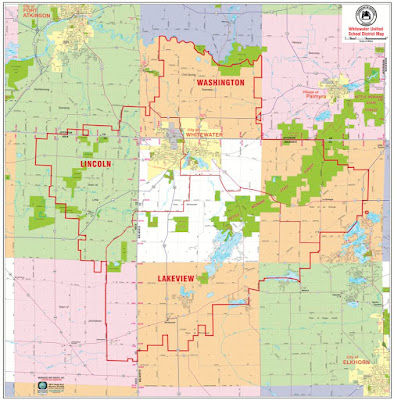
On Friday, I asked three questions about the implications of the June recall election, and yesterday I wrote about the first of them (implications for the newly redistricted 43rd Assembly district). Today, I’ll look at what the numbers say about the electorate within the Whitewater Unified School District. A map of the district appears immediately below. Needless to say, it’s significantly smaller than the state assembly district about which I wrote yesterday. Additionally, also unlike the 43rd, the boundaries of the district aren’t changing.
The April Referendum and the June Recall. In April, a referendum on exceeding revenue caps for the WWUSD passed, with a vote of 1,496 to 1,351. That’s roughly a 52-48% margin. Within the boundaries of the district during the recall, Gov. Walker received 4,207 votes to Mayor Barrett’s 3,604. That’s nearly a 54-46% margin for Walker, and a bit better than his statewide percentage.
Support for candidates and for a referendum differs significantly, and one could reasonably contend that the referendum was less ideological than a contest between a Republican and a Democrat in the recall.
(There are, after all, Republicans and Democrats on both sides of many spending issues.) Although it may pain fiscal conservatives to hear as much, they surely know that there are undependable allies among some Republicans (just as they must see that there are dependable ones among some Democrats).
The Different Results. And yet — and yet — one election yields a result that, I think, would have been unlikely with other election’s voters. Why is that? While the presence of university voters in April but not June may play a role, Whitewater’s citywide vote favored both the referendum in April and the Mayor Barrett in June. What’s even more significant, I think, is that there was a far larger overall turnout in June (7,811) as against April (2,847). The electorate was, actually, 2.74 times as large. June’s voters were more numerous, and it’s safe to say, more conservative.
June’s net for Barrett in Whitewater was 528 votes, but the net for Walker everywhere else in the district was over 1,131. Republicans can and did turn out in large numbers in the district, in a way they did not in April.
Turnout Reserves to Spare. Even if the composition of Whitewater’s electorate changed from April to June, the number of voters outside the city changed, too — there were many more of them than two months’ time earlier.
In general, candidates do better campaigning where votes are plentiful, not where they’re scare. Most Democrats would sensibly rather maximize turnout in Dane County than scrounge for votes in Waukesha County. In the same way, most Republicans would get better results in Ozaukee County than in the City of Milwaukee. Strategies to hold down an opponent’s net majority on his or her terrain wind up spending much for the sake of a few incremental voters of one’s own party.
There are turnout opportunities for both parties in our area, if they’d push harder in that direction.
Although one will see few elections as hard-fought as the recall, June’s results show that there are ample turnout reserves on both sides of a question.
Today’s forecast calls for a sunny day with a high temperature of seventy-four.
On this day in 1987, Pres. Reagan publicly challenged Soviet leader Mikhail Gorbachev to tear down the Berlin Wall.
The Wisconsin Historical Society records today in 1899 as the date of the worst tornado disaster in Wisconsin History:
New Richmond Tornado
On this date the worst tornado disaster in Wisconsin history occured. The storm virtually leveled New Richmond on the day the Gollmar Brothers Circus came to town. At the time, New Richmond was a prosperous town of 2500 people and one of the most scenic places in Wisconsin. On the day of the storm, the streets were filled with residents and tourists waiting for the afternoon circus parade. Shortly after the circus ended, the tornado passed through the very center of town, completely leveling buildings. Over 300 buildings were damaged or destroyed. Massive amounts of flying debris resulted in multiple deaths in at least 26 different families. In all, the storm claimed 117 lives and caused 150 injuries. [Source: National Weather Service]
Google’s daily puzzle asks, “The discovery of what rare metal supports a scientific theory about the event that occurred at Chicxulub crater?”
Last week, I posted a task list with three questions about the June 5th recall election. Here is the first of those three: What do the June 5th results say, if anything, about how the race in the 43rd Assembly District will finish? In this discussion, I’m referring to the newly-redistricted 43rd. The old 43rd has been a seat with small margins (mostly) for the winning party. How’s the new 43rd likely to go this November? It’s a contest between GOP freshman incumbent Evan Wynn and Democratic rep Andy Jorgensen (now of the 37th District).
Immediately below is a map of the new 43rd.
How the new 43rd voted. Looking at Walker-Barrett numbers from across the precincts in the district, one finds that Barrett received 11,687 to Walker’s 10,690 votes. That’s significantly better for Barrett than his statewide average, where he lost to Walker 53-46% (1,334,450 to 1,162,785). (Results from these precincts are from the respective county websites before canvass results.)
What’s in the new 43rd? There are nearly twenty communities in the new 43rd, that largest of them being Whitewater, Milton, and Edgerton. Much of the district in the same as the old 43rd, but it stretches father west now, among other slight changes.
The old district has typically been closely contested, and the Walker-Barrett numbers in the new district’s precincts (52.2-47.6%) fall in that past pattern.
2010
Kim Hixson 9,448 47.5%
Evan Wynn 10,449 52.5%
2008
Kim Hixson* 15,303 51.2%
Debi Towns 14,581 48.8%
2006
Kim Hixson 10,330 50.02%
Debi Towns 10,292 49.83%
2004
Matt McIntyre 12,796 44.4%
Debi Towns 15,960 55.4%
What’s unexpected? That even after redistricting, the new district’s precincts leaned slightly left on June 5th, despite a statewide Walker win that was comfortable, and greater than his 2010 win. The new 43rd is a close outlier, rather than an example of the statewide results.
Obama-Romney instead of Walker-Barrett. However the presidential election in Wisconsin goes this fall, it’s hard to see Gov. Romney doing better in November than Gov. Walker did this June. Romney may do well. (At the beginning of the year, I predicted that Romney would win Wisconsin, a prediction that seems less probable now.) It’s hard to see, though, how he would do as well, let alone better, than Gov. Walker did this month. That might happen if the Obama campaign somehow collapses, as Carter’s did in 1980, but for ever 1980 there are closer contests to be found in 1988, 2000, and 2004.)
Ticket splitting seems unlikely. It’s possible, but improbable, that Obama could carry the state, and the slighter bluer new 43rd, and the Democrats could still lose the 43rd seat. That would require, however, a combination of Obama and Wynn voters. That seems unlikely, and even more unlikely (to the point of nearly impossible) is that either down-ballot candidate would run ahead of the presidential ticket. Even longstanding incumbents don’t receive votes over the top of the ballot. Easiest prediction in the world: it won’t happen here in November.
Relatively new, all around. Wynn is a freshman incumbent, and Jorgensen is a multi-term incumbent from another (redistricted) seat. Wynn is better known to most of the district, but neither one is an entrenched incumbent. The old 43rd would move as statewide or national trends did). Bucking the statewide trend was something that I did not expect for the precincts of the new 43rd, but it’s still not a decisively blue or red district.
Considering how well Gov. Walker did statewide, it is surprising to me that the GOP still trailed in a redistricted 43rd. Redistricting benefits a majority party, but not so much here, one sees, as other places.
Where are the votes? There are some surprises for Whitewater voters, here. For Wynn, a Whitewater resident, neither Whitewater, nor Milton, nor Edgerton offer strongholds. On the contrary, the three leading communities for Barrett votes (Whitewater 1988, Edgerton 1536, and Milton 1337) won’t offer Republicans better prospects in November (absent a Democratic collapse) than they did in June. Although many residents like to think of their respective towns as vital to an electoral outcome, there are better prospects for Wynn in Koshkonong, Whitewater beyond the city , or rural communities in the district. The results would be different without the margins in these three cities (respectively, 528, 755, 254). Walker outperformed Barrett in the rest of district other than those three cities.
For Jorgensen, Whitewater, Milton, and Edgerton are opportunities; for Wynn, the rest of the district is a better playing field. For me, the real question for the fall is (1) how well Romney (Wynn) does in the most rural parts of the district, and (2) how well Obama (Jorgensen) does in these cities. One could keep margins down in an opponent’s strongholds, of course, but there’s only so much time and money available. Maximizing turnout in favorable areas would seem to make more sense, especially in a race between Obama and Romney.
It’s less a two-person contest in places like Whitewater than it is a contest between different parts of the district. This has been true with the old 43rd, it seems even more clear after looking at the results of the new 43rd’s voting on June 5th.
Odds. It’s fundamentally a ticket battle (Obama-Romney) in the 43rd, as neither candidate is a long-term incumbent in the district. It is surprising to me that the redistricted area was not configured more favorably toward the GOP’s legislative majority, and that the precinct totals within the new district bucked the June 5th statewide vote. That statewide vote was comfortable for Gov. Walker; the results here were in contrast to that outcome.
I’d say it’s a slightly blue district, likely to favor candidates farther down on an Obama ballot (Jorgensen) over opposing ones farther down on a Romney ticket (Wynn).
It’s a day of likely thunderstorms with a high of eighty-seven.
In the City of Whitewater today, there will be a meeting of the Joint City Council and Plan Commission Zoning Rewrite Workshop at 6 PM.
The Wisconsin Historical Society observes a famous Milwaukee native’s birthday today:
1935 – Gene Wilder Born
On this date Gene Wilder (aka Jerome Silberman) was born in Milwaukee. Wilder graduated from Washington High School in Milwaukee in 1951. He graduated with a Bachelor of Arts degree from the University of Iowa in 1955 and studied judo, fencing, gymnastics and voice at the Old Vic Theatre School in Bristol, England. Wilder won the Clarence Derwent award for the Broadway play “The Complaisant Lover” in 1962.
He continued to perform on Broadway in One Flew Over the Cuckoo’s Nest (1963), Dynamite Tonight (1964), and The White House (1964). Wilder made his film debut in Bonnie and Clyde (1967), then earned an Oscar nomination the following year as the accountant Leo Bloom in The Producers, the first of three films he made for writer-director Mel Brooks. Wilder is known for his work in such films as Willy Wonka and the Chocolate Factory (1971), Everything You Always Wanted to Know About Sex (But Were Afraid to Ask) (1972), Blazing Saddles (1973), and Young Frankenstein (1974). After his second wife Gilda Radner died of ovarian cancer, Wilder co-founded Gilda’s Club, a support group to raise awareness of the disease. [Source: Internet Movie Database]
Google daily puzzle ask’s a stargazer’s question: “Which irregular galaxies can you see from Earth with the unaided eye?”
There are dozens of possibilities for what the recall election means for Wisconsin, but I’m curious about three local implications, that I’ll write about after looking at precinct-by-precinct gubernatorial results.
(Quick admission: in January, I thought Gov. Walker would lose a close recall election. That prediction was considerably off – he won comfortably. The advantage about writing after an election is that one has actual results on which to base an assessment for the fall.)
Topics of interest:
(1) What do the 6.5.12 results say, if anything, about how the race in the 43rd Assembly District will finish? (Here, I’m referring to the newly-redistricted 43rd.) The old 43rd has been a seat with small margins (mostly) for the winning party. How’s the new 43rd likely to go this November?
(2) What do the 6.5.12 results say about politics within the entire Whitewater Unified School District? (Those results, and prior ones, suggest that the City of Whitewater is now mostly blue, and over time I’d guess will become culturally bluer.) What about the whole district?
(3) Will the 13th Senate District race between Fitzgerald and Compas have any lasting significance for politics in that area (whether in the new or old 13th District)? On this topic, I think the answer is yes, and I’ll explain why.
All topics to research, and then post about, next week.