Today’s suggested topic is open. It’s a free-range forum.
The use of pseudonyms and anonymous postings is, of course, fine.
Although the comments template has a space for a name, email address, and website, those who want to leave a field blank can do so. Comments will be moderated, against profanity or trolls. Otherwise, have at it.
As Radley Balko noted in yesterday’s Morning Links, the Washington Post and other newspapers pulled Wiley Millers syndicated “Non Sequitur” cartoon from their comics pages two Sundays back, because Miller pulled a familiar-to-Reason-readers “Where’s Waldo?” gag with the Prophet Muhammad….
On the other hand, maybe comparisons or references to Waldo are just infuriating.
Over a month ago, I posted a criticism about the absence of Whitewater City Manager Kevin Brunner’s name on a notice about a public hearing for a failing tax district, and included a picture of Waldo.
The joke was straightforward (he’s not standing up for a notice about a project now that it’s failing) and conventional (everyone knows about the Where’s Waldo? series).
(There was a similar reference behind a Where Was George? speech that Ted Kennedy gave at the Democratic National Convention in 1988.)
Maybe some people just don’t find Waldo a laughing matter.
By the way, Reason includes the cartoon that the Washington Post wouldn’t run.
Whitewater’s forecast calls for a sunny day, with a high temperature of sixty-one degrees.
It’s coffee with the principal this morning in schools throughout our district. At Lincoln School, it’s picture re-take day, and there’s also a Road Rally on the playground. At Washington School, it’s Walking 4 Washington, a P.A.T.T. fundraiser featuring some famous area mascots.
The Comment Forum will be up today, and back on schedule, at 10 a.m.
Nearby station WCLO has a podcast of interviews with both candidates: “WCLO News Director Stan Stricker spends 30 minutes with each of the candidates for the 43rd Wisconsin Assembly District race.”
It’s municipal budget season in Whitewater, Wisconsin, and in towns across America. Whitewater’s budget will be presented in stages, over more than one Common Council meeting. That’s been a practice here for years; this year is no different.
I’ll offer a few remarks on a municipal budget, before commentary another time when the city’s proposed budget is unveiled. (Between now and then, I will write in detail about a recent analysis of the City of Whitewater’s fiscal condition.)
A small, rural town with a college campus. We’re a small town of 14,454 people, with a college campus, located in southeast Wisconsin. That’s the easiest way to describe our town. It’s an accurate, but superficial, description. From that single sentence, one would be ignorant of much of what Whitewater’s like. One might expect — and there are more than a few in town who would expect — that the town was a Hallmark card brought to life. I’d say that we are a beautiful, but also a troubled, small town.
A town of considerable poverty, especially among children. Sadly, across all groups within our schools, there’s significant hardship among children — 35.4% of Whitewater’s students require free or reduced lunches. Over one-in-three children in Whitewater — a supposedly “Banner Inland City of the Midwest” — require financial assistance merely to buy a school lunch. Whitewater ranks 11th of 50 schools in this unfortunate category.
(The report covers the City of Whitewater and towns nearby that are part of the Whitewater Unified School District. Complete Census data for the city alone are not yet available.)
One hundred carefully circumscribed trolley routes, happy pictures, or proud declarations are no substitute for seeing Whitewater’s poverty as it is today — so that we may be better off tomorrow.
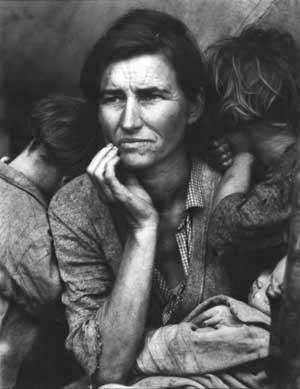
I’m not a progressive, but at least the New Dealers knew how to depict conditions honestly, so that they might spur their fellow citizens to action. Dorothea Lange’s pictures were haunting, yet useful.
New Dealers didn’t favor photographs like this because they disliked America, but because they loved America. (No matter how misguided some of their efforts were — and they were misguided — I recognize that they cared about ordinary people; today’s big-spenders often hawk silly projects that don’t help the needy, but are simply welfare programs for white-collar workers.)
Reducing spending to reduce the tax burden is a good thing. One will sometimes hear that “people just want to pay less in taxes.” One hears this exclaimed with disdain, as though it were the same as saying “people just want to eat kitten and puppies.”
Having earned something, by their own labor, one might expect people to be able to enjoy those earnings for themselves and their families. There’s considerable temerity in bureaucrats smiling and mugging for the camera with the millions they didn’t earn, but only took by compulsion as taxes, from those who did earn that money. It’s not productivity, or success, to play with the millions that others earned.
Indiscriminate reductions are a bad idea — our situation is too dire. Mere austerity — simply spending less — is not enough. We should spend less than we do, so that we might tax less. Simply spending less might be enough for an otherwise prosperous town, in temporarily hard times.
We’re not that town. There are too many poor and working poor in Whitewater to contend honestly that this is a successful, thriving town. No small faction of residents wishing to insist that we’ve arrived will change the truth of our condition. In any event, a few striving men, successful only in promoting themselves through an endless campaign of cheerleading, is the last group whose word anyone should take.
Reductions in spending should affect those at the top, not those most vulnerable. We have too many bureaucrats, and tiny Whitewater’s City Manager was next-to-absurd last year to contend that one solution in Whitewater is to trim the bureaucracy. Tiny Whitewater shouldn’t have a bureaucracy at all. I’ll take him up on his offer, though. Salaries of principal leaders should be held steady or reduced. Others across America have had to take wage cuts — it’s time for Whitewater’s officials to do the same.
That’s also why I am opposed to cuts in spending for a library or even for recreation. Those cuts disproportionately affect the poor and disadvantaged. They’re a middle class official’s idea of seeming responsible, while he leaves less for the poor, as he goes off a trip, etc.
Reducing spending in some areas to reallocate or defend existing commitments is a good idea. Our priories should reflect poverty in town. Spending under the fantasy of a thriving middle class community, when that’s not what we are, is both misplaced and wrong. If Whitewater must spend — and she must — basic public safety, growth and opportunity, and the needs of the poor should trump a manager’s silly schemes.
As for growth and opportunity, it should be real and genuine, and a reduction in fees that actual business people pay is a great place to start.
This is a good time for fee reductions. We need to spur growth. We’re losing jobs now. Spurring growth should begin with reducing fees.
Whitewater took eleven million in grants and public debt for a so-called Innovation Center, but that failing project is less useful to anyone than a single million would have been for fee reductions, or even immediate job training, and expanded food, clothing, and other assistance for the poor, particularly children.
(I understand well that the money for the tech park cannot be reallocated. In fact, we should not have taken any of it; those grants, etc. should have been left to a community that wouldn’t have so selfishly used tax money. Another community would have made better use of those millions. Brunner, Telfer, et al., should not have raised their hands to ask for money for so empty an idea.)
Yet, so ineffectual is the Innovation Center project, that even a fraction of that money spent directly in assistance to the poor would be better than how the whole amount is being spent now.
Cut deeply, beginning at the top, with most savings going to tax or fee reductions to spur genuine private growth, and other savings going to services that aid the poor, while preserving services that benefit the needy.
One or two fewer department leaders, and significant reductions in the use of consultants, would go a long way toward closing a gap, while also reducing taxes & fees, and preserving necessary services.
I’ll add detail to these ideas as the budget process unfolds, with specific suggestions along these lines.
Best-selling author and Wisconsin’s leading authority on the paranormal Linda S. Godfrey will present a book talk and signing for her newly published book, “Haunted Wisconsin: Ghosts and Strange Phenomena of the Badger State” at 6:30 p.m. Oct. 20 at the Lake Geneva Public Library….
Be prepared for Kenosha’s Headless Nun, the Man Bat of La Crosse, Rocky the Rock Lake Monster, and John Dillinger’s phantom. Explore Aztalan’s ancient mounds, the ghostly bars and taverns of Madison and Milwaukee, and the creepy town of Caryville, one of the most haunted places in America. Following the program, copies of all her books will be available to be signed. The program is sponsored by the Friends of the Lake Geneva Public Library….
There is no question that earmarks – rightly or wrongly – have become the poster child for Washington’s wasteful spending binges. They have been linked to corruption and scandal, and serve as a fuel line for the culture of spending that has dominated Washington far too long. These reasons alone would justify completely eliminating earmarks, but the basis for my position doesn’t end there.
The old adage that he who can’t be trusted to reform the “small” problems can’t be trusted to reform the “large” ones applies as much to government as to individuals. Both Republicans and Democrats have an enormous task before us if we are going to get America’s fiscal house in order.
The Wisconsin Historical Society recalls that on this day in 1912, while campaigning for president as a third-party candidate,
Theodore Roosevelt [Was] Shot in Milwaukee
On the night of October 14, 1912, Theodore Roosevelt was shot in Milwaukee. Roosevelt was in Wisconsin stumping as the presidential candidate of the new, independent Progressive Party, which had split from the Republican Party earlier that year. Roosevelt already had served two terms as chief executive (1901-1909), but was seeking the office again as the champion of progressive reform. Unbeknownst to Roosevelt, a New York bartender named John Schrank had been stalking him for three weeks through eight states. As Roosevelt left Milwaukee’s Hotel Gilpatrick for a speaking engagement at the Milwaukee Auditorium and stood waving to the gathered crowd, Schrank fired a .38-caliber revolver that he had hidden in his coat.
Roosevelt was hit in the right side of the chest and the bullet lodged in his chest wall. Seeing the blood on his shirt, vest, and coat, his aides pleaded with him to seek medical help, but Roosevelt trivialized the wound and insisted on keeping his commitment. His life was probably saved by the speech, since the contents of his coat pocket — his metal spectacle case and the thick, folded manuscript of his talk — had absorbed much of the force of the bullet. Throughout the evening he made light of the wound, declaring at one point, “It takes more than one bullet to kill a Bull Moose,” but the candidate spend the next week in the hospital and carried the bullet inside him the rest of his life.
Schrank, the would-be assassin, was examined by psychiatrists, who recommended that he be committed to an asylum. A judge concurred and Schrank spent the remainder of his life incarcerated, first at the Northern Hospital for the Insane in Oshkosh, then at Central State Hospital for the criminally insane at the state prison at Waupun. The glass Roosevelt drank from on stage that night was acquired by the Wisconsin Historical Museum. You can read more about the assassination attempt on their Museum Object of Week pages.
In the Wisconsin State Journal, reporter Deborah Ziff has a profile of the candidates for the 43rd Assembly District, Kim Hixson and Evan Wynn. See, Candidate profiles: 43rd Assembly District.
Each candidate supplies information about his age, family, address, political party, current occupation, community service, education, and website.
The profile also includes a map of the district, one that extends from Whitewater to communities west of Beloit, Wisconsin.
Both candidates will be part of a League of Women voters forum this Saturday, at 11 a.m., at Whitewater’s municipal building, in the Common Council chambers.
In Whitewater, on Monday afternoon, there was a public hearing on the proposed Whitewater Unified School District budget. On Tuesday, there was a newspaper story, entitled Whitewater has budget hearing about the meeting. The story reported that “[t]wo members of the community attended….”
Is it any wonder that a meeting, held during the workday, would have poor attendance? The consequence of limited attendance, of course, is the opportunity to contend that the public had an invitation to attend, and declined that invitation. From these poor numbers, one might falsely conclude that the budget is uncontroversial, or actually has significant support. (If one wanted to claim universal support, one would go a step farther, and instead of holding the meeting during working hours, would hold it on a holiday, or at two o’clock in the morning.)
I have no idea how most people feel about the proposed budget; I do know that a meeting held during working hours, with limited notice, is a bad habit that Whitewater often uses to skirt discussion of potentially controversial matters.
There are few people in town who haven’t seen this approach before. It’s old-hat by now.
If the budget matters so much (and it does), and if it makes sense (I’m not sure), then one would think that district officials would be proud to discuss it with plentiful notice, and at a convenient time. A convenient time for ordinary, working people.
Here are a few points to consider, for next year:
Announce the hearing prominently on the main page of the district’s website. Here’s a screenshot of the school district website, with a listing for that same day the budget meeting was held:
A public hearing on the budget might have been listed, at least along with these entries.
Place the entire budget proposal online, on the district’s website. The district has a colorful, professionally designed website. I’m sure there’s plenty of server space for public documents, including a proposed budget.
The first place a public document about a budget should appear is on the website of the public body to which it pertains. No one should have to hunt for it, or ask for it — it should be available for review as a matter of course. It’s simply a throwback to another era to write, on the top of a budget proposal, that “The Budget in detail is available for public inspection at the Central Office.”
Why not publish it prominently on the district’s website, before the hearing?
There are even more important matters than this. I’m sure there are those who would contend that discussion of the budget involves a dispute between children-supporting educators and cold-hearted, anti-intellectual troglodytes.
I disagree, of course. And yet, I’ll also contend that there are far more important matters than the budget. Substantive work (that is, teaching and principles of the district) matters far more.
Added to substantive teaching, and also important, are policies that involve substantive principles of fairness, equality, and other American ideals. Although these principles are not part of a single curriculum, they matter more than simpler issues. (That some policies are substantive is easy to see. A policy that affords a person time to respond to an allegation is more important than a policy that requires he use a specific font when writing in reply.)
If the budget process isn’t more open and accessible, it speaks poorly of the chance to consider other substantive issues, often controversial, that are even more important.
Still, I am an optimist — Whitewater will be out of this habit someday.
I received the following press release that I am happy to post:
Alzheimer’s Association to Offer Support Group Facilitator Training
-Help Others by Becoming a Support Group Facilitator in Southeastern Wisconsin-
The Alzheimer’s Association is offering training for community members who are interested in leading, or facilitating, an Alzheimer’s Association support group. Training will take place on Tuesday, October 26, 2010 from 8:30 a.m. to 3:30 p.m. at the Alzheimer’s Association, 620 S. 76th Street, Suite 160 in Milwaukee. This training is designed for volunteers interested in becoming a facilitator of a support group for family caregivers who provide care or support to persons with memory loss, Alzheimer’s disease and other types of dementia.
The Alzheimer’s Association, southeastern Wisconsin chapter, offers support groups in Dodge, Fond du Lac, Jefferson, Kenosha, Milwaukee, Ozaukee, Racine, Sheboygan, Washington, Waukesha and Walworth Counties. To inquire about this free training and to receive an application to become a volunteer support group facilitator, please contact Krista Scheel, Program Director, Alzheimer’s Association, at 414-479-8800 or via email at krista.scheel@alz.org.
The Alzheimer’s Association is the leading voluntary health organization in Alzheimer care, support and research. Our mission is to eliminate Alzheimer’s disease through the advancement of research; to provide and enhance care and support for all affected; and to reduce the risk of dementia through the promotion of brain health. Our vision is a world without Alzheimer’s. For more information about Alzheimer’s disease and local services visit www.alz.org/sewi or call the Alzheimer’s Association 24/7 Helpline at 800-272-3900.