In a essay at Bloomberg, Amity Shlaes, fellow in history at the Council on Foreign Relations, writes that Arrogance Surplus Leads to Government Excesses: Commentary by Amity Shlaes. She describes the arrogance of lawmakers and planners in Washington, D.C. (and what she writes would apply just as accurately to state and local governments):
The problem for all is that business isn’t an identifiable person, group or company. Good policy is what might be called humble policy. It starts with admitting what we don’t know. That includes who will lead growth in 2011 or 2012, where that person lives, and how he or she will get capital. Humble policy then goes on to concentrate on trying to let our economy become that broad space that future businesses and industries still unknown, might find inviting.
Humble policy is, of course, hard for a U.S. Congress to get its head around. Policy, in lawmakers’ minds, is all about knowing and crafting smarter law. Lawmakers are arrogant in their certainty that voters will never accept policy that doesn’t reward voters like Pavlov’s dogs. Lawmakers are also certain that they shouldn’t be seen to write law that will help the rich in the future. But again, there is that mistake: they are assuming they know who the rich will be.
Shlaes suggests permanent tax rate reductions, an end to government preferences for specific, favored businesses, abandoning a healthcare mandate, the end of stimulus spending, and encouraging reduced expectations about government entitlement programs.
Here’s the format I will be using for live blogging tonight’s Planning Commission meeting. I wouldn’t expect anyone to read my comments live; instead, I’m interested in experimenting with live blogging to produce commentary more quickly. (My comments will remain after the meeting for later viewing.)
The window will become live just before 6 PM, and comments will appear with the newest remarks at the top of the window. (Update: For replay, comments will appear from top to bottom, first to last.)
I’ve bumped up a post from Monday night on Whitewater’s July Planning Commission meeting. I live blogged the event, and here are a few additional remarks.
Walmart’s Proposed Expansion, Generally. Walmart wants to expand. Good for them, I think more offerings would be of benefit to Whitewater, Wisconsin. I’ve no bias against, or for, chain stores. I’m sure we will have an expanded Walmart, in somewhat more than a year.
The Rush to Build. Walmart’s attorney, speaking before the Planning Commission, talked a mile-a-minute, but could not have thought that approval would come with so many loose ends. Favoring more private investment does not mean that a corporation that presents ideas only at the last minute should get what the approval it wants without careful deliberation.
If it mattered more, Walmart would have found a way to contact local officials sooner. Walmart’s representatives can talk all they want about how much they appreciate Whitewater’s bureaucrats and consultants, but Walmart’s failure to discuss sooner with them shows a lack of respect.
Third-Party Transactions. There may be separate transactions between Walmart and third-party landowners near the Walmart location, to expand the size of the lot, but no third party is obligated to any deal, and whether one happens isn’t as important as agreements between the City of Whitewater and Walmart directly.
An R-O Zoning Ordinance for Whitewater. It won’t work, and in a few years the neighbors in the so-called Historic Starin Neighborhood will be complaining about failed enforcement.
Enforcement Failures in Search of a Zoning Solution. A reduction in the permissible number of unrelated persons lving in a residence from three to two won’t solve the nuisance issues of which these neighbors complain. I do, though, have a suggestion for a way to solve problems with unruly residents….
Introducing…R-NONE Zoning. The best way to make sure that there are no nuisances in a residential neighborhood is to make sure that no one lives there. When R-O zoning fails to curb the problems of which these residents complain, someone will need a backup plan.
I have it, and I will happily propose it, free of charge: Create a zoning ordinance that bans all human inhabitants from a residential district.
Admittedly, there will still be a problem of enforcement, as some people might sneak into the area at night to live in the then-vacant homes. I can fix that problem, too. Purchase a few dobermans, feed them as little as possible, and set them loose in the area each night.
Those starving canines will be able to sniff out any people foolish enough to spoil the beauty of the Historic Starin neighborhood by actually living there.
Problem solved.
Living There. There’s a great deal of maudlin talk about how residents favoring more restrictive zoning live in the neighborhood, they live there. Yes, of course. All the tenants in the neighborhood live there, too.
If someone is prepared to prose that those who really count should own property, rather than rent, have at it. I own property, yet I would oppose such a distinction (and the law wouldn’t allow it). If some residents want a property-ownership-matters-more standard, let them apply it to city employees and politicians first, before stigmatizing tenants in a neighborhood.
Living There, Part 2. ‘There’ is next to a college campus. No one should be surprised that the area is a likely prospect for rental housing.
It would still be unlawful.
Expanding the Overlay to Other Parts of the City. Too funny — if the overlay works, there will be a shortage of rental housing. If it doesn’t (as I think it won’t), there will be other frustrated neighborhoods.
Update: 7-18-10:
Here’s a video recording of the 7-12 meeting. It’s long, but for those who’d like to see what was said, this video is your opportunity. I very much favor recordings, as it lets people check the actual words of commission members against what others report. (Checking includes seeing how reporters ‘clean up’ officials statements to make those they favor seem more articulate or knowledgeable than they actually are.)
I received the following press release that I am happy to post:
The Walworth County Genealogical Society is holding their Annual Ice Cream Social along with an Obituary Writing Class at the Community Centre, 826 E. Geneva Street, Delavan on Tuesday, August 3 at 6:30 PM.
The Society will furnish the ice cream and beverages. Members are to bring a topping or a snack to go with the ice cream. In addition to the Ice Cream Social, the participants will learn how to compose an obituary. The instructor will be R. Gray Betzer, director and owner of Betzer Funeral Home, Delavan. His subject will be “How to Write Your Own Obituary and Make It an Outstanding Final Account of Your Life.”
Betzer, a popular speaker at the Society, makes a return visit to instruct genealogists how to properly compose an obituary with important information that can be gathered ahead time. The event is open to the public.
For additional information, please call 262-275-2426
Whitewater looks forward to a hot day, with highs in the upper eighties, and a chance of thunderstorms.
In Madison, state capital of America’s Dairyland, it’s not cows, but geese, that are on the minds of city officials. The Wisconsin State Journal reports, in a story entitled, “City Taking a New, More Scientific Approach to Geese Problem,” that this is
….part of an effort by the city to better understand its goose problem. A more deliberative approach was adopted mostly because of the furor that was raised earlier this year when word of a city plan to kill the geese in Warner Park resulted in contentious public meetings and a vote by the Parks Commission to forestall the roundup in favor of more research. The roundup had been approved by the Parks Commission because of a request from officials with the Dane County Regional Airport, who are concerned about geese colliding with aircraft.
The story includes a link to a video about the geese in Madison parks.
There’s no prediction in the story of what will come of the study, but observation before action is the very least one should expect of city officials, so careful observations make sense. The story notes that there are possibilities following on other communities’ efforts:
Included in the information being gathered by Hefty this summer will be approaches taken by other communities. On June 30, for example, workers with the U.S. Department of Agriculture rounded up geese on Delavan Lake near Lake Geneva and hauled them away for processing; the meat will be donated to food pantries. The USDA reports that it conducted more than 30 such roundups in Wisconsin in 2009.
But elsewhere, according to the state Department of Natural Resources, communities are using non-lethal methods of keeping geese away from public areas, including no-feeding ordinances, fence barriers, noisemaking devices, repellants or population-control approaches such as oiling eggs so chicks don’t hatch.
The Walworth County Genealogical Society is holding their Annual Ice Cream Social along with an Obituary Writing Class at the Community Centre, 826 E. Geneva Street, Delavan on Tuesday, August 3 at 6:30 PM.
The Society will furnish the ice cream and beverages. Members are to bring a topping or a snack to go with the ice cream. In addition to the Ice Cream Social, the participants will learn how to compose an obituary. The instructor will be R. Gray Betzer, director and owner of Betzer Funeral Home, Delavan. His subject will be “How to Write Your Own Obituary and Make It an Outstanding Final Account of Your Life.”
Betzer, a popular speaker at the Society, makes a return visit to instruct genealogists how to properly compose an obituary with important information that can be gathered ahead time. The event is open to the public.
For additional information, please call 262-275-2426
A very hot day comes to an end, with rain and a low of seventy-four for an overnight temperature.
I was in Lake Geneva today, for a bit, and had a chance to see some of the cycling there. The route went directly through the downtown, and the racers sped through town despite very hot, very humid conditions. If you didn’t have a chance to see it, Walworth County Today offers links to results, a photo slide show, and a video of the racing. Here’s the embeddable video that they recorded:
The online versions of the Janesville and of the Walworth CountyGazette are the only online papers that have a full online presence, with not only an electronic version, but ample photos, videos, and both reporters’ and community residents’ blogs. One has to look 50 miles away, to Madison or Milwaukee, to find something similar.
In other cycling today, Andy Schleck remains first in the general classification, with Alberto Contador 41 seconds back, and with Sergio Paulinho winning the stage.
I’ve promised additional comments on my small town’s latest planning commission meeting, and they’ll be up tomorrow. more >>
In May, seeking to assess the strengh of political charges that Tea Party protesters are racists, Reason.tv went looking to see what they could find.
Lots of protesters, many with views different from the libertarian Reason, but they found no racists among the group.
Lawful protests against an incumbent administration may have many of motivations, and yet not a one based on race. I don’t agree, for example, with the anti-immigration policies of some Tea Party protesters, but that doesn’t mean I think those holding such views are racists.
They aren’t.
The attached video shows what they are, and it’s not racial animosity that animates them.
Sometimes even the most malevolent acts have an absurdity attached to them. That would be true about allegations against a septuagenarian blind man who may have had someone post an ad on Craigslist for a bomb. Here’s the allegation against an elderly Wisconsinite:
The husband of a former Dane County Board member faces a possible attempted murder charge after he allegedly posted an Internet advertisement looking for someone to build him a bomb that he could send to his estranged wife’s boyfriend in Montana, police and court records said.
Jansson S. Wheeler, 76, a former city alderman, a retired attorney for the state of Wisconsin and the husband of recently-retired Dane County Sup. Dorothy Wheeler, posted his ad on Craigslist on May 10 with the help of an assisted living aide, according to a search warrant filed Tuesday in Dane County Circuit Court.
Wisconsin has had more than her share of crimes, including some terrible ones, but these allegations have both malice and oddity combined. The Wisconsin State Journal relates that Wheeler spoke unknowingly with an Alcohol, Tobacco and Firearms agent (posing as a bomb-maker) about his request, and that Wheeler was wearing gloves when he met the agent to accept delivery of the supposed bomb.
Odder still is that someone, working at the assisted living home where Wheeler lived, may have helped the elderly blind man place his ad online.
There’s nothing humorous about any of this, but there is something strange about how methodical the accused’s search seems to have been, one for which he must (being blind) have had help.
Yesterday, at its annual convention in Kansas City, the NAACP issued a resolution condemning elements of the Tea Party movement as racist. It’s an over-reaction to that movement, and debases legitimate charges of racism. No matter how controversial or unwelcome the Tea Party wave is for the left, it’s not a racist movement, and certainly no more of its members are bigoted than other large protest groups.
It its false, undeserved, and likely unavailing, for the NAACP to accuse these disparate groups of racism. It’s also sly and insidious to accuse not the whole group, but elements of it, of racism. In any group of so many, there’s likely to be an elements of racism, unfairness, happiness, confusion, coin collecting, and card-playing. Take a million people, and one will find any element one wants.
On the left, someone not disposed to the Tea Party movement, like Mary Curtis of Politics Daily, sees how futile this resolution against the Tea Parties is:
But every charge by the NAACP will be answered by denials and statements by black Tea Party members, such as the Bishop E. W. Jackson, president of STAND (Staying True to America’s National Destiny) or Rev. C.L. Bryant, a former president of NAACP’s Garland, Texas, chapter, who is now a Tea Party activist.
You can forget about that common ground, over a broken economy, a government — big or small — that works and justice for “real Americans” (you know, the ones who live on farms as well as inner-city apartments)?
Better to argue over a resolution that won’t change one mind.
She’s correct — progressives should be out campaigning for their views, not issuing resolutions like the one from Kansas City.
I am not a member of this movement, but I did once attend a Tea Party rally in Jefferson, Wisconsin, and have followed the effort ever since. See, Scenes from a Tea Party Protest, Jefferson, Wisconsin. (A libertarian has an odd, shifting feeling when watching a Tea Party event — one feels in agreement sometimes, but disagreement in others.)
I found that I agreed with them on some issues (small government) disagreed on others (immigration), but felt that there was nothing racist about their protest. Not at all. Nationally or locally, charging as much is wrong and counter-productive.
The left will one day have its version of these sort of protests, and until they do, they’ll not make ground by false accusations against others.
Whitewater’s forecast for today calls for a hot day, with temperatures in the 90s, followed by thunderstorms this evening.
There’s a meeting today, at 9 a.m., of the Whitewater-University Tech Park Board. The agenda is available online.
The French have two big events today. It’s Bastille Day, commemorating the storming in 1789 of a vast fortress to free seven people:
Bernard-Jordan de Launay, the military governor of the Bastille, feared that his fortress would be a target for the revolutionaries and so requested reinforcements. A company of Swiss mercenary soldiers arrived on July 7 to bolster his garrison of 82 soldiers. The Marquis de Sade, one of the few prisoners in the Bastille at the time, was transferred to an insane asylum after he attempted to incite a crowd outside his window by yelling: “They are massacring the prisoners; you must come and free them.” On July 12, royal authorities transferred 250 barrels of gunpowder to the Bastille from the Paris Arsenal, which was more vulnerable to attack. Launay brought his men into the Bastille and raised its two drawbridges.
On July 13, revolutionaries with muskets began firing at soldiers standing guard on the Bastille’s towers and then took cover in the Bastille’s courtyard when Launay’s men fired back. That evening, mobs stormed the Paris Arsenal and another armory and acquired thousands of muskets. At dawn on July 14, a great crowd armed with muskets, swords, and various makeshift weapons began to gather around the Bastille.
Launay received a delegation of revolutionary leaders but refused to surrender the fortress and its munitions as they requested. He later received a second delegation and promised he would not open fire on the crowd. To convince the revolutionaries, he showed them that his cannons were not loaded. Instead of calming the agitated crowd, news of the unloaded cannons emboldened a group of men to climb over the outer wall of the courtyard and lower a drawbridge. Three hundred revolutionaries rushed in, and Launay’s men took up a defensive position. When the mob outside began trying to lower the second drawbridge, Launay ordered his men to open fire. One hundred rioters were killed or wounded.
Launay’s men were able to hold the mob back, but more and more Parisians were converging on the Bastille. Around 3 p.m., a company of deserters from the French army arrived. The soldiers, hidden by smoke from fires set by the mob, dragged five cannons into the courtyard and aimed them at the Bastille. Launay raised a white flag of surrender over the fortress. Launay and his men were taken into custody, the gunpowder and cannons were seized, and the seven prisoners of the Bastille were freed. Upon arriving at the Hotel de Ville, where Launay was to be arrested by a revolutionary council, the governor was pulled away from his escort by a mob and murdered.
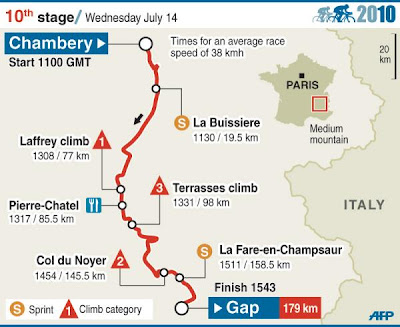
But there’s another event, too, that involves neither fortresses nor gunpowder. Stage 10 of the Tour de France takes place this morning,
It’s a party cloudy night, with a low temperature that will be in the low sixties.
The results of the ninth stage of the Tour de France, following a rest day, seemed to make clear that the battle was down to two riders:
And in a sign of what to expect over the course of the next 12 days, Andy Schleck (Saxo Bank) earned himself the overall race lead following his mano-a-mano exploits with Alberto Contador (Astana) that began on the slopes of the Col de la Madeleine. There’s no doubt that the touch paper which was ignited today will result in an explosion for the maillot jaune once the race hits the Pyrenees.
One fact became glaringly obvious, however: this year’s Tour de France has become a battle between Schleck, winner of Sunday’s stage to Morzine-Avoriaz, and reigning champion Alberto Contador. There’s already two minutes between second-placed Contador and third-placed Samuel Sanchez, and each has the team to help them remain at the head of proceedings….
There’s sound reasoning in all this, but it’s still early. After all, at least one publication saw a different possibility, before the race began:
There’s more information now, by far, than there was just nine stages ago, but there’s still much that’s unknown.
Do desperate times call for desperate measures? One of the wealthiest school districts in Wisconsin, in Williams Bay, is looking to ask voters to support a referendum to “to exceed state revenue caps by $498,000 for the next two school years and by $890,000 for the school years after that.” See, Williams Bay School District sets referendum for September.
One could say that our difficult times call for even wealthy districts to fund operations by raising additional revenue — taxes — to keep going. Alternatively, it’s possible that some school boards, no matter how well off their districts, simply cannot imagine not asking residents for still more revenue.
I’ll end the day on a fine, reassuring note, of possibility. Here’s Duke Ellington, from a clip as he plays Take the A Train. Enjoy.
There’s a video making its way through cyberspace that’s sure to the the first of many like it this election year. The video shows the reaction of participants in a town hall meeting to Congressman Brad Sherman’s declaration that he knew nothing about a Department of Justice dismissal of a case against of voter intimidation filed against the New Black Panther Party. One attendee asks Sherman a question, and others react, vociferously. He answers her question generally, as one would expect, but he makes the mistake of contending that he knows nothing about the dismissed case. Many in the audience react unfavorably to his denial of knowledge.
The Congressman is Brad Sherman, Democrat of California’s 27th Congressional District. (Sherman won his district easily in 2008; he’s been in Congress since first winning the seat in November 2002.)
Sherman stays calm, but seems surprised at the reaction. The situation he faces will prove an increasingly common one, where a someone takes a video camera, someone else asks a question, and members of an audience react. Admittedly, some attendees are surely activists aware beforehand of some of these questions, but that does make the questions, or answers to them, any less legitimate.
For many politicians and bureaucrats, being challenged like this will prove new and uncomfortable, as a sycophantic press would not have reported an encounter like this. Now, these encounters are just a camera and a website away from widespread publication.
A few more episodes like this, and communities may be spared any number of lies or self-serving exaggerations.
Note to the Left — You’ll find yourselves using techniques just like this when conservatives are back in power. What some of you foolishly revile now, you’ll embrace when the balance of political representation shifts.
One often hears that public servants give their time and effort to create a better community. Typically, one hears this from the politicians and bureaucrats who describe themselves as public servants. With all that dedication and attention, it’s not too much to hope that fewer of the goods purchased with taxpayer money would be lost. Sadly, even in a sophisticated community like Los Angeles, almost half of the items reviewed in an audit could not be located.
City Controller Wendy Greuel released an audit today showing that various City departments could not locate hundreds of items purchased with taxpayer funds, and that hundreds of other items had been sitting unopened or unused for up to 7 years …. “Of 254 items that we [Greuel’s team] attempted to locate, 115 were not where they should have been. While 56 items were ultimately found in the wrong location, 59 were unable to be located at a cost of $938,000.”
The press release from the controller’s office is available in pdf format.
It’s true that Los Angeles is a big place, but if a big place with ample means for recording and tracking publicly-financed items can’t locate half of them, we have reason to be concerned about happens in less resource-rich communities.
There’s a solution, of course, that would prevent so many taxpayer-purchased items from disappearing or winding up in the wrong location: purchase fewer items with taxpayer money. Government cannot lose items that it has never had.
Today’s forecast calls for a chance of thunderstorms with a high of eighty-two degrees.
In the City of Whitewater today, there’s a meeting of the Urban Forestry Commission at 4 p.m. The meeting agenda, for a group that would more simply be called a tree commission, is available online. Having abolished the former commission, the city chose to find a new, if less apt, name for the new commission.
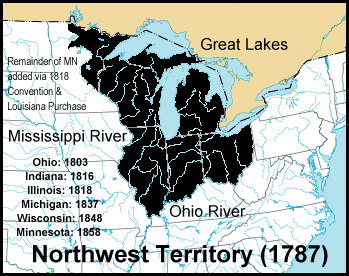
The Wisconsin Historical Society recalls that on this date in 1787, the
Northwest Territory [was] Established
On this date the Northwest Ordinance was passed by the Continental Congress. The ordinance provided for the administration of the territories and set rules for admission as a state. The Northwest territory included land west of Pennsylvania and Northwest of the Ohio River, which encompassed present day Ohio, Indiana, Illinois, Michigan, parts of Minnesota and of course Wisconsin. [Source: Indiana Historical Bureau]