FREE WHITEWATER

Author Archive for JOHN ADAMS

Eleven Fifty-Nine for 7-12-10

Good evening,

It’s a slightly overcast evening, with a low of about sixty degrees for the overnight temperature.

I blogged on Whitewater’s Planning Commission meeting earlier this evening, and I will later update that post with a few additional remarks. See, Whitewater’s Planning Commission Meeting for 7-12-10 (Live Blogging). Much of that meeting concerned residential housing (and the difference, that eluded so many, between enforcement of an existing ordinance and adoption of another, more restrictive one on the number of unrelated persons who may live together in a home in a residential neighborhood).

There’s a story in the Journal Sentinel about tiny homes, not now particularly historic, not part of ‘historic neighborhoods,’ but interesting nonetheless. In Tiny House, Big Questions, Mary Louise Schumacher writes that

While architectural bravado tends to grab headlines, some of the most extraordinary architecture being made in the world today are small, adventurous structures, transitory buildings that take little from the Earth and give more than seems possible in return.

At their best, these pocked-sized projects, sometimes called “micro architecture,” do more than set standards for sustainable practices. They challenge the way we live.

One such project is the EDGE (Experimental Dwelling for a Greener Environment), designed by a small Stevens Point firm, Revelations Architects. The abode is so bitty, in fact, that it doesn’t qualify as an actual house in much of Wisconsin, where 750 or 800 square feet of floor space is required.

The JS also has a link to a video that shows the house in greater detail. A commenter to the story writes that it’s a “[n]ice little house. Just the right size for one person and a cat.”

Here’s a video of a different, micro house, to get an idea of how small they are:


Link: http://www.youtube.com/watch?v=FTF9PfDFv_c

I don’t think these micro homes are superior as a principle (although the architect thinks so, rather smugly) — I simply think they’re interesting.

Homes this small, though, at 500 square feet, for example, would settle many questions about the permissible number of unrelated occupants of a dwelling. more >>

The Worst Ecological Disaster Ever? Looking Beyond the Gulf

I’m sure that I’ve thought, of the oil spill in the Gulf, that it must be the worst ecological disaster in our history. At Commentary, John Steele Gordon asks the question, “The Worst Ecological Disaster Ever?” and concludes that the Gulf spill’s not our worst experience.

He offers some experiences far worse:

….how about the Aral Sea, where the Soviets diverted for agricultural use all the water that had flowed into it, destroying what had been the fourth largest lake in the world (26,000 square miles), as well as the vast ecosystem (and fishing industry) it had nurtured?

Or how about the London killer smog of 1952 that is thought to have killed upwards of 12,000 people, more than a thousand times as many people as have died in the Gulf Oil spill?

In this country, the worst man-made ecological disaster was, by order of magnitude, the Dust Bowl of the 1930s. Drought and poor farming practices in an area that should never have been farmed at all destroyed 100,000,000 acres. One dust storm that started on the high plains on May 9, 1934, dumped an estimated 6,000 tons of dust on the city of Chicago alone — four pounds per person. New York had to turn on the streetlights in broad daylight the next day. Two and half million people fled the area over the decade. Hundreds, perhaps thousands, died of dust pneumonia. Many more, especially children, died of malnutrition. Others were blinded when dust got under their eyelids.

I’m sure he’s right. There are valuable reminders of economics and history in his examples: one doesn’t always assess costs correctly from appearances, and one understandably but erroneously considers present disasters worse than distant, ill-remembered, earlier ones. More than one book has been written on these subjects, so to speak.

(The reverse is surely true, as well — that supposed cost savings from green technologies are sometimes exaggerated, omitting costs of adoption not properly considered. Worse, some of these terms are used like incantations, as though saying green or sustainable about a project makes it a genuine conservation effort.)

Do Libertarians Like Their Message? You Bet We Do

There’s a story from Indiana about how libertarians are fairing in that traditionally Republican state. Entitled, Libertarians Like Their Message, it describes a libertarian candidate as knowing that “your chances of winning are remote, but your goal is to finish as strong as possible and keep building for the future.”

That’s true for those libertarians who run as Libertarians; there are far more libertarians who are independents and swing voters.

There’s a good feeling about advocating something because one believes it and not simply running for personal ambition, hoping to work out a plan only after getting through the door. My preceding post, about how Wisconsin‘s major-party gubernatorial candidates have offered flimsy and incredible solutions, sometimes leads people to a libertarian alternative.

That’s why Chris Spangle, a libertarian from Indiana, can forthrightly say that “[t]here’s no party that represents true fiscal responsibility as much as Libertarians,” he said. “Republicans and sometimes even Democrats talk about libertarian values of fiscal responsibility, but once they get into power, they don’t follow though on all the promises they made.”

Politicians are wrong to blame voters for being apathetic, skeptical, or cynical. People aren’t born that way; if anything, people are too trusting. It’s the emptiness of political promises that leaves people justifiably weary and jaded. A more informed and energetic electorate would develop in a more honest, less selfish political culture. A smaller government would produce a better politics, less attractive to gluttonous politicians.

Years of the major parties pretending that sows’ ears are really silk purses, all the while living as pigs, has taken its toll.

Smaller and limited government, individual liberty, free markets, and commerce with friendly countries.

So, do libertarians like their message? Oh yes, very much indeed.

Journal Sentinel: Wisconsin Candidates’ Cost-Cutting Proposals Don’t Add Up

There’s a story at the Journal Sentinel entitled, Wisconsin candidates’ cost-cutting plans don’t add up. Jason Stein summarizes the candidates’ proposals:

Candidates for governor are sharing more of their plans to slice spending to help balance the state’s struggling budget, but they’re making promises they could find difficult or even impossible to keep.

Milwaukee Mayor Tom Barrett, a Democrat who has shared the most detail on his proposed spending cuts, faces huge obstacles to achieving a key part of his budget proposal, an in-depth look at candidate plans’ shows.

A Republican rival, former U.S. Rep. Mark Neumann, could see a surplus from his savings plan if the economy keeps growing, but only after nixing hundreds of millions of dollars or more in commitments already written into state law. Neither Neumann nor his GOP primary opponent, Milwaukee County Executive Scott Walker, has released many details about how they’ll make these massive cuts. And in the plans that Walker has released, a large chunk of them amount to little more than a bookkeeping exercise.

In Barrett’s case, state figures show it would be incredibly difficult to save a proposed $200 million in a state health program for the poor by insisting that patients be more conscious of costs.

“I don’t know how they calculated that amount or where it comes from,” said Jason Helgerson, Medicaid director for Democratic Gov. Jim Doyle, a Barrett ally. “It has some definite challenges.”

(For more on some of Walker’s supposed savings, by claiming that not filling vacant positions counts as a budget cut, see Meet the New Solution, Same as the Old Solution.)

Stein’s story goes on to illustrate other ways in which each of the major party candidates has offered only incredible, unrealistic budget ideas.

With a $2.5 billion dollar project shortfall in the next two-year budget, and budget-cutting proposals that aren’t cuts at all, Wisconsin’s next governor is sure to disappoint voters who’ll be shocked at inevitable, genuine cuts of which they were never told, and never expected to feel.

Cynicism about politics doesn’t come about accidentally, or because people are naturally skeptical. It comes about in ways like the major candidates’ proposals, offerings that dare residents to believe in, or at least look away from, empty claims and promises.

Walworth-Big Foot Historical Society Farm & Place Tour: July 28, 2010

I received the following press release that I am happy to post:

The Historical Society of Walworth & Big Foot Prairie will conduct their Third Annual Farm and Place Drive-by Tour. The event will occur on Wednesday, July 28 at 6:30 PM with the participants meeting in the parking lot of the Agape School at 215 South Main Street, Walworth. (This is the site of the former Seventh Day Baptist Church.)

The tour will include the farms and homes where the Seventh Day Baptist Society members lived, Cobblestone Cemetery, farms on a route to Zenda, a farm museum tour and South Shore Geneva Lake historical sites. Each family will receive a free map and tour book, then proceed on the tour lead by Co-chairwomen Virginia Hall and Mary Kaye Merwin of Delavan. The tour committee consisting of Virginia Hall, Mary Kaye Merwin, Nancy Lehman, Mike Palmer, Denise Woods, Terry Woods, William Wendeberg, Mary Jordan, Beth Shodeen and Jennifer Coon has worked for months acquiring historical information and personal interviews for the tour. For additional information please call 262-275-2426.

Daily Bread for Whitewater, Wisconsin: 7-12-10

Good morning,

Whitewater’s forecast calls for a chance of thunderstorms with a high of eighty degrees.

The City of Whitewater has a busy municipal calendar today. At 4 p.m., there were be a meeting of the Parks & Recreation Board. The meeting agenda is available online.

At 6 p.m., there will be a meeting of Whitewater’s Planning Commission. The agenda, with a packet of documents related to the meeting, is available online. It’s an improvement for Whitewater over past practice, and brings our city into alignment with the sound practice of putting documents online, in advance of the meeting, for residents to review and consider. I’ve written about this previously. (See, It’s In Your Packet and It’s Online for All: The City of Beloit’s Good Government Example.)

I’ll blog on tonight’s Planning Commission meeting, with topics at that meeting including a residential zoning overlay for the Starin Park neighborhood, and a proposed expansion of our Walmart.

At 6:30 p.m., there will be a meeting of Whitewater’s library board. The agenda for the meeting is available online.

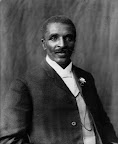
It’s the anniversary of George Washington Carver’s birthday — he was born in 1865, and died in 1943. Upon his death, the New York TImes published an obituary describing his life’s accomplishments, albeit a description that was informative yet deeply condescending:

Dr. George Washington Carver, noted Negro scientist, died early tonight in his home at Tuskegee Institute. His age was 78.

Dr. Carver had been in failing health for some months and was confined to his bed for the last ten days.

He became a member of the Tuskegee Institute faculty in 1894 and had been attached to the Negro institution ever since.

Dr. Carver was recognized as one of the outstanding scientists in the field of agricultural research. He discovered scores of uses for such lowly products as sweet potatoes, peanuts and clay. From the South’s red clay and sandy loam, he developed ink, pigments, cosmetics, paper, paint, and many other articles.

No Ambition for Riches

Dr. Carver, paying no attention to his clothes and refusing to make money on his discoveries, simply devoted his life to scientific agricultural research, to enable his colored brethren to make a better living from the soil in the South.

He became such an authority on cotton, the peanut and the sweet potato that he ended with a place among important white men. His name is in “Who’s Who in America,” and he was accorded a membership in the Royal Society of London.

“Who’s Who” lists him as an educator and follows immediately with the information, which he supplied, that he was “born of slave parents on a farm near Diamond Grove, Mo., about 1864; in infancy lost his father and was stolen and carried into Arkansas with mother, who was never heard of again; was bought from captors for a race horse valued at $300 and returned to former home in Missouri.”

Because he was a puny boy who got his growth late, he was allowed to run around as a household pet without being put to heavy work. Outdoors he learned about trees, shrubs and insects and liked to paint and draw them. In the kitchen he picked up much knowledge of cooking and of canning fruits and vegetables which later was to serve his people. In the parlor he learned something of music.

It’s also the anniversary of the Etch A Sketch. Wired offers a story entitled, Etch a Sketch? Let Us Draw You a Picture that describes the device:

The technology behind this children’s toy is both simple and complex. Simple, in that an internal stylus is used, manipulated by turning horizontal and vertical knobs to “etch a sketch” onto a glass window coated with aluminum powder.

Complex, because the Etch a Sketch employs a fairly sophisticated pulley system that operates the orthogonal rails that move the stylus around when the knobs are turned. The stylus etches a black line into the powder-coated window to create the drawing.

Along with the aluminum powder, the guts of the toy include a lot of tiny styrene beads that help the powder flow evenly when the sketch is being erased (by shaking), recoating the screen for the next drawing. As for how the aluminum powder sticks to the window, well, it pretty much sticks to everything.

Arthur Granjean, a Frenchman, was the Etch a Sketch’s inventor (he called it L’Ecran Magique, or “The Magic Screen”). After failing to get some of the bigger toy companies to bite, he sold his invention to the Ohio Art Company, which has manufactured it ever since.

Walworth-Big Foot Historical Society Farm & Place Tour

The Historical Society of Walworth & Big Foot Prairie will conduct their Third Annual Farm and Place Drive-by Tour. The event will occur on Wednesday, July 28 at 6:30 PM with the participants meeting in the parking lot of the Agape School at 215 South Main Street, Walworth. This is the site of the former Seventh Day Baptist Church. The tour will include the farms and homes where the Seventh Day Baptist Society members lived, Cobblestone Cemetery, farms on a route to Zenda, a farm museum tour and South Shore Geneva Lake historical sites. Each family will receive a free map and tour book, then proceed on the tour lead by Co-chairwomen Virginia Hall and Mary Kaye Merwin of Delavan. The tour committee consisting of Virginia Hall, Mary Kaye Merwin, Nancy Lehman, Mike Palmer, Denise Woods, Terry Woods, William Wendeberg, Mary Jordan, Beth Shodeen and Jennifer Coon has worked for months acquiring historical information and personal interviews for the tour. For additional information please call 262-275-2426.

Eleven Fifty-Nine for 7-11-10

Good evening,

It’s a cloudy night, with a low temperature in the mid sixties for Whitewater. Most of the day here was beautiful, as the day was, also, in the French Alps on Stage 8 of the Tour de France.

If you’ve been watching the Tour, you saw today how unpredictable cycling is. A race over weeks, and thousands of miles, could hardly be otherwise. Contador saw his chances of a second Tour victory fade, and Armstrong saw his (less likely) chances of an eight Tour victory vanish altogether. Armstrong was well behind after seven stages, and Contador hardly a sure bet, but todays’a racing changed the likely outcome in paris still more.

I’ve not been a great fan of Armstrong, to put it mildly, yet I still feel sorry for the day he had today. He feel three times, and he leave Europe a couple of weeks from now to bigger disappointments ahead. I know that there’s a certain kind of American cycling fan who’s quick to champion a European favorite (anyone, really) over an American. It seems sophisticated to them, as though to support a European makes them seem more knowledgeable and genuine.

I am not such a fan; it’s natural and customary to support competitors from one’s country. I have no favorite this year, but I would always prefer to cheer on a fellow American. We’ve also no need to favor a European in a futile, transparent attempt to appear sophisticated. More important still, America doesn’t need to look to Armstrong to find a great champion. We had a great champion, whose legacy looks better by the day, in Greg LeMond.

We can always feel good about that.

There’s a cycling race coming to Wisconsin, this Wednesday, in nearby Lake Geneva, Wisconsin. See, Bicycle races come to Walworth County about the Point Premium Root Beer International Cycling Classic/Superweek Pro Tour. From that story, here are the details of the Lake Geneva component of the tour:

The Lake Geneva race officially is titled the Keefe Real Estate Lake Geneva Criterium presented by Simple Café and the Geneva Lakes YMCA.

Criteriums are held on short courses, usually less than a mile long, and riders race dozens of laps to cover the total race distance.

The Lake Geneva course is eight-tenths of a mile. It heads north on Center Street, east on Main Street, south on Lakeshore Drive and west on Baker Street. Riders will zip along Geneva Lake, past Flat Iron Park and down Main Street. Spectators can line the barriers along the entire course.

The story also has links on competitive cycling information, Wednesday’s race, and even where to go for a good spot to watch.

Few better ways to end a day than with something from Duke Ellington. “It Don’t Mean a Thing (If It Ain’t Got That Swing)” was composed in 1931; the embedded video is of a 1943 performance. Enjoy.


Link: http://www.youtube.com/watch?v=qDQpZT3GhDg. more >>

Recent Tweets, 7-4 to 7-10

WSJ.com – Fowl Fans See Golden Eggs in Catering to Pet-Chicken Market http://on.wsj.com/9VRgKI
about 11 hours ago

Android Gains, Apple Wanes — Oh Yes, Yet Again – PCWorld http://bit.ly/9imcZr
6:42 PM Jul 9th

Two billion, five-hundred million reasons Wisconsin’s government needs true reform to return to responsibility: http://bit.ly/a4KtE3
2:08 PM Jul 9th

Secrets of Successful Cricket Spitters (as reported in the Milwaukee Journal Sentinel) http://bit.ly/dazWcs
3:27 PM Jul 8th

When gov’t budgets based on “needed” services, rather than need to deduce tax burden, there will be too many services, costing too much
2:35 PM Jul 8th

Right way to reduce bloated government budget: How much in taxes/fees should be returned to people for prosperity? Cut spending accordingly
2:30 PM Jul 8th

He’s very right Laffer: Unemployment Benefits Aren’t a Stimulus http://bit.ly/9apVa9 Laffer’s better idea: a federal tax holiday
2:23 PM Jul 8th

Lindsay Lohan’s not a libertarian; she’s a coddled & curdled mess One can see she still has money for a ghostwriter http://bit.ly/cqPPML
1:38 PM Jul 8th

RT @MSpicuzzaWSJ: Developers avoid millions in property taxes using a Wisconsin tax relief law for farmers http://alturl.com/9xywb Gaming!
12:42 PM Jul 8th

Sushi’s okay but raw milk isn’t Why? Because there’s no fish lobby fighting sushi as there is a big dairy lobby fighting raw milk
2:38 PM Jul 7th

RT @IJ: IJ op-ed: The McDonald case was not just about guns, but about all of our rights. Find out why: http://iam.ij.org/9QyuWj
12:16 PM Jul 6th

Running for governor (of WI) with hope — but without much money or recognition http://bit.ly/9jr4vP
9:08 AM Jul 5th

The Volokh Conspiracy » “If they are endowed with inalienable rights, that is final.” http://bit.ly/bSARB0
7:56 AM Jul 4th

Wisconsin State Journal: Proposal Would Ban Dogs (and Other Animals, Too) from Many Madison Events

There’s a proposal, offered at the request of a Madison businessman, to ban dogs, etc., from some public events, like fairs, in Madison. The businessman (Keith Peterson of Madison Festivals) runs some of these events, like the Taste of Madison. See, Proposal Would Ban Dogs (and Other Animals, Too) from Many Madison Events.

That the businessman who runs the events, rather than patrons, asks for the legal ban on dogs should trigger suspicion. That’s because it’s a classic case of special interest pleading, in which a private, well-connected party asks for a change in the law that benefits and makes its own endeavors easier.

Here’s the contention:

The proposed city ordinance would prohibit dogs and other animals from any Madison event where a street use permit is required and there are 10 or more food vendors.
“We love pets, but we just don’t think it’s appropriate to have them around 50,000 people and small children and food,” said Keith Peterson, event director for Madison Festivals Inc., which puts on Taste of Madison and requested the ordinance.

The tip off is Peterson’s use of the word ‘appropriate‘ — he doesn’t quantify harm or risk, just offers a justification not far removed from ‘we just don’t think it’s polite,” or ‘it’s not what proper people do.’ Perhaps he’s right, but one needn’t care, as it’s not law’s place to establish rules of mere politeness. The law should be used for bigger things.

One can guess that Peterson’s patrons disagree with him, as they’re the ones bringing dogs to his events. So what he really should admit is that some of his patrons are vulgar and inappropriate in his eyes, and he’d like the CIty of Madison to make unlawful their ongoing conduct (and his failure to discourage them).

Event organizers can ban pets now, of course, and if they can’t prevent patrons from bringing dogs, and they can’t show violations other existing criminal statutes, Peterson should be out of luck.

Government owes this private businessman no ordinance; a municipality should not extend legislation for him, or his festivals. If he can’t manage the area now, from the profits he derives, then he should find another line of work.

Legislation should have a broader origin than this.