Good morning. Saturday in Whitewater will be sunny with a high of 73. Sunrise is 5:37 and sunset is 8:06, for 14 hours, 28 minutes of daytime. The moon is a waxing gibbous with 95.9 percent of its visible disk illuminated. On this day in 1773, the Parliament of Great Britain passes the Tea Act, designed to save…
Good morning. Wednesday in Whitewater will be partly cloudy with a high of 69. Sunrise is 5:40 and sunset is 8:02, for 14 hours, 22 minutes of daytime. The moon is a waxing gibbous with 78.4 percent of its visible disk illuminated. Whitewater’s Starin Park Water Tower Committee meets at 6 PM, and the Landmarks…
Good morning. Tuesday in Whitewater will be sunny with a high of 75. Sunrise is 5:42 and sunset is 8:01, for 14 hours, 19 minutes of daytime. The moon is a waxing gibbous with 70 percent of its visible disk illuminated. The Whitewater Unified School District’s Finance Committee meets at Noon. Whitewater’s Alcohol Licensing Committee…
Good morning. Monday in Whitewater will be cloudy with a high of 62. Sunrise is 5:43 and sunset is 8:00, for 14 hours, 17 minutes of daytime. The moon is a waxing gibbous with 60.3 percent of its visible disk illuminated. The Whitewater Unified School District Board meets in open session at 6:30 PM, then…
Good morning. Sunday in Whitewater will see a mix of clouds and sun with a high of 64. Sunrise is 5:44 and sunset is 7:59, for 14 hours, 15 minutes of daytime. The moon is in its first quarter with 50.3 percent of its visible disk illuminated. On this day in 2007, Greensburg, Kansas is almost…
Wednesday in Whitewater will be partly sunny with a high of 55. Sunrise is 6:11 and sunset is 7:38, for 13 hours, 28 minutes of daytime. The moon a waning gibbous with 89 percent of its visible disk illuminated.
Whitewater’s Parks & Recreation Board meets at 5:30 PM.
Yesterday’s post, Farmers, cited reporting on the effects of a trade war on farmers. Trump is aware of these concerns, and so he used his Truth Social platform to publish his position on a trade war’s effects on agriculture. Below are Trump’s remarks contrasted with real experiences.
Our farmers are GREAT, but because of their GREATNESS, they are always put on the Front Line with our adversaries, such as China, whenever there is a Trade negotiation or, in this case, a Trade War. The same thing happened in my First Term. China was brutal to our Farmers, I these Patriots to just hold on, and a great trade deal was made. I rewarded our farmers with a payment of $28 Billion Dollars, all through the China deal. It was a great transaction for the USA, until Crooked Joe Biden came in and didn’t enforce it. China largely reneged on the deal (although they behaved during the Trump Administration), only buying a portion of what they agreed to buy. They had ZERO respect for the Crooked Biden Administration, and who can blame them for that? Interestingly, they just reneged on the big Boeing deal, saying that they will “not take possession” of fully committed to aircraft. The USA will PROTECT OUR FARMERS!!!
The payments were helpful, Pihl said. But they weren’t a fix for the longer-term damage done by Trump’s first-term tariffs.
“That was just for the one year. What about the market loss that continued through his term and into Biden’s term? I think the amount is incredible,” he said.
Trump claims that China has ‘behaved’ during his administration, but he admits in his post that (a) they’ve hit back at Boeing and (b) China has applied huge retaliatory tariffs across the board.
Meanwhile, here’s how ordinary Chinese are depicting the Trump Admin:
Even ordinary TikTok users on the other side of the world have Trumpism’s number.
One can and should oppose the Chinese government without stumbling into an inflationary trade war.
Meanwhile, where did Trump get all those gaudy gold appliqués with which he’s littered the Oval Office? Trump’s vulgar additions are surprisingly similar to what the Chinese sell on Alibaba:
Is Trump's oval office plastered with Chinese-made, faux gold, polyurethane "French palace" wannabe wall coverings? We don't know for sure, but boy these items we found on Alibaba sure do look similar sherwood.news/power/shop-t…
Tuesday in Whitewater will be windy with a high of 50. Sunrise is 6:12 and sunset is 7:37, for 13 hours, 25 minutes of daytime. The moon a waning gibbous with 94 percent of its visible disk illuminated.
On this day in 1922, U.S. Senator John B. Kendrick of Wyoming introduces a resolution calling for an investigation of a secret land deal, which leads to the discovery of the Teapot Dome scandal.
Tariffs are making life more expensive for John Pihl. He’s been farming in Northern Illinois for more than 50 years.
“These tariffs are going to affect everything. It’ll affect our parts — it’s just across the board. Which is going to hurt everything,” he said.
Not only do tariffs affect the cost of farm supplies, but they also raise the risk of retaliation against exports of U.S. crops: a double-whammy for farmers like Pihl.
“It’s a good way to lose your customers,” he said. “And I think we’ll probably lose more on this round too, because I know that Mexico is our biggest importer of corn. But this time, they may figure out that they can get corn from South America just as easily as from the U.S.”
….
All told, the first Trump administration spent $28 billion bailing out farmers. This time around, the tariffs are much higher than they were six years ago, and it’s unclear how long they will persist.
NPR asked the White House for details on what relief is under consideration this time, but received no response.
The payments were helpful, Pihl said. But they weren’t a fix for the longer-term damage done by Trump’s first-term tariffs.
“That was just for the one year. What about the market loss that continued through his term and into Biden’s term? I think the amount is incredible,” he said.
But it’s all fake news, right? These consequences for can’t be true, can they? Mr. Trump has a plan, of course he does. (He had a plan before each of his six business bankruptcies, didn’t he?)
Come for the culture war, stay for the inflationary trade war.
Elephants formed an ‘alert circle’ to protect their young after a 5.2 magnitude earthquake in southern California. Video footage from the San Diego zoo safari park showed elephants instinctively circling their young, as soon as they felt the earthquake on 14 April
Monday in Whitewater will be windy with a high of 59. Sunrise is 6:14 and sunset is 7:36, for 13 hours, 22 minutes of daytime. The moon a waning gibbous with 98 percent of its visible disk illuminated.
Whitewater’s Plan and Architectural Review Commission meets at 6 PM.
On this day in 1958, the Soviet satellite Sputnik 2 falls from orbit after a mission duration of 162 days. This was the first spacecraft to carry a living animal, a female dog named Laika, who likely lived only a few hours.
One of the justifications for tariffs is to bring back manufacturing to states like Wisconsin. It’s ill-considered:
But one of the biggest barriers to bringing manufacturing back, both in Wisconsin and nationally, is a labor shortage.
Over the last decade, [founder of the Florida-based Reshoring Initiative Harry] Moser said employers have told him the U.S. labor market is “weak, both in terms of quantity of people and quality of people.” He said there have been efforts in recent years that have helped some, pointing to high school apprenticeship programs. He says Trump’s goal of bringing manufacturing back hinges on workforce.
….
In Wisconsin, a 2023 research report from WMC found the state’s median age was older than the rate nationally, and warned if the population doesn’t grow at a faster rate, workforce shortages would worsen.
“We don’t have enough workers for the jobs that we have, let alone if we want to grow a job (field),” [president of the business lobbying group Wisconsin Manufacturers & Commerce Kurt] Bauer with WMC said. “This is a significant challenge.”
One hears talk in Whitewater on recruiting for manufacturing before any other priority. It’s more a diversionary tactic than anything else; these gentlemen are simply looking for something, however implausible, to shift the conversion.
Monday in Whitewater will be windy with a high of 45. Sunrise is 6:50 and sunset is 7:12, for 12 hours, 22 minutes of daytime. The moon is a waning crescent with 28.7 percent of its visible disk illuminated.
Whitewater’s Urban Forestry Commission meets at 5:30 PM and the Police and Fire Commission at 6 PM.
Farm and construction equipment manufacturers started the year with high hopes for the economy, bolstered by President Donald Trump’s campaign promises to cut taxes on domestic producers and slash government regulations.
But that optimism has given way to fears of a possible recession, sparked by Trump’s international trade war, said Kip Eideberg, senior vice president for the Association of Equipment Manufacturers, a national trade group based in West Allis.
“If we are dragged or pushed into a recession as a result of the tit for tat tariffs, that’s a whole ’nother level of pain,” he said. “That’s the biggest fear right now.”
….
China, Canada and the European Union plan to hit Wisconsin’s two largest industries, agriculture and manufacturing, with retaliatory tariffs. The moves come in response to Trump’s tariffs on steel and aluminum and his broader threats and use of tariffs.
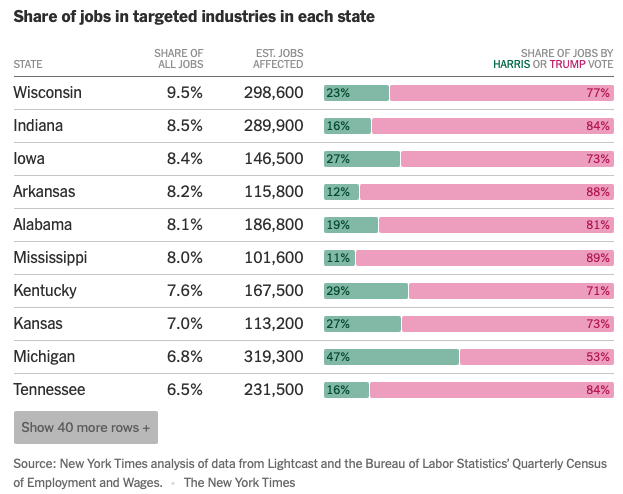
Almost 10 percent of Wisconsin’s jobs — or nearly 300,000 — were in industries those countries are targeting. That’s the largest share of any state in the country, according to an analysis from The New York Times.
From the New York Times, here’s the portion of the story to which the WPR story refers:
Rural parts of the country are once again at risk from retaliation. Agriculture is a major U.S. export and farmers are politically important to Mr. Trump. And rural counties may have one major employer — like a poultry processing plant — that provides a big share of the county’s jobs, compared with urban or suburban areas that are more diversified.
The retaliatory tariffs target industries employing 9.5 percent of people in Wisconsin, 8.5 percent of people in Indiana and 8.4 percent of people in Iowa. The shares are also relatively high in Arkansas, Alabama, Mississippi, Kentucky and Kansas.
The shapes of these cells are puzzling. They have wavy edges and protrusions and fit together a bit like puzzle pieces. But what is it for? New research looking at the lymph capillary cells, found throughout human tissues, has determined how exactly these tiny vessels are able to let fluid and immune cells pass through between them while also being strong enough to resist rupturing under pressure. Their unusual shape seems to be key…
Tuesday in Whitewater will be windy with a high of 48. Sunrise is 7:13 and sunset is 5:03, for 9 hours, 50 minutes of daytime. The moon is a waning crescent with 1.2 percent of its visible disk illuminated.
Whitewater’s Finance Committee meets at 5 PM, and the Public Arts Commission at 5:30 PM.
On this day in 1958, the Lego company patents the design of its Lego bricks, still compatible with bricks produced today.
More data centers — computer warehouses that underpin artificial intelligence and store everything from PayPal transactions to YouTube videos — are coming to Wisconsin.
Microsoft has purchased 240 acres for a new data center complex in Kenosha, the city announced Monday. It will sit northwest of the intersection of Interstate 94 and Route 142, 6 miles south of the company’s $3.3 billion data center campus under construction in Mount Pleasant.
Meanwhile, the hydroelectricity that once powered Wisconsin Rapids’ paper mill will now flow to a new data center. The data center developer Digital Power Optimization, known as DPO, announced on Thursday it has purchased the site and its power supply.
Friday in Whitewater will be partly cloudy with a high of 26. Sunrise is 7:04, and sunset is 4:22, for 9 hours, 18 minutes of daytime. The moon is a waning crescent with 2.5 percent of its visible disk illuminated.
On this day in 1961, Enos, a chimpanzee, is launched into space. The spacecraft orbits the Earth twice and splashes down off the coast of Puerto Rico.
Monday in Whitewater will be partly sunny with a high of 69. Sunrise is 6:44, and sunset is 6:49, for 12 hours, 5 minutes of daytime. The moon is a waning gibbous, with 63.7 percent of its visible disk illuminated.
Whitewater’s Urban Forestry Commission meets at 5:30 PM. The Whitewater School Board’s Policy Review Committee meets at 6 PM, and the full board in regular session at 7 PM.
Whitewater once again has a stand-alone supermarket, and like so many residents, this libertarian blogger is pleased to see ALDI in town. Note well: the public policy of recruiting a supermarket is not the matter of a single business, but of how local public officials have managed through public bodies (like the Whitewater Community Development Authority) under public laws and principles. However hard it has been, and remains, for Whitewater’s declining old guard to grasp, each of them (or any of us) is no less — but no more — than 1 of 15,000 in the city.1
Unquestionably right. The old Sentry closed in ’15, and Whitewater went years fumbling with old-guard CDA attempts to bring a dedicated supermarket. They accomplished nothing of the kind.
ALDI is in Whitewater because the city has a new municipal administration that brought ALDI here.
Larry Kachel indicated that the prior property owner [DLK related] had been in discussion with ALDI beginning in 2017, but the company had concluded that the traffic counts and population did not meet their minimum criteria. Kachel hastened to add that the late Jim Allen’s persistent efforts over many years to attract a store should also be recognized. Tom Howard, ALDI’s regional real estate developer, told the Banner that the city became a viable possibility for a store as a result of the success that the company has recently enjoyed with other stores in rural areas. Jon Kachel indicated that discussions have taken place with a variety of prospects regarding the property located between ALDI and Culver’s, but nothing has come together yet.
I’ll offer six remarks:
First, the City of Whitewater — through its taxpayers — had to spend $500,000 of public money to remediate — to clean up — the site of the prior private property owner, DLK Enterprises. In the language of a consultant’s assessment:
The existing structures on the property will be demolished and the site remediated, including the removal of asbestos and lead in the buildings. This cost is significant and potentially cost prohibitive for any new development.
I’m glad the City of Whitewater accepted this proposal, yet one should be clear about what this means: ordinary people had to pay to clean up the prior, local owner’s mess. The local business did not pay this money — ordinary people did. This municipal administration, under law, through the Community Development Authority and the Whitewater Common Council, had to pay this money up front to make the deal possible.
Second, It seems likely, if not certain, that the publicly-funded remediation has made the remaining area more suitable for sale. (The Brothers Kachel are free to thank the taxpayers of Whitewater at their earliest convenience.)
Third, and admittedly, the Banner‘s paragraph is a poor specimen on which to rely. There’s nothing quoted here; it’s a conversation or conversations related from one person to another, as though people were talking along a fence line. There isn’t even a claim to word-for-word accuracy: it’s an account of what someone “indicated,” not what someone said verbatim. It’s also told from a narrow perspective in which every reader should know the local people mentioned and in which the local men cited should be taken at face value3.
Fourth, the corporate real estate developer for ALDI, at least as recounted here, reasonably states the obvious about why ALDI would pick this city (once the property was cleaned up, of course). That statement says nothing about the many prior, fruitless local efforts to find a supermarket.
Sixth, equally puzzling is why anyone at the Whitewater Community Foundation’s Banner would look for answers from ALDI before seeking public documents from his or her own city. The foundational issue is about years’ long local policy to seek to a supermarket, and conduct at the Whitewater CDA across a decade’s time, not any given business arriving recently.
What portion of this libertarian blogger’s contention — ALDI is in Whitewater because the city has a new municipal administration that brought ALDI here — is accurate?
All of it, every last word.
I’m glad ALDI is here — one should be clear about how she’s here.
Denoted as a fraction, these aged men of the old guard would each look like this: 1/15,000 or 0.000067 ↩︎
The request, submitted and received under Wis. Stat. §§ 19.31–19.39, has more than one use. ↩︎
The Banner‘s author writes in his paragraph with a credulousness that suggests no awareness or no appreciation of the challenges to the modernization — normalization, truly — of local government over the last two years. ↩︎
Thursday in Whitewater will be partly cloudy, with a high of 84. Sunrise is 6:39, and sunset is 6:56, for 12 hours and 17 minutes of daytime. The moon is a waning gibbous, with 96.7 percent of its visible disk illuminated.
Whitewater’s Community Development Authority meets at 5:30 PM.
Before today’s grand opening, I stopped in last night and found ALDI clean, well-organized, with wide aisles. (I had never been inside an ALDI before, although we have ordered from the Janesville location through Instacart.)
Quite sharp, and a welcome business addition to Whitewater.
Updated, morning of 9.19: I added a reply to a post comment. I’ve also reproduced that reply below:
Unquestionably right. The old Sentry closed in ’15, and Whitewater went years fumbling with old-guard CDA attempts to bring a dedicated supermarket. They accomplished nothing of the kind.
ALDI is in Whitewater because the city has a new municipal administration that brought ALDI here.
Thursday in Whitewater will be partly sunny with a high of 81. Sunrise is 6:25, and sunset is 7:20, for 12h 55m 15s of daytime. The moon is a waxing crescent with 5.5 percent of its visible disk illuminated.
Three years ago, during the pandemic, pondering the social media scene, I posted on Formation, General:
Some level of formation, of structure and learning, is needed to make sense of a difficult subject.
Come now the conservative populists, who are convinced that there is no field, no topic, that requires more effort than their own ‘common sense.’ They ask — they demand — that others who have committed years of formal or self-study recognize unconsidered or ill-considered populist opinions as valid as any other opinion.
They sometimes simply don’t know what they don’t know. Their ignorance of substantive study is matched by their arrogance in insisting that substantive study doesn’t matter. Someone might tell these conservative populists that arrogance invites Nemesis, but it would take some reading for them to make sense of those cautionary words.
Modern medicine, architecture, or materials science requires dedicated study. Anyone, in any era, might have said he or she possessed ‘common sense.’ And yet, and yet, those people from those earlier times often lived short lives in filth and misery.
The conservative populists enjoy lives in an era of technological and scientific accomplishment dependent on the efforts of the very experts they denigrate.
When common sense fails for these populists, when they misread medical texts and legal documents, they make the excuse that the topics were too hard or too confusing for anyone to understand. No and no again: the texts and documents were too hard only for those who had not committed the proper amount of study to the topic.
The lack of formation —of a learned foundation in politics, history, science, or even ordinary English usage — leaves the conservative populists unimpressive to anyone outside their circle.
Mallorca is the largest of the Balearic islands and the sixth-largest island in the Mediterranean Sea, but despite its size and location research suggests that it was among the last Mediterranean islands to be settled by humans. But exactly when people arrived on the island is a subject of much debate, with current estimates placing it at around 4,400 years ago. However, an ancient stone bridge in a flooded cave may call that timeline into question. By dating mineral deposits in the cave scientists have given a new window for when they suggest humans actually reached the island — at least 1,000 years earlier than previously thought.