
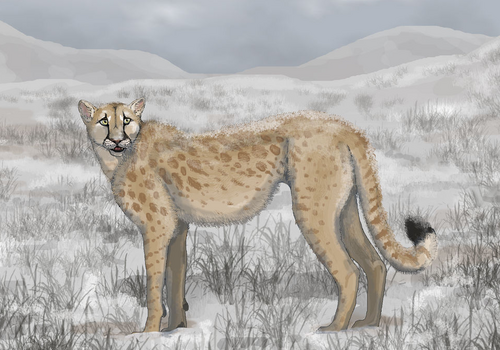
Sadly, North America never had its own true cheetah. The American cheetah, long since extinct, was closer to an American puma:
With their slender bodies and long front legs, Miracinonyx trumani—often nicknamed the “American cheetah”—was long thought to be a North American analog of the African big cat. But in a new study published in the journal Current Biology, researchers reveal that the extinct cat was more closely related to pumas. Some populations living near the Arctic preyed almost exclusively on fish, challenging the long-held assumption that these “cheetahs” chased fast-running prey, such as pronghorns.
[…]
However, in recent years, increasing evidence has suggested that M. trumani may not have been as cheetah-like as its appearance suggests. To delve deeper, Cassatt-Johnstone and her team sequenced the most complete M. trumani ancient DNA data set to date from four specimens, one from Wyoming and three from Canada’s Yukon Territory. The Yukon samples were previously thought to be a different species, but the team confirmed that they belong to M. trumani, extending the known range of M. trumani more than 20 degrees of latitude (more than 1,400 miles) farther north than previously known.
[…]
The team found that despite being discovered in different locations and having lived hundreds of years apart, the Yukon M. trumani individuals all showed signals indicating that they preyed almost exclusively on fish. The fossils’ nitrogen profiles were similar to those observed in fish-specialist orcas and sea wolves living along the coast of British Columbia, which eat mainly marine animals. In contrast, the M. trumani in Wyoming had the nitrogen markers of a terrestrial predator that mostly eats herbivores, similar to lions.
See Gaby Clark, The extinct American ‘cheetah’ was not a cheetah after all, Phys.org, September 6, 2026.