FREE WHITEWATER

DNA to Exonerate the Innocent (and Identify the Guilty)

At the Wisconsin State Journal, there’s a story about the Wisconsin Innocence Project’s work on behalf of an innocent man. Entitled, DNA project finally clears name of wrongly imprisoned man, the story shows the excellent work of Wisconsin’s Innocence Project:

The state’s effort to collect thousands of missing DNA profiles has paid off for a Milwaukee man who had been released – but not officially cleared – in a 1984 rape and murder.

Another suspect was recently identified through DNA testing and has confessed to the crime for which Robert Lee Stinson spent 23 years in prison, Byron Lichstein, an attorney with the Wisconsin Innocence Project who represents Stinson, said Monday.

Stinson, 45, was released in 2009 after the Innocence Project presented evidence that the DNA found on the victim didn’t match Stinson’s and that the bite marks – which were virtually the only evidence against him – also didn’t come from Stinson….

After Stinson was released, the UW-Madison-based project continued to pursue the case, paying a private company to create a DNA profile of the perpetrator that could be run through Wisconsin’s DNA databank.

“We knew someone had committed this crime, and we didn’t want him or her walking the streets,” Lichstein said.

Lichstein said he was notified about a week ago that the profile was found to match a profile in the DNA databank taken from convicted rapist and murderer Moses Price in November. Price, 49, has signed a notarized statement describing the crime in detail and taking responsibility for it, Chicago attorney Heather Donnell said….

Stinson’s conviction was overturned last year after prosecutors decided not to oppose the motion to free him. Lichstein said Price’s confession and the positive DNA match provide the final proof that Stinson was wrongfully convicted.

Robert Lee Stinson spent twenty-three years in prison for a crime that he did not commit, and a culpable man spent those years unpunished for having raped and murdered someone. The use of DNA evidence not only freed an innocent man, it allowed for the identification of a guilty one.

The Innocence Project acted correctly twice over, in exoneration of someone innocent, and identification of someone guilty.

It’s not just the biological science of DNA matching that can help law enforcement; television cameras can help law enforcement in a similar way. Use of camcorders at police stops can help determine when officers have committed misconduct, and when they have been falsely accused by those they question.

No one believes that identification or recording are perfect, but they are far more beneficial than their absence.

I’m sure that Robert Lee Stinson, and the victims of Moses Price, would think so.

Daily Bread for Whitewater, Wisconsin: 5-11-10

Good morning,

It’s a rainy day today, with a forecast high temperature of only fifty degrees.

There’s an urban forestry commission meeting today at 4 p.m. I understand that ‘urban forestry’ is meant as a term of art, but its use for a small rural town will always be incongruous and affected. Like the description of our city hall as a municipal building, it’s an awkward and contrived term. Tree commission, city hall: much more simple, as ordinary language.

There will be a band concert at our high school tonight at 7 p.m. Earlier in the day, there will be a P.T.O. meeting at 3:15 p.m. at Lincoln School. It’s scheduled to take place in the LMC, following the pattern of a small town with a municipal building and an urban forestry commission. I’m not so modern and fancy as I should be. I recall a time when a room filled with books for reading or lending was called a library.

There will also be a 6:30 p.m. P.A.T.T. meeting at Washington School.

Iron Man 2 had a good weekend, with $128 million in ticket sales. I’ve not yet seen it, but I enjoyed the first film. For those curious about how the film’s designers crafted Iron Man’s suit, there’s a story at Wired entitled, Secrets of Iron Man’s New Suits.

So can you fill us in on Iron Man’s suit? What are his stats? I read that in theory, it was supposed to weigh 600 pounds. How has that changed?

The trick to these kinds of things is, you have to present it in a way that feels the part, when actually it’s quite light. The suit has to feel like it’s being made out of metal. The height of the suit is 6 foot, 5 (inches), and 600 to 800 pounds has always been the number that we kicked around with the design team.

But what about the shoulders? He looks like he has insanely broad shoulders and a tiny waist.

That’s true, that’s true. That’s the comic book proportions. That’s the trait that makes him successful. He has very broad shoulders, the smallest head possible, and very narrow hips on really long legs. It’s a really interesting body type, which is the comic-book body type.

So is Robert Downey Jr. even close to the actual measurements of the suit?

No, nobody is. The aspect of what it is, is if you were to take a formula for drawing a person, is seven heads tall. Just about anybody, proportional to their body. The comic book [formula] is eight heads tall. His suit is actually eight heads, which is to say, they took the measurement of the head and stacked them eight from the ground up, he’s eight heads tall. I think that’s partially why the suit looks as good.

Wisconsin State Journal: Local [Dane County] Officials Concerned Hispanic Immigrants Will Avoid Census

The decennial census is a constitutional requirement, from Article I, section 2: “The actual Enumeration [of states’ populations] shall be made within three Years after.. the first meeting of the Congress of the United States, and within every subsequent Term of ten Years, in such Manner as they shall by Law direct.”

I have a small logo about the 2010 census on the left side of this website, that’s been up before the count began, and will stay up until it’s over. Although civil libertarians often oppose some of the questions as too intrusive, I support the efforts of the census for Whitewater, particularly.

Those reasons are simple — I don’t think that the 2000 census accurately measured Whitewater’s demographics. I am concerned the same will happen again. Specifically, the number of Hispanic residents is likely significantly greater than published reports.

A high or low number, accurately tallied, should be of no difference to the community; an inaccurate number should be of concern to everyone. We should have long since passed the point when anyone could say that the number of Hispanic families was less than one-in-ten. I’m not sure that it was truly less than that in 2000. It’s impossible — wholly impossible — that it’s not a significantly greater portion now.

One-in-ten, one-in-one-hundred — I don’t care so long as the number’s right. The number hasn’t been right, not close to right, I wouldn’t wonder. An inaccurate, published count describes a Whitewater that does not exist.

I’d rather see things as they are.

As the census also measures poverty, and notably child poverty, an accurate count will be a test of how well the community is faring in its ability to provide a minimal standard of living for its youngest and most vulnerable members.

(I’ve not addressed, in detail, a recent community survey that the City of Whitewater distributed. I’ve read one or two political references to the survey as proof of community contentment, but the strength of those claims depends on the strength of the sample. That’s a topic for another day.)

For more on concerns about the census count in a nearby county, see Wisconsin State Journal: Local [Dane County] Officials Concerned Hispanic Immigrants Will Avoid Census.

A Leopard’s Spots

Like most people, I’ve heard the expression that leopards don’t change their spots. It’s so commonplace that I can’t remember when I first heard it.

Here’s a picture of a leopard, with a characteristic, spotted coat.


Impressive.

I’d guess that if the photographer went back the next day, and took another picture, the spots would be in the same places. A week or month later, and the result would be the same: spots in place, not having moved.

One knows, though, that’s not what the expression means; the declaration is not about the outside of a leopard, but about its inside. The fundamental instincts of Panthera pardus don’t change, even through attempts at taming. A carnivore remains a carnivore; the taste for meat cannot be abated through circus training. The desire inside stays immutable.

One knows, too, that the expression isn’t really about leopards, but about men and women. It’s an underlying contention that human nature is immutable. There may be changes in a person’s life, moments that transform, to the betterment of the person. For the most part, though, many people stay the same.

They stay the same on account of a fundamental nature, but also from institutional and organizational cosseting — bolstered in narrow views, shielded from contrary points of view, encouraged to the point of being patronized — all a recipe for business as usual. Business as usual amounts to, and remains, business-as-self-interest, business-as-personal agenda, or business-as-status quo-defense.

One cannot fault a leopard for its unchanging appearance, or instincts; people-as-leopards, though, will always be a different, troubling situation.

The remedy, apart from personal transformation, is a society that allows, that encourages, free expression and debate. There will be no penultimate or ultimate moments in this debate, no final resolutions.

There is just the daily work of reading, reflecting, and writing. A good politics is an ongoing politics, and like it, good commentary is ongoing.

A Milwaukee County Bureaucrat’s Immoral Utilitarianism

In the Milwaukee Journal Sentinel, there’s a shocking story entitled, “Mental Health Exec Defends Sex Crime Risk,” about the dangerous practice of placing female mental patients with male mental patients. John Chianelli, the county administrator of the Behavioral Health Division,

told county supervisors during a closed-door session last month that segregating men and women would result in more violence.

“It’s a trade-off,” he said. “Putting 24 aggressive male patients into a male-only unit would increase the level of violence in the unit.”

Chianelli’s remarks came during a County Board committee called into closed session on April 14 to find out why there are reports of an increasing number of sexual assaults at the county facility, including the rape of a 22-year-old pregnant woman last summer.

His comments are detailed in a four-page letter by Supervisor Lynne De Bruin recapping points he made at the closed session. Two other supervisors who attended the meeting of the County Board’s Health and Human Needs Committee verified the account.

The Journal Sentinel obtained the letter through a request under the state’s open records law.

The trade-off Chianelli’s talking about is his decision to place women at risk of sexual assault from men, supposedly to reduce the risk of physical assaults between men otherwise segregated in a male-only ward.

It’s not as though Chianelli ignores the risk of female patients being raped — he’s well aware of that risk, and was willing to impose it on female patients:

Chianelli defended mixed-gender units as a way to reduce the likelihood of violence by male patients against other male patients. He also conceded that such units at the Mental Health Complex “cause more sexual problems,” De Bruin’s letter says.

Chianelli reviewed medical literature and found, “Going to gender-based units trades violence for sexual assaults.”

County supervisors called Chianelli into a meeting to discuss that case and the overall policy of sexual contact between patients. According to De Bruin’s letter and the remarks of other supervisors at the meeting, Chianelli told them that patients had a right to express themselves sexually. De Bruin agreed but said that right ends when they are placed in the county’s acute psychiatric unit. A large majority of those patients are involuntarily committed.

Such conditions would be horrific for anyone, but consider these patients’ particular circumstances: most are involuntarily committed, due to the extreme nature of their disorders. Expressing themselves, some against others, through rape is no “expression” that Milwaukee County, Wisconsin, or America should ever countenance.

(Coincidentally, there’s a post at the blog Volokh Conspiracy that proposes a way to reduce prison assaults: segregate same gender inmates by size and weight to reduce the incidence of assaults. Note the distinction: the moral course is to reduce assaults, not engineer a so-called trade-off. There’s no acceptable trade to be had.)

It’s hard to overestimate the immorality of Chianelli’s policy, of this cold utilitarian, deciding for someone’s safety over another’s, rather than moving all the world to reduce violence wherever he sees it. A man who should be dedicated to improving the conditions of each and every mental patient instead trades the safety of some for that of others.

One does not have to speculate, but instead should readily see, that Chianelli’s willingness to trade the safety of female patients so blithely has both an immorality and a perversity to it.

Immoral as it does not respect the rights of any individual involuntarily confined as a mental patient, but also perverse because it shows a disordered confusion between expression and sexual assault.

Chianelli’s theory, and its implementation, is profoundly wrong.

I seldom call for someone’s resignation from office, although I have said that some officeholders are undeserving of their positions.

Chianelli’s disregard for the safety of mental patients as individuals makes him unfit to serve. He should be removed at the earliest opportunity, never to return to a similar position of authority. Though he might serve in other ways, he has shown himself incapable of the judgment his current position requires.

(The story notes that Chianelli has now sought legal counsel. I’m sure he will need a lawyer; he could use a course or two in moral philosophy while he’s at it.)

Those in government who would allow Chianelli to continue in office would bear culpability for failing to address adequately his egregious errors. In doing so, they, too, would share some responsibility for both Chianelli’s immoral and perverse policy, and its consequences.

In this one sees a test: Will government do the right thing, and act swiftly and comprehensively, or will it merely turn away and hope memories fade?

Daily Bread for Whitewater, Wisconsin: 5-10-11

Good morning,

Whitewater’s forecast calls for rain today, with a high of sixty degrees.

Today is a day of of significant public meetings. The Park & Rec Board will meet today at 5 p.m., and the Friends of the Mounds, dedicated to preserving Whitewater’s Indian Mounds, invites attendance at that meeting for input on the name of the site.

At 6 p.m., the Planning Board will meet. There’s a published account that mentions that the meeting’s scheduled discussion of the Starin Neighborhood’s proposed zoning overlay (to restrict further rental housing in the neighborhood). See, Zoning proposal would limit growth of rental housing. Not long ago, the city through a consultant proposed neighborhood preservation zones that did not, I recall, include the Starin neighborhood. The proposed overlay, itself a form of planning, comes about only through the failure of other efforts at planning, proposed or imposed, before it.

At 6:30 p.m., the Library Board will meet at the Irvin Young Library.

Also at 6:30 p.m., the Board of Review will meet, regarding three commercial appeals.

In Wisconsin history on this date, the Wisconsin Historical Society recalls a proud moment for Wisconsin’s soldiers — the 1865 capture of Confederate president Jefferson Davis:

1865 – Wisconsin Troops Capture Jefferson Davis

Just after dawn on May 10, 1865, Col. Henry Harnden of Madison and his squad of 30 volunteers from the First Cavalry arrested the President of the Confederacy. After Robert E. Lee surrendered on April 9th, Davis fled south with his cabinet and family. Col. Harnden, commanding the Wisconsin First Cavalry at Macon, Ga., was ordered to scour the countryside for him. After four days of searching, early on May 10th they caught up with Davis and his entourage in the woods near Irwinville.

As they approached, Col. Harnden’s troops were attacked by soldiers in the brush. Returning fire, they killed two of their adversaries before discovering they were U.S. soldiers who had converged on Davis from a different direction. Hearing this friendly fire tragedy, the Confederate President tried to escape but Harnden “rode up, dismounted and saluted, and I asked if this was Mr. Davis. ‘Yes,’ he replied, ‘I am President Davis.’ At this the soldiers set up a shout that Jeff. Davis was captured.” They included about 30 enlisted men from Wisconsin who helped bring the Civil War to its close that day. [Source: Wisconsin Local History & Biography Articles]

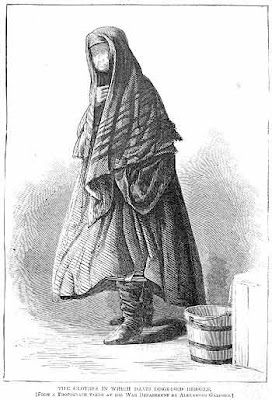
Davis was rumored to be wearing his wife’s dress and shawl at the time of his capture, and Union newspaper and officials reported the claim. (There’s a dispute about whether he intentionally or accidentally put on his wife’s coat while fleeing Union soldiers. One presumes that if Jackson should have also been wearing his wife’s dress, the wearing of it would not have been accidental.) United States Secretary of War Stanton publicized widely the supposed disguise:

The Libertarian Environmentalist

Here’s a post from the FreedomChatter.com entitled, “The Libertarian Environmentalist: A New Beginning of Localism,” advocating for the individual’s indispensable role in conservation. The post is well worth reading — here’s its conclusion:

The true environmental movement begins with the direct experience of an individual and cannot be furthered by governmental law. True environmentalism and libertarianism originate in the same source: the individual. Both believe strongly in individual liberty and the responsibility that comes with that liberty. By providing individuals with the full power of responsibility over their own lives, the environment will take a greater step forward in the minds of people. People won’t feel detached and separated from nature, they will feel a direct connection and obligation in their local communities. Are people not more concerned and responsible about the land, air, and water they see and use on a daily basis?

Return the responsibility of duties to the individual, not unelected bureaucracies promising the wonders of central planning, and you immediately provide the incentive (through property rights) and ability to maintain clean property, engage in sustainable activities, and preserve environmental quality. Returning to the responsibility of the individual on a local level is the only reasonable and lasting method for true conservation and respect of natural beauty.

Reason.tv: How Did GM Pay Back Its Loans “In Full and Ahead of Schedule?” It Didn’t!

Here’s a short, solid description of how corporate-welfare case General Motors is lying when it says it’s truly paid back its government loan. Every ad and statement that GM makes to that claim is fraudulent and, of course, self-serving.

I would not contend that GM was a great car company even five years ago, but I am sure it has never been as dishonest as it is now, under a rotten (and likely destructive) relationship to the federal government.

more >>

Webby Awards: GameZombie TV Wins Big

I mentioned the Webby Awards recently, honoring the best websites in categories receiving honors from judges or popular vote. The Webby Awards are the largest awards of their kind, and GameZombie TV of the University of Wisconsin-Whitewater has won big:

The student-produced Web series GameZombie TV at the University of Wisconsin-Whitewater has won two top awards at this year’s 14th annual Webby Awards.

Competing against projects from much larger schools, GameZombie TV garnered enough votes to win the People’s Voice Award in addition to the Webby Award, whose recipient is chosen by a panel of judges.

“This is something we’ve been striving toward for years now,” said Spencer Striker, UW-Whitewater communication instructor and series creator. “Winning the award from both the academy and the people’s vote makes us the top student online video creators in the world.”

Congratulations to everyone who worked on the series.

(I wrote earlier about the Institute for Justice’s nomination for a Webby Award, and they won a People’s Voice Award in their category.)

For more on the GameZombie TV win, see GameZombie TV Wins Webby Award.

Friday Open Comments Forum

Here’s an open comments post, following reader responses to a recent poll.

The use of pseudonyms and anonymous postings will be fine.

Although the template has a space for a name, email address, and website, those who want to leave a field blank can do so. Comments will be moderated, against profanity or trolls. Otherwise, have at it.

I’ll keep the post open through Sunday afternoon. A test last night showed that my replies may not appear in the precise order of all comments. No matter for now – comments and replies will post. I’ll sort out the issue before next week.

Binge drinking, planning, questions about libertarian ideas, whatever. I will try to moderate and move comments along as quickly as possible.

Whitewater’s Ban on Drink Specials: Bad Origins and False Empiricism

I’m not surprised that a majority on Whitewater’s Common Council made the mistake of banning drink specials at Tuesday night’s Common Council meeting. I wrote about the proposal a few months ago, and I did so in the belief that the ban would be passed.

(For remarks on the topic, see, The New Prohibition – Drink Specials (Part 1, Regulation) and The New Prohibition – Drink Specials (Part 2, Advice)).

Two aspects of Tuesday’s discussion are notable.

Bad Origins

First, the proposal began in the worst way — with a few business people meeting away from the whole Council, with the presence of Whitewater’s Police Chief Coan and City Attorney McDonell, and a Council representative. In a better-ordered community, those involved would know not to meet that way. It’s just business as usual for some in Whitewater. A situation like this has all the makings of a proposal for a special pleader.

When one reads the Daily Union‘s May 5th account of how this ordinance first came before council, one reads that “[t]he issue had been brought to the council by a tavern owner who supported the ban.”

That’s not accurate, and it’s misleading. It’s not even consistent with the paper’s prior coverage of the origins of the ordinance, from a story they published in February:

The issue was brought forth by Councilperson Jim Olsen, who said he was presenting it on behalf of some of the local tavern owners after discussing the issue with them.

“This came up during a meeting with the police chief (James Coan), city attorney (Wally McDonnell), and myself and five of the tavern owners, back in August,” he said. “This was something they requested. When they brought it up, the chief thought it was a good idea …”

They’re not the same accounts, are they? In the most recent account, the DU story makes it seem as though someone walked into council during time for citizen comments, and asked for legislative action. In the earlier — and accurate account — this was an ex parte meeting, of a few, with others unnotified at the time.

(One should note that the Daily Union‘s latest account of the ordinance’s origins isn’t even internally consistent. The latest account is contradictory to the actual origins of the proposal, even within the May 5th’s story. Although the 15th paragraph states that someone approached council, one sees in the 32nd paragraph that there was concern about the proposal’s origins — that it was not a conventional path to council at all.)

The recording of the meeting February meeting, and the DU‘s initial coverage, reveals that this was the effort of a few seeking legislation on their own behalf.

The ordinance is a kind of business welfare — support for some at the expense of others.

False Empiricism.

One would hope for a city with less binge drinking, but this legislation will not produce that result. For the most part, there’s really no attempt to show how the legislation might help, except to repeat that binge drinking is a problem. That’s predictable — advocates of additional legislation use the words ‘binge’ or ‘abuse’ like magic wands to conjure away the need for facts.

Chief Coan’s career, for example, seems to rest on the idea that to say something is to prove it; to declare is enough. On those rare occasions I’ve heard him refer to a study, it’s typically something old or trite, long-since discarded as a concept in other places.

There was, however, an attempt at a more empirical approach at Tuesday’s meeting: a representative’s catalog of other municipalities’ binge-drinking ordinances.

It’s a false empiricism, though, resting not on the relationship between legislation and actual drinking behavior (the true concern), but instead is merely a list of cities’ ordinances. This approach conflates the ubiquity of legislation with its effectiveness. It assumes that legislation widely adopted must accurately address the supposed health risks to which it is addressed.

It’s easy to show that the catalog of ordinances does not establish whether an ordinance for Whitewater would be useful.

Consider an example, from the 1920s, regarding leprosy. One might live in a town that was concerned about the risk of lepers infecting other people, and spreading their affliction. That’s a legitimate health concern — one would not want others to become ill.

The town’s government would wonder what to do, about the risk, and might look and see what other towns had done. Perhaps some banned lepers, others jailed them, some confined them permanently to their homes, some marked them with special clothes, and a few have did nothing.

Looking at that situation, what would someone using this ordinance-examination method conclude? That some proposals are more or less restrictive than others, and perhaps that an approach that’s in the middle would be a moderate, prudent course. After all, an approach in the middle wouldn’t be as restrictive and harsh as some towns’ schemes, or as unrestrictive as others’ approaches.

The town fathers might decide that to prevent the spread of leprosy, they would confine lepers to their homes, but not jail or ban them from town.

As it turns out, leprosy is not highly contagious, is likely not contagious for long, and most are immune to it. A solution that confines lepers permanently to their homes would be consistent with other practices, but would be medically unsound.

Following the examples of other towns would not produce an effective, rational solution.

An ordinance examination-approach conflates a catalog of ordinances with a true empiricism (studying how leprosy rises or falls in a given town with or without legislation).

It’s not a comparison of statutes, but a comparison of statutes to conditions in each town that would be a true and useful empiricism.

Tuesday’s method looks in the wrong place. One would need to compare towns with ordinances, towns without, etc., to actual drinking in those towns.

Needless to say, looking at ordinances alone makes no such comparison.

(Note — I’m not even considering the contention that ordinances banning drink specials actually increase binge drinking — that these efforts to ban drink specials will exacerbate binge drinking by driving it underground, and will lead to greater harm than current commercial practices.)

If enough for now to note that a mere ordinance-by-ordinance comparison is an unsound method to consider correctly the effects of legislation on public health. It has the appearance of an empirical approach, but not the substance of a good method.

Legislation should not advance through special pleading, nor by the power of flowery rhetoric or dubious method.

One can see the meeting online, at http://blip.tv/file/2080598/.

more >>

Daily Bread for Whitewater, Wisconsin: 5-7-10

Good morning,

It’s a rainy morning, and the forecast calls for a day of rain with a high of fifty degrees.

Tonight at Lincoln School’s upper gym, it’s Spring Fling, from 5 to 8 PM. Over at Washington School, it’s Family Fun Night from 6:30 to 8 PM.

In Wisconsin history on this date, the Wisconsin Historical Society recalls an ironic crime from 1932:

1932 – Illegal Distillery Discovered in Janesville

On this date Rupert E. Fessenden, Rock County’s chief deputy, discovered the largest ever illegal liquor distillery in southern Wisconsin. The distillery was found on the old Frances Willard estate south of the Wisconsin School for the Blind. Ironically, Willard was one of the founders of the Women’s Christian Temperance Union. [Source: Janesville Gazette].