
Public Meetings
Planning Board
by JOHN ADAMS •
Public Meetings
Park & Rec Board Meeting
by JOHN ADAMS •
Public Meetings
Friends of Mounds Meeting
by JOHN ADAMS •
@ Municipal Building’s community room
City
More About “Whitewater’s College Campus During the Depression”
by JOHN ADAMS •
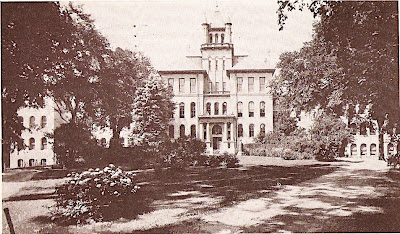
Yesterday, I posted a picture of Whitewater’s college campus as it appeared on a postcard. Here’s a bit more about the postcard that someone sent me —
Below the picture, on the front of the card, is the inscription, “The Normal School, Whitewater, Wisc.”
On the reverse, there’s a green, one-cent stamp, with Benjamin Franklin’s picture. The stamp bears a circular postmark from “Whitewater Aug 13 9 AM Wis.”
The card is from the Auburn Greeting card Co., Auburn, Ind.
Someone sent the post card from Whitewater to a recipient in Forest Park, Illinois.
The greeting and addressee listed on the card are both written in pencil, and describe a trip that included a stop in Paddock Lake. The sender describes a decision not to stay overnight there “for one reason,” left unstated.
The sender concludes that the group of which she’s a part would be heading to Madison, after having traveled one-hundred fifty miles thus far. She notes that they “stopped in this town [Whitewater] to eat. Did I eat.”
Generations ago, someone in Whitewater provided travelers a good meal. The record of that trip survives, in a card sent during the Depression, from our small town.
City, Press Release
Friends of the Mounds Meeting: Monday, May 10th at 5 p.m.
by JOHN ADAMS •
I received the following press release from Friends of the Mounds, about the Indian Mounds in Whitewater, that I’m happy to post:
Dear Neighbors,
As Friends of the Mounds, we met and discussed the proposed name changes to the Indian Mounds Park in Whitewater. There is not consensus in our community about the terminology used to identify the site. The Friends of the Mounds has always supported the preservation of and education about this unique site in the city of Whitewater.
We encourage individuals to share their opinions and to attend the meeting, Monday, May 10, 2010, at 5:00 p.m. at the Community Room of City Hall, Whitewater. In attendance will be Park and Recreation Board, Landmarks Commission, Mounds Task Force and Friends of the Mounds.
Nancy Dade Stone
Carol Christ
Richard Helmick
Mariann Scott
Roberta Taylor
Denay Trykowski
Whitewater, Wisconsin
For questions or more information call Nancy at 262-473- 7917 or Mariann Scott at 262-473-4219
Laws/Regulations, School District
Tribal Symbols for Schools and Legislative Over-Reach
by JOHN ADAMS •
Whitewater’s high school has the whippet as a mascot, following the tradition of many schools to choose impressive animals as symbols. There are, though, some schools in Wisconsin that have chosen tribal leaders or tribes as symbols, including some nearby (the Blackhawks of Fort Atkinson come to mind).
Governor Doyle has signed legislation that allows district residents to complaint to Wisconsin’s superintendent of schools about symbols or mascots that the complainants feel are fostering race-based stereotypes. (The legislation is available online as Senate Bill 25. For more about local districts with such mascots, see Schools Stand Behind American Indian Names.)
The legislation is a bad idea, for four reasons.
First, the legislation takes away local decision-making, and places it in the hands of the state’s superintendent of schools. Local communities should be able to choose their symbols, mascots, etc.
Second, this legislation places the burden on the district , not the complainant, to establish non-discrimination:
At the hearing, the school board has the burden of proving by clear and convincing evidence that the use of the race-based name, nickname, logo, or mascot does not promote discrimination, pupil harassment, or stereotyping, as defined by the state superintendent by rule.
A resident can contend merely on flimsy grounds, but a district must defend with clear and convincing evidence. The burden of proof has been shifted to engineer an easy road to force change.
Third, there’s already a way to challenge locally those symbols that one might not like — through a local school board, and by voting in elections to that board. Residents have always had this option, and placing decision-making in a faraway bureaucrat is a way to trump local authority unnecessarily.
Fourth, the legislation is so broad that it’s possible to complain about any tribal leader as a symbol. One can see that that’s likely the purpose of the legislation, too — not simply to decide against egregious uses, but to make any symbolic use of a tribal leader suspect and impermissible. Note that it is, after all, the state superintendent of schools who has the power to define his own standards by rule.
In this over-breadth, one finds not a respect for racial diversity, but an ideological motivation to rely on a bureaucrat to ban any symbol hyper-sensitive activists find objectionable. One need only read the comments of Barb Munson, head of the Indian Mascot and Logo Task Force, to see that she’s reaching mightily to ban just about any symbol.
Her efforts to rely on an outside arbiter to decide these local questions — involving logos and mascots, not fundamental rights of voting, for example — will only undermine progress toward racial harmony. Imposition of an outside solution for something like a logo is a bad idea. If residents of a community choose symbols foolishly, or insultingly, it should fall to other residents to seek local redress.
There should, and need, be no compromise of the fundamental the rights of all residents. Certainly, a small town, filled with mediocre bureaucrats, must not be allowed to flout state or federal law. I have argued as much consistently. Many a town squire thinks like Yertle the Turtle, puffed with importance, and ridiculously distorts state law and policy into something unrecognizable as either law or good policy.
These logos are not, however, a matter involving risks to fundamental rights. Good or bad, they do not require a state-imposed solution.
By the way, I don’t believe that a symbol like that of Fort Atkinson is wrong or offensive. It seems just the opposite, actually — a genuine tribute to a tribal leader.
Far important still, I believe that the burden of proof should not have been placed on local districts, and that decision-making should never have been placed in the hands of the state superintendent of schools.
Comment Forum
Open Comments Post on Friday
by JOHN ADAMS •
Last week, I mentioned adding comments in response to results from a reader poll. I’ve always been available through adams@freewhitewater.com, but I’m happy to give readers a crack at offering comments in a different way. The leading suggestion, from over half of respondents, was to have an open comments post, as a kind of open comments forum.
I’ll run one on Friday, posted at 8 a.m.
Naturally, use of pseudonyms and anonymous postings will be fine. The template I have has a space for an email address, but those who want to write ‘unlisted’ can do so. Comments will be moderated, against profanity or trolls. Otherwise, have at it. I will try to moderate and move comments along as quickly as possible.
I’ve no idea whether I’ll get any comments, and if I had to guess, I wouldn’t expect more than a few.
I’ll offer a few starter topics, but the comments need not be confined to my selections. Note: I’ll have a post tomorrow at 7 a.m. about Whitewater’s new ban on drink specials.
Finally, if something doesn’t work quite right tomorrow, I’ll head back to the drawing board for next Friday. I’ll not be daunted by an initial glitch. There are no ‘moments,’ in my way of thinking — just an ongoing, consistent commitment of writing and contending.
Daily Bread
Daily Bread for Whitewater, Wisconsin: 5-6-10
by JOHN ADAMS •
Good morning,
Today’s forecast calls for a mostly sunny day in Whitewater, with a high of sixty-three degrees.
Today’s a great anniversary in Wisconsin history — it’s Orson Welles’s birthday. The Wisconsin Historical Society offers details on his extraordinary life:
1915 – Orson Welles Born
On this date George Orson Welles was born in Kenosha. The name George was soon dropped. The family moved to Chicago in 1919, and two years later, Welles’ parents separated. After his mother’s death in 1924, he travelled the world with his father, only to lose him in 1928. Welles turned down the chance at college in 1931, choosing instead to go on a sketching trip to Ireland. In 1934, Welles made his New York debut, playing Tybalt in Katherine Cornell’s staging of Romeo and Juliet.
In the mid 1930s, he established himself as a radio actor on The March of Time and The Shadow, among other shows. He began working with John Houseman and together they formed the Mercury Theatre in 1937. Their program, The Mercury Theatre on Air, became famous for the notorious events surrounding their version of The War of the Worlds in 1938, in which they provoked mass panic among listeners.
A renowned actor, writer, producer, and director, Welles is known best for his roles in such films as Citizen Kane (1941), Jane Eyre (1944), Macbeth (1948), Moby Dick (1956), A Man for all Seasons (1966), and Catch 22 (1970). Welles was awarded an Honorary Oscar in 1971 and a Lifetime Achievement Award from the American Film Institute in 1975.
Despite his lack of commercial success, the Directors Guild of America awarded him their highest award, the D.W. Griffith Award, in 1984. Welles was briefly married to Hollywood actress Rita Hayworth from 1943 to 1948, with whom he had one daughter. Orson Welles died on October 9, 1985. [Source: Wisconsin Film Office].
Here’s a portion of that 1938 program, the original audio having been added to YouTube with a picture of Welles from that time:
Free Markets
Should People Raise Really, Really Tiny Horses? Sure, Why Not?
by JOHN ADAMS •
There’s a story at Wired about the world’s smallest horse. Named Einstein, he was “…born in late April on a farm in New Hampshire. Weighing in at 6 pounds at birth, Einstein appears to have beaten the previous record holder by three whole pounds.” See, Could a Mini Horse Be Bred Small Enough to Fit in Your Palm?
The science of animal husbandry that leads to really small horses is still advancing, despite some unknowns. Einstein may now be the world’s smallest horse, but much smaller horses may be possible. We may see horses that really could fit in one’s palm.
Two quick points.
If horses could really be that small, municipal ordinances against horses in Whitewater wouldn’t make sense. Even now, one can see from a photo accompanying the Wired story that Einstein is much smaller than a Saint Bernard. There are few horses like this, but some of them are small enough to render current ordinances outdated, and increasingly irrational. Circumstance and ingenuity run beyond regulatory imagination.
I would also support continued research and breeding of small horses like this. Breeders may make discoveries useful for humans health, through what they learn about genetics from breeding these small horses. That knowledge might be significant, and about matters far more important than developing lines of miniature horses.
Breeders have an incentive to produce happy, healthy horses without government regulation. The Wired story mentions that the limits on human behavior are private and culture, not public and legal:
The real limits then, may not be genetic, but cultural. At some point, it may become difficult to get healthy, tiny horses. To breed ever smaller horses, we might have to deal with a lot of deformed animals.
“It brings up this question of personal responsibility and what’s humane and what’s inhumane. That’s something the tone of which will be set by public opinion,” [university geneticist] Brooks said. “I don’t think we’re at the point that we’re breeding monsters. I don’t think we’re there but maybe we will be.”
The way [Einstein’s owner] Cantrell sees it, avoiding the downsides of mini breeding comes down to the individual breeders. “It’s just like with dogs: There are puppy mills, and there are mini mills,” he noted. Einstein is more a lucky break than an attempt to breed the smallest horse. Both of his parents are champion 30-inch show horses. He just happened to come out lilliputian.
Cantrell argued that despite the difficulty of breeding the minis, it’s worth it because they provide humans with a special feeling that standard horses cannot.
“When you get up close and personal to a miniature horse that is 30 inches tall, there is something about being able to touch him and walk with him in a very calm and safe manner, where you don’t feel like you’re going to be stomped to death,” Cantrell said.
Below I have embedded a video of Einstein, available through YouTube, in which one can see that although he’s tiny, he seems happy and well-adjusted.
Enjoy.
City, University
Whitewater’s College Campus During the Depression
by JOHN ADAMS •
There are happy coincidences in life, and I received one yesterday. I’ve written about the campus in the last few days. Yesterday, a post card arrived that someone sent of our college campus in Whitewater, with a picture of the school during the Depression. The University of Wisconsin-Whitewater’s campus appears on part of the card as a ‘Normal School,’ a common term for a teacher’s college.
The postmark is from 1934, at a time when America was still mired in unemployment and uncertainty.
I think there’s something hopeful about the picture of the campus, even in hard times — a representation of strength and confidence. That strength didn’t come then, and doesn’t come now, from how something looks, but from the teaching and opportunities offered.
Lovely, in the deepest way, I think.
Daily Bread
Daily Bread for Whitewater, Wisconsin: 5-5-10
by JOHN ADAMS •
Good morning,
It’s a rainy day for Whitewater, with a day of scattered showers and a high of sixty-nine degrees.
It’s Cinco de Mayo, day of celebration of the Mexican defeat of French forces in 1862. The holiday is perhaps more popular in the United States than even Mexico, and represents a defeat over foreign forces outside the hemisphere occupying part of North America. The French later abandoned Mexico.
There’s a Landmarks Commission meeting tonight in Whitewater, from 5 to 7 p.m.
At Washington School, there’s a fifth grade band concert at 2 p.m.
In Wisconsin history today, the Wisconsin Historical Society recalls that today is the birthday of Marc
1942 – Actor Marc Alaimo Born
On this date actor Marc Alaimo was born in Milwaukee. He has appeared in more than 100 TV episodes, including numerous episodes of Star Trek Deep Space Nine, Star Trek The Next Generation, Walker Texas Ranger, Quantum Leap, and Hill Street Blues. He has also appeared in more than 30 films, including Total Recall, Naked Gun 33 1/3, and Tango & Cash. [Source: Internet Movie Database].
The Internet Movie Database to which I have linked observes that Alaimo “has played more distinct roles than anyone else on Trek: two different humans, two different Cardassians, an Antican, and a Romulan.”
Fans of Star Trek may remember particularly Alaimo’s portrayal of Gul Dukat, a Cardassian (who meets a bad end in the Trek series Deep Space Nine).
Uncategorized
Go Badger(s)! “Wayward Badger Found at Downtown Post Office.”
by JOHN ADAMS •
The Milwaukee Journal Sentinel website has a story and accompanying video about a badger found in a Milwaukee post office. Reporter Meg Jones describes the badger’s adventure:
A wayward badger somehow managed to get into a building at the main post office in downtown Milwaukee this morning….
A Department of Natural Resources warden was called to the scene and with the help of postal employees, the badger was herded out of the locker room. The animal huddled in a corner of a gated area outside the building where postal trucks are maintained….
The DNR did not put the badger in a cage because it’s likely it’s living nearby with newborn kits. Badgers, Wisconsin’s state animal, are usually nocturnal creatures who burrow holes into the ground where they live underground. It’s unknown how the badger ended up at the post office.
Badgers really are impressive animals with sharp, distinctive markings.
Here’s the video: