
City
The Fairhaven Postcard
by JOHN ADAMS •
There are lots of interesting items that one can find for sale, of memorabilia of a town’s past. I found something like that recently, and thought readers might find it interesting. It’s a postcard of Fairhaven, in Whitewater, from decades ago.


(I’ve no connection to Fairhaven, except to know of it as a senior care residence in Whitewater. More about Fairhaven is available online, at www.fairhaven.org.)
The postcard is in excellent condition, is unused, and bears the motto, “Fairhaven — Where Life is Added to Years.” It’s from the Artvue Post Card Company, 225 Fifth Avenue, New York, New York.
(I would guess that it dates from the 1950s about fifty years ago, as this was apparently the heyday of Artvue’s publishing. [Note: My initial guess was that the postcard was from the 1950s, but someone kindly wrote and said Fairhaven’s not that old, so I’m on a revised guess, now. My original theory remains, only in strikethrough.])
Daily Bread
Daily Bread for Whitewater, Wisconsin: 4-16-10
by JOHN ADAMS •
Good morning,
Today’s forecast for Whitewater calls for a breezy day with a high of fifty-nine degrees.
It’s a proud day for Wisconsin’s naval history, as the Wisconsin Historical Society recalls that on this day in 1944
1944 – USS Wisconsin Commissioned
On this date the USS Wisconsin battleship was put into active duty for service during World War II. The ship, decommissioned in 1948, was recommissioned in 1951 for service in the Korean War. [Source: The National Maritime Center]

Law
King Kong, YouTube, Universal Studios, and Publishing
by JOHN ADAMS •
I’m a fan of both the original King Kong (1933) and the Peter Jackson version (2005). They’re both astonishing, and among the finest American films I’ve ever seen.
(I know Peter Jackson’s from New Zeland, but his film is American in scope, and deep in an understanding of this country. One of the reasons that I think that the 1976 version — a terrible film in many ways — failed was because it lacked the Carl Denham role. The original and the Jackson version both saw presented Denham as an easily identifiable, big-dreaming, ambitious American. The 1976 version didn’t have Denham, and director John Guillermin lacked any understanding of grand American dreams.)
In the 2005 version, Jackson begins with a montage of life in Depression-era Manhattan, with a mixture of poverty & unemployment, alongside wealth and high-living. Those early scenes — especially in a movie that’s about an adventure on a mysterious island — are astonishing.
I could take a brief clip — about two minutes or less — and post it to YouTube, as an example of a filmmaker’s portrayal of the Depression. One cannot do that, of course, as YouTube’s software scans and blocks a film clip as the property of Universal Studios.
A few quick comments –
YouTube as Private Property.
Although I think there’s a strong fair use claim for using the clip, that’s a claim against action from Universal Studios, not YouTube. If YouTube doesn’t want to post a clip from an adventure film about a rampaging ape, or Depression-era montage, they don’t have to do so. YouTube is private property, and they can restrict clips of Universal’s films. They need not assert, against Universal Studios, or anyone else, any claims at all. That’s their choice.
It’s not censorship, either, for YouTube to ban giant ape films (if they wanted a blanket rule). They’re a private enterprise (part of Google), and not a government agency.
(The do offer users the chance to assert offer fair use justifications that they, YouTube, could evaluate. I don’t know where their evaluations lead, but I can guess that most users who submit a form still don’t get a video clips posted. Again, that’s YouTube’s choice.)
Defending Directly.
If a blogger wanted to post a clip from Jackson’s King King and assert a fair use right to embed the clip, he or she could do so on his or her own website. In this case, no third party would be required — only the blogger and the copyright holder would be involved. I’ve asserted fair use rights on my website before. I’ve not done so in the case of the 2005 King Kong. I’d like to see what would happen to a request to YouTube first. (I think I can guess correctly what will happen.)
Defending Tenaciously.
If something’s important, and worth defending, then it’s worth defending tenaciously. People who don’t understand blogging, and the assertion of rights under the constitution or from a statute (like fair use from copyright law), sometimes don’t expect a tenacious defense of these rights. They may assume the blogger will relent, as they see blogging as a hobby, or a casual pursuit. For some bloggers, that’s likely true.
Not for others, though — there’s no game in asserting one’s rights. It’s safe to say that websites with a lot of political content are likely to be committed to defending against encroachment to speech and other constitutional or statutory rights. Still, a committed defender of individual liberty may be born when told that her travel website site is now unlawful, and banned.
A right asserted also deserves a defense, should one be necessary. It deserves not just any defense, but a tenacious one.
That’s the way in which, when pressed, bloggers are ‘happy warriors,’ in the way that Gov. Al Smith of New York was often described. One fights for something good, and against a worse alternative.
So is it worth fighting over a clip of the 2005 King Kong to be published for critical or artistic commentary? Yes, I am sure that it is. First, I’ll see what YouTube has to say, and after that, I’d be curious to see what Universal might say (if anything).
We’ll see what happens.
Laws/Regulations, Libertarians, Liberty
The Institute for Justice
by JOHN ADAMS •
I’ve added a link to my blogroll for the Institute for Justice, a civil liberties law firm. A tagline from their website tells their tale succinctly: “Litigating for Liberty.” Their motto, “We change the world, and have fun doing it,” tells how much they enjoy their work.
If you’ve not visited their site, it’s surely worthwhile to do so.
One often hears how, in different times, people were excited to be part of a principled commitment, and worthy undertaking. Those who work at the Institute for Justice — and those who support their work — know what it feels like to be part of something good and meaningful, right and hopeful.
Here’s a more complete description of their work, from the IJ website:
Founded in 1991, the Institute for Justice is what a civil liberties law firm should be. As our nation’s only libertarian public interest law firm, we engage in cutting-edge litigation and advocacy both in the courts of law and in the court of public opinion on behalf of individuals whose most basic rights are denied by the government–like the right to earn an honest living, private property rights, and the right to free speech, especially in the areas of commercial and Internet speech. As Wired magazine said, the Institute for Justice “helps individuals subject to wacky government regulations.”
Simply put, we challenge the government when it stands in the way of people trying to earn an honest living, when it unconstitutionally takes away individuals’ property, when bureaucrats instead of parents dictate the education of children, and when government stifles speech. We seek a rule of law under which individuals can control their destinies as free and responsible members of society.
We have accomplished a great deal since our founding in 1991. You may have seen our clients, cases and attorneys featured frequently in the national media, such as ABC News 20/20 or the CBS News program 60 Minutes. As Investor’s Business Daily observed, “The Institute for Justice’s influence is being felt across the nation.”
The Institute for Justice is a 501(c)(3) organization; contributions are tax-deductible.
When bureaucrats impose layer upon layer of regulations on common people, or ban activities entirely, they often assume that there’s no other possiblity, that their way is the only way. They’re often quite sure that they’re right, and surprised when others disagree. Quick to take umbrage, they afterward try twice as hard to force their way on others. Their way makes sense to them; they find others’ ideas alien and strange. There’s nothing alien and strange about a commitment to individual liberty and limited government, especially not in a truly extraordinary place like America.
Their surprise is unsurprising, and its extent measures the distance between our tradition of individual liberty and a pinched, contrary understanding.
Have fun exploring the Institute for Justice website, for the first time, or on a return visit. Looking around, it’s easy to see why the IJ is dedicated to its work, and has fun while working.
Daily Bread
Daily Bread for Whitewater, Wisconsin: 4-15-10
by JOHN ADAMS •
Good morning,
Today’s forecast calls for a breezy day, with a high of eighty-one degrees.
There’s a morning meeting today at 7 a.m. of the Whitewater Aquatic Center Board. The agenda is available online.
It’s Library Night at Culver’s in Whitewater tonight. From 4:00-8:00 p.m, tonight Culver’s will donate a percentage of their sales to the library.
In this day in Wisconsin history, in 1900, Spencer Tracey was born, as the Wisconsin Historical Society reports:
On this date Spencer Tracy was born in Milwaukee. He attended the Northwestern Military Academy in Lake Geneva and Ripon College. He won Academy Awards for Best Actor in Captain Courageous and Boys Town. [Source: Wisconsin Film Office]
City, Laws/Regulations, Libertarians
Could a Libertarian Run a Competitive Campaign Against President Obama? Yes.
by JOHN ADAMS •
Over at Rasmussen Reports, there’s a poll asking about a matchup in 2012 between President Obama and libertarian-oriented Ron Paul. The results aren’t surprising – there’s a considerable support for a libertarian-leaning candidate, even if people don’t always refer to support for free markets, individual liberty, and limited government by using the term libertarian.
In Rasmussen’s matchup, the pollsters finds that if one were to “Pit maverick Republican Congressman Ron Paul against President Obama in a hypothetical 2012 election match-up, and the race [would be] — virtually dead even. A new Rasmussen Reports national telephone survey of likely voters finds Obama with 42% support and Paul with 41% of the vote. Eleven percent (11%) prefer some other candidate, and six percent (6%) are undecided.”
These results are all the more impressive when one considers that Paul has some views idiosyncratic for most libertarians, and that he’s had nowhere near the favorable press attention that President Obama has had. I don’t doubt that Representative Paul would lose a real race against President Obama, but I think he’d come much closer to winning on election day than the incumbent’s supporters, or status quo Republicans, would find comfortable. (Of the group that Rasmussen defines as the “political class,” 95% would favor Obama; of those that Rasmussen defines as “mainstream,” 58% would favor Paul. Definitions of these terms, and the questions and toplines from the survey, are available at Election 2012: Barack Obama 42%, Ron Paul 41%.
More interesting to me is how the results show the decline not of the left, so much as so-called big-government conservatism. There’s been much of that these last several years, and it’s brought the Republican party only voter discontent and defeat. Simultaneously, it left the Republicans unable to challenge credibly the more far-reaching political program of America’s progressives. Those Americans who favor government intervention and regulation aren’t likely to find the lukewarm efforts of big-government Republicans appealing. I don’t support government intervention in this, that, and the other thing, but if I did, I’d rather have the genuine article over a pale copy. Why would one buy a Republican rabbit for the same price as a Democratic mink?
In Whitewater, one can see the Pyrrhic victory that big-government, there-oughta-be-a-law conservatives have had. The price of entry into local politics is a “we-have-to-regulate-something, we-have-to-prohibit-something” admission ticket. Small-government conservative are plentiful in the city, but not so much in office. On a topic like binge drinking, for example, one will find an alliance between incumbent progressives who want to legislative to prevent harm, and incumbent conservatives who want to extend enforcement authority. It’s a bad bargain for the left: the problem of over-drinking won’t go away, and big-government conservatives will just move on to another area of administrative over-reach, using their last effort as a precedent.
These victories come at a price. One can see the wide gap between how officials portray regulatory efforts, and how people freely describe them, whenever comments are published freely. Outside of a small, sycophantic press, initiatives touted as major or extraordinary are often viewed skeptically, or ridiculed. It’s not radicals – we don’t have ‘radicals’ in town – who have come to doubt the florid justifications for government intervention. Look carefully at those voicing objections, and one will see that many are center-right in viewpoint, but increasingly doubtful of one grand claim after another. If enforcement actions meet with increasing skepticism — and they do — it’s because formerly supportive moderates and conservatives have grown tired of grand talk.
New ordinances should be subject to half-year and full-year review, where officials would be required to present concrete, verifiable evidence of a new ordinance’s influence. That’s the last thing many advocates of new regulatory authority would want, but it’s among the first things that the city should require, and expect.
Daily Bread
Daily Bread for Whitewater, Wisconsin: 4-14-10
by JOHN ADAMS •
Good morning,
Today’s forecast calls for a sunny day with a high of seventy-nine degrees.
Walworth County Today has a story about the departure of Fred Burkhardt from the Walworth County Economic Development Alliance, entitled, “Walworth County Economic Development Alliance head takes job in Ohio.”
In January, Walworth County Board Supervisor Dan Kilkenny urged the county board to seek an audit or financial review of the economic development alliance, partly due to what he referred to as Burkhardt’s “serious financial problems.”
“I am not suggesting that something is necessarily amiss with WCEDA’s finances because of the executive vice president’s personal financial problems, nor am I making any accusations,” the supervisor wrote.
“But I think that if you asked a professional auditor, they would advise that an audit would probably be in order under the circumstances.”
Kilkenny wrote that the county board’s lack of oversight and its unwillingness to judge the economic development alliance and its officials objectively would cause embarrassment to the county board.
County board supervisors, however, decided against considering the subject.
Wired has a story today on how technology helps diners detect adulterations in their food: DNA Testing Finds Endangered Whale Meat in Restaurants:
Genetic tests of whale meat from Japanese restaurants in Los Angeles and Seoul, South Korea, have confirmed the meat is from endangered animals.
The Los Angeles bust was publicized in March, prompting a restaurant there to close, but finding the meat in South Korea was even more troubling.
“This problem may be more widespread than we originally thought,” said Scott Baker, a whale researcher at Oregon State University. The identifications are described in a paper published April 13 in Biology Letters.
Killing sei, fin and minke whales was outlawed by the International Whaling Commission in 1986, and trade in their products is forbidden by the Convention on International Trade in Endangered Species.
Possessing or selling whale meat is illegal in the United States. Japan and South Korea allow endangered whales caught as “bycatch” by fishermen to be sold. Japan also operates a research program that’s been criticized as scientific cover for continued whale hunts.
No one thinks that DNA testing was initially designed to analyze restaurant dishes, but the wider application of the technology is a consequence of its increasingly lower cost. There’s no certain or natural use for the technology — its more frequent use is a market development, as more efficient and lower-cost tests meet market demand.
Economy, Government Spending
Do Earmarks Crowd Out Local Private Investment?
by JOHN ADAMS •
Yes, they do. Federal pork depresses private investment. See, from Cato, Do Earmarks Crowd Out Local Private Investment?
Earmarks are like a free package of seeds that turns out to be nothing but weeds, denying space for useful vegetables and attractive flowers.
Laws/Regulations, University
On Binge Drinking and UW-Stout’s Failing Prohibition
by JOHN ADAMS •
I’ve written before about regulation of drink specials in Whitewater, and there’s a video from Reason.tv that considers UW-Stout’s efforts to regulate excessive drinking. The University of Wisconsin-Stout’s Chancellor, Charles Sorenson, has made regulating drinking a top priority, and he’s won acclaim for his efforts. A closer look shows that regulation has simply driven the problem underground, revealing the limitations of regulation, and now leading to still more regulations.
A regulatory approach has the advantage of show, and after the problem is driven into private homes beyond regulatory reach, the subsequent advantage of allowing officials to say, we did everything we could, it’s out of our hands. That doesn’t mean that some officials won’t try to double-down on a regulatory bet, as Sorenson is trying — impose university punishments for off-campus conduct. That, despite prior efforts, Sorenson needs to take this extra step shows how unavailing the initial regulatory efforts in Menomonie (UW-Stout’s hometown) have been.
There’s nothing surprising about the failure of prior efforts at limiting — wait for it — drink specials. The Journal Sentinel has a story about Sorenson’s current campaign, and the story points out the failure of prior efforts in Madison:
An attempt by former UW-Madison Chancellor John Wiley a decade ago to crack down on alcohol abuse at the state’s flagship school resulted in some clashes with critics and with mixed results on dangerous drinking. Limiting drink specials at area bars resulted in fewer tickets for students. But the revelry at house parties and in dorms continued. UW-Madison topped the Princeton Review’s list of top party schools in 2005. This year, the school was No. 8 in the ranking.
First to eighth, out of all America – a problem unsolved.
See, Stout Chancellor Defends University’s Crackdown on Boozing.
If the goal is truly to reduce a problem, the likelihood of monitoring and limiting the problem is greater in a commercial setting of taverns than one of private homes. (When only some tavern owners support regulation, while others oppose, one can guess that there’s more than controlling drinking at work. It’s predictable that some businesses would benefit commercially through using concerns about public health as a limit on others’ competitive advantage in the marketplace.)
For those who’ve wondered, I’m not much of a drinker, by any standard. I don’t think there’s anything glamorous or enjoyable about over-drinking, and I drink rarely. I don’t write about the issue because I have a taste for alcohol, but because I have a distaste for ineffective, often counter-productive, regulations.
Link: http://www.youtube.com/watch?v=-qQzYUZ_MNU
Today, we all take the drinking age for granted, but should we? In fact, the US is one of only four countries in the world with a drinking age as high as 21—the other three are Indonesia, Mongolia and Palau.
Is the policy working to reduce health and safety issues related to youthful alchohol abuse? Is enforcing the drinking age the best use of scarce public resources? What are the unintended consequences of alcohol prohibition for 18-20 year olds?
Organizations such as Mother Against Drunk Driving (MADD) argue that the drinking age is an effective policy and that the answer to ongoing alcohol related problems for 18-20 year olds is more education and better enforcement.
John McCardell, president of Choose Responsibility, and 135 university presidents and chancellors across the country believe it’s time to take a fresh look at the drinking age. The former president of Middlebury College and the new head of Sewanee/University of the South, McCardell says our current system encourages unsupervised binge drinking.
Reason.tv went to the University of Wisconsin-Stout in Menomonie, Wisconsin to get a first-hand look at the war on underage drinking.
Produced and hosted by Paul Feine; shot and edited by Alex Manning. more >>
Daily Bread
Daily Bread for Whitewater, Wisconsin: 4-13-10
by JOHN ADAMS •
Good morning,
Today’s forecast calls for a partly sunny day, with a high of sixty-four degrees.
There will be a PTO meeting at Lincoln School tonight at 6:30 p.m, and a PATT meeting at Washington School at the same time.
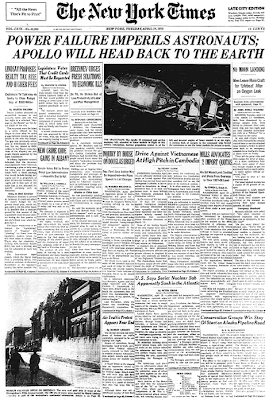
On this day in 1970, an explosion forced the Apollo 13 astronauts to abandon a planned moon landing. The New York Times reported on the event:
Houston, Tuesday, April 14 – The Apollo 13 Astronauts, their lives threatened by a serious oxygen leak, were forced to evacuate their command ship late last night and use their intended moon-landing craft as a “lifeboat” for a fast return to the earth.
In cool and cryptic words, they were instructed by mission control here to use the attached lunar module’s rocket to power them back to an emergency splashdown in the Pacific Ocean at about noon on Friday.
There will be great risks and little margin for error or delay.
At a news conference here officials were asked if there was enough oxygen to get the astronauts back to earth safely. A space agency official answered, “Yes.”
“I’m glad to hear it,” the questioner said.
The lunar landing module has a supply of 48 pounds of oxygen.
Christopher C. Kraft, deputy director of the Manned Spacecraft Center, said:
“I think their chances are excellent at the moment, assuming their lunar module operates all right.”
The crew returned safely to earth four days later, on April 17th.
Daily Bread
Daily Bread for Whitewater, Wisconsin: 4-12-10
by JOHN ADAMS •
Good morning,
It’s a cloudy day in Whitewater, with a chance of thunderstorms, and a probable high temperature in the upper sixties.
There’s a Planning Commission meeting scheduled for Whitewater tonight, at 6 p.m., with a single item on the agenda: “Review the proposal to acquire land for the Starin Road extension from North Fremont Street to Highway 59fNorth Newcomb Street and make a report to the council which will include approval or non-approval by the Plan Commission of the acquisitions.”
There will also be a Library Board meeting tonight, at 6:30 p.m. The agenda for the meeting is available online.
Our public school district’s administrator will hold a public listening session tonight from 5 to 5:45 p.m. at the district’s central office.
It’s Cancer Awareness Week at Whitewater High School, with dress days based on color throughout the week, with a particular color for each day: students are asked to wear a particular color to honor the fight against a particular type of cancer. The days are as follows: Monday Blue for Teen Cancer, Tuesday Orange for Leukemia, Wednesday Green for Lymphoma, Thursday Yellow for Ewing’s Sarcoma and White for Bone Cancer, Friday Pink for Breast Cancer.
On this day in 1861, the Civil War began. The History Channel recalls the beginning of that years-long conflict:
The bloodiest four years in American history begin when Confederate shore batteries under General P.G.T. Beauregard open fire on Union-held Fort Sumter in South Carolina’s Charleston Bay. During the next 34 hours, 50 Confederate guns and mortars launched more than 4,000 rounds at the poorly supplied fort. On April 13, U.S. Major Robert Anderson surrendered the fort. Two days later, U.S. President Abraham Lincoln issued a proclamation calling for 75,000 volunteer soldiers to quell the Southern “insurrection.”
As early as 1858, the ongoing conflict between North and South over the issue of slavery had led Southern leadership to discuss a unified separation from the United States. By 1860, the majority of the slave states were publicly threatening secession if the Republicans, the anti-slavery party, won the presidency. Following Republican Abraham Lincoln’s victory over the divided Democratic Party in November 1860, South Carolina immediately initiated secession proceedings. On December 20, the South Carolina legislature passed the “Ordinance of Secession,” which declared that “the Union now subsisting between South Carolina and other states, under the name of the United States of America, is hereby dissolved.” After the declaration, South Carolina set about seizing forts, arsenals, and other strategic locations within the state. Within six weeks, five more Southern states–Mississippi, Florida, Alabama, Georgia, and Louisiana–had followed South Carolina’s lead.
In February 1861, delegates from those states convened to establish a unified government. Jefferson Davis of Mississippi was subsequently elected the first president of the Confederate States of America. When Abraham Lincoln was inaugurated on March 4, 1861, a total of seven states (Texas had joined the pack) had seceded from the Union, and federal troops held only Fort Sumter in South Carolina, Fort Pickens off the Florida coast, and a handful of minor outposts in the South. Four years after the Confederate attack on Fort Sumter, the Confederacy was defeated at the total cost of 620,000 Union and Confederate soldiers dead.
Fort Sumter is now a United States national monument.

Public Meetings
Planning Commission
by JOHN ADAMS •
Uncategorized
Teaching Euclidean Geometry
by JOHN ADAMS •
Consider a classroom, with a teacher of Euclidean geometry. The teacher lectures on the Elements, and summarizes the work, book by book. The description of the first ten books is conventional and unremarkable.
However, when the teacher comes to book eleven, he tells the students that it’s about Euclid’s postulate of wavy lines, that undulate with the movement of the tides, and change colors with the seasons. A brave student raises her hand, and says that she’s read all the work, and there’s no portion that talks about wavy lines, tides, and seasonal color changes.
In a normal, conventional political culture, of the kind that Americans expect, the teacher would admit his error, one of reading from the wrong book, or being drunk, or simply fabricating the description because he was too lazy to prepare the students’ lesson on book eleven.
In a distorted political culture, that’s not what would happen. The teacher might deny that he was wrong: “No, Euclid did say that. I have the revised copy of the Elements, that only teachers have” or “No, I didn’t say anything about wavy, color-changing lines. You misheard me.”
The teacher might deny that the ridiculously false teaching mattered: “Well, no one cares about book eleven” or “All these postulates are speculative anyway, and no one has to be too exact about them.”
The teacher might even suggest that he had improved on Euclid: “Well, it’s been reported that, in fact, Euclid wanted to change the text of book eleven, to bring it closer to what I’ve said you about lines, colors, tides, and seasons. He would have appreciated my creativity. Oh, and by the way, he always hated students who questioned their teachers.”
There are countless variations.
The explanations for the false teaching all have one thing in common: an upside down notion of what matters most. The teacher holds himself more important than his teaching, and he’s willing to say anything to preserve his own image. The subject, no matter how important or well-established, becomes less important than the teacher’s image. The teacher’s image becomes a principle all its own.
This is the sad state to which a distorted political culture may deteoriate. It’s all about looking good, about political image, substance and policy being merely the appetizers to a main course of self-agrandizement.
That’s a culture of men and women, but not of principle. There’s a difference (one hopes small, sadly often vast) between being an American official and representing American political and legal principles. They are manifestly not the same, but pointing out the difference is often hard for officials to take. Common people understand that difference intuitively; it’s only officials themselves, and a few synchophants, who seem confused or offended by the distinction.
For more on the difference between a government of laws and a government of men, see Jason Kuznicki’s A Government of Laws, Not Men from Cato@Liberty.