
FREE WHITEWATER

Daily Bread for 8.17.20

Good morning.

Monday in Whitewater will be partly cloudy with a high of seventy-nine.  Sunrise is 6:04 AM and sunset 7:52 PM, for 13h 47m 23s of daytime.  The moon is a waning crescent with 3.5% of its visible disk illuminated.


 The Whitewater Unified School District’s board meets via audiovisual conferencing at 6:30 PM in closed session and at 7 PM in open session.

 On this day in 1936, the state of Wisconsin issues the first unemployment compensation check in the United States for the amount of $15.

Recommended for reading in full —

Nitasha Tiku reports Mark Zuckerberg’s effort to disrupt philanthropy has a race problem:

As Facebook faced criticism in recent months about the way its policies can harm Black people, Mark Zuckerberg pointed to his investments in criminal justice reform through the Chan Zuckerberg Initiative (CZI), the philanthropic company he co-founded with his wife as a vehicle to funnel 99 percent of their Facebook stock, now worth roughly $80 billion, into charitable causes.

….

To many Black employees at CZI, however, the organization’s goal of advancing justice has been compromised both by its internal practices and its approach to giving, according to recordings of company meetings, employee surveys, email, and interviews with current and former employees, some of whom spoke on the condition of anonymity because they are not authorized to speak for CZI. Some Black employees say that their voices have been marginalized and their expertise discounted. They also say CZI’s grant-making has left Black leaders and Black communities unsupported.

 Erik Gunn reports Donald Trump Is to Blame for Wisconsin Coronavirus Test Shortage, Lawmaker Says:

“The failure of leadership from the Trump Administration is resulting in a rationing of health care in Wisconsin and it is unacceptable,” [Sen. Tammy] Baldwin wrote in the letter sent on Tuesday, addressing Pence in his capacity as head of the White House Coronavirus Task Force. “Months into this crisis, and we do not have enough supplies available in the state of Wisconsin for the widespread testing that is needed to monitor and contain the virus.”

Baldwin’s letter was prompted by reports that Milwaukee-based Advocate Aurora Health, which operates hospitals and clinics in Wisconsin and northern Illinois, has had to curtail testing as “the federal government redirects testing supplies to COVID-19 hotspots across the U.S.”

Howard Markel writes of America’s Coronavirus Endurance Test (‘To defeat the virus, we will have to start thinking in years, not months’):

The challenge, therefore, isn’t just flattening the curve but keeping it flat—holding the line not for months but for years. In a study published in Science in April, researchers at the Harvard T. H. Chan School of Public Health estimated that, in the absence of a vaccine for the coronavirus, periods of social distancing would be necessary into the year 2022. (Their analysis was, in its own way, optimistic: it incorporated the possibilities of new treatments for covid-19, increases in I.C.U. capacity, and the spread of durable immunity over time.) The researchers noted that, even after social distancing lets up, governments will need to continue tracking the virus and addressing occasional outbreaks. In that sense, there’s a good chance that the pandemic may not be over until 2024.

Not Impossible: Ending Hunger in America:

more >>
A Black Cowboy’s Story

Cowboys are among the most iconic figures of the American West. They’re mythologized as strong, independent people who live and die by their own terms on the frontier. And in movies, the people who play them are mostly white. But as with many elements of Americana, the idea of who cowboys are is actually whitewashed — scholars estimate that in the pioneer era, one in four cowboys were black. The historian Quintard Taylor writes about how before then, enslaved people “were part of the expansion of the livestock industry into colonial South Carolina, passing their herding skills down through the generations and steadily across the Gulf Coast states to Texas.”

In Dillon Hayes’s “All I Have to Offer You Is Me,” we meet Larry Callies, who comes from a long line of cowboys. Growing up in Texas, Callies dreamed of becoming like Charley Pride, the first African-American inductee in the Country Music Hall of Fame. As with the cowboy, there’s an assumption of who makes up country music, despite its diverse history. The breakthrough of artists like Lil Nas X, Jimmie Allen and Kane Brown has returned attention to the contributions of black artists to the genre. Callies’s journey shows what we lose when we don’t acknowledge the full breadth of history.

Daily Bread for 8.16.20

Good morning.

Sunday in Whitewater will be sunny with a high of eighty-two.  Sunrise is 6:03 AM and sunset 7:53 PM, for 13h 50m 00s of daytime.  The moon is a waning crescent with 8.5% of its visible disk illuminated.


 On this day in 1930, the first color sound cartoon, Fiddlesticks, is released.

Recommended for reading in full —

William A. Galston writes Election 2020: A once-in-a-century, massive turnout?:

A new Pew Research Center survey released this week provides the most compelling evidence yet that turnout this November will be massive and that states will be challenged to complete timely counts of a record number of mail-in ballots.

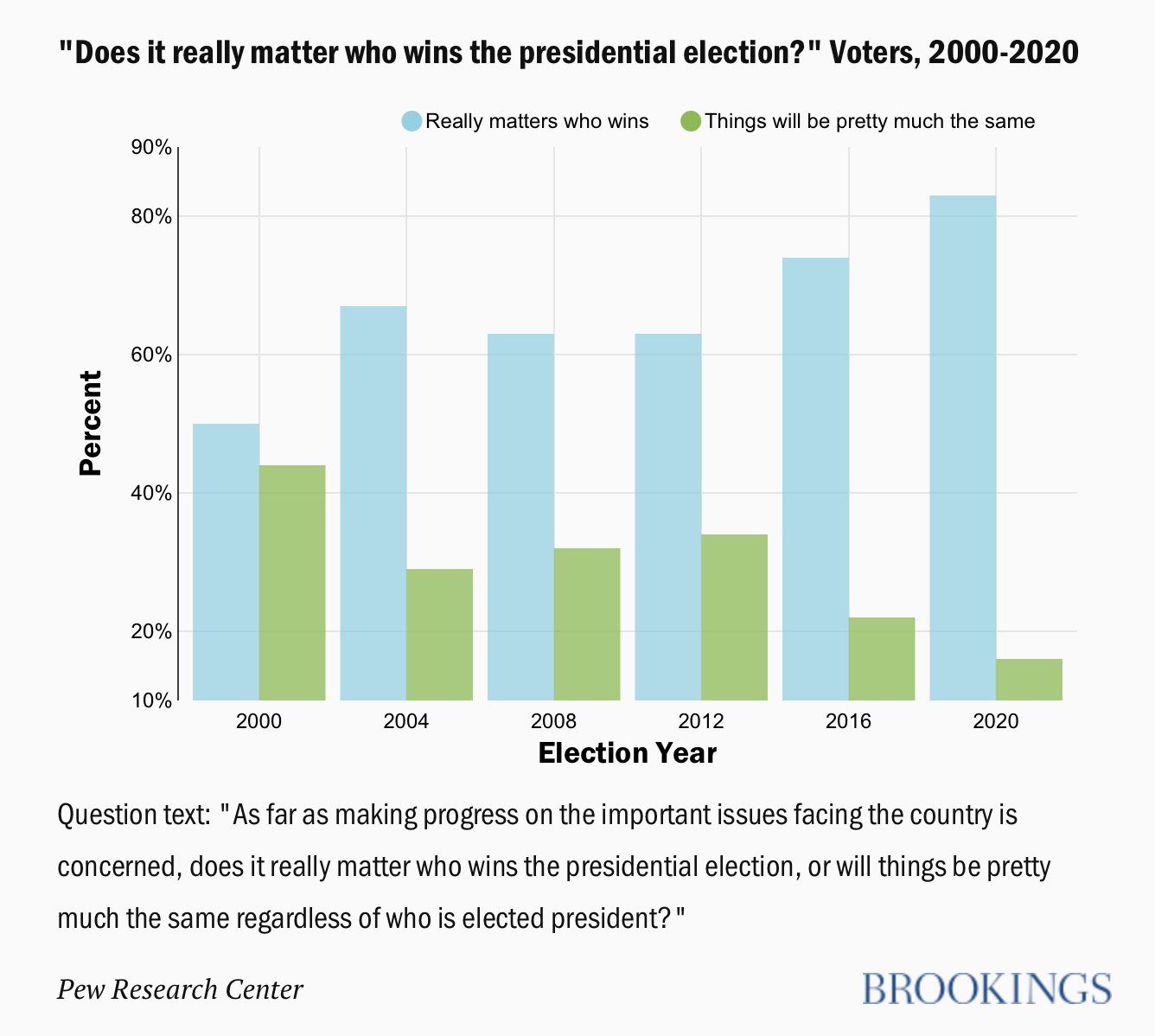
During the past two decades, Pew has used multiple indicators to gauge voters’ interest and intensity as the presidential election approaches. Here are some key findings:

Prior to the 2000 election between George W. Bush and Al Gore, just 50% of the voters thought that it really mattered who won, versus 44% who thought that things would be pretty much the same, whoever won. This year, a record 83%—including 85% of Democrats, 86% of Republicans—say that it really matters.

Although divergent reactions to President Trump are driving some of this intensity, clashes on the issues are playing a role as well. Prior to the 2000 election, 51% of the voters believed that the major party candidates were articulating differing positions on the issues, compared to 33% who saw them as taking similar positions. This year, 86% perceive the candidates as differing on the issues, while only 9% see similarities.

 Steve Elbow reports Postal Service slowdown hits Wisconsin:

Craig Brown started to notice it about three weeks ago when a customer who should have gotten a package within three days called to say it still hadn’t arrived after nearly two weeks. Brown, the owner of Steve’s Curling Supplies — named for his father — has since seen the same thing happen with other packages he’s shipped through the U.S. Postal Service.

One package, he said, is still “in limbo.”

“It normally takes two days, and it’s been a month,” he said.

Thankful that it’s not the busy season, when he normally ships 30 to 50 packages a day, he’s looking with trepidation to the future.

“If this was October through Christmas, when I’m shipping 30 to 50 packages a day, I’d either have to switch everybody to UPS and charge them two to three times as much for shipping, or I’d have to field 20 calls a day from unhappy customers complaining that they haven’t got their stuff yet,” he said.

It’s not business as usual. Last year he shipped more than 3,000 packages and had issues with 10 at most.

Lomi Kriel reports ICE guards ‘systematically’ sexually assault detainees in an El Paso detention center, lawyers say:

Guards in an immigrant detention center in El Paso sexually assaulted and harassed inmates in a “pattern and practice” of abuse, according to a complaint filed by a Texas advocacy group urging the local district attorney and federal prosecutors to conduct a criminal investigation.

The allegations, detailed in a filing first obtained by ProPublica and The Texas Tribune, maintain that guards systematically assaulted at least three people in a facility overseen by Immigration and Customs Enforcement — often in areas of the detention center not visible to security cameras. The guards told victims that no one would believe them because footage did not exist and the harassment involved officers as high-ranking as a lieutenant.

What Breakfast Is Like Around the World:

more >>

Daily Bread for 8.15.20

Good morning.

Saturday in Whitewater will be partly sunny with a high of seventy-nine.  Sunrise is 6:02 AM and sunset 7:55 PM, for 13h 52m 35s of daytime.  The moon is a waning crescent with 15.5% of its visible disk illuminated.


 On this day in 1944, in Operation Dragoon, Allied forces land in southern France.

Recommended for reading in full —

 AJ Vicens reports Michigan’s Postal Workers Say the Fix Is In:

While President Donald Trump forthrightly acknowledged only yesterday [8.13] that weakening the Post Office will help him obstruct mail balloting this fall, postal workers in the key swing state of Michigan say his mission has been clear for weeks.

Delayed mail, a consequence of battles over funding for the United States Postal Service and of the agency’s staffing shortages, affects many aspects of American life—the delivery of millions of prescriptions, paychecks, bills. But recentfunding cuts, overtime reductions, and other changes imposed by Louis DeJoy, the man Trump recently appointed as head of the postal service, have left postal workers warning about new multi-day delays—and that a deliberate effort to slow down the mail and interfere with the election is underway.

“I think it’s absolutely true,” said Steve Wood, a mail clerk who works at the Michigan Metroplex, a massive mail sorting center near Detroit. He says he was convinced in recent weeks as he and his colleagues saw the removal of almost a quarter of the facility’s mail sorting machines, a lack of substitute employees to replace workers missing due to the COVID-19 pandemic, and a general lack of urgency to locate and send along ballots that have piled up in bins.

Rachel Maddow reports Donald Trump’s postmaster general, Louis DeJoy, had to halt the removal of mailboxes from city streets after reporting in Montana led to widespread public outcry:

Paul Waldman asks Is QAnon the shape of the Republican backlash to come?:

The leading contender is already taking shape and working its way into the GOP: the lunatic conspiracy theory known as QAnon. It already has its first soon-to-be member of Congress, along with a raft of candidates who have captured Republican nominations for a number of offices, including in the U.S. Senate. And it has establishment Republicans confused and uncertain, aghast at what it represents but too cowardly to purge it from their ranks.

In case you’re not familiar, QAnon began a few years ago with posts on 4chan claiming that an anonymous government insider (“Q”) was revealing the hidden forces behind all current events. The theory posits that Trump is a messianic figure at war with an international cabal of satanic, cannabalistic pedophiles; at any moment, the president (who in some tellings was partnering in this effort with special counsel Robert S. Mueller III) will expose his enemies and cart them all off to Guantanamo Bay. The FBI believes QAnon poses a domestic terrorism threat.

At Trump rallies, you could see signs and T-shirts promoting QAnon, and the Trump campaign has courted the movement’s adherents. For a president who is, himself, both a consumer and an advocate of all manner of conspiracy theories, it was an easy fit.

Video from Space – Weekly Highlights from This Week:

more >>

Daily Bread for 8.14.20

Good morning.

Friday in Whitewater will be sunny with a high of eighty-five.  Sunrise is 6:01 AM and sunset 7:56 PM, for 13h 55m 10s of daytime.  The moon is a waning crescent with 23.7% of its visible disk illuminated.


 On this day in 1945, Japan accepts the Allied terms of surrender in World War II and the Emperor records the Imperial Rescript on Surrender (August 15 in Japan Standard Time).

Recommended for reading in full —

Amy Gardner, Josh Dawsey, and Paul Kane report Trump opposes election aid for states and Postal Service bailout, threatening Nov. 3 vote:

President Trump on Thursday said he opposes both election aid for states and an emergency bailout for the U.S. Postal Service because he wants to restrict how many Americans can vote by mail, putting at risk the nation’s ability to administer the Nov. 3 elections.

Trump has been attacking mail balloting and the integrity of the vote for months, but his latest broadside makes explicit his intent to stand in the way of urgently needed money to help state and local officials administer elections during the coronavirus pandemic. With nearly 180 million Americans eligible to vote by mail, the president’s actions could usher in widespread delays, long lines and voter disenfranchisement this fall, voting rights advocates said.

Trump said his purpose is to prevent Democrats from expanding mail-balloting, which he has repeatedly claimed, without evidence, would invite widespread fraud. The president has also previously admitted that he believes mail voting would allow more Democrats to cast ballots and hurt Republican candidates, including himself.

In an interview Thursday with Fox Business Network’s Maria Bartiromo, Trump said he opposes a $25 billion emergency injection sought by the U.S. Postal Service, as well as a Democratic proposal to provide $3.6 billion in additional election funding to the states. Both of those requests have been tied up in congressional negotiations over a new coronavirus relief package.

Tom Scheck, Geoff Hing, and Dee J. Hall report Postal delays, errors in Wisconsin and other swing states loom over election:

Based on its own performance measures —  and the loss of hundreds of Wisconsin ballots on their way to voters this summer — the U.S. Postal Service has its work cut out for it before Election Day.

Among the 13 postal districts serving key presidential battleground states, four failed to meet any on-time service goals handling first-class mail between April 1 and June 30, and six districts achieved only one.

The laggards are in, or in parts of, five battleground states — Pennsylvania, Michigan, Florida, Wisconsin and North Carolina — politically competitive blends of urban and rural voters that will likely determine the presidential election. The postal service district serving Arizona, also expected to be a highly competitive state but with voters who typically vote by mail, hit both delivery targets.

 Denise Lu reports The True Coronavirus Toll in the U.S. Has Already Surpassed 200,000:

Across the United States, at least 200,000 more people have died than usual since March, according to a New York Times analysis of estimates from the Centers for Disease Control and Prevention. This is about 60,000 higher than the number of deaths that have been directly linked to the coronavirus.

As the pandemic has moved south and west from its epicenter in New York City, so have the unusual patterns in deaths from all causes. That suggests that the official death counts may be substantially underestimating the overall effects of the virus, as people die from the virus as well as by other causes linked to the pandemic.

Belarus: Detained protesters ‘repeatedly beaten’ and abused in post-election crackdown:

more >>

Social Capital and Hardship

What role does social capital play in a community’s health? Adam Gopnik, in The Paradoxical Role of Social Capital in the Coronavirus Pandemic, ponders whether there’s a relationship between communities with high social capital and a community’s public health. Gopnik uses a traditional definition of social capital as the “parts of society that, without being explicitly political, foster links and bridges of common sympathy and trust.” Of social capital & the novel coronavirus, he writes that

Now, all general truths about the pandemic are premature. But the empirical results so far seem at least to suggest an intriguing paradox: that places with a great deal of social capital got hit worst by the virus, and then recovered fastest.

….

It’s a paradox of place: people who were not socially distanced at the start of the plague had an easier time learning to social-distance by its end. A striking study in Italy, for instance, found that places with high existing “civic capital” tended to “display greater mobility”—that is, people travelled around more—than places without it. But, “as soon as the threat of the virus became real, communities with high civic capital started to self-restrain and to internalize the risk of propagating the infection through social contacts.” Translated from the academese, people who are used to going out a lot stopped when people they trusted told them that doing so was a good way to get sick.

Like Gopnik, one will have to wait for more measurements to see if this relationship of social capital to public health proves generally applicable during this pandemic.

There is, however, obviously a broader way in which discussions of social capital apply; the concept was not developed simply for times of plague or pandemic.

Small Midwestern communities like Whitewater – having struggled for years with related maladies – would do well to consider whether their present divisions, disagreements, and lingering ailments come from a lack of social capital (rather than any single external event).

If that should be so, then this question arises: how will these communities rebuild that social capital? People and communities require no advanced schooling to place an emphasis on private charity, humility, honesty, avoidance of conflicts of interest & rationalizations of them, standard written composition, and sound reasoning.

Instead, for many of these communities, one finds reliance on government action, proud self-promotion, boosterism (accentuating the positive regardless of conditions), conflicts of interest, poor writing, and weak reasoning.

Midwestern communities have had hard times; they’ve also responded in ways that have only increased their own miseries.

Daily Bread for 8.13.20

Good morning.

Thursday in Whitewater will be partly cloudy with a high of eighty-five.  Sunrise is 6:00 AM and sunset 7:58 PM, for 13h 57m 43s of daytime.  The moon is a waning crescent with 32.7% of its visible disk illuminated.


 Whitewater’s Landmarks Commission meets at 1:30 PM via audiovisual conferencing.

 On this day in 1942, Major General Eugene Reybold authorizes the construction of facilities that would house the “Development of Substitute Materials” project, better known as the Manhattan Project.

Recommended for reading in full —

 Jennifer Rubin writes American greatness is in the future, not the past:

When does the president think America was great? Maybe the 1950s, when Jim Crow was in effect and few women worked outside their homes. Maybe the 1970s, when landlords still finagled to deny Hispanic and Black renters a place to live, and when White flight was seen as the antidote to living with “those” people. Maybe it was during the post-Civil War South, when Southerners erected their Lost Cause rubbish, which Trump seems to have adopted as his own, to mask the real motivation behind the Civil War — slavery.

….

November’s election really is about which America you want to live in. The one where Trump and White evangelical snake-oil salesmen would have you think the Lost Cause defines America’s “tradition”? Or the one that reflects the kaleidoscope of American experiences and demands that we take our founding documents seriously? Biden sure had it right when he first declared that the election is about the soul of America. His running mate amplifies his vision of 21st-century America. Together they invite us to stride forward.

 Tom Philpott writes Industrial Hog Farms Are Breeding the Next Pandemic:

The likely source of the next pandemic is all around us: It’s the same one that triggered the 2009 scare. Industrial-scale hog and chicken farming—innovated in the United States and rapidly spreading globally—provides an ideal environment for the evolution and transmission of novel pathogens, especially influenza, that can infect people. (Cattle generally aren’t susceptible to human-adapted flus.)

“Another influenza pandemic occurring at some stage of the future is exceedingly high,” said Richard Webby, professor of infectious diseases at Memphis-based St. Jude Children’s Research Hospital and director of the World Health Organization’s Collaborating Center for Studies on the Ecology of Influenza in Animals. “The chances that it’ll come from some sort of farmed animal—my personal opinion is, that’s high as well.”

Gregory Gray, a professor of medicine, global health, and environmental health at Duke University and an expert on animal-to-human disease transmission, is even more direct. His biggest worry for the next viral pandemic? “Influenza A viruses that originate in pigs,” he said. “Hands down.”

 Oliver Milman reports US proposes change to shower rules after Trump’s hair-washing moan:

The US president’s hair-washing complaints on Wednesday prompted the government to propose an easing of shower pressure standards.

The Trump administration proposed rule changes that would allow shower heads to boost water pressure, after Donald Trump repeatedly complained that bathroom fixtures do not work to his liking.

The Department of Energy plan followed comments from Trump last month at a White House event on rolling back regulations. He said he believed water does not come out fast enough from fixtures.

“So what do you do? You just stand there longer or you take a shower longer? Because my hair – I don’t know about you, but it has to be perfect,” he said.

How Larry King Unwittingly Starred in Chinese Propaganda:

<
more >>

Frontline: Love, Life & the Virus (Full Film)

The story of a young mother in a coma battling COVID-19 after giving birth — and the schoolteacher who stepped in to care for the newborn. This journalism is made possible by viewers like you. Director Oscar Guerra chronicles a 30-year-old mother named Zully and her fight to survive COVID and see her newborn baby, after giving birth on a ventilator and spending nearly three weeks in a coma — as her husband, Marvin, and older son, Junior, battled the virus as well. The film tells the story of how, in the Guatemalan immigrant family’s moment of crisis, their community in Stamford, CT, stepped in to help — including Junior’s ESL teacher, Luciana Lira, who took the newborn into her home while Zully, Marvin and Junior recovered.

Daily Bread for 8.12.20

Good morning.

Wednesday in Whitewater will be sunny with a high of eighty-five.  Sunrise is 5:59 AM and sunset 7:59 PM, for 14h 00m 16s of daytime.  The moon is a waning crescent with 42.3% of its visible disk illuminated.


 On this day in 1939, the Wizard of Oz has its world premiere — in Oconomowoc.

Recommended for reading in full —

Rabbi Jack Moline writes Trump says Biden will ‘hurt God,’ but such 2020 posturing really hurts religious Americans:

The pastors and parishioners who accept Trump’s casual relationship with the truth and with the righteous life they preach are coming up on a test. Come November, will they, like the object of their admiration, replace faith with partisanship. Do their allegiances lie with God or with Trump? Now is the time to stand up and say to him, “Mr. President, we accept your choice to play golf on Sunday morning and behave in uncharitable ways toward others, but we cannot accept your denigration of the Bible itself and Almighty God.” The very suggestion that any human being can damage Scripture and wound God is, to the faithful, blasphemous.

Perhaps that was not what Trump was implying when he said Biden “is going to do things that nobody ever would ever think even possible because he’s following the radical left agenda.” But for years, we have watched the president denigrate the faith of his rivals, demonstrate an abysmal knowledge of the Bible and use a photo op in front of a church as an excuse for violence. This latest attack on Biden suggests Trump is not a man of faith, nor is he a man of decency. But what about his supporters?

 Michael Gerson reports Trump’s seeming indifference to Russian influence is part of his moral incapacity:

Trump’s deeper incapacity is moral. Rather than judging his own actions against the standards of a creed or ideology, Trump finds his ethical inspiration in the mirror. Those who support him are fundamentally good; those who resist him are stupid, malicious and evil. A general or Cabinet secretary who bows and scrapes is the best at his or her job in human history. Those who contradict him are overrated and “dumb as a rock.” People carrying Confederate battle flags along with Trump signs can’t be all bad. Democrats who politically oppose him and media figures who challenge him are traitors or enemies of the people.

For Trump, egotism even takes precedence over nationalism. In his ambitious revision of political ethics, foreign dictators who support his reelection (and imprison their own opponents) are friends and models. Even if they sow discord and chaos in U.S. democracy. Even if they set out to humiliate the country. Even if they offer bounties for killing U.S. troops.

 Amanda Carpenter writes Trump Has a Pen and a Phone:

After riffing on “Sleepy Joe Biden,” hyping unproven allegations of voter fraud, and bragging about his still unbuilt border wall, Trump announced a series of executive orders. He said he would bypass Congress to defer payroll taxes through the end of the year, provide $400-per-week unemployment benefits, suspend payments on some student loans through the end of the year, and stop renters from being evicted from their homes.

Will these orders actually be implemented? Who can say.

They are likely to be challenged in court because only Congress can authorize spending. This is a tenet of Constitutional Conservatism that you may have heard some Republican here or there mention in the times before Trump.

Can These Companies Solve The Plastic Waste Problem?:

more >>