It is a simple principle that public officials should not be newspaper reporters on their own meetings and actions. For readers, reporters, editors, publishers, and public officials this should be obvious.
Worse: public officials should not be newspaper reporters when their roles as public officials are not expressly identified.
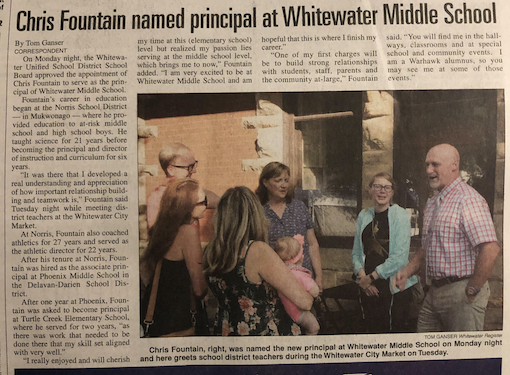
It’s right – of course – to welcome a new school principal, and it’s right to report about his hiring.
It’s not right – and never will be – for a newspaper to use a school board member to report on the hiring, especially when that school board member voted on the hiring and his status as a public official is undisclosed in the story.
I’m not a reporter, and do not want to be (blogging suits me, as pamphleteering suited our forefathers during America’s formative years). I am, however – like so many others – someone who grew up in a household with newspapers and books, where reading carefully and widely was expected.
The Daily Union’s editor (Spangler) has a history of allowing conflicted reporting that looks more like warmed-over press releases for public officials or connected business groups: 1, 2, 3.
A newspaper story about a public employee should come from someone other than a public official (especially one sharing in oversight authority).
Americans – including residents of small towns – have no need to compromise on the standards that make our country great and admirable.
If newspapers now bemoan their economic straits, then they should look to the unnecessary compromises and concessions that they have made to principle.
Thursday in Whitewater will be partly cloudy with a high of seventy-seven. Sunrise is 6:01 AM and sunset 7:56 PM, for 13h 54m 33s of daytime. The moon is full with 100% of its visible disk illuminated.
Whitewater’s Community Development Authority meets at 5:30 PM.
Republican colleagues of a paralyzed lawmaker haven’t signed a letter urging the state Assembly’s leader to allow the Democrat to call in to meetings when he’s unable to attend in person.
All 36 Democratic members of the Assembly signed a letter dated Aug. 8 asking the house’s Republican leaders to provide accommodations for Rep. Jimmy Anderson, which they say are reasonable and fall under requirements of the American Disabilities Act. None of the 63 Republicans attached their names to the letter.
Anderson also is asking Assembly Speaker Robin Vos to prohibit lawmakers from convening in floor sessions that stretch overnight unless there is an emergency purpose for doing so, to conduct business during reasonable hours and to assign an ADA coordinator to determine which accommodations requests should be granted.
“It costs the state nothing and only asks for those in power to be considerate of Representative Anderson’s disability,” the letter reads.
Anderson was paralyzed from the chest down in 2010 after a drunken driver collided with the vehicle he was traveling in, permanently injuring him and killing his family members.
The Fitchburg lawmaker wants to be able to call in to committee meetings when he has difficulty attending them in person for health reasons associated with his disability and to bar lawmakers from meeting overnight, which could prevent Anderson from being able to participate.
Perhaps the most outrageous recent example of secrecy in the name of privacy is the news that Jake Patterson, the man convicted of abducting 13-year-old Jayme Closs and killing her parents, has been moved to an out-of-state prison whose location is not being disclosed, according to a state Department of Corrections spokesperson, “for his safety.” We only know he is now in a prison in New Mexico because the Green Bay Press Gazette was able to determine this independently.
So now Wisconsin is officially sending people to secret prisons to protect their privacy. Don’t ask, because the state won’t tell.
While tornadoes are fairly rare events, the people who actively seek out the storms start their hunts in the United States, the country with far more tornadoes than anywhere else in the world. The US records, on average, more than 1,000 twisters per year. By comparison, Canada, the country in second place, records around 100.
John Bresnahan and Burgess Everett report Deficit Don? Red ink gushes in Trump era (‘The president endorsed a bipartisan budget deal without any of the spending restraints previously demanded by Republicans’):
With a new bipartisan budget deal that does nothing to cut federal spending, Trump is on track for another $1 trillion deficit this year. And there’s no reason to believe the following fiscal year will be any different, with ballooning deficits from higher spending, the 2017 tax cuts — Trump’s signature legislative achievement, which slashed revenue — and none of the entitlement reforms long preached by Republican leaders on Capitol Hill.
Candidate Trump bragged that he would pay off the entire federal debt in eight years, but President Trump is governing as if deficits don’t matter.
In fact, Trump is approaching the level of red ink from President Barack Obama’s first term, when Obama racked up trillion-dollar deficits four years in a row. Trump is on pace to do the same, starting with this year’s yawning deficit of more than $1 trillion, according to budget estimates.
But there are huge differences: Trump has a growing economy with historically low unemployment and a soaring stock market, while Obama was battling a brutal downturn in the economy during the worst recession in 80 years, making it much harder to curb federal spending.
Austerity has an unfairly bad name, and Bresnahan and Everett imply a common claim about the tolerability of spending during recessionary times. Yet there are times when austerity is prudent. See Use—and Abuses—of Austerity, reviewing the fine Austerity: When It Works and When It Doesn’t(available on Kindle and well-recommended).
Trump lacks a recessionary foundation in defense of ever-greater spending. Instead, he endorses spending in huge amounts, favoring chosen investors (men who catch his attention), often unconnected to areas of suffering (such as the Midwest), and propping up otherwise dead-end industries (e.g., coal).
Ironically, Tump’s trade war footing and anti-market tariffs push the economy in a wrong direction that encourages others to seek even more spending to shield against the effects of his trade war footing and anti-market tariffs.
Spending under Trump winds up benefitting those without need (wealthy donors and no-future-anyway companies) with a small part going to compensate for the damage of his own pre-modern economic policies.
Trump’s market interference may drive America to a recession, by which time his trillions in spending will leave less room for those who would otherwise seek – by their estimation – a pro-spending program to lessen that future recession’s effects.
Trump often talks about what’s huge, but his own role as a huge wastrel will only leave America smaller.
Wednesday in Whitewater will see occasional thundershowers with a daytime high of seventy-five. Sunrise is 6:00 AM and sunset 7:57 PM, for 13h 57m 06s of daytime. The moon is full with 99.2% of its visible disk illuminated.
President Trump has repeated the same mantra for months: The Chinese are paying the full price of his tariffs. It’s a line that the overwhelming majority of economists and business owners say is false, but Trump kept saying it — until Aug. 13.
The White House announced Tuesday that the president’s latest tariffs on China would be delayed on many popular items like cellphones, laptops and strollers. The 10 percent tax would not go into effect until Dec. 15, effectively ensuring retailers can import goods for the holidays before the tariffs take effect.
Trump himself told reporters the delay is to ensure consumers don’t face higher costs this Christmas. Here are his full remarks:
“We are doing this for the Christmas season, just in case some of the tariffs would have an impact on U.S. consumers. So far they’ve had virtually none. The only impact has been that we’ve collected almost $60 billion from China, compliments of China. But just in case they might have an impact on people, what we’ve done is we’ve delayed it so they won’t be relevant for the Christmas shopping season,” Trump told reporters before he flew to western Pennsylvania.
He used qualifying phrases such as “just in case” and “might have,” but his words — and actions — are a noticeable change from his insistence that the Chinese are paying the full cost of his tariffs. (Note that the harm to American farmers comes from China’s counter-tariffs, which Trump has sought to offset with a bailout targeting farm country.)
WASHINGTON (AP) — More than one in 10 voters could cast ballots on paperless voting machines in the 2020 general election, according to a new analysis, leaving their ballots more vulnerable to hacking.
A study released by the Brennan Center for Justice at NYU School of Law on Tuesday evaluates the state of the country’s election security six months before the New Hampshire primary and concludes that much more needs to be done. While there has been significant progress by states and the federal government since Russian agents targeted U.S. state election systems ahead of the 2016 presidential election, the analysis notes that many states have not taken all of the steps needed to ensure that doesn’t happen again.
Updated 8.13.19 afternoon with video. Whitewater’s school board met in special session on Monday night, with two main agenda items: hiring a new middle school principal, and considering among several expenditures from five-hundred thousand dollars available to the district.
A few points to consider:
1. The school board unanimously selected Chris Fountain, most recently of the Delavan-Darien School District, as Whitewater Middle School’s new principal. More about Fountain: (1, 2).
2. Every new hire represents possibility, and at first only that. One always hopes for the best, as this community has always been deserving of the best. (SeeChanges at Whitewater Middle School: “There has never been a time – and perhaps never will be – when a mere departure, a mere change of personnel – proved sufficient. A change of leadership is sometimes necessary, but hardly enough, to create a better climate.”)
3. Oddly, it’s in the discussion of the expenditures – what otherwise would seem the smaller matter when compared to the schooling for three grade levels of students – that one encounters an issue almost as important.
The issue is not the money, however large the sum, but how to approach any expenditure.
We live in difficult times, where the end of the Great Recession has left stagnation and poverty, for our rural community and many others.
Under these circumstances, Whitewater’s conditions are less those of a boutique for cosmetic surgery than an emergency room.
Emergency rooms, or other places of serious need, should operate under principles of triage, in which degrees of urgency are assigned to illnesses to decide the order of treatment of a large number of people.
DLT met on August 1st to discuss a 2019-20 budget update. With the budget compiled with all known information, we believe we have $500,000 of revenue or authority available. DLT discussed recommendations:
– Combining two part-time special education paraprofessional vacancies at the HS
– Updating PA systems in three elementaries and MS
– Appropriate additional funds to IT and Curriculum
– Increase sub pay 5% and explore a permanent SpEd para sub
– Waive summer school fees
– Update CO 3rd meeting space
– Increase math interventionist at Washington to 1.0 FTE (from 0.5)
– Add 1.0 FTE pupil services support at Lincoln/Washington (e.g. social worker)
– Increase Lakeview school counselor to 1.0 FTE (from 0.5)
– Appropriate $110,000 for classroom updates (amount dependent on final budget)
Board members had different ideas about whether or how to spend this money, and so there was no action taken.
What’s unexpected, though, is that in difficult economic and fiscal conditions, no one in the meeting could recite from memory an ordered list of district-wide priorities and match that global list against these DLT spending recommendations, right then and there.
Whether in individual agreement or disagreement with such a list, everyone in the district (certainly including elected board members) should be able to recite an agreed-upon triage protocol. Individual disagreement should be encouraged (seeLocal Gov’t Desperately Needs a Version of the ‘Tenth Man Rule’) but that disagreement requires an established, commonly-understood set of priorities against which to measure alternatives.
There are such priorities, no doubt; what’s odd is that they were not at the ready as a foundation for discussion.
4. A simple matter on spending: all decisions are made at the moment, in the margin. One allocates based on present, prospective needs. A school board member who thought that because the district had spent money on six of something it should spend no more wasn’t thinking reasonably: the key concern isn’t what one has already spent (or saved), but how to spend (or save) when evaluating present needs, not past actions.
To insist on additional spending because one has already spent significantly in the same way in the past, ignoring present need or opportunity, is simply to fall into a sunk cost fallacy. In a similar way, to refuse to spend in the present simply because one has already spent a certain amount in the past is to spend without regard to present need or opportunity.
Given where one stands now, with the needs of the present, what its the best allocation among many possibilities? That’s a reasonable outlook.
Principles of triage should guide that discussion, and deviations from those principles should be well-considered and well-explained.
Keeping common priorities top-of-mind isn’t pessimism – it’s an expression of optimism that one can, truly, act to make a difference even in difficult times.
Tuesday in Whitewater will be partly sunny with a daytime high of eighty. Sunrise is 5:59 AM and sunset 7:59 PM, for 13h 59m 38s of daytime. The moon is a waxing gibbous with 96.5% of its visible disk illuminated.
A City of Whitewater Joint Public Works and Finance Committee will meet at 6 PM.
On this day in 1961, Communist East Germany begins construction of the Berlin Wall.
In early June, the Allegheny County Board of Elections held a special meeting in downtown Pittsburgh, inviting a trio of election security experts to offer advice as the county selects new voting equipment. Marian Schneider, a former Pennsylvania state elections official and the current president of Verified Voting, an election security watchdog group, gave an opening statement framing the day’s conversation in stark terms.
….
After the meeting, Candice Hoke, a longtime election administration and security expert who’d also been invited to speak, described the gathering as an unusual bright spot, contrasting the attention Allegheny County had devoted to the issue to many places around the country where the state of election security lags. Efforts by federal agencies to work with states and jurisdictions to improve election security are helping, Hoke says, but the bureaucrats overseeing the country’s more than 10,000 election jurisdictions are still routinely outmatched.
Now, critics of Big Tech are lining up to plead, cajole, and threaten—from the left and right. In June, Senators Cruz (R-TX) and Hawley (R-MO) proposed legislation that would require social media companies over a certain size to prove no political bias when moderating content. Convinced that conservatives voices are being unfairly targeted, they followed up with a letter to the Federal Trade Commission asking for an investigation into moderation policies on Facebook, YouTube, and Twitter. In July, Tulsi Gabbard (D-HI), candidate for the Democratic nomination for President, filed suit against Google for, among other things, “playing favorites, with no warning, no transparency—and no accountability” in their content moderation.
As with the reactive policies implemented by the media companies themselves, this legislation and lawsuit are also naïvely focused on yesterday’s problems. They do not acknowledge the way the platforms are actually being gamed today, nor how they will be abused tomorrow.
Serial harassers and trolls will always figure out tricks to avoid the bans, and even if they somehow catch a block that sticks, the growing “Alt Tech” ecosystem made of decentralized, niche services often located in other countries, is more than willing to scoop them up. Finally banned from YouTube? Try Bitchute or DLive. De-platformed from Facebook or Twitter? Try Telegram, Parler, or Gab—the site favored by the Pittsburgh synagogue shooter back in October 2018—or the so-called “image boards” like 8chan, where the Christchurch, San Diego, and El Paso shooters all posted their manifestos.
Monday in Whitewater will be cloudy with occasional afternoon thundershowers and a daytime high of eighty-one. Sunrise is 5:58 AM and sunset 8:00 PM, for 14h 02m 10s of daytime. The moon is a waxing gibbous with 91.4% of its visible disk illuminated.
The Whitewater Unified School District Board meets at 6 PM in closed session, with an open session beginning at 7 PM.
Item 2A on the agenda for the meeting describes the purpose of the closed session: “Adjourn into closed session, pursuant to the provisions of Sec. 19.85(1)(c), Wis. Stats., considering employment, promotion, compensation or performance evaluation data of any public employee over which the governmental body has jurisdiction or exercises responsibility; specifically, to discuss the middle school principal candidate and contract. (Action Item).”
Item 4E describes names the candidate: “Employment – ADMINISTRATOR – Middle School Principal. Motion to approve the employment of Chris Fountain, middle school principal effective ???” [Question marks in original.]
Item 5A on the agenda lists Staffing and Programming Recommendations (Possible Action Item): “Motion to approve the 2019-20 staffing and programming recommendations, as presented.”
The agenda lists these recommendations:
DLT met on August 1st to discuss a 2019-20 budget update. With the budget compiled with all known information, we believe we have $500,000 of revenue or authority available. DLT discussed recommendations:
– Combining two part-time special education paraprofessional vacancies at the HS
– Updating PA systems in three elementaries and MS
– Appropriate additional funds to IT and Curriculum
– Increase sub pay 5% and explore a permanent SpEd para sub
– Waive summer school fees
– Update CO 3rd meeting space
– Increase math interventionist at Washington to 1.0 FTE (from 0.5)
– Add 1.0 FTE pupil services support at Lincoln/Washington (e.g. social worker)
– Increase Lakeview school counselor to 1.0 FTE (from 0.5)
– Appropriate $110,000 for classroom updates (amount dependent on final budget)
Whitewater’s Planning Commission also meets at 6:00 PM.
Eric Fanning, former Secretary of the Army, remembers When Children at the Border Got Compassion (‘The United States has a moral responsibility for unaccompanied children—and took it seriously, at least in 2014’):
In the spring of 2014, a sudden surge of unaccompanied children began crossing the southern border from Mexico into the United States. I was the undersecretary of the Air Force at the time, and the Pentagon had been tasked with finding facilities and funds so that the Department of Health and Human Services could shelter children until they were reunited with family. It was my job to review the housing that the Air Force would provide. So, with a few others from the Pentagon, I flew down to Lackland Air Force Base in San Antonio, Texas, to see for myself that these children were being cared for and protected…..
It was hard for any of us to understand the trauma the children had already experienced. But we knew that our role—our moral responsibility—was not merely to deal with them, but to care for them. And that is exactly what our country did.
We set up multiple facilities on military bases, and HHS worked with a coalition of organizations to shelter these vulnerable children while we looked for proper guardians. There was an outpouring of local community support, from church groups making food to a nearby school donating artificial turf for a soccer field.
A different set of values is now on display, as a new surge of migrants from Central America is fleeing northward toward the United States. Many are escaping extreme violence, while others are yearning for a better life for themselves and their families. Upon their arrival at the American border, the United States is placing these people—including children—in appalling physical conditions, needlessly turning an immigration challenge into a humanitarian crisis.
The policies currently in effect include stripping kids from their families, holding them in conditions unfit for human health, and prioritizing their incarceration over placing them with family or guardians. Every news cycle brings to light new revelations that tug at our hearts: young children caring for infants; kids covered in food and filth, sleeping on cold floors with the lights always on; officials arguing that “safe and sanitary” doesn’t mean providing soap or toothbrushes, let alone the mental-health services children going through traumatic experiences require.
Sunday in Whitewater will see scattered thundershowers with a daytime high of eighty. Sunrise is 5:57 AM and sunset 8:02 PM, for 14h 04m 40s of daytime. The moon is a waxing gibbous with 86% of its visible disk illuminated.
Today [8.10], President Trump accused his predecessor, Bill Clinton—or possibly his 2016 campaign opponent, former First Lady and Secretary of State Hillary Clinton—of complicity in the death of the accused sex-trafficker, Jeffrey Epstein
Many seem to have responded with a startled shrug. What do you expect? It’s just Trump letting off steam on Twitter.
Reactions to actions by Trump are always filtered through the prism of the ever-more-widely accepted view—within his administration, within Congress, within the United States and around the world—that the 45th president is a reckless buffoon, a conspiratorial racist moron, whose weird comments should be disregarded by sensible people.
….
The certainty that Trump will descend ever deeper into sub-basements of “new lows” after this new low should not numb us to its newness and lowness.
Neither the practical impediments to impeachment and the Twenty-Fifth Amendment process, nor the foibles and failings of the candidates running to replace him, efface the fact that this presidency shames and disgraces the office every minute of every hour of every day. And even when it ends, however it ends, the shame will stain it still.
For nearly two decades, the Trump Organization has relied on a roving crew of Latin American employees to build fountains and waterfalls, sidewalks and rock walls at the company’s winery and its golf courses from New York to Florida.
Other employees at Trump clubs were so impressed by the laborers — who did strenuous work with heavy stone — that they nicknamed them “Los Picapiedras,” Spanish for “the Flintstones.”
For years, their ranks have included workers who entered the United States illegally, according to two former members of the crew. Another employee, still with the company, said that remains true today.
President Trump “doesn’t want undocumented people in the country,” said one worker, Jorge Castro, a 55-year-old immigrant from Ecuador without legal status who left the company in April after nine years. “But at his properties, he still has them.”
Adam Serwer is right to contend that cruelty is the point; this is a policy by the worst for the worst.
America will need an accounting of those who used the state power in this way, down to the last person. We are, fortunately, an advanced society in which records are easily compiled.
A delightful comedy about a group of women who form a cheerleading squad at their retirement community, proving that you’re never too old to ‘bring it.’ Stars Diane Keaton, Rhea Perlman, and Pam Grier.
Saturday in Whitewater will see morning showers with a daytime high of seventy-eight. Sunrise is 5:56 AM and sunset 8:03 PM, for 14h 07m 09s of daytime. The moon is a waxing gibbous with 77.8% of its visible disk illuminated.
On this day in 1846, Pres. Polk signs legislation to establish the Smithsonian Institution as “an Establishment for the increase & diffusion of knowledge.”
Election officials across the country have stepped up efforts to block hackers from wreaking havoc during the 2020 contests after Russians interfered with the 2016 presidential election. Congress has been warned that there could be more foreign interference next year, when Wisconsin is expected to be a presidential swing state again.
But Wisconsin Elections Commission Election Security Lead Tony Bridges said in a memo to commissioners released Friday that some local clerks are still logging into the state election system using Windows XP or Windows 7.
Microsoft stopped supporting Windows XP in 2014 and said it will stop providing free security updates for Windows 7 in January. Bridges wrote that it’s safe to assume a large percentage of clerks won’t upgrade before the deadline or pay for updates. Even clerks with current operating systems often fail to install security patches, he said.
The failure to maintain current operating systems exposes state elections to tremendous risk, Bridges wrote. He pointed to an incident in March in which a ransomware variant called Ryuk shut down vital systems in Jackson County, Georgia, including computers supporting emergency dispatch. Ransomware is software designed to shut down computer systems or data until a ransom is paid.
Ryuk gained access to the systems through a file-sharing vulnerability in older networks. An update that eliminated the vulnerability had been available since 2017, but no one had bothered to install it. The county ended up paying a $400,000 ransom to unlock the system.
Wisconsin elections officials are considering spending more than $800,000 to replace outdated equipment, update software and further address computer security as the state prepares for the 2020 presidential election.
Among the proposals in a Wisconsin Elections Commission plan is to establish a program that would lend new computers to municipalities with outdated operating systems.
More than 500 state elections system users are on computer systems that have reached the end of their life or will do so in the next six months, according to a commission memo. Some of these users have plans to update their systems, but the commission is proposing lending 250 devices to municipalities unable to replace them.
The loans will be free and distributed on a first-come, first-served basis. The equipment is expected to cost up to $300,000.
The action was part of a prayer vigil for migrant children and their families during the ELCA Churchwide Assembly this week at Milwaukee’s Wisconsin Center.
It took place on the same day the Evangelical Lutheran Church in America declared itself a “sanctuary church body,” signaling its support for immigrants.
Both came in response to President Trump’s policies at the U.S. border with Mexico and his pledge to deport millions.
….
More than 570 voting members of the churchwide assembly signed up to participate in the prayer vigil at the ICE building. They were joined by staff from the ELCA and its AMMPARO (Accompanying Migrant Minors with Protection, Advocacy, Representation and Opportunities) ministry, as well as members of the Greater Milwaukee Synod, the New Sanctuary Movement and Voces de la Frontera, a local grass-roots organization.
The group marched nearly a mile from the Wisconsin Center to the ICE building, carrying signs with messages like “We put the protest back in Protestant” and chanting “This is what the love of God looks like.”
Astoria, New York (CNN) — Paul Santell spends at least 30 hours each week feeding and trapping stray cats throughout New York City’s boroughs.
It’s a mission that sort of fell in his lap five years ago but has now earned him the moniker “Paul the Cat Guy.”
“When I moved to Queens, I didn’t realize there were so many cats,” Santell said. “I knew nothing about animal rescue.”
In the United States, there are 30 to 40 million stray or feral cats roaming outside and only about 2% of them have been spayed or neutered. These community cats produce around 80% of the kittens born in the US each year, adding to the overpopulation concern.
On his way home each night, Santell began noticing strays living in poor conditions. He started to feed one of them. That quickly became two cats, then three. Before he knew it, he was feeding a whole colony.
“After about two months of feeding them, I said, ‘You know what? I want to do more to help them.'”
Santell attended an ASPCA class, where he learned about Trap-Neuter-Return, or TNR—defined as the humane and effective approach for managing community cats. Cats are trapped and taken to a veterinarian to be spayed or neutered and vaccinated. After recovery, the cats are released back where they were found or, if they’re friendly, adopted.
“You learn how to use a trap. You understand what colony cats are. And once you get certified, you’re able to use the free spay-neuter service at the ASPCA,” Santell said.