
Daily Bread
Daily Bread for 12.17.16
by JOHN ADAMS •
Good morning.
Saturday in Whitewater will see snowfall throughout the day, with a high of twenty-two and a few inches of accumulation. Sunrise is 7:20 AM and sunset 4:22 PM, for 9h 01m 58s of daytime. The moon is a waning gibbous with 83.4% of her visible disk illuminated.
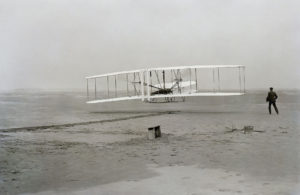
On this day in 1903, Orville and Wilbur Wright make the first successful powered airplane flight, near Kitty Hawk, N.C. Demonstrations of their design in France five years later won over doubters: “Facing much skepticism in the French aeronautical community and outright scorn by some newspapers that called him a “bluffeur”, Wilbur began official public demonstrations on August 8, 1908 at the Hunaudières horse racing track near the town of Le Mans, France. His first flight lasted only one minute 45 seconds, but his ability to effortlessly make banking turns and fly a circle amazed and stunned onlookers, including several pioneer French aviators, among them Louis Blériot. In the following days, Wilbur made a series of technically challenging flights, including figure-eights, demonstrating his skills as a pilot and the capability of his flying machine, which far surpassed those of all other pioneering aircraft and pilots of the day.[95][96]
The French public was thrilled by Wilbur’s feats and flocked to the field by the thousands, and the Wright brothers instantly became world-famous. Former doubters issued apologies and effusive praise. L’Aérophile editor Georges Besançon wrote that the flights “have completely dissipated all doubts. Not one of the former detractors of the Wrights dare question, today, the previous experiments of the men who were truly the first to fly …”[97] Leading French aviation promoter Ernest Archdeacon wrote, “For a long time, the Wright brothers have been accused in Europe of bluff … They are today hallowed in France, and I feel an intense pleasure … to make amends.”[98]“
Worth reading in full —
Chelsey Lewis offers 100 things to do in Wisconsin this winter: “The weather outside is frightful, and the fire may be delightful, but that doesn’t mean there’s no place to go. Beat cabin fever with these 100 things to do across Wisconsin this winter.” (Her list starts strong, as numbers 1, 2, and 3 are enticing.)
Adam Entous and Ellen Nakashima report that the FBI backs CIA view that Russia intervened to help Trump win election: “FBI Director James B. Comey and Director of National Intelligence James R. Clapper Jr. are in agreement with a CIA assessment that Russia intervened in the 2016 election in part to help Donald Trump win the presidency, according to U.S. officials. Comey’s support for the CIA’s conclusion — and officials say that he never changed his position — suggests that the leaders of the three agencies are in agreement on Russian intentions, contrary to suggestions by some lawmakers that the FBI disagreed with the CIA. “Earlier this week, I met separately with (Director) FBI James Comey and DNI Jim Clapper, and there is strong consensus among us on the scope, nature, and intent of Russian interference in our presidential election,” CIA Director John Brennan said in a message to the agency’s workforce, according to U.S. officials who have seen the message.”
Philip Bump reports that Now you can fact-check Trump’s tweets — in the tweets themselves: “We made a tool [an extension for Google Chrome] that slips a bit more context into Trump’s tweets. It’s still in the early stages, but our goal is to provide additional context where needed for Trump’s tweets moving forward (and a few golden oldies). For example, here’s what it shows in relation to that Trump tweet…”
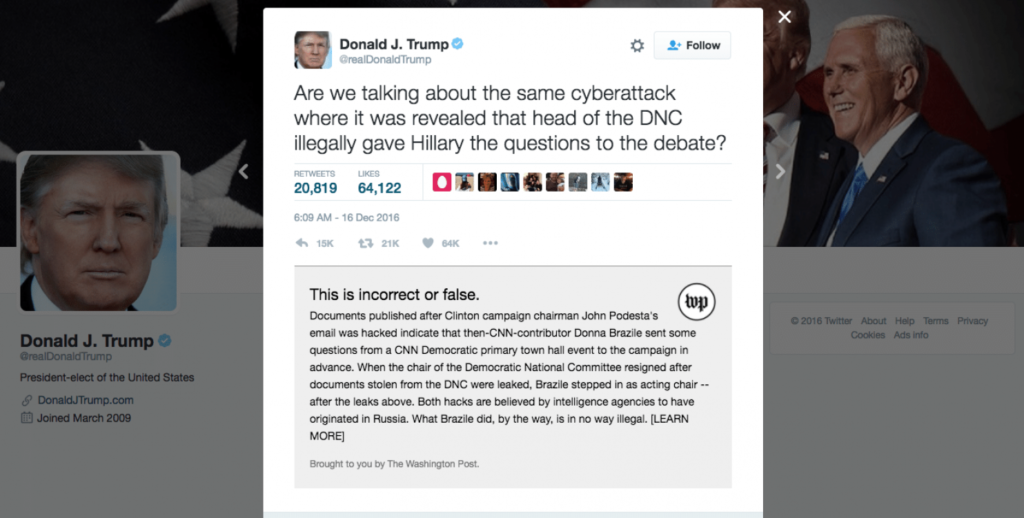
WashPo fact checking tool: extension for Google Chrome, https://chrome.google.com/webstore/detail/realdonaldcontext/ddbkmnomngnlcdglabflidgmhmcafogn .
Visiting Twitter using Chrome produces a fact-checking box under Trump’s tweets that merit fact-checking. (The extension only seems to apply to tweets that are factually refutable; Trump’s mere opinions, or his many misspellings and grammatical failures of standard written English, are left unaddressed.)
Peter Beinart offers a theory about why some (but certainly not all) conservatives support Trump in The Key to the Conservative Spilt on Trump: “Partly, they’re aping Trump. But there’s something deeper at work. Ideological conservatives loathe Putin because he represents an authoritarian challenge to the American-backed order in Europe and the Middle East. But many civilizational conservatives, who once opposed the Soviet Union because of its atheism, now view Putin’s Russia as Christianity’s front line against the new civilizational enemy: Islam. Among the alt-right, Putin is a very popular man. He’s popular because he resists the liberal, cosmopolitan values that Muslims supposedly exploit to undermine the West. Richard Spencer, who was until recently married to a pro-Putin Russian writer, has called Russia the “sole white power in the world.” Matthew Heimbach, another prominent figure in the alt-right, recently told Business Insider that “Russia is the leader of the free world.” In 2013, Pat Buchanan penned a column entitled, “Is Vladimir Putin a paleoconservative? In the culture war for mankind’s future, is he one of us?”
Capra contributed to the Why We Fight series to explain the moral imperative of America’s war with the Axis. We’ve no such series against racist nationalists, but hearing and seeing Richard Spencer is a reminder why each day compels a complete & tenacious resistance against Spencer and his ilk:
Charity, City, Culture, Hip & Prosperous
An Oasis Strategy
by JOHN ADAMS •


There’s a wide difference between believing that we’ve difficult national or local times ahead and losing confidence. I’m as confident today as ever that Whitewater has a bright long-term future. There’s simply hard work ahead between now and then, and more hard work now than we might have hoped (national trends being what they are).
What to do? A few simple suggestions, all around the view that Whitewater can pursue an oasis strategy in which she departs from the routine and emphasizes creatively, with liveliness, the genuinely unique, apolitical accomplishments in the wider area.
Unlike a mirage, an oasis is a real place of real respite. An oasis is noticeable and desirable among its wider surroundings; it’s noticeable and desirable for what it genuinely offers. The mirage presents illusory beauty at a distance but offers nothing up close; an oasis is beautiful at a distance but even more desirable upon arrival.
1. Look away from local government. Common Council isn’t the Roman Senate (and then, the Roman Senate wasn’t what one often hears it was; there were very few truly noble Romans, to be clear about it). Forget the notion that local government sits at the peak of the city. There is no peak; there are thousands of equally valuable spots.
2. Recognize the masking effect of commonplace background noise. Outside Whitewater are Fort Atkinson, Palmyra, Milton, Jefferson, etc. Saying the same things that other towns say in their schools, and at their local council meetings, only gets lost amid the background noise of daily life. Trying to leverage often momentary gains in particular metrics won’t catch anyone’s notice; leveraging selective parts of reports either goes similarly unnoticed, or – far worse – only alienates people already disillusioned with cherrypicking.
Behind tiresome, mundane presentations of school report cards, for example, are stories of genuine, specific accomplishment – what a student wrote, built, said, or discovered. That’s impressive, and compelling. Tell those stores with lively, graceful prose and add video to one’s accounts – short videos will add life to these stories.
3. Emphasize the uniquely creative and charming. We’ve nice restaurants, a charming City Market, an annual race to Discover Whitewater, a Community Foundation, and countless charitable work in the city. More good work is done there than in any conventional political meeting.
The City Market, for example, is charming, but that charm has no particular politics: a style, and a fine selection, are without partisanship. There’s a playful style to the market, but the sensibility that produced that style transcends politics. It’s not enjoyable for one group or demographic – it’s accessible equally to all. When one thinks about something like Discover Whitewater, one wouldn’t think about the politics of the runners – they’re here to have a good time, and the city is here to welcome them.
4. Whitewater’s not one community, nor need it ever be. This city’s not of one culture or one identity; we’re not a homogeneous place. We’re a diverse and multicultural community. Revanchism on behalf of some won’t make the city great for any. On the contrary, that path will prolong present difficulties, and delay significantly (although not prevent) this city’s more prosperous future.
In even the most difficult times, of economic and political trouble, Americans have still produced great works, committed to charitable undertakings, and carried on admirably (all the while addressing national issues separately). This city can do the same, as well as others before us did in their challenging times.
Cats
Friday Catblogging Double Feature: Rescue & Christmas-Tree-Climbing Cats
by JOHN ADAMS •
Highway Rescue —
This cat got stuck on a highway, but rescuers refused to give up on her. pic.twitter.com/Rg1BBlbHJv
— The Dodo (@dodo) December 13, 2016
Christmas-Tree-Climbing Cats —
Daily Bread
Daily Bread for 12.16.16
by JOHN ADAMS •
Good morning.
Here is our small city we’ll have cold temperatures after afternoon snowfall: Friday’s daytime high will be nineteen, with a significant snowfall beginning in the afternoon and stretching into Saturday. Sunrise is 7:20 AM and sunset 4:22 PM, for 9h 02m 13s of daytime. The moon’s a waning gibbous with 91.3% of its visible disk illuminated.
On this day in 1773, the Boston Tea Party takes place as colonists protest British taxation. On this day in 1944, the Battle of the Bulge begins as Germany launches her last major offensive of the Second World War through the Ardennes; the Allies repulsed the offensive within about a month.
Worth reading in full —
Steven Mufson and Max Ehrenfreund report that Trump considers financial pundit Larry Kudlow for Council of Economic Advisors: “If selected, Kudlow would mark another unorthodox pick for Trump. Under both Republican and Democratic presidents, the council has provided expert economic advice to the president and attracts a staff of top-flight young economists. But Kudlow lacks a graduate or undergraduate degree in economics and has not written scholarly papers on the subject….In recent years, he has become a popular figure on television, but his record as an economic forecaster is full of potholes. Less than nine months before the economic crisis hit in 2008, Kudlow wrote in the National Review that “There’s no recession coming. The pessimistas were wrong. It’s not going to happen. At a bare minimum, we are looking at Goldilocks 2.0. (And that’s a minimum). Goldilocks is alive and well. The Bush boom is alive and well… Yes, it’s still the greatest story never told.”
Elena Holodny reports on a study showing that Juvenile incarceration is way more expensive than tuition at a private university: “The annual cost of youth incarceration for a single individual is $112,555, according to the annual report of the Council of Economic Advisers. That’s about 3.5 times the average tuition and fees at a four-year, non-profit private university ($32,405), and almost five times the average cost of tuition and fees at a four-year public university for an out-of-state student ($23,893), according to the report’s data. The cost of incarceration is also more than 11.5 times the average for a year of Head Start ($9,770), and about nine times the cost of an average year of public school ($12,508).”
Evan Osnos, writing of Xu Hongci’s experiences as a dissident in China, asks a difficult question: “What is the precise moment, in the life of a country, when tyranny takes hold? It rarely happens in an instant; it arrives like twilight, and, at first, the eyes adjust.”
Jonathan Martin and Alexander Burns see Democrats at Crossroads: Win Back Working-Class Whites, or Let Them Go?: “For Democrats, the election last month has become a Rorschach test. Some see Mrs. Clinton’s loss as a result of an unfortunate series of flukes — Russian tampering, a late intervention by the Federal Bureau of Investigation director and a poor allocation of resources — but little more than a speed bump on the road to a demographic majority. Others believe the results reflect a more worrisome trend that could doom the party. It’s is a sensitive topic, touching on race and class, but the choices that Democrats make in the coming months will shape their post-Obama identity and carry major implications in both the 2018 midterm elections and the next presidential race.”
 Bob Bryan reports that A professor has calculated how much blowing up the Death Star in ‘Star Wars’ would set back gross galactic product: “In this paper we study the financial repercussions of the destruction of two fully armed and operational moon-sized battle stations (“Death Stars”) in a 4-year period and the dissolution of the galactic government in Star Wars,” began the abstract of the study. “The emphasis of this work is to calibrate and simulate a model of the banking and financial systems within the galaxy. Along these lines, we measure the level of systemic risk that may have been generated by the death of Emperor Palpatine and the destruction of the second Death Star.” With full on footnotes and in-text citations to “Lucas” and “Kershner” (the screenwriters of Star Wars, George and Irvin respectively), Feinstein found that the destruction of the Death Stars and collapse of the Galactic Empire would throw the galactic economy into chaos. “In this case study we found that the Rebel Alliance would need to prepare a bailout of at least 15%, and likely at least 20%, of [Gross Galactic Product] in order to mitigate the systemic risks and the sudden and catastrophic economic collapse,” said the study. “Without such funds at the ready, it likely the Galactic economy would enter an economic depression of astronomical proportions.”
Charity, City, Good Ideas
The Whitewater Community Foundation’s First Annual Campaign
by JOHN ADAMS •
Please see a news release about charitable work in our small city — best wishes to all who are supporting the campaign –
Whitewater Community Foundation is concluding its first ever Annual Campaign
Thank you to everyone who donated! We reached our modest goal of $50,000, and the donations are still rolling in! Thank you to everyone who contributed to help us continue our Community Action Grants. Our grants help nonprofits in town accomplish amazing projects that benefit us in numerous ways – through education, beautification, health and preservation. We believe that real change starts at the local level. And those of you who donated have shown that you believe this too!
If you were thinking about donating and got distracted, you still have time until the end of the year to contribute your tax deductible gift toward great projects in our great city. You can go to our website at whitewatercommunityfoundation.org and click the “donate” button at the bottom of the page or you can donate the old-fashioned way by sending the Whitewater Community Foundation a check to P.O. Box 428, Whitewater, WI 53190. We’ll be contacting you early next year to find out more about what you value in Whitewater.
Business, Corporate Welfare, Economy, State Capitalism, Trump
What a Card! Jean Card’s Comedic Claim That Trump Will Rein in Crony Capitalism
by JOHN ADAMS •
Jean Card is a weekly blogger at U.S. News & World Report (yes, it’s still in publication), former speechwriter for the secretaries of Labor (2001-03) and Treasury (2004-06) in the Bush Administration, and owner of Jean Card Ink, where she is “a writer and communications consultant with a proven track record of translating public policy jargon and government-speak into compelling, persuasive English” with the reassuring company tagline that this is important “Because Words Matter.”
She’s also quite the comedienne, as one can easily discern from her latest post, Will Donald Trump Rein in Crony Capitalism and Let Small Business Flourish? (The subtitle’s even more amusing: “President-elect Donald Trump has crony capitalists sweating and small businesses cheering.”)
In fact, Trump’s economics involves a contradictory (and at bottom) ineffectual mix of badgering and then bribing of large corporations to do what he selfishly wants. John Tamny has it right in Carrier Corp.: Donald Trump Potentially Destroys Millions Of Jobs To ‘Save’ 800:
what’s so shameful about some of the support on the right for Trump’s alleged ‘coup’, Trump’s actions vis-à-vis Carrier sent a strong signal that the U.S. will no longer be as hospitable a locale to the very investors who create all jobs. As Trump so obnoxiously and chillingly put it, “Companies are not going to leave the U.S. anymore without consequences. Leaving the country is going to be very, very difficult.” Where is the outrage? Trump didn’t signal help on the way as much as he signaled retaliation against the companies that don’t do as he wishes….
Funnier still is Card’s contention that Trump will help business by rejecting crony capitalism. Far from rejecting favors for his friends, he’s gone one better: he can use political power to discuss business for himself and his own family rather than mere associates and cronies. Argentina’s president denies that Trump sought favors for a hotel project in that country, but the Guardian reports that “[Argentine] local media reports have alleged that Trump asked [President] Macri for help over a stalled construction permit for a 35-storey project called Trump Office in downtown Buenos Aires. A source told the Guardian that the information came from Macri’s staff.”
Drew Harwell describes Trump’s generally conflicted situation in a story entitled, On the day Trump said he’d clarify his business dealings, his conflicts of interest look thornier than ever:
If Trump gives his children corporate management responsibilities but still partially owns the businesses, he will have a financial stake that could influence his presidential decision-making, former White House ethics advisers said.
Business experts also wonder how Trump could promise “no new deals” for a business that has depended on routine dealmaking — both in large measure, such as signing new real estate partnerships or sealing branding agreements, as well as everyday deals, including hiring employees and refinancing debts.
Some government officials weighed in. Office of Government Ethics Director Walter Shaub, whose agency advises public officials on how to avoid conflicts, wrote in a letter Tuesday to Sen. Thomas R. Carper (D-Del.) that “a President should conduct himself ‘as if’ he were bound by” financial conflict-of-interest laws. “Transferring operational control of a company to one’s children would not constitute the establishment of a qualified blind trust, nor would it eliminate conflicts of interest,” Shaub wrote.
Card wants to position Trump as someone who badgers big companies (“Translation: the cronies are sweating”), but with his approval Indiana targeted seven million for Carrier, Boeing gave a million to Trump’s inaugural committee after being attacked on Twitter, and Trump’s telegraphed-a-day-in-advance attack on Lockheed was no surprise to hedge fund managers.
Sweating? No, they’re cashing in and ponying up for more opportunities.
Oddest of all is Card’s contention that small businesses are hopeful about Trump. She cites a National Federation of Independent Business’ optimism index, without telling readers that (1) the survey is self-selected (it’s only from among NFIB members), (2) the NFIB membership is only a fraction (about 1.1%) of all small businesses in the U.S., (3) the NFIB was the principal plaintiff in a losing case at the U.S. Supreme Court case against the Obama Administration, and – wait for it – (4) Card doesn’t disclose in her post or her US N&WR bio that she was Vice President of Media & Communications for the NFIB from 2010-2014.
Former speech writer, former communications flack, and consultant?
Oh, no, dear readers – it’s a comedy act that Jean Card has going.
America, City
When Are We?
by JOHN ADAMS •
A simple but significant question about the time in which we live: when are we? That is, looking at past events, how far along would we say we are in within a given historical progression (assuming one can say)? Assuming one can say is hardly a simple conditional, but if one could venture a guess, what might one guess?
I’d say that, nationally, we’re at the beginning of something, where that beginning will lead to far worse and far more volatile conditions, perhaps for many years. I say that locally, we’re in the middle of something much smaller, where this small city is likely to see a continuing but slow decline, likely for several more years.
Which, though, matters more? In good national times, one might principally focus on local matters (although I’ve always argued that local should be considered from a national perspective). Yet, I’ve not even the least perceptible feeling that these are good national times. On the contrary, these days have the feel of incipient loss, with this beautiful republic at risk, of a kind unlike that expereienced within our time.
I write all this coldly, with composure, as I’d guess the country has a not a sudden, but rather a lengthy, time of struggle ahead.
Perhaps one can’t find the comparison, but it’s worth noting that a man in the Boston of 1861 or in the New York of 1939 would have more on his mind than events close at hand.
At the least, one would hope so.
If ever one had confirmation that a narrowly and exclusively local focus was foolish, then one has that confirmation now.
Daily Bread
Daily Bread for 12.15.16
by JOHN ADAMS •
Good morning.
Thursday in Whitewater will be clear and cold, with a high temperature of eight degrees. Sunrise is 7:19 AM and sunset 4:21 PM, for 9h 02m 34s of daytime. The moon is a waning gibbous with 98.6% of its visible disk illuminated.
On this day in 1791, following ratification by Virginia, the Bill of Rights takes effect. On this day in 1847, Wisconsin convenes its second constitutional convention in Madison.
Worth reading in full —
William Arkin, Ken Dilanian, and Cynthia McFadden unsurprisingly report that U.S. Officials: Putin [Was] Personally Involved in U.S. Election Hack: “U.S. intelligence officials now believe with “a high level of confidence” that Russian President Vladimir Putin became personally involved in the covert Russian campaign to interfere in the U.S. presidential election, senior U.S. intelligence officials told NBC News. Two senior officials with direct access to the information say new intelligence shows that Putin personally directed how hacked material from Democrats was leaked and otherwise used. The intelligence came from diplomatic sources and spies working for U.S. allies, the officials said. Putin’s objectives were multifaceted, a high-level intelligence source told NBC News. What began as a “vendetta” against Hillary Clinton morphed into an effort to show corruption in American politics and to “split off key American allies by creating the image that [other countries] couldn’t depend on the U.S. to be a credible global leader anymore,” the official said.”
Eli Lake suggests that Obama Should Out Putin’s Wealth as Payback for Election Hacking: “Obama should shine a spotlight on the Russian president’s money. Since the 2014 stealth invasion of Ukraine, the CIA and the Treasury Department have devoted more resources to learning the details of Putin’s personal wealth. Obama should declassify dossiers of Putin’s and his inner circle’s fortune: their front companies, their homes, their yachts, their secret bank accounts. If he’s feeling puckish, Obama could tell his administration to anonymously post all that information on random public websites. He could say the CIA was hacked. Oops. Sorry, Vladimir. Our cyber security is a mess right now. U.S. officials have hinted before that they know more than they are saying about Putin’s money. Adam Szubin, the acting undersecretary of the Treasury for terrorism and financial intelligence, told the BBC in January that Putin “supposedly draws a state salary of something like $110,000 a year. That is not an accurate statement of the man’s wealth, and he has long time training and practices in terms of how to mask his actual wealth.” In October, retired Admiral James Stavridis told NBC News: “It’s well known that there’s a great deal of offshore money moved outside of Russia from oligarchs. … It would be very embarrassing if that was revealed, and that would be a proportional response to what we’ve seen.”
Mark Galeotti writes that Putin Is Waging Information Warfare. Here’s How to Fight Back: “Instead of trying to combat each leak directly, the United States government should teach the public to tell when they are being manipulated. Via schools and nongovernmental organizations and public service campaigns, Americans should be taught the basic skills necessary to be savvy media consumers, from how to fact-check news articles to how pictures can lie.Deterrence can also take the form of limiting the Russians’ ability to buy media muscle covertly. Global finance is still gangsters and the spooks’ best friend, allowing them to secretly move and spend money. By joining the Organization for Economic Cooperation and Development’s latest and most stringent Common Reporting Standards agreement for sharing financial information, for example, and by putting pressure on American states with notoriously tough secrecy laws, Washington would make it harder for not just corrupt Russians officials but also Moscow’s security apparatus to spend money at will in America.”
Elizabethn Weise writes that It’s new and it’s bad: Yahoo discloses 1B account breach: “The latest breach is separate from a 500-million-account breach the company disclosed in September of this year. At the time, the 500-million-account breach, which took place in 2014, was believed to be the largest on record. Yahoo (YHOO) shares fell 2.5% after hours.”
Great Big Story tells describes how “[t]hree paralyzed men take up one of sailing’s most grueling challenges—a 750 mile race to Alaska through some of the most treacherous and remote waters on the planet. With no motors allowed and many miles from any help, the competition can be too dangerous for the world’s most fearless sailors. This team is out to prove they have what it takes to finish…”:
Hard Ship | A Really Great Big Story from Great Big Story on Vimeo.
Authoritarianism, Crime, Foreign Affairs, Trump, Tyranny
Someone the President-Elect Admires
by JOHN ADAMS •
President Rodrigo Duterte of the Philippines, overseer of a contentious and bloody crackdown on drug dealers and users, boasted on Monday about having personally killed criminal suspects when he was mayor of Davao City.
“In Davao, I used to do it personally — just to show to the guys that if I can do it, why can’t you?” Mr. Duterte told business leaders at a meeting in Manila, explaining how he goaded police officers to gun down suspects.
“And I’d go around in Davao with a motorcycle, with a big bike around, and I would just patrol the streets, looking for trouble also,” he said, according to The Manila Times. “I was really looking for a confrontation, so I could kill.”
Via Rodrigo Duterte on Killing Criminal Suspects: ‘I Used to Do It Personally.’
See also Philippine President Duterte unveils his Trump impression, complete with profanities. (“Oh, President Duterte,” Duterte’s Trump impersonation begins. “We should fix our bad relations. It needs a lot of, y’know, you just said something good here. And you’re doing great. I know what’s your worry about these Americans criticizing you. You are doing good. Go ahead.”)
Foreign Affairs, Russia
The Next Secretary of State’s Peaceful & Honest Friends
by JOHN ADAMS •
As #Aleppo civilians were being gunned down in their homes & on the streets, Russia reported there's "jubilation" in the city. #RussiaLies pic.twitter.com/8rvcOm1GDz
— Julia Davis (@JuliaDavisNews) December 14, 2016
America, Authoritarianism, Liberty, Russia
Alexei Navalany Announces Run for President of Russia
by JOHN ADAMS •
We’ll find those we can support, from among our hundreds of millions, with much good work we can do in support.
Daily Bread
Daily Bread for 12.14.16
by JOHN ADAMS •
Good morning.
Midweek in Whitewater will be chilly, with gradually clearing skies and a high of fifteen. Sunrise is 7:18 AM and sunset 4:21 PM, for 9h 02m 57s of daytime. The moon is full, with 99.6% of its visible disk illuminated.
Whitewater’s Aquatic Center Board meets at 7 AM, and her Tech Park Board at 8 AM.
On this day in 1911, Norwegian explorer Roald Amundsen becomes the first man to reach the South Pole. On this day in 1893, Frederick Jackson Turner delivers his “Significance of the Frontier in American History” address at the forty-first annual meeting of the State Historical Society of Wisconsin.
Worth reading in full —
Eric Lipton, David E. Sanger, and Scott Shane describe The Perfect Weapon: How Russian Cyberpower Invaded the U.S.: “An examination by The Times of the Russian operation — based on interviews with dozens of players targeted in the attack, intelligence officials who investigated it and Obama administration officials who deliberated over the best response — reveals a series of missed signals, slow responses and a continuing underestimation of the seriousness of the cyberattack….The low-key approach of the F.B.I. meant that Russian hackers could roam freely through the committee’s network for nearly seven months before top D.N.C. officials were alerted to the attack and hired cyberexperts to protect their systems. In the meantime, the hackers moved on to targets outside the D.N.C., including Mrs. Clinton’s campaign chairman, John D. Podesta, whose private email account was hacked months later.”
Liz Wahl, formerly of the Russia Today network, describes how Trump Is Using Our Old Putin TV Propaganda Playbook: “When news came out that the CIA believes Russia had intervened in America’s election to help elect Trump, his transition team denied it: “These are the same people that said Saddam Hussein had weapons of mass destruction. The election ended a long time ago in one of the biggest Electoral College victories in history. It’s now time to move on and ‘Make America Great Again.’” Invoking Iraq is a common tactic of deflection in Russian media. Asking “What about Iraq?” is meant to bring the conversation to a halt and absolve the Kremlin of any wrongdoing. How dare the U.S. assert any moral superiority after invading Iraq? On my final day of anchoring at RT, when it became apparent Russian forces were present in Ukraine, the news director demanded I pose this question to former Congressman Ron Paul: “The mainstream media has been covering Ukraine non-stop. John Kerry famously said ‘You just don’t invade another country on phony pretext’ Why didn’t the mainstream media challenge the secretary of State regarding pretext to war in Iraq?”
In a post about hacking (Former CIA officer Evan McMullin weighs in on Trump hacking denial), Jennifer Rubin breaks news of a future politics: “[McMullin] says he will be starting a new organization within the month “to stand up for liberty and equality.” What form that takes and whether it spurs Republicans to confront the incoming president, whose actions would prompt calls for impeachment if he were a Democrat, remain to be seen. Nevertheless, McMullin may fill a much-needed role of conservative watchdog.”
Gina Barton reports that in Wisconsin, 3,000 [were] sent to prison without new convictions in 2015: “Nearly 3,000 people in Wisconsin were sent back to prison last year even though they were not found guilty of new crimes, according to a report released Tuesday. Some were on probation when the violations occurred. Others had been released from custody but were still being supervised by the Department of Corrections. About 70% of them were suspected of criminal activity, the department says. But because they were not formally charged, they did not have due process rights in court. These ex-offenders were re-incarcerated for “technical violations,” which also can include things such as accepting a job without permission, missing a meeting with their probation and parole officer, or leaving their home counties.A Journal Sentinel investigation published last year found the process that forces violators back behind bars relies largely on the judgment of individual parole agents, which can vary widely. Once accused of violations, people on parole can be sent back to prison for years without proof beyond a reasonable doubt — and they are left with little chance of a successful appeal.”
They’ve been friends for a long time, one hears, and there are still cabinet positions to fill…
“We’ve been friends for a long time”: Kanye West and President-elect Trump appear together at Trump Tower https://t.co/QoofBJzY1x pic.twitter.com/DK6z1P9LhG
— CNN (@CNN) December 13, 2016
Foreign Affairs, Television
Cable News Never Fails to Disappoint
by JOHN ADAMS •
Priyanka Boghani of Frontline PBS writes of today’s news —
None of the cable news networks on in our newsroom right now seem to think Aleppo burning is more important to cover than Kayne meeting Trump.