FREE WHITEWATER

Daily Bread for 3.30.16

Good morning, Whitewater.

Wednesday in town will see a likelihood of afternoon showers and a high of fifty-six. Sunrise is 6:37 AM and sunset 7:17, for 12h 42m 09s of daytime. The moon is a waning gibbous with 61.8% of its visible disk illuminated.

The Tech Park Board meets today and 8 AM, and a landscape committee of the Urban Forestry Commission at 1 PM.

On 3.30.1867, Secretary of State William Seward signs a treaty (later ratified) for a large purchase:

U.S. Secretary of State William H. Seward signs a treaty with Russia for the purchase of Alaska for $7 million. Despite the bargain price of roughly two cents an acre, the Alaskan purchase was ridiculed in Congress and in the press as “Seward’s folly,” “Seward’s icebox,” and President Andrew Johnson’s “polar bear garden.”

The czarist government of Russia, which had established a presence in Alaska in the mid-18th century, first approached the United States about selling the territory during the administration of President James Buchanan, but negotiations were stalled by the outbreak of the Civil War. After 1865, Seward, a supporter of territorial expansion, was eager to acquire the tremendous landmass of Alaska, an area roughly one-fifth the size of the rest of the United States. He had some difficulty, however, making the case for the purchase of Alaska before the Senate, which ratified the treaty by a margin of just one vote on April 9, 1867. Six months later, Alaska was formally handed over from Russia to the United States. Despite a slow start in U.S. settlement, the discovery of gold in 1898 brought a rapid influx of people to the territory, and Alaska, rich in natural resources, has contributed to American prosperity ever since.

On this day in 1865, Wisconsinites fight in Virginia:

1865 – (Civil War) Battle at Gravelly Run, Virginia
The Battle at Gravelly Run erupted east of Petersburg, Virginia. The 6th, 7th and 36th Wisconsin Infantry regiments participated in this battle, which was one of a series of engagements that ultimately drove Confederate forces out of Petersburg. Wisconsin’s Iron Brigade regiments fought at Gravelly Run, and when ordered to fall back before the enemy, they were the last to leave the field.

A Google a Day asks a question about architecture:

Of what type of architecture is the Paris Cathedral that in 1970 was the site of Charles de Gaulle’s funeral?


Assumptions on Referenda

33cscreenshotPost 11 in a weekly series.

There’s a theory – in Whitewater and other places – that good policy comes from having as many ‘adults in the room’ (that is, as many established & mature people) as possible. I’d say that’s necessary, but insufficient. Relying only on the established & mature, without specific consideration of discernment and insight, relies on too little.

One has to ask: what do you believe, and why do you believe it?

Asking what one believes, and why one believes it, should be an ongoing exercise. Circumstances change; one evaluates anew by what exists now, not on what was, or on what one thinks about oneself.

In the last Whitewater Schools referendum, I assumed (incorrectly) that the vote would be close, and that even the place of the referendum question on the ballot might prove significant.

Looking back, those assumptions were wrong: the referendum carried well enough, and ballot position probably made little if any difference.

I thought as I did because previous referenda in Whitewater had been contentious. That was, however, some time ago.

Looking at referenda results now, from across the state, it’s clear that an overwhelming number of referenda pass (74 of 76 referenda from the February 2016 elections passed).

What does this mean? A few new assumptions and questions:

1. A majority of voters will support more spending for schools, even using referenda to do so.  This must include significant numbers of voters who did (and still do) support Act 10.  It’s numerically impossible that every winning referendum came about only with the votes of those opposed to Act 10; even obviously conservative districts have supported referenda.

2. Waiting for an outcry against spending, of the kind outcry that this school district had in the past, is probably waiting for a lion who’s not there, and won’t show up.

3. Some referenda will fail, and some will only pass on a second try (still possible under our laws, mere legislation obviously notwithstanding).

4. It’s impossible that because most referenda pass, any referendum has a greater than ninety percentage chance of success.  These votes are not like drawing lots, where nine of ten are drawn, without knowledge of what the lots look like.  On the contrary, the minimum requirements of a school referendum require a stated amount sought and the purposes for it.

(Janesville not long ago proposed a municipal referendum where the city sought an amount but described no purpose for it.  It failed, of course.  By the way, the recommendation to submit a referendum without a stated purpose is an example of some of the worst municipal lawyering I can recall.)

5. There must be – in these many referenda that succeed – a successful gauging of what the community will bear.   It’s not (I’ll assume it cannot be) only by chance that referenda succeed.

6. Even in a favorable climate, requests will have to be defensible, as even a favorable climate has limits.

7. What is that defensible amount, and what are those defensible purposes?  I’m not sure.

8. Is it easier or harder to advance a referendum in a unified school district (that is, one that is made up from several towns)?  I think harder, overall, for reasons I’ll state in a future post.

So, a revised assumption: that a referendum’s more likely to pass that I thought at the time of our last referendum, but there are still critical elements that make the high success rate of February 2016’s referenda deceptively reassuring.

Next week: What Not to Do When Seeking a Referendum.

THE EDUCATION POST: Tuesdays @ 10 AM, here on FREE WHITEWATER.

(About the picture for this series – it’s a screenshot of a calculator app for Android phones that emulates a Hewlett Packard 33C.  I used an HP calculator in school, and they were amazing machines.  My phone’s calculator app pays tribute to a fine machine of yore.)

Daily Bread for 3.29.16

Good morning, Whitewater.

Tuesday in town will be mostly sunny with a high of fifty-nine. Sunrise is 6:39 AM and sunset 7:18 PM, for 12h 39m 15s of daytime. The moon is a waning gibbous with 70.9% of its visible disk illuminated.

On this day in 1929, the president gets a desk phone:

…President Herbert Hoover has a phone installed at his desk in the Oval Office of the White House. It took a while to get the line to Hoover’s desk working correctly and the president complained to aides when his son was unable to get through on the Oval Office phone from an outside line. Previously, Hoover had used a phone located in the foyer just outside the office. Telephones and a telephone switchboard had been in use at the White House since 1878, when President Rutherford B. Hayes had the first one installed, but no phone had ever been installed at the president’s desk until Hoover’s administration.

On this day in 1865, Union soldiers, including many from Wisconsin, near the end of a long war:

1865 – (Civil War) Appomattox Campaign Begins in Virginia
When it became clear that the Confederate capital at Richmond, Virginia, was about to fall, Confederate leaders and troops began moving west toward the town of Appomattox Court House. Union troops, including several Wisconsin regiments, followed close on their heels in a series of battles fought March 29 – April 9, 1865, that became known as the Appomattox Campaign.

A Google-a-Day asks a history question:

What tactics did Germany use in France, forcing a desperate British withdrawal at Dunkirk?

The View from 30,000 Feet

WGTB logo PNG 112x89 Post 67 in a series.

For today, a simple question about waste importation into Whitewater:

301. If there had been no milk processing plant in Whitewater, would the city have constructed digester capacity as large as it now has, for importing waste into the city from other locations? That is, in cases like these, would one ordinarily separate a production facility from a waste-receiving facility?

For proponents, this question probably seems irrelevant, as there already is this capacity in Whitewater (and so one might as well use it). The unused capacity to them must seem like a happy accident, or a long-forgotten gem, again found.

And yet, it’s both relevant and material, as a truly profitable waste-importation regime could be duplicated by any city through long-term financing.

Are there really long-enduring, unique happy accidents in a capitalist system?

WHEN GREEN TURNS BROWN: Appearing at whengreenturnsbrown.com and re-posted Mondays @ 10 AM here on FREE WHITEWATER.

Whitewater update: I’ll spend part of the next two weeks or so working on the stand-alone website for this series, and then storing content for it there. That way I’ll have only a single location as a repository, and will re-post content (at least some) back here at FW on Mondays. I’ve gone through several themes without (yet) finding one that seems just right. It will be a long series, so there’s time to find something good.

The more I think about the series, the more interesting it is to me, and the more I think that there are related topics to be explored. It’s about a project, of course, but that project implicates our city’s view of itself and of its development. I’m opposed the the project, to be sure, but the more I hear of it, the more justified the focus (immediately and widely) seems.

Daily Bread for 3.28.16

Good morning, Whitewater.

Monday in town will begin cloudy skies, but give way to afternoon sunshine and a high of fifty-two.  Sunrise is 6:41 AM and sunset 7:17 PM, for 12h 36m 21s of daytime.  The moon is waning gibbous with 79.2% of its visible disk illuminated.

Cockatiels sometimes imitate human speech,  but then there are iPhone tones to mimic, too:

On this day in 1979, a reactor overheats at Three Mile Island:

The most serious nuclear accident in United States history takes place at the Three Mile Island plant near Harrisburg, Pennsylvania, on this day in 1979, when one of the reactors overheats. Fortunately, a catastrophic meltdown was averted and there were no deaths or direct injuries from the accident.

The Three Mile Island plant had begun operations just months earlier on December 28, 1978. Very shortly after operations began, problems arose. It was 3:58 a.m. on March 28 when a pump that directed steam to the plant’s electric turbines stopped working, causing a water circulation pump to break down. Without the water, the temperature of the reactor rose dramatically and a relief valve opened to stop the pressure from building to dangerous levels. Unfortunately, the valve then would not close.

The plant operators, with no experience in emergencies, made key errors. Another valve was opened to allow water from the nuclear system into a waste tank. But this water ruptured the tank and radioactive water flooded into the reactor. Even worse, an operator shut off the automatic core-cooling system. The result of all these events and mistakes was that radioactive steam poured out of the plant. Additionally, radioactive water had to be released into the Susquehanna River. However, area authorities were not notified of these events until nearly three hours later.

A Google a Day asks a sports question:

In what year did the manager and team depicted in the blockbuster film “Moneyball” finally win their first playoff series?

Daily Bread for 3.27.16

Good morning, Whitewater.

Easter Sunday in town will be mostly cloudy, with a probability of rain, and a high of forty-eight.  Sunrise is 6:43 AM and sunset 7:16 PM for 12h 33m 26s of daytime.  The moon is a waning gibbous with 86.3% of its visible disk illuminated.

On this day in 1912, Japanese cherry trees are first planted along the Potomac as a sign of friendship between Japan and America:

In Washington, D.C., Helen Taft, wife of President William Taft, and the Viscountess Chinda, wife of the Japanese ambassador, plant two Yoshina cherry trees on the northern bank of the Potomac River, near the Jefferson Memorial. The event was held in celebration of a gift, by the Japanese government, of 3,020 cherry trees to the U.S. government.

The planting of Japanese cherry trees along the Potomac was first proposed by socialite Eliza Scidmore, who raised money for the endeavor. Helen Taft had lived in Japan while her husband was president of the Philippine Commission, and knowing the beauty of cherry blossoms she embraced Scidmore’s idea. After learning of the first lady’s interest, the Japanese consul in New York suggested making a gift of the trees to the U.S. government from the city of Tokyo.

In January 1910, 2,000 Japanese cherry trees arrived in Washington from Japan but had fallen prey to disease during the journey. In response, a private Japanese citizen donated the funds to transport a new batch of trees, and 3,020 specimens were taken from the famous collection on the bank of the Arakawa River in Adachi Ward, a suburb of Tokyo. In March 1912, the trees arrived in Washington, and on March 27 the first two trees were planted along the Potomac River’s Tidal Basin in a formal ceremony. The rest of the trees were then planted along the basin, in East Potomac Park, and on the White House grounds.

The blossoming trees proved immediately popular with visitors to Washington’s Mall area, and in 1934 city commissioners sponsored a three-day celebration of the late March blossoming of the trees, which grew into the annual Cherry Blossom Festival….

On 3.27.1920 Wisconsin, a national first:

On this date Janesville was chosen as home base for the National Guard’s first tank company in the United States, the 32nd. When activated for duty during WWII, the unit was called Company A, 192nd Tank Battalion. This company fought in the Philippines during World War II. Many of the ninty-nine Janesville men who became prisoners of war and were tortured during the infamous Bataan Death March, were affiliated with this tank company. Its story is told in a compelling collection of documents and interviews created by high school students in nearby Maywood, Illinois. [Source: Janesville Gazette.]

Daily Bread for 3.26.16

Good morning, Whitewater.

Saturday in town will be mostly sunny with a high of fifty-four.  Sunrise is 6:44 AM and sunset 7:15 PM for 12h 30m 32s of daytime.  The moon is a waning gibbous with 91.8% of its visible disk illuminated.

On this day in 1953, a medical accomplishment becomes public:

On March 26, 1953, American medical researcher Dr. Jonas Salk announces on a national radio show that he has successfully tested a vaccine against poliomyelitis, the virus that causes the crippling disease of polio. In 1952–an epidemic year for polio–there were 58,000 new cases reported in the United States, and more than 3,000 died from the disease. For promising eventually to eradicate the disease, which is known as “infant paralysis” because it mainly affects children, Dr. Salk was celebrated as the great doctor-benefactor of his time.

In Wisconsin history on this day in 1881, a famous mascot dies in an accident:

1881 – Old Abe Dies
On this date Old Abe, famous Civil War mascot, died from injuries sustained during a fire at the State Capitol. Old Abe was the mascot for Company C, an Eau Claire infantry unit that was part of the Wisconsin 8th Regiment. During the Capitol fire of 1881, smoke engulfed Old Abe’s cage. One of his feathers survived and is in the Wisconsin Historical Museum. [Source: Wisconsin Lore and Legends, pg. 51]

Daily Bread for 3.25.16

Good morning, Whitewater.

Good Friday in Whitewater will see a high of forty-eight and gradually clearer skies. Sunrise is 6:46 AM and sunset 7:14 PM, for 12h 27m 37s of daytime. The moon is a waning gibbous with 96.5% of its visible disk illuminated.

On this day in 1911, America experiences an industrial tragedy:

In one of the darkest moments of America’s industrial history, the Triangle Shirtwaist Company factory in New York City burns down, killing 145 workers, on this day in 1911….

The Triangle factory, owned by Max Blanck and Isaac Harris, was located in the top three floors of the 10-story Asch Building was a sweatshop in every sense of the word: a cramped space lined with work stations and packed with poor immigrant workers, mostly teenaged women who did not speak English. At the time of the fire, there were four elevators with access to the factory floors, but only one was fully operational and it could hold only 12 people at a time. There were two stairways down to the street, but one was locked from the outside to prevent theft by the workers and the other opened inward only. The fire escape, as all would come to see, was shoddily constructed, and could not support the weight of more than a few women at a time….

On March 25, a Saturday afternoon, there were 600 workers at the factory when a fire broke out in a rag bin on the eighth floor. The manager turned the fire hose on it, but the hose was rotted and its valve was rusted shut. Panic ensued as the workers fled to every exit. The elevator broke down after only four trips, and women began jumping down the shaft to their deaths. Those who fled down the wrong set of stairs were trapped inside and burned alive. Other women trapped on the eighth floor began jumping out the windows, which created a problem for the firefighters whose hoses were crushed by falling bodies. Also, the firefighters’ ladders stretched only as high as the seventh floor, and their safety nets were not strong enough to catch the women, who were jumping three at a time.

On this day in 1865, the 36th and 38th engage Confederates in Virginia:

1865 – (Civil War) Battle of Fort Stedman, Virginia
The 36th and 38th Wisconsin Infantry regiments participated in the Battle of Fort Stedman, Virginia, during the Siege of Petersburg. Confederate troops temporarily broke through the Union lines and captured the fort but soon lost it to superior numbers.

Daily Bread for 3.24.16

Good morning, Whitewater.

We’ll have a wintry mix, with high winds, in Whitewater today, with a high of thirty-four.  Sunrise is 6:48 AM and sunset 7:13 PM, for 12h 24m 42s of daytime.

Whitewater’s CDA is scheduled to meet today at 5 PM.

On this day in 1989, Alaska suffers a tanker spill:

The worst oil spill in U.S. territory begins when the supertanker Exxon Valdez, owned and operated by the Exxon Corporation, runs aground on a reef in Prince William Sound in southern Alaska. An estimated 11 million gallons of oil eventually spilled into the water. Attempts to contain the massive spill were unsuccessful, and wind and currents spread the oil more than 100 miles from its source, eventually polluting more than 700 miles of coastline. Hundreds of thousands of birds and animals were adversely affected by the environmental disaster.

It was later revealed that Joseph Hazelwood, the captain of the Valdez, was drinking at the time of the accident and allowed an uncertified officer to steer the massive vessel. In March 1990, Hazelwood was convicted of misdemeanor negligence, fined $50,000, and ordered to perform 1,000 hours of community service. In July 1992, an Alaska court overturned Hazelwood’s conviction, citing a federal statute that grants freedom from prosecution to those who report an oil spill….

In Wisconsin history, it’s the birthday of a magician connected to Appleton:

Harry Houdini Born
On this date magician Harry Houdini was born in Budapest, though he later claimed to have been born on April 6, 1874, in Appleton, Wisconsin. At the age of 13 he left Appleton, where his family had emigrated, for New York City, and began his career as an escape artist and magician. [Source: History Museum at the Castle]

Daily Bread for 3.23.16

Good morning, Whitewater.

Midweek in town will be rainy with a high of thirty-six.  Sunrise is 6:50 AM and sunset 7:11 PM for 12h 21m 47s of daytime.  We’ve a full moon today.

On this day in 1839, O.K. makes its way into a major newspaper, advancing in our vernacular:

On this day in 1839, the initials “O.K.” are first published in The Boston Morning Post. Meant as an abbreviation for “oll correct,” a popular slang misspelling of “all correct” at the time, OK steadily made its way into the everyday speech of Americans.

During the late 1830s, it was a favorite practice among younger, educated circles to misspell words intentionally, then abbreviate them and use them as slang when talking to one another. Just as teenagers today have their own slang based on distortions of common words, such as “kewl” for “cool” or “DZ” for “these,” the “in crowd” of the 1830s had a whole host of slang terms they abbreviated. Popular abbreviations included “KY” for “No use” (“know yuse”), “KG” for “No go” (“Know go”), and “OW” for all right (“oll wright”).

Of all the abbreviations used during that time, OK was propelled into the limelight when it was printed in the Boston Morning Post as part of a joke. Its popularity exploded when it was picked up by contemporary politicians. When the incumbent president Martin Van Buren was up for reelection, his Democratic supporters organized a band of thugs to influence voters. This group was formally called the “O.K. Club,” which referred both to Van Buren’s nickname “Old Kinderhook” (based on his hometown of Kinderhook, New York), and to the term recently made popular in the papers….

On this day in 1865, Union soldiers from Wisconsin conclude successfully the North Carolin campaign:

1865 – Wis. Troops End Hostilities in N.C.
On this date, the 21st Wisconsin Infantry, made up mostly of soldiers from the Oshkosh area, finished fighting their way through the South during Sherman’s March to the Sea and reached Goldsboro, N.C., where the campaign in the Carolinas ended. Its veterans reunited 40 years later in Manitowoc. [Source: 21st Wisconsin Infantry homepage]


Daily Bread for 3.22.16

Good morning, Whitewater.

Tuesday in town will be cloudy with a high of fifty-eight. Sunrise is 6:51 AM and sunset 7:10 PM, for 12h 18m 51s of daytime. We’ve a fill moon today, with 99.1% of its visible disk illuminated.

Whitewater’s Urban Forestry Commission meets today at 4:30 PM, and the CDA Ad Hoc Committee on Grocery at 6 PM.

It’s Eugene Shepard’s birthday:

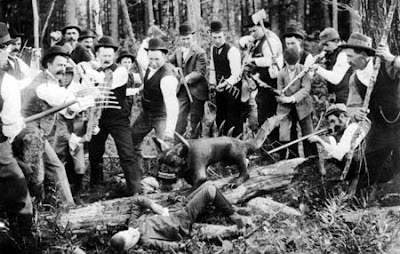
On this date Eugene Shepard was born near Green Bay. Although he made his career in the lumbering business near Rhinelander, he was best known for his story-telling and practical jokes. He told many tales of Paul Bunyan, the mythical lumberjack, and drew pictures of the giant at work that became famous. Shepard also started a new legend about a prehistoric monster that roamed the woods of Wisconsin – the hodag. Shepard built the mythical monster out of wood and bull’s horns. He fooled everyone into believing it was alive, allowing it to be viewed only inside a dark tent. The beast was displayed at the Wausau and Antigo county fairs before Shepard admitted it was all a hoax. [Source: Badger saints and sinners, by Fred L. Holmes, p.459-474]


The hodag’s become the mascot for Rhinelander, Wisconsin,  and  a music festival, the Hodag County Festival, that carries the animal’s name (gates open this July 2nd, by the way).