FREE WHITEWATER

Parts and Wholes

If one were to look for Whitewater’s population, the U.S. Census Bureau’s report from 2010 would say it was 14,390, and that same bureau’s 2014 American Community Survey would say it was 15,040.

Let’s call the total population 15,000, at least for a moment.  Expressed this way, Whitewater seems like one place of a certain size.

I think that’s an inaccurate view of Whitewater – as one thing of a certain size – although there is a huge investment in what’s left of Whitewater’s political class to describe the city that way.

The truth, however, is that it’s more accurate to say that Whitewater is less one thing, one creature, and more like two or more creatures living in each other’s midst.  For other posts along these lines, see, The Meaning of Whitewater’s Not-Always-Mentioned Demographics and A Small But Diverse City, Seldom Described That Way.

Springer spaniels weigh about forty pounds, and Great Danes weigh about one-hundred thirty pounds.  Add them up, and that’s a one-hundred seventy-five pound dog.

But, of course, they’re not a one-hundred seventy-five pound dog at all.  They’re two dogs, of different sizes.  They have decidedly different needs.

Nor can one combine how much each weighs, divide by two, and thereby determine what kind of animal they are.  Doing that, one would conclude that the composite dog is a medium-sized animal, somewhere in the middle:

Springer spaniels and Great Danes added together do not make a bigger dog, nor do they make a medium-sized dog.  They’re two separate creatures.

We’ve been describing Whitewater, far too much, as one creature, but the city is composed of several demographics that want different things, and thus combine for a common goal only sometimes.

Tomorrow: Data Around Whitewater’s Size.

Film: Will A Supposed Blockbuster Make Enough Money?

Over at Forbes, Mark Hughes writes about the financial prospects of Batman v. Superman, an incoming, big-budget film.  He’s addressing concerns that the film won’t make enough money.  The fretting reduces to the worry that since the film cost a lot to make and market (yes, indeed) it will have to do amazingly well at the box office.  That seems reasonable, of course.  But a view like that looks at only some measurements, and not others: there are many ways for a film to make money.

The story’s about a film, but it’s really a cautionary tale about looking at information superficially.

Hughes writes:

Is Batman v Superman shaping up to be a failure? Is Warner worried about the film? Are the future DCU plans all in jeopardy of falling apart? Is Justice League likely to be delayed? Will Batman be brought in to sort of rescue and restart the whole plan? There’s a lot to talk about here, fans, and I’ve crunched a whole lot of numbers and talked to a bunch of people in order to bring you as clear, definitive, and detailed a reply to these rumors and speculation as I can right now. So sit back and get ready, and hopefully you’ll feel a little better after I’m done. It’s a lot of information, comparisons, box office numbers, estimates, and points, but stick with me and I think you’ll find it’s worthwhile….

SeeRelax, Fans: ‘Batman V Superman’ Won’t Flop, Despite Rumors @ Forbes.

Sometimes superficiality leads to worry, and at other times to overconfidence.  In both cases, inadequate work leaves gaps in understanding that lead to error.  It seems reasonable to think the film’s financial success is a subtraction of simple cost and marketing expenses from box office receipts, but it’s not like that.

Hughes’s article is a solid, lengthy reminder to look at information thoroughly.  That takes time, but it’s worth the effort.

Worry not.


Daily Bread for 3.2.16

Good morning, Whitewater.

Midweek in Whitewater will be partly cloudy with a high of thirty-one.

At 4:30 PM today, an ad hoc group from the Urban Forestry Commission will meet about a butterfly garden.

It’s Dr. Seuss’s birthday:

Theodor Seuss Geisel … March 2, 1904 – September 24, 1991) was an American writer and illustrator best known for authoring popular children’s books under the pen name Dr. Seuss (/su?s/). His work includes several of the most popular children’s books of all time, selling over 600 million copies and being translated into more than 20 languages by the time of his death.[2]

Geisel adopted his “Dr. Seuss” pen name during his university studies at Dartmouth College and the University of Oxford. He left Oxford in 1927 to begin his career as an illustrator and cartoonist for Vanity Fair, Life, and various other publications. He also worked as an illustrator for advertising campaigns, most notably for Flit and Standard Oil, and as a political cartoonist for the New York newspaper PM. He published his first children’s book And to Think That I Saw It on Mulberry Street in 1937. During World War II, he worked in an animation department of the United States Army where he produced several short films, including Design for Death, which later won the 1947 Academy Award for Documentary Feature.[3]

After the war, Geisel focused on children’s books, writing classics such as If I Ran the Zoo (1950), Horton Hears a Who! (1955), If I Ran the Circus (1956), The Cat in the Hat (1957), How the Grinch Stole Christmas! (1957), and Green Eggs and Ham (1960). He published over 60 books during his career, which have spawned numerous adaptations, including 11 television specials, four feature films, a Broadway musical, and four television series. He won the Lewis Carroll Shelf Award in 1958 for Horton Hatches the Egg and again in 1961 for And to Think That I Saw It on Mulberry Street. Geisel’s birthday, March 2, has been adopted as the annual date for National Read Across America Day, an initiative on reading created by the National Education Association.

On this day in 1967, students protest at Beloit College:

1967 – Beloit Students and Faculty Protest Dow
On this date a group of Beloit College students and faculty staged a silent vigil, protesting Dow Chemical representatives recruiting prospective employees on the Beloit campus. Dow Chemical manufactured napalm, or jellied gasoline, used by the U.S. military in bombing raids during the Vietnam conflict. Dow was prominently protested the same year at the University of Wisconsin Madison campus. [Source: Janesville Gazette]

JigZone‘s puzzle for today is of a bird:

Borsuk on Testing

33cscreenshotPost 8 in a weekly series.

In January, Alan Borsuk, a senior fellow in law and public policy at Marquette University Law School, wrote an essay in the Journal Sentinel about Wisconsin’s mercurial standardized-testing regime.  See, Wisconsin grades as proficient in standardized testing chaos.

Borsuk observes the scene over the last few years:

The standardized tests a few hundred thousand Wisconsin third- through eighth-graders will take this spring will be the third version of such tests used in three years, each with a different definition of proficiency.

Months overdue, results the Department of Public Instruction released Wednesday did not include data for individual schools or districts or for private schools taking part in the voucher program, a big step backward from past practice.

The state testing picture has been chaotic of late. There seems to be some hope it will settle into a more consistent, maybe even helpful testing routine, starting this spring. But the ups and downs of the last couple of years justify skepticism.

Since substantive topics could not have changed much over this brief period, and the science of test-taking cannot possibly have changed meaningfully over the same brief time, there is only a political explanation (not left or right, but instead deeper than either) for the swings from one test to another.  Either the political class failed to choose tests properly somewhere along the way, or they’re still failing to choose properly.

Toward the end of his essay, Borsuk mentions recent state ACT scores:

Last year, close to all Wisconsin 11th-graders took the ACT college-admission test. In the past, the ACT was voluntary; 73% of students in the Class of 2015 took it, including 12th-graders and some who took it multiple times. Officials last summer reported an average ACT score of 22.2 for Wisconsin, which politicians of all stripes bragged about. In the new data, based on almost all juniors, the average score was 20.0. This is almost certain to mean politicians will:

a. Talk a lot less about average ACT scores in Wisconsin.

b. Overlook inconvenient details and keep talking about a 22.2 average.

He implies that the correct answer is a combination of (a) and (b): speaking less about inconvenient facts, and relying on stale data.

Turns out that his implication is spot on.

I’d recommend the full essay to readers.

THE EDUCATION POST: Tuesdays @ 10 AM, here on FREE WHITEWATER.

Daily Bread for 3.1.16

Good morning, Whitewater.

There will be a bit more snow today, less than a inch, with cloudy skies and a high of twenty-five. Sunrise is 6:28 and sunset 5:45, for 11h 17m 42s of daytime. The moon is a waning gibbous with 54.3% of its visible disk illuminated.

Common Council meets tonight at 6:30 PM.

On this day in 1815, Napoleon – French dictator and imperialist – returns to Europe from exile to begin the Hundred Days:

While the Allies were distracted, Napoleon solved his problem in characteristic fashion. On 26 February 1815, when the British and French guard ships were absent, he slipped away from Portoferraio on board the brig Inconstant with some 1,000 men and landed at Golfe-Juan between Cannes and Antibes on 1 March 1815. Except in royalist Provence, he was warmly received.[7][13] He avoided much of Provence by taking a route through the Alps, marked today as the Route Napoléon.[14]

Firing no shot in his defence, his troop numbers swelled until they became an army.

As it turns out, the man responsible for the deaths of literally millions from fighting across all Europe didn’t look, to many, the same as he did during his former rule:

The evidence as to Napoleon’s health is somewhat conflicting. Carnot, Pasquier, Lavalette, Thiébault, and others thought him prematurely aged and enfeebled.[7] At Elba, as Sir Neil Campbell noted, he became inactive and proportionately corpulent.[citation needed] There, too, as sometimes in 1815, he began to suffer intermittently from retention of urine, but to no serious extent.[7] For much of his public life, Napoleon was troubled by hemorrhoids, which made sitting on a horse for long periods of time difficult and painful. This condition had disastrous results at Waterloo; during the battle, his inability to sit on his horse for other than very short periods of time interfered with his ability to survey his troops in combat, and thus exercise command.[16] Others saw no marked change in him; while Mollien, who knew the emperor well, attributed the lassitude which now and then came over him to a feeling of perplexity caused by his changed circumstances.[7]

On this day in 1985, the Bucks go for eighteen million:

1985 – Kohl purchases Bucks
On this day in 1985 Milwaukee businessman and future United States Senator Herb Kohl purchased the Milwaukee Bucks for 18 million dollars. By 1999 the team was worth an estimated 100 million dollars. [Source: Harvard Business School Bulletin, December 1999

Here’s the Tuesday puzzle from JigZone:

September to December 2015

WGTB logo PNG 112x89 Post 63 in a series. When Green Turns Brown is an examination of a small town’s digester-energy project, in which Whitewater, Wisconsin would import other cities’ waste, claiming that the result would be both profitable and green.

On 9.17.15, Whitewater’s City Manager, Cameron Clapper, gave brief remarks in support of waste hauling into Whitewater. See, Text of the 9.17.15 Remarks on Waste Importation.

About three months later, on 12.15.15, the city’s Wastewater Superintendent, Tim Reel, spoke along similar lines. I’ve some of Reel’s remarks, and a transcript of them, immediately below.

September to December 2015 from John Adams on Vimeo.

“I’ll, I’ll start, jump in anywhere.  So, the, the, one of the misconceptions that we dealt with when we started talking about high-strength waste is that, uh, and I think everyone here heard it is that we were adding digesters, you know, and that, so again to make sure everyone is aware of that we are adding no capacity, you know, to our digesters, we’re not adding a digester at our location.  Um, what that high-strength waste facility or receiving, receiving station gives us is the ability to safely receive some materials which could be, um, food waste, perhaps a grease trap from a local business, um, it could be a, um, you know, we have already uh tried, for example, some spoiled salad dressing, that’s an example of something we’ve taken.  What we’re not taking about is hazardous waste, you know, coming in to the city of Whitewater, and going out there.”

There are two things to say about this for now.

First, like Clapper in September, Reel apparently thinks he’s making a strong case. He doesn’t show the slightest awareness that he might sound repetitive, and repetitive of absurdities.  He’s confident.

(Goodness knows how many times Reel and Clapper have repeated the false claim that there’s a misconception that ‘everyone here heard’ this project is about adding digesters. I debunked that straw man on 3.26.15, 264 days before Reel repeats it in December 2015.  See, The City of Whitewater Digester Clarification that Could Use a Clarification.

But he says it yet again on 12.15.15 as though he’s defending an eternal verity.  By the way,  he gets the capacity argument wrong in any event, for reasons that have to do with additional capacity that a second mixer permits.  A second digester has never been in contention, but expanding present capacity is.  Reel doesn’t seem to know the difference between a thing and its capacity.)

The bigger issue isn’t there, of course. It’s in Clapper’s contention on 9.17.15 and again on 12.15.15 ( at 27:50) that there’s nothing harmful in this, that in fact there cannot be anything harmful in this. Reel makes this distinction, too: that this isn’t about the hazardous, as they define it. I’ve yet to address Clapper’s point from 12.15, but it’s an on-camera claim that really stands in a class of its own.

That, of course, is a longer conversation for the months after the project begins.

But there’s a second issue, as important as the first. There’s a reason that some of these theories are repeated between 9.17.15 and 12.15.15: Clapper and Reel are operating in a closed circle where no one questions their claims, and so they assume they must be onto something true and right. That’s a problem, of course, but it’s one of an environment that has cosseted them and nurtured them to believe their own statements.

Over these months, I’ve come to see this project less like the Innovation Express bus (a wasteful policy) and more like a say-anything-to get-what-I-want scheme. That was the point, really, of a post from two weeks ago about Bill Ackman and his battle against Herbalife.  SeeAckman’s Right About Herbalife.

He’s convinced – rightly, I think – that Herbalife is wrong for deeper reasons than a choice between business options.

Believing this, Ackman sees that as they’re still going, he’ll keep going. But he also sees that the effort against Herbalife will not be won in Herbalife’s boardroom.

Instead, Ackman has gone outside, and is making his case there. He’s built his own website, and has videos describing Herbalife’s many false claims. I’m working on my own site, too.  (A lot still has to be done, but I like my format.) He has the patience to make his case over years.  Some conflicts are over a single event or moment; some take far longer.

I looked over some notes I had from June 2015, written on a glass board where (from that time) I tried to sketch how the months ahead might go. (It wasn’t a smart board, so I had to take a picture of my ideas.) At the time, I expected that this project would be approved by September 2015, and that I would complete questions on it by three months’ time afterward (December 2015). That would leave December 2015 to begin to submit public records requests to fill in gaps, and consideration for how records requests had been fulfilled by about March 2016 (that is, by about now, actually).

Well, I’m still in the asking questions, reviewing presentations phase. There hasn’t been much of my own work, along the lines of fiscal, economic, environmental, human health, and about a city’s political and business culture.

And yet, along the way, I have acquired a confidence like Ackman’s. His work against Herbalife is inspirational.  Months of posts (since my first on 3.26.15) only seem like a few days’ worth.

I’ll try to complete the question phase soon.

WHEN GREEN TURNS BROWN: Appearing at whengreenturnsbrown.com and re-posted Mondays @ 10 AM here on FREE WHITEWATER.

Daily Bread for 2.29.16

Good morning, Whitewater.

Leap Day in Whitewater will be partly cloudy and windy, with a high of forty-seven. Sunrise is 6:29 and sunset 5:44, for 11h 14m 49s of daytime. The moon is a waning gibbous with 63.8% of its visible disk illuminated.

On this day in 2004, Lord of the Rings: The Return of the King wins big:

Perhaps the most attention-grabbing, trailblazing performer in film in 2003 did not receive an Academy Award nomination for Best Actor–but he was honored nonetheless. The eerily lifelike quality of Gollum, the computer-generated (CG) creature who simpered and schemed his way through The Lord of the Rings film trilogy, remained one of the most awe-inspiring aspects of the trilogy’s final installment, The Return of the King. At the 76th Academy Awards ceremony, held on this day in 2004, the film won a record-tying 11 Oscars, including Best Picture, Best Director (Peter Jackson) and Best Visual Effects.

On this day in 1956, a prominent Wisconsin Republican passes away, after taking the party in a different direction:

1956 – Father of Modern Wisconsin Republican Party dies
On this day William J. Campbell, a major contributor the Wisconsin Republican Party, died at his home in Oshkosh. A lumber broker and former University of Wisconsin regent, Campbell never held public office, but was generally given credit for the founding of the Republican Voluntary Committee, the working party organization in the state. State Attorney General Vernon W. Thomson hailed Campbell as a “true political pioneer” for steering the selection of GOP candidates away from the “domination of Robert M. LaFollette, Sr.” An ardent opponent of the “nomination paper” method of endorsing candidates for office, Campbell founded the Republican Voluntary Committee in 1925, in large part as a means of circumventing state limitations on spending by the statutory Republican Party. [Source: Milwaukee Journal 2/29/1956, Section 2 p. 12]

It’s a tape measure puzzle today from JigZone:

‘A Trust Betrayed’: The Update on the Title IX Claims Against UW-Whitewater

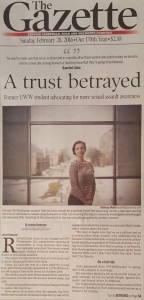
Over at the Gazette, above the fold, there’s a frontpage story about Ms. Raechel Liska, an honors graduate of UW-Whitewater, and her Title IX claim against UW-Whitewater for failing to  address properly her sexual assault complaint. The story refers also to an earlier Title IX complaint against the school (the two complaints are now joined administratively), and the account of a
third student that corroborates the experiences of the two Title IX complainants.

See, from Andrea Anderson, A Trust Betrayed, http://www.gazettextra.com/20160227/former_uw_w_student_stands_up_for_more_awareness_around_sexual_assault (subscription req’d).

Ms. Anderson’s story publishes significant new information about the claims, and more detail about what’s already been published.

The story reveals that there are at least three, not two, women who allege the same administrative misconduct and concealment. Two of those women have filed Title IX complaints, and a third submitted a supporting statement:

20160228“Liska has encouraged at least one other student to come forward and submit supplemental testimony to be attached to Liska’s Title IX claim.

Sarah, a senior at UW-W who agreed to let The Gazette use her first name, learned about Liska through the media. In her testimony, Sarah wrote she experienced a similar response as Liska from UW-W after reporting she was sexually assaulted by another student.

Sarah claims Mackin did not inform her of her Title IX rights and felt as if Mackin “talked down” to her and “never addressed the actual problem that I was having: I was abused by another UW-Whitewater student and I was terrified,” according to the testimony.

UW-W police talked to the accused, but Sarah still felt the university was minimizing her fears of retaliation from the man, Sarah wrote.

Sarah could not file her own Title IX complaint because the deadline had passed, Held said. Sarah was given the option to add testimony to Liska’s claim and did so to help push for improvement in UW-W’s response to sexual assault victims.

It was “distressing to realize that, after talking to Raechel about her interactions with the school, I wasn’t alone in this treatment. It made me want to change the way the University deals with cases like mine and Raechel’s,” Sarah said in her testimony.”

Most of these cases are resolved administratively, and that’s the goal of the claimants here. How this will be resolved, of course, I do not know; successful resolutions need good terms and a sincere effort to carry them out.

I’ve no connection whatever to these claimants or their lawyers. That’s both by nature and design – having seen more than one tragedy in this small & beautiful, but sometimes troubled city, I simply don’t believe, for politics or policy, in close.  On the contrary, it’s distance that makes one’s work, as an ongoing chronicle, possible.

I would hope that these claimants, as people with unique hopes and aspirations, find whatever measure of remedy they are seeking, so fully and completely as possible.

See, also, other posts that are part of a category on Assault Awareness and Prevention dedicated to this topic.

Daily Bread for 2.28.16

Good morning, Whitewater.

We’ll have a mild Sunday with afternoon showers and a high of fifty-seven. Sunrise is 6:41 and sunset 5:43, for 11h 11m 57s of daytime. The moon is a waning gibbous with 72.4% of its visible disk illuminated.

Friday’s FW poll asked readers which movie they favored in the Best Picture category at the Academy Awards ceremony tonight. Of the eight nominees, 29.27% of respondents chose The Revenant, 26.83% chose The Martian, 14.63% chose Bridge of Spies, with remaining contenders each receiving fewer than ten percent of responses.

Here’s schedule of posts for the week ahead, with other posts possible (if there are changes to these scheduled posts I’ll explain why):

  • Today: DB, a post about UW-Whitewater and Title IX, evening post
  • Monday: DB, weekly music post, WHEN GREEN TURNS BROWN post, evening post
  • Tuesday: DB, weekly education post, evening post
  • Wednesday: DB, weekly film post, a post on relative sizes among demographic groups, evening post
  • Thursday: DB, a food post, a post on Whitewater’s economy, evening post
  • Friday: DB, weekly poll, weekly cataloging, a post on Whitewater’s economy
  • Saturday: DB, weekly Animation post, evening post

On this day in 1844, Pres. Tyler survives a shipboard explosion:

On February 28, she departed Alexandria, Virginia on a pleasure and demonstration cruise down the Potomac with President John Tyler, his Cabinet, former first lady Dolley Madison, and approximately four hundred guests on board. The guests viewed the firing of the ship’s guns and then retired below decks for lunch and refreshments. When they were summoned once more to view another test firing, the firing of Stockton’s Peacemaker caused the gun to burst, sending shrapnel into the crowd. Instantly killed were Secretary Upshur, Secretary Gilmer, Capt. Beverly Kennon, who was Chief of the Bureau of Construction, Equipment and Repairs, Virgil Maxcy of Maryland, who had served as Chargé d’Affaires to Belgium from 1837 to 1842, Colonel David Gardiner of New York, the father of Julia Gardiner (who afterwards became the President’s fiancée), the President’s valet, a black slave named Armistead, and two sailors. It also injured about 20 people, including Capt. Stockton. The President was unharmed, having been below decks when the gun exploded.[1] When Julia Gardiner, who was aboard, found out her father had died in the explosion she fainted, not waking up until Tyler was carrying her off the ship.[2]