
Anderson, Cartoons & Comics, Holiday
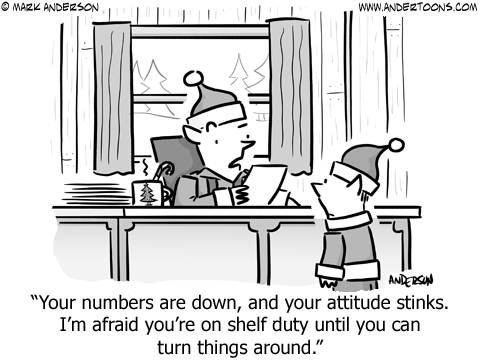
Shelf Duty
by JOHN ADAMS •
Good morning, Whitewater.
Wednesday in town will be warm, with a high of fifty-six, on a day of rain and scattered thundershowers. Sunrise is 7:23 and sunset 4:25, for 9h 01m 51s of daytime. The moon is a waxing gibbous with 95% of its visible disk illuminated.
On this day in 1783, America’s victory having been made formal under the Treaty of Paris, Gen. Washington resigns his command:
“Happy in the confirmation of our independence and sovereignty, and pleased with the opportunity afforded the United States of becoming a respectable nation, I resign with satisfaction the appointment I accepted with diffidence; a diffidence in my abilities to accomplish so arduous a task; which however was superseded by a confidence in the rectitude of our cause, the support of the supreme power of the Union, and the patronage of Heaven….
“Having now finished the work assigned to me, I retire from the great theatre of action; and bidding an affectionate farewell to this august body, under whose orders I have so long acted, I here offer my commission, and take any leave of all the employments of public life.”
On this day in 1865, the 13th Wisconsin returns:
1865 – (Civil War) The 13th Wisconsin Infantry returns home
The 13th Wisconsin Infantry returned home to Madison to be discharged. During its service it had moved through Missouri, Kentucky, Alabama, and Tennessee. The regiment lost 193 men during service. Five enlisted men were killed and 188 enlisted men died from disease..
Good morning, Whitewater.
It’s the first day of winter in the Whippet City, and this day arrives with a high of forty degrees, morning fog, and afternoon clouds. Sunrise is 7:22 and sunset 4:24 for 9h 01m 43s of daytime.
Nine hours, one minute, and forty-three seconds of daytime isn’t much sunshine, but from the perspective of stargazers it’s an offering of plentiful evening skies.
Anyone thinking carefully about human history has reason to be confident in America and her future. Our best days lie ahead. One small but significant confirmation of that observation is to be found in SpaceX’s successful launch and return upright of an orbital rocket:
The third attempt at a historic reusable-rocket milestone was the charm for SpaceX.
The private spaceflight company
brought the first stage of its Falcon 9 rocket back to Earth for a soft touchdown tonight (Dec. 21), pulling off history’s first-ever rocket landing during an orbital launch. (Blue Origin, the company led by Amazon.com founder Jeff Bezos, landed its New Shepard booster successfully last month, but that occurred during a suborbital test.) The Falcon 9 mission also delivered 11 commercial satellites into orbit for SpaceX customer ORBCOMM.
“I do think it’s a revolutionary moment. No one has ever brought an orbital class booster back intact,” SpaceX founder and CEO Elon Musk told reporters in a teleconference after the launch and landing success. “We achieved recovery of the rocket in a mission that also deployed 11 satellites. This is a fundamental step change compared to any other rocket that’s ever flown.” [SpaceX’s Epic Falcon 9 Rocket Landing in Pictures]
For more, see Wow! SpaceX Lands Orbital Rocket Successfully in Historic First @ Space.com.
On this day in 1862, the 17th Wisconsin deploys to protect Union supplies:
1862 – (Civil War) The 17th Wisconsin Infantry protects supplies in Tennessee
The 17th Wisconsin Infantry was ordered to protect Grand Junction, Tennessee, after the loss of Holly Springs, Mississippi.
 Post 52 in a series. When Green Turns Brown is an examination of a small town’s digester-energy project, in which Whitewater, Wisconsin would import other cities’ waste, claiming that the result would be both profitable and green.
I’m not sure who first said ‘all facts are friendly,’ but for policy it’s true: one applies theories to what’s true, to conditions as they now actually are. Out of that one hopes for something good, something better than conditions as they now actually are.
Better, however, rests not on mere hope, not on directionless ambition, and surely not on pride. Better policy rests on facts, and on seeing those facts as friendly.
The most recent discussion of waste importation into a city like Whitewater is a cornucopia of contentions, claims, and theories, chock-full, really. Several people have asked me if I will go through the meeting, point by point.
I will.
For all the two years’ time of municipal planning and presentations about a wastewater upgrade, and about waste importation into tiny Whitewater, the 12.15.15 meeting is revealing.
Puzzling, as much as revealing. I’ve reviewed the meeting twice in full, and parts more than that, and there are fundamental claims from city officials or from the vendor that are simply false, almost strangely so. At the same time, by good fortune grounded in hard work, the meeting also saw solid questions about the project from residents or councilmembers. Some of these good questions were ignored, answered erroneously, answered incompletely, or answered evasively.
Why that is, I don’t know. Perhaps this city’s full-time staff members want something so much, are so committed to it, that facts don’t matter anymore. Perhaps facts (even simply ones) seem not friendly but instead inconvenient, or even hostile. To my knowledge, no municipal staff anywhere in our state has said, on camera, as many dubious things about a waste-importation project as Whitewater’s staff members have said about this one. (That’s disappointing as a resident of Whitewater, but publication of an account may be useful to other communities.)
Even a small town like Whitewater has, after all, millions of dollars at its disposal; even in 2015, that’s a lot of money.
The strangest part of this is that not a word was said from Whitewater’s full-time staff or from her vendor that had to be said, that was compelled – every word, sensible or absurd – was freely given, was unforced. If it should irritate some to read in the new year an assessment of those words, well, those so irritated are the source of their own irritation.
There’s much to transcribe and assess in detail, and time to do it. Good work is methodical, deliberate, and patiently friendly to facts.
WHEN GREEN TURNS BROWN: Mondays @ 10 AM, here on FREE WHITEWATER.
Good morning, Whitewater.
Monday brings precipitation, but not snow: we’ll have a rainy Monday morning in Whitewater, with a cloudy afternoon, and a high of forty-four. Sunrise is 7:22 and sunset 4;24, for 9h 01m 39s of daytime. The moon is a waxing gibbous with 80.5% of its visible disk illuminated.
On this day in 1898, a nineteenth-century power couple makes a discovery:
Radium is a chemical element with symbol Ra and atomic number 88. It is the sixth element in group 2 of the periodic table, also known as the alkaline earth metals. Pure radium is almost colorless, but it readily combines with nitrogen (rather than oxygen) on exposure to air, forming a black surface layer of radium nitride (Ra3N2). All isotopes of radium are highly radioactive, with the most stable isotope being radium-226, which has a half-life of 1600 years and decays into radon gas (specifically the isotope radon-222). When radium decays, ionizing radiation is a product, which can excite fluorescent chemicals and cause radioluminescence…..
Radium was discovered by Marie Sklodowska-Curie and her husband Pierre Curie on 21 December 1898, in a uraninite sample.[14] While studying the mineral earlier, the Curies removed uranium from it and found that the remaining material was still radioactive. They separated out an element similar to bismuth from pitchblende in July 1898, that turned out to be polonium. They then separated out a radioactive mixture consisting mostly of two components: compounds of barium, which gave a brilliant green flame color, and unknown radioactive compounds which gave carmine spectral lines that had never been documented before. The Curies found the radioactive compounds to be very similar to the barium compounds, except that they were more insoluble. This made it possible for the Curies to separate out the radioactive compounds and discover a new element in them. The Curies announced their discovery to the French Academy of Sciences on 26 December 1898.[15][16] The naming of radium dates to about 1899, from the French word radium, formed in Modern Latin from radius (ray): this was in recognition of radium’s power of emitting energy in the form of rays.[17][18][19]
On 12.21.1879, brewing in Wisconsin experiences a setback:
1879 – Fire Destroys Phillip Brewing Company
On this date fire destroyed the Phillip Brewing Company’s malthouse, grain elevators and office building in Milwaukee. [Source: Pabst Brewery History]
Via FREE WHITEWATER.
Good morning, Whitewater.
Sunday in town will be partly cloudy but warm (for this time of year), with a high of forty-three. Sunrise is 7:21 and sunset 4:23, for 9h 01m 40s of daytime. The moon is awaxing gibbous with 71.7% of its visible disk illuminated.
Eggnog wins again the the FW Friday poll, with 69.57% of respondents saying they’d go for it.
At the New York Times, there’s an interactive article entitled, Mapping Saturn’s Moons, and an accompanying video on the possibility of (simple) life on the Saturnian moon, Enceladus:
From 1941-1945, Wisconsinites serve with distinction and great personal sacrifice, to defeat the Axis:
1941 – Wisconsin Soldiers Enlist, 1941-1945
After the attack on Pearl Harbor, thousands of Wisconsin citizens volunteered to fight. Roughly 320,000 Wisconsin soldiers served in the armed forces during the WWII, including more than 9,000 women. Wisconsin’s National Guard formed a substantial part of the new Red Arrow Division, helping to maintain the respected reputation of its predecessor from World War I by remaining undefeated in the Pacific theater. The majority of Wisconsin soldiers were draftees who served in units comprised of men from around the country. More than 8,000 soldiers died and another 13,000 were wounded in combat. Fifteen Wisconsin men won the Medal of Honor during WWII. [Source: Turning Points in Wisconsin History]
Good morning, Whitewater.
Saturday in town will be sunny with a high of twenty-nine. Sunrise is 7:21 and sunset 4:23, for 9h 01m 46s of daytime. The moon is a waxing gibbous with 60.6% of its visible disk illuminated.
It’s understandable that in ordinary usage we refer casually to many kinds of trees as pine trees – pine is meant as a shorthand term for evergreens. What, though, is the difference between pines, spruces, and firs? Minute Earth describes them for us:
On this day in 1776, Paine begins publication of the American Crisis series:
The American Crisis is a pamphlet series by 18th century Enlightenment philosopher and author Thomas Paine, originally published from 1776 to 1783 during the American Revolution. Often known as The American Crisis or simply The Crisis, there are sixteen pamphlets in total. Thirteen numbered pamphlets were published between 1776 and 1777, with three additional pamphlets released between 1777 and 1783.[1] The first of the pamphlets were published in Pennsylvania Journal.[2] Paine signed the pamphlets with the pseudonym, “Common Sense.”
The pamphlets were contemporaneous with early parts of the American Revolution, during a time when colonists needed inspiring works. Paine, like many other politicians and scholars, knew that the Colonists weren’t going to support the American Revolutionary War without proper reason to do so. They were written in a language that the common man could understand, and represented Paine’s liberal philosophy….
Paine sees the British political and military maneuvers in America as “impious; for so unlimited a power can belong only to God.” Paine states that he believes God supports the American cause, “that God Almighty will not give up a people to military destruction, or leave them unsupportedly to perish, who have so earnestly and so repeatedly sought to avoid the calamities of war, by every decent method which wisdom could invent”.
Paine takes great lengths to state that Americans do not lack force, but “a proper application of that force” – implying throughout that an extended war can lead only to defeat unless a stable army was composed not of militia but of trained professionals. But Paine maintains a positive view overall, hoping that this American crisis can be quickly resolved, “for though the flame of liberty may sometimes cease to shine, the coal can never expire.”[5]
For the full work, see Thomas Paine, The Writings of Thomas Paine, Collected and Edited by Moncure Daniel Conway (New York: G.P. Putnam’s Sons, 1894). Vol. 1. 12/19/2015. <http://oll.libertyfund.org/titles/343>
If one’s been around a bit, one has the opportunity for annual posts or polls, including this one: an eggnog poll.
So, a simple question: eggnog, yes or no?
Here’s a link to an eggnog recipe that I’ll try this Christmas – 1958: Eggnog @ New York Times Cooking.
Good morning, Whitewater.
Friday in town will be cloudy with a high of twenty-nine. Sunrise is 7:20 and sunset 4:22 for 9h 01m 55s of daytime. The moon is in its first quarter.
On this day in 1620, the Mayflower first docked at (what’s now) Plymouth Harbor:
The passage was a miserable one, with huge waves constantly crashing against the ship’s topside deck until a key structural support timber fractured. The passengers, who had already suffered agonizing delays, shortages of food and of other supplies, now were called upon to provide assistance to the ship’s carpenter in repairing the fractured main support beam. This was repaired with the use of a metal mechanical device called a jackscrew, which had been loaded on board to help in the construction of settler homes and now was used to secure the beam to keep it from cracking further, making the ship seaworthy enough.[22][23]
The crew of the Mayflower had some devices to assist them en route such as a compass for navigation as well as a log and line system to measure speed in nautical miles per hour or “knots”. Time was measured with an ancient method – an hour glass.
There were two deaths, but this was only a precursor of what happened after their arrival in Cape Cod, where almost half the company would die in the first winter.[24]
On November 9, 1620, they sighted land, which was present-day Cape Cod. After several days of trying to sail south to their planned destination of the Colony of Virginia where they had already obtained permission from the Company of Merchant Adventurers to settle, strong winter seas forced them to return to the harbor at Cape Cod hook, well north of the intended area,[25] where they anchored on November 11. To establish legal order and to quell increasing strife within the ranks, the settlers wrote and signed theMayflower Compact after the ship dropped anchor at Cape Cod, in what is now Provincetown Harbor.[24][26][27][28]
On Monday, November 27, an exploring expedition was launched under the direction of Capt. Christopher Jones to search for a suitable settlement site. As master of theMayflower, Jones was not required to assist in the search, but he apparently thought it in his best interest to assist the search expedition. There were 34 persons in the open shallop – 24 passengers and 10 sailors. They were obviously not prepared for the bitter winter weather they encountered on their reconnoiter, the Mayflower passengers not being accustomed to winter weather much colder than back home. Due to the bad weather encountered on the expedition, they were forced to spend the night ashore ill-clad in below-freezing temperatures with wet shoes and stockings that became frozen. Bradford wrote “(s)ome of our people that are dead took the original of their death here”.[29]
The settlers explored the snow-covered area and discovered an empty native village, now known as Corn Hill in Truro. The curious settlers dug up some artificially made mounds, some of which stored corn, while others were burial sites. Nathaniel Philbrick claims that the settlers stole the corn and looted and desecrated the graves,[30] sparking friction with the locals.[31] Philbrick goes on to say that, as they moved down the coast to what is now Eastham, they explored the area of Cape Cod for several weeks, looting and stealing native stores as they went.[32] He then writes about how they decided to relocate to Plymouth after a difficult encounter with the local native, the Nausets, at First Encounter Beach, in December 1620.
On this day in 1863, the Milwaukee Sentinel urges more support for Union soldiers:
1863 – (Civil War) Milwaukee Sentinel urges better pay for soldiers
The Milwaukee Daily Sentinel advocated for an increase in military compensation: “If any men deserve to be well paid it is the men who are enduring the hardships and running the risks of a war like this.” It also provided details of a senate bill to increase soldiers’ pay to $16 a month and pay African-American soldiers the same as white soldiers.
Here’s the final game in this week’s Puzzablity series, Trimming the Tree:
|
This Week’s Game — December 14-18
|
|||||
|
Trimming the Tree
|
|||||
|
We’re adding the decorations to our Christmas tree this week. Each day, we started with a word or phrase, added the eight letters in ORNAMENT, and rearranged the remaining letters to get a new phrase. Both pieces are described in each day’s clue, with the shorter one first.
|
|||||
|
Example:
|
|||||
|
Feral; aged personification of the coldest season
|
|||||
|
Answer:
|
|||||
|
Wild; Old Man Winter
|
|||||
|
What to Submit:
|
|||||
|
Submit both pieces, with the shorter one first (as “Wild; Old Man Winter” in the example), for your answer.
|
|||||
 |
|||||
|
Friday, December 18
|
|||||
|

