FREE WHITEWATER

Daily Bread for 11.29.15

Good morning, Whitewater.

In town, Sunday will be mostly sunny with a high of forty-one.  Sunrise is 7:04 and sunset 4:22, for 9h 18m 20s of daytime.  The moon is a waning gibbous with 83.9% of its visible disk illuminated.

On Friday’s FW poll, on preferred shopping times, respondents selected from these choices (with multiple selections possible): Black Friday (26.83%), Small Business Saturday (25.61%), Cyber Monday (14.63%), but the most-selected choice was Other (32.93%).

On this day in 1942, America adds coffee to the list of rationed goods:

As of 1 March 1942, dog food could no longer be sold in tin cans, and manufacturers switched to dehydrated versions. As of 1 April 1942, anyone wishing to purchase a new toothpaste tube, then made from metal, had to turn in an empty one.[3]:129–130Sugar was the first consumer commodity rationed, with all sales ended on 27 April 1942 and resumed on 5 May with a ration of .5 pounds (0.23 kg) per person per week, half of normal consumption. Bakeries, ice cream makers, and other commercial users received rations of about 70% of normal usage.[6]Coffee was rationed nationally on 29 November 1942 to 1 pound (0.45 kg) every five weeks, about half of normal consumption, in part because of German U-boatattacks on shipping from Brazil.[9] By the end of 1942, ration coupons were used for nine other items.[3]:138Typewriters,gasoline, bicycles, footwear, silk, nylon, fuel oil, stoves, meat, lard, shortening and oils, cheese, butter, margarine, processed foods (canned, bottled, and frozen), dried fruits, canned milk, firewood and coal, jams, jellies, and fruit butter were rationed by November 1943.[10] Many retailers welcomed rationing because they were already experiencing shortages of many items due to rumors and panics, such as flashlights and batteries after Pearl Harbor.[3]:133

Rationing of some foods and non-medical items, however effective or ineffective, was yet a small price to pay to defeat the Axis.  (Rationing of medicine was, needless to say, a more significant sacrifice.)

On this day in 1848, Milwaukee gets an opera house:

On this date Milwaukee opened its first opera house with a performance of As You Like It. Over 1,000 patrons attended this inaugural performance. The idea for this arts structure was conceived and promoted by John B. Rice, later mayor of Chicago, who arrived in Milwaukee in 1846 to establish a first rate theater. [Source: History of Milwaukee, Vol II, p. 122]

Daily Bread for 11.28.15

Good morning, Whitewater.

Saturday in the Whippet City will be partly cloudy with a high of thirty-eight. Sunrise is 7:03 and sunset is 4:22, for 9h 19m 49s of daytime. The moon’s a waning gibbous with 90.9% of its visible disk illuminated.

On this day in 1520, Magellan reaches the Pacific:

Ferdinand Magellan… Portuguese: Fernão de Magalhães … Spanish:Fernando de Magallanes, … c. 1480 – 27 April 1521) was a Portuguese explorer who organised the Spanish expedition to the East Indies from 1519 to 1522, resulting in the first circumnavigation of the Earth.

Born into a wealthy Portuguese family in around 1480, Magellan became a skilled sailor and naval officer and was eventually selected by King Charles I of Spain to search for a westward route to the Maluku Islands (the “Spice Islands”). Commanding a fleet of five vessels, he headed south through the Atlantic Ocean to Patagonia, passing through the Strait of Magellan into a body of water he named the “peaceful sea” (the modern Pacific Ocean). Despite a series of storms and mutinies, the expedition reached the Spice Islands in 1521 and returned home via the Indian Ocean to complete the first circuit of the globe. Magellan did not complete the entire voyage, as he was killed during the Battle of Mactan in the Philippines in 1521.

The Magellanic penguin is named after him, as he was the first European to note it.[3] Magellan’s navigational skills have also been acknowledged in the naming of objects associated with the stars, including the Magellanic Clouds, now known to be two nearby dwarf galaxies; the twin lunar craters of Magelhaens and Magelhaens A; and the Martian crater of Magelhaens.[4]

….At 52°S latitude on 21 October, the fleet reached Cape Virgenes and concluded they had found the passage, because the waters were brine and deep inland. Four ships began an arduous trip through the 373-mile (600 km) long passage that Magellan called the Estrecho (Canal) de Todos los Santos, (“All Saints’ Channel”), because the fleet travelled through it on 1 November or All Saints’ Day. The strait is now named the Strait of Magellan. He first assigned Concepcion and San Antonio to explore the strait, but the latter, commanded by Gómez, deserted and returned to Spain on 20 November. On 28 November, the three remaining ships entered the South Pacific. Magellan named the waters the Mar Pacifico (Pacific Ocean) because of its apparent stillness.[23]Magellan and his crew were the first Europeans to reach Tierra del Fuego just east of the Pacific side of the strait.

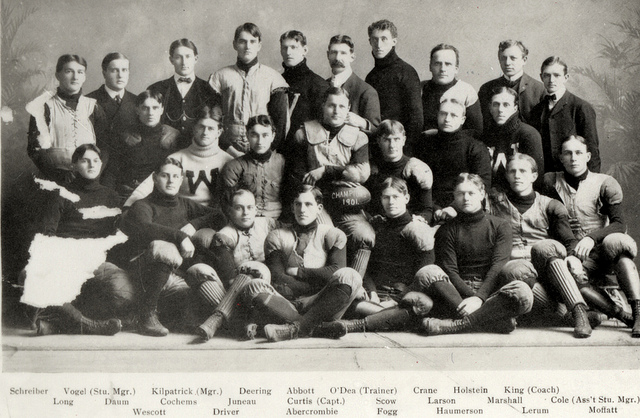
For UW football, 1901 was a good year:

uwfootball1901

On this date the University of Wisconsin defeated the University of Chicago, 35-0, to finish its first undefeated football season in school history with a 9-0 record. [Source: Milwaukee Journal Sentinel]


Friday Catblogging: Music for Cats

For the first time ever, there’s music for cats that’s been verified by science. Help fund music that’s been proven to enrich animals’ lives by donating to our Kickstarter campaign at:
https://www.kickstarter.com/projects/355308040/music-for-cats-0

We’d like to give a special thanks to our feline stars and their owners:
– Lori Shepler and City the Kitty: citythekitty.com
– Chris Poole and Cole & Marmalade: coleandmarmalade.com
– May Chung and Bacon: instagram.com/baconcup
– Pookie Mathachittiphan and Nala: nalacat.com

We’d also like to say thanks to Anomaly (anomaly.com) for their leadership and generous, enthusiastic support while making this all possible, Animal Haven (animalhavenshelter.org) for letting us film, Getty (gettyimages.com) for access to stock video assets, H. Paul Moon (zenviolence.com) for his imagination and generous addition to the rooftop film, and Owen Brown (owenbrown.nyc) for brilliantly leading the Kickstarter campaign’s creative efforts. Special thanks are due to Chuck Snowden, the scientist’s scientist who has such a rare combination of a brilliant, open mind with a capacity for rigorous attention to detail.

Via Music for Cats @ YouTube.

Friday Poll: Preferred Shopping Times, 2015


The Friday FW poll asks about how you’ll shop over the weekend.  It’s third year that I’ve run this poll (versions of it ran in 2012 and 2013).  Let’s see how this year’s answers compare with those earlier versions.  (Multiple selections are possible for those who’ll shop in different ways.)

Daily Bread for 11.27.15

Good morning, Whitewater.

Friday in Whitewater will be cloudy with a high of thirty-six. Sunrise is 7:01 and sunset 4:23, for 9h 21m 23s of daytime. The moon is a waning gibbous with 96.2% of its visible disk illuminated.

It’s been a century since Einstein’s general theory of relativity, and here’s a quick video summary of his remarkable insight:

On this day in 1882, a first performance, and on this day in 1903, the birth of a great player:

1882 – Ringling Brothers’ First Performance

On this date the Ringling brothers of Baraboo, Wisconsin performed their first show to an audience in Mazomanie. The brothers called their show the “Ringling Brothers Classic Comic Concert Company.” The show was barely a success, bringing in 59 paid admissions – just enough money to meet their hotel expenses. However, the brothers continued to tour and raised over $300 in three months, performing in Wisconsin, Iowa, and the Dakotas. After extensive investment and practice, the brothers launched their first circus in Baraboo on May 19, 1884. [Source: Badger Saints and Sinners by Fred L. Holmes, p.476-492]

1903 – Green Bay Packer Johnny Blood Born

On this date Johnny Blood (aka John McNally) was born in New Richmond. Blood was an early NFL halfback playing for Green Bay from 1929 to 1933 and 1935 to 1936. He also played for the Milwaukee Badgers, Duluth Eskimos, Pottsville Maroons, and the Pittsburgh Pirates. An elusive runner and gifted pass receiver, he played a major role in the Packers’ drive to the first three championships in 1929, 1930 and 1931. Johnny Blood died on November 28, 1985, at the age of 82. Titletown Brewing Co. in Green Bay named their brew Johnny “Blood” Red Ale after the famed halfback. [Source: Packers.com]

Here’s the final game in Puzzability‘s Eat! Eat! series:

This Week’s Game — November 23-27
Eat! Eat!
We’re serving up some trivia for this week’s feast. The answer to each day’s quiz question is a title or phrase that contains the sequence EAT in two places. Some instances of EAT may have a space between letters.
Example:
What 2013 hit by the indie rock band The Neighbourhood evokes autumn’s climate?
Answer:
“Sweater Weather”
What to Submit:
Submit the title or phrase (as “Sweater Weather” in the example) for your answer.
Friday, November 27
What tiny Off-Off-Broadway venue in New York was founded in 1996 to create “a joyful hell in a small space”?

Shop Small on Saturday, November 28, 2015

If you’re out and about on Saturday, I hope you’ll shop at some of the many independent, small merchants of Whitewater. You’ll find a wide selection of items for purchase as gifts, and good restaurants at which to eat while shopping during the day.

Best wishes to all for a happy and prosperous season —

12038598_1090923104258945_1015105124366213245_o

See, for more information, Small Business Saturday® on Facebook.

Daily Bread for 11.26.15

Good morning, Whitewater.

Thanksgiving Day in Whitewater will be rainy but mild, with a high of fifty-six. Sunrise is 7:00 and sunset 4:23 for 9h 23m 00s of daytime. It’s a full moon today.

On this day in 1941, Franklin Roosevelt signs a bill establishing a special significance to the fourth Thursday in November:

The tradition of celebrating the holiday on Thursday dates back to the early history of the Plymouth and Massachusetts Bay colonies, when post-harvest holidays were celebrated on the weekday regularly set aside as “Lecture Day,” a midweek church meeting where topical sermons were presented. A famous Thanksgiving observance occurred in the autumn of 1621, when Plymouth governor William Bradford invited local Indians to join the Pilgrims in a three-day festival held in gratitude for the bounty of the season.

Thanksgiving became an annual custom throughout New England in the 17th century, and in 1777 the Continental Congress declared the first national American Thanksgiving following the Patriot victory at Saratoga. In 1789, President George Washington became the first president to proclaim a Thanksgiving holiday, when, at the request of Congress, he proclaimed November 26, a Tuesday, as a day of national thanksgiving for the U.S. Constitution. However, it was not until 1863, when President Abraham Lincoln declared Thanksgiving to fall on the last Thursday of November, that the modern holiday was celebrated nationally.

With a few deviations, Lincoln’s precedent was followed annually by every subsequent president–until 1939. In 1939, Franklin D. Roosevelt departed from tradition by declaring November 23, the next to last Thursday that year, as Thanksgiving Day. Considerable controversy surrounded this deviation, and some Americans refused to honor Roosevelt’s declaration. For the next two years, Roosevelt repeated the unpopular proclamation, but on November 26, 1941, he admitted his mistake and signed a bill into law officially making the fourth Thursday in November the national holiday of Thanksgiving Day.

On this day in 1838, a first:

1838 – Legislature Assembled in Madison for the First Time

On this date, after moving from the temporary capital in Burlington, Iowa, the Wisconsin Territorial Legislature assembled in Madison for the first time. Two years earlier, when the territorial legislature had met for the first time in Belmont, many cities were mentioned as possibilities for the permanent capital — Cassville, Fond du Lac, Milwaukee, Platteville, Mineral Point, Racine, Belmont, Koshkonong, Wisconsinapolis, Peru, and Wisconsin City.

Madison won the vote, and funds were authorized to erect a suitable building in which lawmakers would conduct the people’s business. Progress went so slowly, however, that some lawmakers wanted to relocate the seat of government to Milwaukee, where they also thought they would find better accommodations than in the wilds of Dane Co. When the legislature finally met in Madison in November 1838 there was only an outside shell to the new Capitol. The interior was not completed until 1845, more than six years after it was supposed to be finished. On November 26, 1838, Governor Henry Dodge delivered his first speech in the new seat of government. [Source: Wiskonsan Enquirer, Nov. 24 and Dec. 8, 1838]

Here’s the Thursday game in Puzzability‘s Eat! Eat! series:

This Week’s Game — November 23-27
Eat! Eat!
We’re serving up some trivia for this week’s feast. The answer to each day’s quiz question is a title or phrase that contains the sequence EAT in two places. Some instances of EAT may have a space between letters.
Example:
What 2013 hit by the indie rock band The Neighbourhood evokes autumn’s climate?
Answer:
“Sweater Weather”
What to Submit:
Submit the title or phrase (as “Sweater Weather” in the example) for your answer.
Thursday, November 26
What well-received 1982 documentary can no longer be seen because Paul McCartney bought its rights to make way for a more in-depth Fab Four documentary series?


Daily Bread for 11.25.15

Good morning, Whitewater.

Wednesday in town will be mostly cloudy with a high of forty-five. Sunrise is 6:59 and sunset 4:24 for 9h 24m 40s of daytime. We’ve a full moon today.

On this day in 1783, the last British soldiers leave New York:

…nearly three months after the Treaty of Paris was signed ending the American Revolution, the last British soldiers withdraw from New York City, the last British military position in the United States. After the last Redcoat departed New York, U.S. General George Washington entered the city in triumph to the cheers of New Yorkers. The city had remained in British hands since its capture in September 1776.

Four months after New York was returned to the victorious Patriots, the city was declared to be the capital of the United States. In 1789, it was the site of Washington’s inauguration as the first U.S. president and remained the nation’s capital until 1790, when Philadelphia became the second capital of the United States under the U.S. Constitution.

On this day in 1863, more than a dozen Wisconsin units win at Chattanooga:

1863 – (Civil War) Battle of Missionary Ridge at Chattanooga, Tennessee

Fourteen Wisconsin units — seven Wisconsin Infantry regiments and seven Wisconsin Light Artillery batteries participated in breaking the siege at Chattanooga. The 15th and 24th Wisconsin Infantry regiments were among the forces that charged up Missionary Ridge, broke through the Confederate ranks, and seized the strategic location on November 25.

Here’s the midweek game from Puzzability:

This Week’s Game — November 23-27
Eat! Eat!
We’re serving up some trivia for this week’s feast. The answer to each day’s quiz question is a title or phrase that contains the sequence EAT in two places. Some instances of EAT may have a space between letters.
Example:
What 2013 hit by the indie rock band The Neighbourhood evokes autumn’s climate?
Answer:
“Sweater Weather”
What to Submit:
Submit the title or phrase (as “Sweater Weather” in the example) for your answer.
Wednesday, November 25
What marine reptile, larger than all reptiles except three kinds of crocodile, has a shell that isn’t hard?

Theranos as a Cautionary Tale

Theranos is a much-hyped biomedical start-up that’s fallen in valuation and reputation (not always the same thing) following published doubts (e.g., @ Wall Street Journal, Fortune) about its supposedly revolutionary technology.

Here’s the meaning of this story for Whitewater: Theranos had the participation (and attention) of some of the most gifted men and women in America, yet its (likely exaggerated) claims escaped serious scrutiny for years.

When Whitewater’s city government, Community Development Authority, and local university administration receive fawning stories from the Daily Union, Gazette, Register, Banner, or whatever, does anyone believe that those economic development gurus are receiving anything like the scrutiny Theranos or any American project should receive?

Theranos’s problems have not been for lack of talent (CEO Elizabeth Holmes, is undeniably intelligent, persuasive).

And yet, and yet, intelligent and persuasive do not assure successful new technologies. Doubt not how very much I and others would wish the Theranos story to have a successful outcome: a new & powerful blood-test technology, that would save lives, time, and money from a compelling American entrepreneur would be to humanity’s benefit.

Prof. of Finance Aswath Damodaran of NYU’s Stern School writes about the problems of Theranos – in part problems that are ours for believing so much in the company’s tales – in a post entitled, Runaway Stories and Fairy Tale Endings: The Cautionary Tale of Theranos @ his Musings on Markets Blog.

Here’s Prof. Damodaran:

I can offer three possible reasons that should operate as red flags on future young company narratives:
  1. The Runaway Story: If Aaron Sorkin were writing a movie about a young start up, it would be almost impossible for him to come up with one as gripping as the Theranos story: a nineteen-year old woman (that already makes it different from the typical start up founder), drops out of Stanford (the new Harvard) and disrupts a business that makes us go through a health ritual that we all dislike. Who amongst us has not sat for hours at a lab for a blood test, subjected ourselves to multiple syringe shots as the technician draw large vials of blood, waited for days to get the test back and then blanched at the bill for $1,500 for the tests? To add to its allure, the story had a missionary component to it, of a product that would change health care around the world by bringing cheap and speedy blood testing to the vast multitudes that cannot afford the status quo….
  2. The Black Turtleneck: I must confess that the one aspect of this story that has always bothered me (and I am probably being petty) is the black turtleneck that has become Ms. Holmes’s uniform. She has boasted of having dozens of black turtlenecks in her closet and while there is mention that her original model for the outfit was Sharon Stone, and that Ms. Holmes does this because it saves her time, she has never tamped down the predictable comparisons that people made to Steve Jobs. If a central ingredient of a credible narrative is authenticity, and I think it is, trying to dress like someone else (Steve Jobs, Warren Buffett or the Dalai Lama) undercuts that quality.
  3. Governance matters (even at private businesses):… Theranos illustrates the limitations of these built in governance mechanisms [that is, the desire of founders and venture capitalists to protect their investment in a way managers might not], with a board of directors in August 2015 had twelve members:
Board Member Designation Age
Henry Kissinger Former Secretary of State 92
Bill Perry Former Secretary of Defense 88
George Schultz Former Secretary of State 94
Bill Frist Former Senate Majority Leader 63
Sam Nunn Former Senator 77
Gary Roughead Former Navy Admiral 64
James Mattis Former Marine Corps General 65
Dick Kovocovich Former CEO of Wells Fargo 72
Riley Bechtel Former CEO of Bechtel 63
William Foege Epidemologist 79
Elizabeth Holmes Founder & CEO, Theranos 31
Sunny Balwani President & COO, Theranos NA
I apologize if I am hurting anyone’s feelings, but my first reaction as I was reading through the list was “Really? He is still alive?”, followed by the suspicion that Theranos was in the process of developing a biological weapon of some sort. This is a board that may have made sense (twenty years ago) for a defense contractor, but not for a company whose primary task is working through the FDA approval process and getting customers in the health care business….

So-called ‘Whitewater Advocacy’ has done a huge disservice to Whitewater by flacking wasteful ideas that have only diverted time and money from higher priorities.

It can’t last, of course, just as the outcomes of similar schemes elsewhere show.

The real question for Whitewater is who runs dry first: public schemes that divert resources to cronies’ projects or the local press that touts these projects?

They’re both destined for the ash can, but I’m not sure which one will arrive first.  As it is, I’d say it’s likely to be a close race between the two.

Film: Buster Keaton – The Art of the Gag

Buster Keaton – The Art of the Gag from Tony Zhou on Vimeo.

Before Edgar Wright and Wes Anderson, before Chuck Jones and Jackie Chan, there was Buster Keaton, one of the founding fathers of visual comedy. And nearly 100 years after he first appeared onscreen, we’re still learning from him. Today, I’d like to talk about the artistry (and the thinking) behind his gags. Press the CC button to see the names of the films.

For educational purposes only. You can donate to support the channel at
Patreon: http://www.patreon.com/everyframeapainting

And follow Tony Szhou on:
Twitter: https://twitter.com/tonyszhou
Facebook: https://www.facebook.com/everyframeapainting

Music:
Alexandre Desplat – Escape Concerto
Paul Simon – Me and Julio Down by the Schoolyard
Mark Mothersbaugh – Piranhas Are a Very Tricky Species
Mark Mothersbaugh – Bookstore Robbery
Alexandre Desplat – The Lutz Police Militia
English Chamber Orchestra – Playful Pizzicato
Alexandre Desplat – Kristofferson’s Theme
Devo – Gut Feeling

Recommended Reading & Viewing:
The Gag Man by Matthew Dessem – http://thecriticalpress.com/books/the-gag-man/
Keaton by Rudi Blesh – http://www.amazon.com/dp/0025115707/
Buster Keaton: A Hard Act to Follow (1987) – https://www.youtube.com/watch?v=WjCDuNzv6yM
Studs Terkel Interviews Buster Keaton – http://studsterkel.wfmt.com/blog/interview-with-buster-keaton/