Daily Bread
Daily Bread for 10.12.15
by JOHN ADAMS •
Good morning, Whitewater.
Monday in town will be warm, with afternoon sunshine and a high of seventy-one. Sunrise is 7:05 and sunset is 6:16, for 11h 11m 34s of daytime. We’ve a new moon today.
Whitewater’s Planning Commission will meet at 6:30 PM this evening.
On this day in 1492, Columbus reaches the New World:
After twenty-nine days out of sight of land, on October 7, 1492, the crew spotted “[i]mmense flocks of birds”, some of which his sailors trapped and determined to be “field” birds (probably Eskimo curlews andAmerican golden plovers). Columbus changed course to follow their flight.[25]
Land was first sighted at two a.m. on October 12, 1492, by a sailor named Rodrigo de Triana (also known as Juan Rodriguez Bermejo) aboard La Pinta.[26] Columbus would later assert that he had first seen the land and, thus, earned the reward of 10,000 maravedís.[27][28] Columbus called the island San Salvador, in the present-day Bahamas or Turks and Caicos, although the indigenous residents had already named it Guanahani. Exactly which island in the Bahamas or Turks and Caicos this corresponds to is an unresolved topic; prime candidates are Samana Cay, Plana Cays, Grand Turk, or San Salvador Island(named San Salvador in 1925 in the belief that it was Columbus’ San Salvador)
The indigenous people he encountered in their homelands were peaceful and friendly. At the time of the European discovery of most of the islands of the Caribbean, three major indigenous peoples lived on the islands: the Taíno in the Greater Antilles, the Bahamas, and the Leeward Islands; the Island Caribs (Kalina) and Galibi in theWindward Islands and Guadeloupe; and the Ciboney (a Taíno people) and Guanahatabey of central and western Cuba, respectively. The Taínos are subdivided into Classic Taínos, who occupied Hispaniola and Puerto Rico; Western Taínos, who occupied Cuba, Jamaica, and the Bahamian archipelago; and the Eastern Taínos, who occupied the Leeward Islands.[29]Trinidad was inhabited by both Carib-speaking and Arawak-speaking groups. Most of modern Central America was part of theMesoamerican civilization. The Native American societies of Mesoamerica occupied the land ranging from central Mexico in the north to Costa Rica in the south. The cultures of Panama traded with both Mesoamerica and South America and can be considered transitional between those two cultural areas.
Columbus proceeded to observe the people and their cultural lifestyle. He also explored the northeast coast of Cuba, landing on October 28, 1492, and the northern coast of Hispaniola, present day Haiti and Dominican Republic, by December 5, 1492. Here, the Santa Maria ran aground on Christmas Day, December 25, 1492, and had to be abandoned. Columbus was received by the native cacique Guacanagari, who gave him permission to leave some of his men behind. Columbus founded the settlement, La Navidad, leaving behind 39 men.
On January 15, 1493, he set sail for home by way of the Azores.
On this day in 1782, Henry Dodge is born:
On this date Territorial Governor Henry Dodge was born in Vincennes, Indiana. The son of Israel Dodge and Nancy Hunter, Henry Dodge was the first Territorial Governor of Wisconsin. Prior to this position, he served as Marshall and Brigadier General of the Missouri Territory, Chief Justice of the Iowa County (Wisconsin) Court. During the Black Hawk War of 1832 he led the Wisconsin militia who ultimately brought the conflict to its tragic end. He served as Territorial Governor from July 3, 1836 to October 5, 1841 and again from May 13, 1845 to June 7, 1848. He also served as U.S. Territorial Senator from 1841 to 1846. When Wisconsin was admitted to the Union as a State, dodge was elected as a Democrat to the United States Senate; he was reelected in 1851 and served from June 8, 1848, to March 3, 1857. He was also twice nominated for President and once for Vice President, all of which he declined. Henry Dodge died on June 19, 1867 in Burlington, Iowa.
Puzzability begins a new series this week, entitled, Series Cancellations. Here’s Monday’s game:
|
This Week’s Game — October 12-16
|
|||||
|
Series Cancellations
|
|||||
|
Let’s see what you can put together for this week’s TV viewing. For each day, we’ll give you a series of clues, each of which leads to a word. You must drop one letter out of each of these answer words and put them together (in order), adding spaces as needed, to get the full name of a current TV drama.
|
|||||
|
Example:
|
|||||
|
Macabre illustrator Edward / elf’s boss / rock opera by The Who
|
|||||
|
Answer:
|
|||||
|
Grey’s Anatomy (Gorey / Santa / Tommy)
|
|||||
|
What to Submit:
|
|||||
|
Submit the TV show’s name and the smaller words (as “Grey’s Anatomy (Gorey / Santa / Tommy)” in the example) for your answer.
|
|||||
 |
|||||
|
Monday, October 12
|
|||||
|


Animation, Film
Sunday Animation: Giant Robots from Outer Space
by JOHN ADAMS •
Daily Bread
Daily Bread for 10.11.15
by JOHN ADAMS •
Good morning, Whitewater.
Sunday in town will be sunny with a high of seventy-seven. Sunrise is 7:04 and sunset 6:18, for 11h 14m 23s of daytime. The moon is a waning crescent with 1.9% of its visible disk illuminated.
Friday’s FW poll asked if readers would like Joe Biden to run for president (regardless of their motivation for wishing him to run). A clear majority of respondents (65.22%) said that they would like him to run.
The Arrow Stork helped solve a problem of natural history:
Daily Bread
Daily Bread for 10.10.15
by JOHN ADAMS •
Good morning, Whitewater.
We’ll have a mostly sunny Saturday with a high of sixty-six. Sunrise is 7:03 and sunset is 8:20, for 11h 17m 14s of daytime. The moon is a waning gibbous with 5.2% of its visible disk illuminated.
Millions of Americans – and people around the world – have watched the original Pizza Rat video, in which a subway rat tries to carry a piece of pizza back to its lair. Well, there’s a sequel, in which the Pizza Rat battles a rival over a discarded slice of za:
It’s Thelonious Monk’s birthday:
Thelonious Sphere Monk[2] (October 10, 1917[3] – February 17, 1982) was an American jazz pianist and composer. Monk had a unique improvisational style and made numerous contributions to the standard jazz repertoire, including “‘Round Midnight“, “Blue Monk“, “Straight, No Chaser” “Ruby, My Dear“, “In Walked Bud“, and “Well, You Needn’t“. Monk is the second-most recorded jazz composer after Duke Ellington, which is particularly remarkable as Ellington composed more than 1,000 pieces, whereas Monk wrote about 70.[4]His compositions and improvisations feature dissonances and angular melodic twists, and are consistent with Monk’s unorthodox approach to the piano, which combined a highly percussive attack with abrupt, dramatic use of silences and hesitations.
He was renowned for his distinctive style in suits, hats, and sunglasses. He was also noted for an idiosyncratic habit observed at times during performances: while the other musicians in the band continued playing, he would stop, stand up from the keyboard, and dance for a few moments before returning to the piano.
Monk is one of five jazz musicians to have been featured on the cover of Time, after Louis Armstrong, Dave Brubeck, and Duke Ellington, and before Wynton Marsalis.[5][6]
Cats, Music
Friday Catblogging: Cat v. Flute
by JOHN ADAMS •
Politics, Poll
Friday Poll: Joe Biden in the 2016 Presidential Race?
by JOHN ADAMS •
A simple question for this Friday’s poll: Should Joe Biden enter the presidential race? Regardless of your own politics or motivation for answering, would you like him to enter the ’16 contest?
Daily Bread
Daily Bread for 10.9.15
by JOHN ADAMS •
Good morning, Whitewater.
Friday in town will be partly cloudy with a high of sixty-one. Sunrise is 7:10 and sunset 6:21, for 11h 20m 05s of daytime. The moon is a waning crescent with 10.5% of its visible disk illuminated.
On this day in 1635, the soon-to-be founder of Rhode Island is banished from Massachusetts:
Religious dissident Roger Williams is banished from the Massachusetts Bay Colony by the General Court of Massachusetts. Williams had spoken out against the right of civil authorities to punish religious dissension and to confiscate Indian land.
After leaving Massachusetts, Williams, with the assistance of the Narragansett tribe, established a settlement at the junction of two rivers near Narragansett Bay, located in present-day Rhode Island. He declared the settlement open to all those seeking freedom of conscience and the removal of the church from civil matters, and many dissatisfied Puritans came. Taking the success of the venture as a sign from God, Williams named the community “Providence.”
Among those who found a haven in the religious and political refuge of the Rhode Island Colony were Anne Hutchinson–like Williams, she had been exiled from Massachusetts for religious reasons–some of the first Jews to settle in North America, and the Quakers. In Providence, Roger Williams also founded the first Baptist church in America and edited the first dictionary of Native-American languages.
A Google a Day asks a history question:
Whose death did the commander of the Confederate forces say was like “losing my right arm”?
America, Food
USA ♥ Pizza
by JOHN ADAMS •
“The United States of Pizza” author Craig Priebe joins Lunch Break With Tanya Rivero and discusses the numerous variations of pizza found around the country. Photo: Rizzoli/Jeff Kauck
Via Wall Street Journal.
Animals
Speedy Pups Running on Two Legs
by JOHN ADAMS •
Newspapers may be circling the drain – they are! – but here at FREE WHITEWATER it’s an enduring, eclectic mix of independent political & economic commentary and… videos of dogs running on two legs:
Newspapers
Newspapers Decline Even Faster
by JOHN ADAMS •
Print newspapers are going away. Not all at the same pace, but in time they’ll all meet the same end.
One might have expected the Journal Sentinel to cease print publication by 2020 or so, but Gannett’s decision to buy the J-S (and the rest of the print papers in the Journal Media Group) is a sign of how bad conditions are for print:
Gannett Co. Inc. said Wednesday it plans to buy Journal Media Group — the parent company of the Milwaukee Journal Sentinel — for about $280 million in cash.The deal, which is expected to close in the first quarter of 2016 if it receives regulatory and shareholder approval, adds Wisconsin’s biggest newspaper to Gannett, which already owns newspapers in Green Bay, the Fox Valley and other important markets in the state….
The agreement is part of an era of further consolidation in the U.S. newspaper industry, as newly pure-play newspaper companies take steps to meet the competitive threat of scaled digital news and advertising businesses, the companies said in a statement.When the deal is completed, Gannett, the parent company of USA Today, The Arizona Republic and The Indianapolis Star, will be in 116 U.S. markets and have a digital audience of more than 100 million unique visitors each month.
See, Gannett to buy Journal Media Group, parent of Journal Sentinel, for $280 million @ JSOnline.
A few remarks:
1. Gannett earlier split its print publications from its broadcast ones, just as Journal Communications did (with the broadcast properties going to Scripps, and additional print ones coming from Scripps to the Journal Media Group). What’s left is for Gannett print to buy as many newspapers as possible to keep going.
That’s not a sign of strength, it’s desperation for as many organ donors as Gannett can find.
2. Gannett won’t care about left-right conflicts in Milwaukee or elsewhere; their publications are safe, middle-of-the-road sedatives for undemanding readers. The battle between conservatives and liberals for the Journal Sentinel‘s heart and soul will end; Gannett papers have neither.
In a short time, no one will care about what the Gannett-owned Journal Sentinel thinks or feels about anything.
3. Gannett doesn’t have a local perspective: it’s a national enterprise with little regard to local issues.
4. If the Journal Media Group couldn’t stand on its own, local chains will fare no better.
5. Local print everywhere in Wisconsin – including near Whitewater – is already mediocre, and often laughably so.
When policymakers and politicians tailor their arguments to receptive reporters at the Gazette, Daily Union, or Register, they’re tailoring their work to an adolescent’s level of understanding and composition. Supportive stories in these publications are mostly unread, but worse, those stories lull politicians into a dull complacency.
6. Each day, I hand-curate posts from Wisconsin’s leading bloggers at Daily Wisconsin, and the work of those bloggers is the equal in quality and reasoning with the best reporters at the Journal Sentinel or State Journal. I learn a lot from reading these other bloggers; their work has been enriching.
The work of those same bloggers is markedly superior in composition and reasoning to anything written at the Gazette, Daily Union, or Register. It’s not even close, really.
So when local politicians, bureaucrats, and town squires play to the level of those local papers, they’re playing to a substandard level, below the quality of reasoning and composition found elsewhere in our state or country.
They could try harder, surely, but it’s easier for them (and perhaps more satisfying to their pride) to do poor work and get a fawning local headline than to do good work and meet a proper standard.
These men are not less intelligent; instead they’re less practiced, and less practiced in a competitive environment. They’ve simply atrophied through complacency, indolence, and self-regard.
That makes all the difference.
The purchase of the Journal Sentinel is one more sign that print is doomed, that those who have relied on print (especially small-town print) have relied in vain, and that the future holds promise only for those who have tried – who have at least tried – to reach a more competitive standard.
Daily Bread
Daily Bread for 10.8.15
by JOHN ADAMS •
Good morning, Whitewater.
Thursday in town will be warm, with a high of seventy-six, and an even chance of afternoon thunderstorms. Sunrise is 7:00 and sunset 6:23, for 11h 22m 56s of daytime. The moon is a waning crescent with 17.3% of its visible disk illuminated.
Millions of years ago, the great reptiles of this planet vanished from existence. There were, however, other animals living at that time – including small mammals – that survived even as the dinosaurs waned into extinction. Among them was Kimbetopsalis simmonsae:
While an asteroid impact, earthquakes and volcanoes wiped out much of life on earth, one survivor apparently emerged, a furry, buck-toothed creature science has dubbed Kimbetopsalis simmonsae.
Identified from fossils, the new species was a member of a group of mammals known as multituberculates, named for the many cusps, or tubercles, found on their teeth.
The rodent-like animals lived alongside the dinosaurs, but unlike the doomed reptilian giants, they managed to live for another 30 million years after the asteroid that pushed the dinosaurs off the evolutionary stage.
What was bad for the dinosaurs proved a boon to Kimbetopsalis, researchers explain.
After the asteroid impact pushed many species to extinction, “all this ecological space became available and the mammals went a bit nuts,” says University of Edinburgh paleontologist Sarah Shelley, co-author of a published study on the discovery.
Via Fossil Find Is Ancient Beaver-Like Mammal That Outlived The Dinosaurs @ Tech Times.
Go mammal, or go home, it seems.
On this day in 1871, fire devastates Chicago and Wisconsin:
The Great Chicago Fire was a conflagration that burned from Sunday, October 8, to early Tuesday, October 10, 1871. The fire killed up to 300 people, destroyed roughly 3.3 square miles (9 km2) of Chicago, Illinois, and left more than 100,000 residents homeless.[1] Though the fire was one of the largestU.S. disasters of the 19th century, and destroyed much of the city’s central business district, Chicago was rebuilt and continued to grow as one of the most populous and economically important American cities. The same night the fire broke out, an even deadlier fire annihilated Peshtigo, Wisconsin, and other villages and towns north of Green Bay, Wisconsin.
The Peshtigo fire took more lives than any other in American history:
1871 – Peshtigo Fire
On this date Peshtigo, Wisconsin was devastated by a fire which took 1,200 lives. The fire caused over $2 million in damages and destroyed 1.25 million acres of forest. This was the greatest human loss due to fire in the history of the United States. The Peshtigo Fire was overshadowed by the Great Chicago fire which occurred on the same day, killing 250 people and lasting three days. While the Chicago fire is said to have started by a cow kicking over a lantern, it is uncertain how the Peshtigo fire began. [Source:Wisconsin Magazine of History].
A Google a Day asks a geography question:
What area with nearly 2 million life forms was created to protect the wildlife of the country with the largest economy in Africa?
Art
‘3 Questions with the Guy Who Hates Renoir’
by JOHN ADAMS •
I posted yesterday about a protest against the works of Renoir. The protest was the inspiration of Max Geller, who has an Instagram account – renoir_sucks_at_painting – dedicated to his dislike of Renoir.
There’s more from Geller, in an interview with NPR, entitled, 3 Questions with the Guy Who Hates Renoir.
Geller doesn’t dislike art, and he admires many Impressionists. It’s Renoir‘s work he dislikes:
Why do you hate Renoir?
“I hate Renoir because he is the most overrated artist east, west, north and south of the river Seine. I think in real life trees are beautiful and the human eyeball conveys emotional force. If you took his word for it, trees would be a collection of disgusting, green squiggly lines and eyeballs would be jet black as if they were colored by sharpies. In real life trees are beautiful; Renoir just sucks at painting.”
Do you also hate the other French Impressionists: Edgar Degas, Claude Monet, Edouard Manet, Gustave Caillebotte?
“No, and I resent the question. It’s not a misunderstanding of the ethos of Impressionism. I get that it’s not representative, but if you look at it you get that it is a beautiful impression of the information that the artist is translating. [Renoir’s] is a very bleak, nightmarish one filled with cadavers, pallid skin and chauvinism.”
There’s a sad & laughable expectation in many places, include sometimes in Whitewater, that one is not to criticize art (or more properly Art or ART, as though a particular work or artist were a Platonic form). This sort of view brings with it a dimwitted snobbishness, as though true admirers of art would know that some works and artists are not to be criticized.
It’s a kind of secular Gnosticism, this idea that a few hold special, hidden knowledge that the many – falsely presumed as ignorant – neither have nor would understand. Every town has a few people like this, and we’re no exception.
Renoir, or anyone else, is an artist to be considered, pondered, criticized, and debated, for goodness’ sake; what an embarrassment for some to approach even the consideration of the subject as though an offense against all creation. Just as the Gnostics were wrong to think knowledge of the divine was within the grasp of only a few, so those who think artistic insight is the possession of only a few are mistaken.
Geller may not win over many, but he’s entitled to his view, one that, by the way, seems spot on to me.
In any event, Geller’s is a more lively and ruddy approach than that of the dull, pale defenders of conventional opinion on the other side of this question.
Anderson, Cartoons & Comics
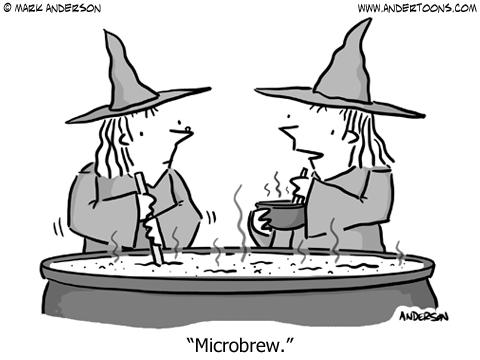
Microbrew
by JOHN ADAMS •