
Culture, Local Government, Politics, University
The Remains of the Day
by JOHN ADAMS •
If one would like to see the present condition and future prospects of Whitewater’s insiders, there are no better accounts (truly) than two stories from the Daily Union:
UW-Whitewater chancellor session held @ http://www.dailyunion.com/news/article_f042575e-a63a-11e4-bcd8-939679ffcc09.html
Whitewater bids fond farewell to Telfer @ http://www.dailyunion.com/news/article_68cb8454-1c18-11e5-8e44-a3bfa315d78f.html.
Each story is purportedly about UW-Whitewater’s chancellor (the search for a new one, or the retirement of the current one, respectively). In fact, the stories are more about town notables than anyone else.
Some will see in these accounts that local group’s continuing strength and vitality; others will see in these same stories evidence of weakness and infirmity.
I’ve a definite view on this question. In any event, it seems improbable that one could read these stories without thereafter forming an opinion, one way or the other.
(This post’s title is not original with me, needless to say. The Remains of the Day is Kazuo Ishiguro’s novel about an English butler. There was also a film version of the story. Both were well-told, if melancholy, tales of lost opportunities. )
Film
Film: Aloha Nalu
by JOHN ADAMS •
ALOHA NALU from O'Neill on Vimeo.
In this film, Steven worked with Team O’Neill surfer and professional athlete Malia Manuel to capture a unique perspective on a single day’s surf session in Western Australia. Utilising drones for the majority of the videography, Steven plays with perspective, taking the viewer into, above, and beyond the waves.
Daily Bread
Daily Bread for 6.30.15
by JOHN ADAMS •
Good morning, Whitewater.
June ends for Whitewater with partly cloudy skies and a high of seventy-six. Sunrise is 5:20 and sunset 8:37, for 15h 17m 13s of daytime. The moon is a waxing gibbous with 96.7% of its visible disk illuminated.
Today is the anniversary, from 1908, of the Tunguska (Siberia) event:
The Tunguska event was a large explosion, caused by an asteroid or comet, which occurred near the Podkamennaya Tunguska River in what is now Krasnoyarsk Krai, Russia, at about 07:14 KRAT (00:14 UT) on June 30 [O.S. June 17], 1908.[1][2][3] The explosion occurred at an altitude of 5–10 kilometres (3–6 mi) at 60.886°N, 101.894°E. It is classified as an impact event even though the object is believed to have burst in the air rather than hit the surface.[4] Different studies have yielded widely varying estimates of the impacting object’s size, on the order of 60 m (200 ft) to 190 m (620 ft).[5] It is the largest impact event on Earth in recorded history.
Since the 1908 event, there have been an estimated 1,000 scholarly papers (mainly in Russian) published on the Tunguska explosion. Many scientists have participated in Tunguska studies: the best known are Leonid Kulik, Yevgeny Krinov, Kirill Florensky, Nikolai Vladimirovich Vasiliev, and Wilhelm Fast. In 2013, a team of researchers led by Victor Kvasnytsya of the National Academy of Sciences of Ukraine published analysis results of micro-samples from a peat bog near the center of the affected area showing fragments that may be of meteoritic origin.[6][7]
Estimates of the energy of the blast range from as low as three to as high as 30 megatons of TNT (between 13 and 130 PJ).[8][9] Most likely it was between 10 and 15 megatons of TNT (42 and 63 PJ),[9] and if so, the energy of the explosion was about 1,000 times greater than that of the atomic bomb dropped on Hiroshima, Japan; roughly equal to that of the United States’ Castle Bravo ground-based thermonuclear test detonation on March 1, 1954; and about two-fifths that of the Soviet Union‘s later Tsar Bomba (the largest nuclear weapon ever detonated).[10]
It is estimated that the Tunguska explosion knocked down some 80 million trees over an area of 2,150 square kilometres (830 sq mi), and that the shock wave from the blast would have measured 5.0 on the Richter scale. An explosion of this magnitude would be capable of destroying a large metropolitan area,[11] but due to the remoteness of the location, no fatalities were documented. This event has helped to spark discussion of asteroid impact avoidance.
Here’s Puzzability‘s Tuesday game:
|
This Week’s Game — June 29-July 3
|
|||||
|
One Nation, Divisible
|
|||||
|
Get out your red, white, and blue-ray for this week’s filmfest. For each day, we’ll give you a series of clues, each of which leads to a word. You must drop one letter out of each of these answer words and put them together (in order), adding spaces as needed, to get a movie title that includes a word evoking the July 4th holiday—a different such word every day.
|
|||||
|
Example:
|
|||||
|
“We hold ___ truths to be self-evident” / “Fourscore and seven years ___” / composer of The Merry Widow / public defamation, legally / uninhibited part of the psyche
|
|||||
|
Answer:
|
|||||
|
The Eagle Has Landed (these / ago / Lehar / slander / id)
|
|||||
|
What to Submit:
|
|||||
|
Submit the movie title and the smaller words (as “The Eagle Has Landed (these / ago / Lehar / slander / id)” in the example) for your answer.
|
|||||
 |
|||||
|
Tuesday, June 30
|
|||||
|


Science/Nature
Syracuse University Lava Project
by JOHN ADAMS •
WGTB, WHEN GREEN TURNS BROWN
Quiet
by JOHN ADAMS •
 Post 17 in a series. When Green Turns Brown is an examination of a small town’s digester-energy project, in which Whitewater, Wisconsin would import other cities’ waste, claiming that the result would be both profitable and green.
Month after month, in the first half of 2014, after behind-the-scenes discussions in 2013, vendor Trane presented to Whitewater on both a digester-energy project and an energy-savings project. The price for these two deals was over a million dollars, with a ‘feasibility’ study for the digester-energy project alone priced at, effectively, six-figures. (One might consider the cost of the digester-energy study more like Whitewater’s payment for Trane’s sales own presentations, but that’s not how either Whitewater’s city manager, wastewater superintendent, or Trane’s representatives described it.)
I’ve devoted posts to these two Trane proposals because Whitewater’s municipal manager and wastewater superintendent spent so much time on them. They advanced these proposals, and supported their approval, insisting on the merit of both vendor and concept.
And so, I’ve written about those meetings, and that support:
- Looking at the 12.3.13 Digester Presentation.
- Parsing a Presentation (12.3.13).
- First Vendor Presentation of 1.21.14 to Whitewater’s Common Council.
- Whitewater’s Common Council Votes to Fund a Vendor Study.
- Trane Presents an Energy-Savings Contract.
- Meetings & Motivations.
- Trane’s Second Presentation on an Energy-Savings Contract.
- Trane’s Third Presentation on an Energy-Savings Contract.
From those meetings alone, I’ve populated a Question Bin with inquiries to be considered. Those questions will be useful to me later on; there should be an order for addressing a topic. (See, Steps for Blogging on a Policy or Proposal.)
What, then, of the confidence that Whitewater City Manager Cameron Clapper and Wastewater Superintendent Tim Reel placed in Trane? What of their consistent urging (and that of others) that, in their judgment, Whitewater should spend well over a million (along the way to millions more) on Trane’s work?
One finds these entries, from the Whitewater Common Council agendas of 12.2.14 and 12.16.14, respectively:
CLOSED SESSION. Adjournment to Closed Session, to reconvene
approximately 25 minutes after adjournment to closed session, per Wisconsin
Statutes 19.85(1)(e):
“Deliberating or negotiating the purchasing of public properties, the investing
of public funds, or conducting other specified public business, whenever
competitive or bargaining reasons require a closed session”,
and per 19.85(1)(g):
“Conferring with legal counsel for the governmental body who is rendering
oral or written advice concerning strategy to be adopted by the body with
respect to litigation in which it is or is likely to become involved.”
Item to be Discussed:
Strategy and settlement discussions related to the Bio solids and Efficiency
Improvement Project Contract with Trane U.S. Inc. and other aspects of the
project.
Reconvene into Open Session:
Directions to City staff concerning actions related to the Bio solids and
Efficiency Improvement Project Contract with Trane U.S. Inc. and other
aspects of the project.
ADJOURNMENT.
and
EXECUTIVE SESSION. Adjournment to Closed Session, to reconvene
approximately 25 minutes after adjournment to closed session, per Wisconsin
Statutes 19.85(1)(e):
“Deliberating or negotiating the purchasing of public properties, the investing
of public funds, or conducting other specified public business, whenever
competitive or bargaining reasons require a closed session”,
and per 19.85(1)(g):
“Conferring with legal counsel for the governmental body who is rendering
oral or written advice concerning strategy to be adopted by the body with
respect to litigation in which it is or is likely to become involved.”
and per 19.85(1)(c):
“Considering employment, promotion, compensation or performance
evaluation data of any public employee over which the governmental body
has jurisdiction or exercises responsibility.”
Items to be Discussed:
Strategy and settlement discussions related to the Bio solids and Efficiency
Improvement Project Contract with Trane U.S. Inc. and other aspects of the
project.
Union Negotiations with WPPA (Wisconsin Professional Police
Association).
Reconvene into Open Session:
Possible directions to City staff concerning actions related to the Bio solids
and Efficiency Improvement Project Contract with Trane U.S. Inc. and other
aspects of the project.
AND
Possible Action on WPPA Union Contract.
ADJOURNMENT
The minutes for these meetings report that no action was taken after reconvening from closed session. Details of the concerns that prompted these two closed sessions have not, to my knowledge, been published anywhere.
Council Discussion Closed Session, 12.2.14 (Trane)
Agenda: http://www.whitewater-wi.gov/images/stories/2014-1202_complete_packet_with_links.pdf
Minutes: http://www.whitewater-wi.gov/images/stories/2014-1202.pdf
Video: https://vimeo.com/113940875
Council Presentation, 12.16.14 (Donohue) and Closed Session (Trane)
Agenda: http://www.whitewater-wi.gov/images/stories/2014-1216_complete_packet_reduced_with_links.pdf
Minutes: http://www.whitewater-wi.gov/images/stories/2014-1216.pdf
Video: https://vimeo.com/113940875
WHEN GREEN TURNS BROWN: Mondays @ 10 AM, here on FREE WHITEWATER.
Music
Monday Music: Jazz Vespers Quartet, Norwegian Wood
by JOHN ADAMS •
Daily Bread
Daily Bread for 6.29.15
by JOHN ADAMS •
Good morning, Whitewater.
Monday in town will be cloudy, with a high of seventy-six, and a probability of afternoon thundershowers. Sunrise is 5:19 and sunset 8:37, for 15h 17m 50s of daytime. The moon is a waxing gibbous with 91.9% of its visible disk illuminated.
On this day in 1943, Pres. Roosevelt writes to Dr. J. Robert Oppenheimer, then working with other scientists on the development of an atomic bomb. Roosevelt marks his letter ‘secret,’ and needless to say never mentions the particulars of the project or any code names used for it:
THE WHITE HOUSE
WASHINGTON
June 29, 1943SECRET
My dear Dr. Oppenheimer:
I have recently reviewed with Dr. Bush the highly important and secret program of research, development and manufacture with which you are familiar. I was very glad to hear of the excellent work which is being done in a number of places in this country under the immediate supervision of General L.R. Groves and the general direction of the Committee of which Dr. Bush is Chairman. The successful solution of the problem is of the utmost importance to the national safety, and I am confident that the work will be completed in as short a time as possible as the result of the wholehearted cooperation of all concerned.
I am writing to you as the leader of one group which is to play a vital role in the months ahead. I know that you and your colleagues are working on a hazardous matter under unusual circumstances. The fact that the outcome of your labors is of such great significance to the nation requires that this program be even more drastically guarded than other highly secret war development. I have therefore given directions that every precaution be taken to insure the security of your project and feel sure that those in charge will see that these orders are carried out. You are fully aware of the reasons why your endeavors and those of your associates must be circumscribed by very special restrictions. Nevertheless, I wish you would express to the scientists assembled with you my deep appreciation of their willingness to undertake the tasks which lie before them in spite of the dangers and the personal sacrifices. I am sure that we can rely on their continued wholehearted and unselfish labors. Whatever the enemy may be planning, American science will be equal to the challenge. With this thought in mind, I send this note of confidence and appreciation.
Though there are other important groups at work, I am writing only to you as the leader of one which is operating under very special conditions, and to General Groves. While this letter is secret, the contents of it may be disclosed to your associates under pledge of secrecy.
Very Sincerely Yours
Franklin Delano Roosevelt
Dr. J. R. Oppenheimer
Post Office Box 1663
Santa Fe,
New Mexico
Here’s the first game in Puzzability‘s Independence Day themed series, One Nation, Divisible:
|
This Week’s Game — June 29-July 3
|
|||||
|
One Nation, Divisible
|
|||||
|
Get out your red, white, and blue-ray for this week’s filmfest. For each day, we’ll give you a series of clues, each of which leads to a word. You must drop one letter out of each of these answer words and put them together (in order), adding spaces as needed, to get a movie title that includes a word evoking the July 4th holiday—a different such word every day.
|
|||||
|
Example:
|
|||||
|
“We hold ___ truths to be self-evident” / “Fourscore and seven years ___” / composer of The Merry Widow / public defamation, legally / uninhibited part of the psyche
|
|||||
|
Answer:
|
|||||
|
The Eagle Has Landed (these / ago / Lehar / slander / id)
|
|||||
|
What to Submit:
|
|||||
|
Submit the movie title and the smaller words (as “The Eagle Has Landed (these / ago / Lehar / slander / id)” in the example) for your answer.
|
|||||
|
|||||
|
Monday, June 29
|
|||||
|

Animation
Sunday Animation: The Duplicators – Cartoon Network ID Short
by JOHN ADAMS •
Daily Bread
Daily Bread for 6.28.15
by JOHN ADAMS •
Good morning, Whitewater.
Sunday will be sunny in the morning, but increasingly cloudy as the day goes on, with an even chance of thunderstorms in the late afternoon, and a high of seventy-six. Sunrise is 5:19 and sunset is 8:37, for 15h 18m 23s of daytime. The moon is a waxing gibbous with 85.6% of its visible disk illuminated.
An overwhelming majority of respondents to the FW Friday Poll, a poll that asked whether kangaroos should be permitted as service animals, said that they should not be allowed.
Whatever the merits of kangaroos as service animals for people, they’re not always accommodating to others of their own species:
On this day in 1919, the First World War formally ends with the principal warring nations’ signing of the Treaty of Versailles. German representatives were without a spirit of conciliation to that treaty’s stringent terms:
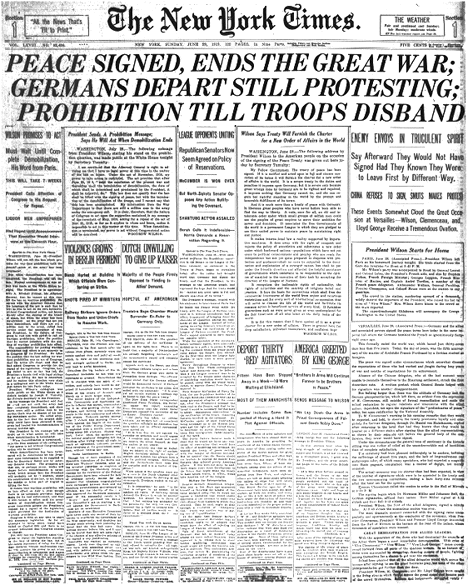
Versailles, June 28, (Associated Press.)–Germany and the allied and associated powers signed the peace terms here today in the same imperial hall where the Germans humbled the French so ignominiously forty-eight years ago.
This formally ended the world war, which lasted just thirty-seven days less than five years. Today, the day of peace, was the fifth anniversary of the murder of Archduke Francis Ferdinand by a Serbian student at Serajevo.
The peace was signed under circumstances which somewhat dimmed the expectations of those who had worked and fought during long years of war and months of negotiations for its achievement.
Absence of the Chinese delegates, who at the last moment were unable to reconcile themselves to the Shantung settlement, struck the first discordant note. A written protest which General Smuts lodged with his signature was another disappointment.
But bulking larger than these was the attitude of Germany and the German plenipotentiaries, which left them, as evident from the expression of M. Clemenceau, still outside of formal reconciliation and made the actual restoration to regular relations and intercourse with the allied nations dependent, not upon the signature of the “preliminaries of peace” today, but upon ratification by the National Assembly….
On this day in 1832, Gen. Atkinson leads thousands in the Black Hawk War:
1832 – Atkinson starts up Rock River in Black Hawk War
On this date General Henry Atkinson and the Second Army began its trip into the Wisconsin wilderness in a major effort against Black Hawk. The “Army of the Frontier” was formed of 400 U.S. Army Regulars and 2,100 volunteer militiamen in order to participate in the Black Hawk War. The troops were headed toward the Lake Koshkonong area where the main camp of the British Band was rumored to be located. [Source: Along the Black Hawk Trail by William F. Stark, p. 93-94]
Daily Bread
Daily Bread for 6.27.15
by JOHN ADAMS •
Good morning, Whitewater.
Saturday in town will be partly cloudy with a high of seventy-nine. Sunrise is 5:18 and sunset 8:37, for 15h 18m 52s of daytime. The moon is a waxing gibbous with 77.8% of its visible disk illuminated.
On this day in 1972, Nolan Bushnell incorporated Atari:
Atari (from a Japanese verb meaning “to hit the target” or “a success”) is a corporate and brand name owned by several entities since its inception in 1972, currently by Atari Interactive, a subsidiary of the French publisher Atari, SA(ASA).[1][2][3] The original Atari, Inc. founded in 1972 by Nolan Bushnell and Ted Dabney was a pioneer in arcade games, home video game consoles, and home computers. The company’s products, such as Pong and the Atari 2600, helped define the electronic entertainment industry from the 1970s to the mid-1980s.
In 1984, the original Atari Inc. was split due to its role in the video game crash of 1983, and the arcade division was turned into Atari Games Inc.[4] Atari Games received the rights to use the logo and brand name with appended text “Games” on arcade games, as well as rights to the original 1972–1984 arcade hardware properties. The Atari Consumer Electronics Division properties were in turn sold to Jack Tramiel’s Tramel Technology Ltd., which then renamed itself to Atari Corporation.[5][6] In 1996, Atari Corporation reverse-merged with disk-drive manufacturer JT Storage (JTS),[7] becoming a division within the company.
In 1998, Hasbro Interactive acquired all Atari Corporation related properties from JTS,[8] creating a new subsidiary, Atari Interactive.[9] Infogrames Entertainment (IESA) bought Hasbro Interactive in 2001 and renamed it to Infogrames Interactive, later Atari Interactive in 2003, when Infogrames Inc. licensed the Atari name and logo from the latter and changed its name to Atari Inc.,[2][10][11] a name used for a company founded in 1993 as GT Interactive, which IESA also renamed to Infogrames, Inc. and acquired a 62% controlling interest in by 1999.[12] After IESA’s acquisition of Hasbro Interactive, Infogrames, Inc. intermittently published Atari branded titles for Infogrames Interactive. On October 11, 2008, Infogrames completed its acquisition of Atari, Inc., making it a wholly owned subsidiary.[13]
On this day in 1837, Wisconsin’s now-oldest newspaper begins publishing:
1837 – The Milwaukee Sentinel Founded
On this date the Milwaukee Sentinel, the oldest newspaper in the state, was founded as a weekly publication by Solomon Juneau, who also was Milwaukee’s first mayor. [Source: History Just Ahead: A Guide to Wisconsin’s Historical Markers edited by Sarah Davis McBride, p. 19]
Corporate Welfare, Gluttony, Government Spending, WEDC
WEDC Backed Use of Public Funds to Pay Off Luxury Cars
by JOHN ADAMS •
There is more than one person in this town who has insisted, more than once, that the Wisconsin Economic Development Corporation has been good for Wisconsin, and good for Whitewater.
It’s been, instead, a failure and a disgrace.
At a time when many communities did not have enough money for vital needs, WEDC was trying to find money for a firm to pay off its Maserati lease.
All the talk from a few local men and women describing WEDC as a positive force has been evidence of poor judgment and contempt for sound reasoning. All the plaques and certificates that a few local men and women have received from WEDC are, themselves, pitiful badges of poor judgment and contempt for sound reasoning.
Consider the latest on the Wisconsin Economic Development Corporation:
Madison — Officials at Wisconsin’s top jobs agency sought federal tax incentives for a failing Milwaukee business for a year after being told that the owner was seeking the money to pay off business debts such as the leases on luxury cars.
Officials at the Wisconsin Economic Development Corp. worked to get that federal help for Building Committee Inc. even though a $500,000 loan it had given to the company had gone sour within months and the owner of the firm had provided false information to the state.
Top officials in Gov. Scott Walker’s administration pushed to get Building Committee the initial loan and worked to get more for the company. But the jobs agency had to pass on giving the company more funding from state taxpayers after finding numerous problems with the firm and being told that owner Bill Minahan was promising some of this second proposed loan to pay a leasing debt on cars such as a 2010 Maserati and a 2011 Nissan 370Z luxury sports car.
Information about state officials’ long-running attempts to find help for the troubled company are coming to light just as the Republican governor prepares to announce his bid for the presidency next month. Walker said he didn’t think his jobs agency had cut any corners.
WEDC officials’ alarm didn’t stop them from persuading three counties to allocate $4.5 million for Building Committee from a federal program meant to spur energy conservation, according to hundreds of pages of emails and other documents recently released under the state’s open records law. Those federal incentives were never used because, even with the subsidies in hand, Building Committee was unable to get the financial backing it needed to proceed with its project.
WEDC officials never told those counties about the concerns that had made them email each other with statements like “Yikes!” and “I can’t believe we are actually going to do this” about earlier proposed help for Building Committee….
See, WEDC backed firm after learning state money was for luxury car debts @ JSOnline.
Cats
Friday Catblogging: Cat Wins ‘Hero Dog’ Award from Los Angeles SPCA
by JOHN ADAMS •
Well done, loyal feline —
Previously, at FW, Heroic Cat Saves Boy from Vicious Dog.
Poll
Friday Poll: Kangaroos as Service Animals?
by JOHN ADAMS •
In Beaver Dam, a woman was evicted from a McDonald’s restaurant after employees rejected her contention that the kangaroo accompanying her into the establishment was a service animal. Beaver Dam subsequently banned the use of kangaroos as service animals.
What do you think: Should kangaroos be considered service animals?