FREE WHITEWATER

Daily Bread for 2.23.15

Good morning, Whitewater.

Our Monday will be sunny and cold, with a high of nine degrees. Sunrise is 6:38 and sunset is 5:37, for 10h 58m 23s of daytime. The moon is a waxing crescent with 27% of its visible disk illuminated.

On this day in 1945, http://www.history.com/this-day-in-history/us-flag-raised-on-iwo-jima“United States Marines raise the American flag on Iwo Jima:

The famous photograph taken by Rosenthal was the second U.S. flag-raising event of the day. On orders from Colonel Chandler Johnson—passed on by Captain Dave Severance—Sergeant Michael Strank, Corporal Harlon H. Block, Private First Class Franklin R. Sousley, and Private First Class Ira H. Hayes (all four from the Second Platoon, Easy Company) spent the morning after the first flag-raising laying a telephone wire to the top of Mt. Suribachi. Severance also dispatched Private First Class

Rene A. Gagnon, the battalion runner for Easy Company, to the command post for fresh SCR-300 walkie-talkie batteries.[17]

Meanwhile, Lieutenant Albert Theodore Tuttle[16] had found a larger (96-by-56–inch) flag in nearby Tank Landing Ship USS LST-779. He made his way back to the command post and gave it to Johnson. Johnson, in turn, gave it to Rene Gagnon, with orders to take it up to Lt. Schrier on Mt. Suribachi and raise it.[18] The official Marine Corps history of the event is that Lt. Tuttle received the flag from Navy Ensign Alan Wood of USS LST-779, who in turn had received the flag from a supply depot in Pearl Harbor.[19][20][21]

horlicksmaltedtabletfrontw

On this day in 1846, a (malted) milk magnate is born:

1846 – William Horlick Born
On this date William Horlick was born in Ruardean, Gloucestershire, England. A noted food manufacturer and philanthopist, Horlick arrived in the U.S. in 1869 and settled in Racine. In 1872 he moved to Chicago with his brother and began to manufacture food products.

In 1876 his company moved to Racine where he began to experiment with creating a dried milk product. In 1887 he trademarked Malted Milk. In 1889 he opened a company branch in New York City and another in England the following year. He constructed additional plants in Racine in 1902 and 1905. The company name was changed to Horlick’s Malted Milk Co. in 1906. This success enabled Horlick to achieve a widespread reputation as a philanthropist in Racine. He also helped fund the first Byrd expedition to the South Pole and the Amundsen expedition to the North Pole. After his death in 1936, control of the company passed to his son, Ander James Horlick. [Source: Dictionary of Wisconsin Biography, SHSW 1960, pg. 177]

Puzzability‘s game for the week is about hit singles:

This Week’s Game — February 23-27
Singled Out
There are hits missing this week. For each day, fill in the two-word title of a #1 hit song so that a familiar phrase or compound word is formed by the first word in the clue followed by the first word in the song title, and likewise a phrase or word is formed by the second word in the song title followed by the second word in the clue.
Example:
GILA ____ ____ NOTE
Answer:
“Monster Mash”
What to Submit:
Submit the song title (as “Monster Mash” in the example) for your answer.
Monday, February 23
HERE’S ____ ____ DUST

Film – Scenes You’ve Seen: Blockbuster movies recreated with stock footage

In time for the Oscars, a homage to famous films using stock footage —

Scenes You’ve Seen: Blockbuster movies recreated with stock footage from Dissolve on Vimeo.

Scenes you’ve seen … or have you? Using Dissolve stock footage – and the magic of editing – we’ve created this impressionistic homage to some classic movies. Can you name all 14 films?
See and license the clips used at dissolve.com/scenes

Now try your luck with Scenes You’ve Seen 2: Award Winners Edition: vimeo.com/119382931

Music: “Retro Smash Hit” by Pat Andrews, licensed from Audiosocket bit.ly/retrosmash

Via Vimeo.

Daily Bread for 2.22.15

Sunday in town will be sunny and cold, with a high of nine degrees. Sunrise is 6:40 and sunset is 5:35, for 10h 55m 34s of daytime. The moon is a waxing crescent with eighteen percent of its visible disk illuminated.

In the Friday FREE WHITEWATER poll, readers voted on their preferred Best Picture winner at tonight’s Academy Awards ceremony. A plurality of respondents favored American Sniper (28.57%), with Boyhood coming in next (16.33%), then The Theory of Everything (14.29%), The Grand Budapest Hotel (12.24%), Birdman (10.2%), Whiplash (8.16%), and Selma (4.08%).

Good morning, Whitewater.

It’s cold today, but in on February 22, 1922, Wisconsin saw much worse:

1922 – Ice Storm Wreaks Havoc

Unprecedented freezing rain and snow assaulted the Midwest February 21-23, 1922. In Wisconsin, the central and southern parts of the state were most severely affected, with the counties between Lake Winnebago and Lake Michigan south to Racine being hardest hit. Ice coated trees and power lines, bringing them down and cutting off electricity, telephone and telegraph services.

Cities were isolated, roads were impassible, rivers rose, streets and basements flooded, and train service stopped or slowed. Near Little Chute a passenger train went off the rails, injuring several crew members. Appleton housed 150 stranded traveling salesmen, near Plymouth a sheet of river ice 35 feet long and nearly three feet thick washed onto the river bank, while in Sheboygan police rescued a flock of chickens and ducks from their flooded coop and a sick woman from her flooded home.

Icy streets caused numerous automobile accidents, but the only reported deaths were a team of horses in Appleton that were electrocuted by a fallen power line. Sources: Wisconsin newspaper accounts, February 22 and 23, including the Appleton Post-Crescent, the Sheboygan Press, Waukesha Daily Freeman, Oshkosh Daily Northwestern.

For more about the storm, see This Day in Weather History for southeast Minnesota, northeast Iowa, and western Wisconsin. On page 20, National Weather Service meteorologists Todd Rieck and Jeff Boyne describes the conditions in Wisconsin during 1922 ice storm.

Daily Bread for 2.21.15

Good morning, Whitewater.

Saturday in town will bring a twenty-percent chance of snow showers with a high of twenty-eight. Sunrise is 6:41 and sunset 5:34, for 10h 52m 46s of daytime. The moon is a waxing crescent with 9.5% of its visible disk illuminated.

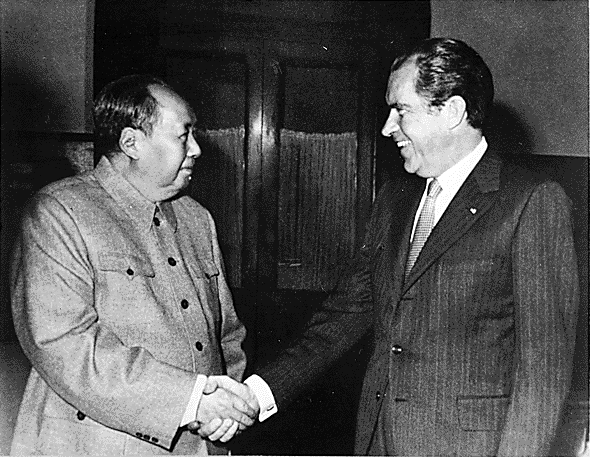
On this day in 1972, Nixon arrives in China:

Nixon_Mao_1972-02-29

Before even being elected president, Richard Nixon had talked of the need for better relations with the PRC, with which the U.S. did not maintain diplomatic relations as it recognized the government of the Republic of China on Taiwan as the government of China. Early in his first term, Nixon and National Security Adviser Henry Kissinger began sending subtle overtures hinting at warmer relations to the PRC government. After a series of these overtures by both countries, Kissinger flew on secret diplomatic missions to Beijing, where he met with Premier Zhou. On July 15, 1971, the President announced that he would visit the PRC the following year.

Occurring from February 21 to 28, 1972, the visit allowed the American public to view images of China for the first time in over two decades. Throughout the week the President and his most senior advisers engaged in substantive discussions with the PRC, including a meeting with Chairman Mao Zedong, while First Lady Pat Nixon toured schools, factories and hospitals in the cities of Beijing, Shanghai and Hangzhou with the large American press corps in tow. Nixon dubbed the visit “the week that changed the world.”
The repercussions of the Nixon visit were vast, and included a significant shift in the Cold War balance, pitting the PRC with the U.S. against the Soviet Union. “Nixon going to China” has since become a metaphor for an unexpected or uncharacteristic action by a politician.

On this day in 1918, Wisconsin’s Assembly stands with La Follette:

…a move to denounce Sen. Robert La Follette and the nine Wisconsin congressmen who refused to support World War I failed in the State Assembly, by a vote of 76-15. Calling LaFollette “disloyal,” the amendment’s originator, Democrat John F. Donnelly, insisted that La Follette’s position did not reflect “the sentiment of the people of Wisconsin. We should not lack the courage to condemn his actions.” Reflecting the majority opinion, Assemblyman Charles F. Hart retorted that “The Wisconsin State Legislature went on record by passing a resolution telling the President that the people of this state did not want war. Now we are condemning them for doing that which we asked them to do.” [Source: Capital Times 2/21/1918, p.1]

Chancellor Telfer & UW-Whitewater Officials: Why Wait 147 Days?

On September 18, 2014, with the support of national-assault prevention groups, law enforcement, therapists & doctors, and actors & actresses, a bipartisan coalition launched the It’s On Us campaign.

The campaign asks everyone to pledge

To RECOGNIZE that non-consensual sex is sexual assault.
To IDENTIFY situations in which sexual assault may occur.
To INTERVENE in situations where consent has not or cannot be given.
To CREATE an environment in which sexual assault is unacceptable and survivors are supported.

The very day after the program’s launch, I posted one the first videos from the campaign, at FREE WHITEWATER, as it appeared in the Washington Post. See, from 9.19.14, that post with video @ FW.

Just last week, on February 12, 2015, UW-Whitewater announced that it would promote the It’s On Us campaign. It’s a good and right thing to do. America is a great and honest nation; we are a people that has faced and overcome many serious problems, and we can do so again.

A question presents itself: Why did Chancellor Telfer and the UW-Whitewater administration wait 147 days to embrace this program?

The campaign was nationally-known and publicized from its very beginning.

The UW-Whitewater administration commands a budget of hundreds of millions, and a staff of ten – ten people – in its Media Relations department alone.

Could they – should they – not have been part of making a local commitment to a campaign like It’s On Us among their highest priorities?

How long would it have taken to promote this campaign months ago?

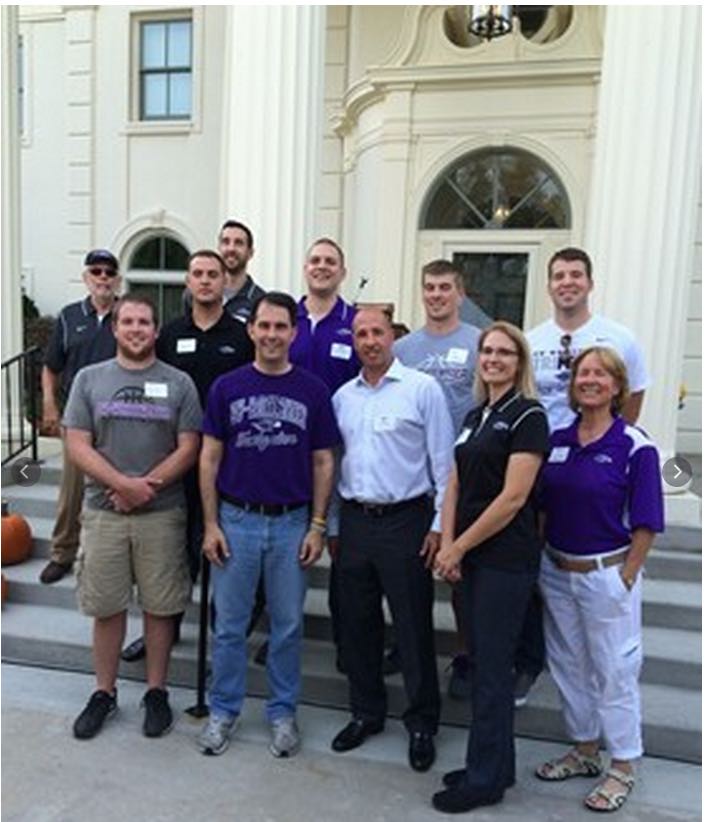
After all, on September 27, 2014, UW-Whitewater officials, including Chancellor Richard Telfer, Provost Beverly Kopper, and Athletic Director Amy Edmonds had time to travel to Maple Bluff and pose for a photo opportunity with Governor Walker.

Wisconsin-Whitewater Photo Galleries - National Champions at Governor's Mansion
(Provost Kopper and Athletic Director Edmonds are on the right. That’s Chancellor Telfer in the back row, wearing sunglasses. Feel free to click the picture for a larger image, if you should be so inclined.)

In less time than it took for the photo op – even on the morning before it – these same officials could have embraced and launched the It’s On Us campaign at UW-Whitewater.

Now, with just a few weeks until the arrival of Title IX investigators on campus to conduct student focus groups following a federal Title IX complaint against UW-Whitewater, they’ve embraced the campaign.

That commitment and support should have come sooner, with diligence and seriousness, long before a federal visit. That commitment and support should continue, with diligence and seriousness, long after a federal visit.

See, below, a video from the It’s On Us YouTube Channel:

I would encourage readers to donate to the It’s On Us campaign, and to support these and other efforts to prevent sexual violence.

Those who have experienced sexual assault will find resources of support at www.notalone.com.

Friday Poll: Best Picture at the Academy Awards


The Academy Awards will be presented this Sunday, February 22nd. Of the eight nominees for best picture, which film do you think should win? Here are those best-film nominees:

  • American Sniper
  • Birdman or (The Unexpected Virtue of Ignorance)
  • Boyhood
  • The Grand Budapest Hotel
  • The Imitation Game
  • Selma
  • The Theory of Everything
  • Whiplash

Embedded below is a printable list of nominees in principal award categories —

Daily Bread for 2.20.15

Good morning, Whitewater.

The work week ends with a high of seventeen and a seventy-percent chance of snow. Daytime accumulation will be about an inch. Sunrise is 6:43 and sunset 5:33, for 10h 49m 58s of daytime. The moon is a waxing crescent with 3.5% of its visible disk illuminated.

On this day in 1950, Sen. McCarthy makes his accusations on the Senate floor:

1950 – McCarthy Delivers Allegations to Senate
On this date, in a six-hour speech delivered before the U.S. Senate, Wisconsin Senator Joseph McCarthy claimed he had the names of 81 U.S. government officials actively engaged in Communist activities, including “one of our foreign ministers.” [Source: Internet Archives]

Puzzability‘s Oscar Losers series ends today:

This Week’s Game — February 16-20
Oscar Losers
Sometimes when you lose, you lose big. For each day this week, we started with a nominee for the Best Actor Oscar who didn’t win it in at least one year (though he may have won it in another year). We then removed all instances of the letters in OSCAR, though not all five of the letters necessarily appear in the name.
Example:
HINFD
Answer:
Harrison Ford
What to Submit:
Submit the actor’s name (as “Harrison Ford” in the example) for your answer.
Friday, February 20
PENETY

Former Coach Fader Vindicated Five Times Over

It’s been over nine months since Chancellor Richard Telfer suspended former UW-Whitewater wrestling coach Tim Fader, and later effectively fired him (Fader’s contract was not renewed). 

In April 2014, a woman alleged that a wrestling recruit assaulted her, and Fader has consistently said that he contacted the Whitewater Police Department about the incident, and that he (Fader) had someone accompany the accused recruit to the WPD at our municipal building.   

In these many months since, Mr. Fader has been vindicated in his principal claims, (at least) five times over:

1.  Fader was exonerated of any criminal wrongdoing (this never should have been even a question, truly, based on the circumstances of the allegations).

2. Fader, did, as he claimed, see that an assistant coach escorted the alleged assailant so that the accused recruit would speak with officers of the Whitewater Police Department. 

3. A university committee assembled under Chancellor’s Telfer’s direction recommended changes to the wrestling recruiting program, but recommended no sanctions or disciplinary action against Coach Fader.

4.  The National Collegiate Athletic Association and the Wisconsin Intercollegiate Athletic Conference, in reviews comprising three-hundred pages of documents, recommended or imposed no sanctions against Coach Fader or UW-Whitewater’s wrestling program.

5.  Athletic Diector Amy Edmonds, in published remarks from 2.18.15, admits that after the NCAA and WIAC reports, specific changes have not been made to recruiting visits.

So, here we are: Chancellor Telfer and A.D. Edmonds ended a career, but by Ms. Edmonds’s reported account, she made no specific changes to recruiting.

Chancellor Telfer & A.D. Edmonds rushed to suspend, and soon thereafter to terminate, and announce as much, but now? 

Now, Ms. Edmonds implicitly contends that although she effectively fired an award-winning coach, there was no substantial basis for that action. 

More concerning, here’s how Amy Edmonds, a publicly-employed athletic director at a leading UW System Division III school, describes her responsibility to open government and accountability:

“Certainly we weren’t as transparent, if you want to say that,” Edmonds said. “We didn’t have all these wonderful links and documents and such on our website. Now we’ve done that to allow anybody and everybody to take a peek at what our practices are.”

Transparency of public employees at a public school supported at public expense: you know, it’s just ‘wonderful links, ‘documents’ and ‘such’ on a website. 

Ms. Edmonds generously offers that others may now ‘take a peek’ at all this.

Honest to goodness, could Athletic Director Edmonds speak more glibly and cavalierly if she tried?

Does our university not deserve greater seriousness and commitment from an athletic director than ending a career the way Ms. Edmonds has done?

Does our university not deserve greater seriousness and commitment from an athletic director than these light and flippant remarks about open government?  

Does our university not deserve greater seriousness and commitment from an athletic director than these light and flippant remarks about providing prudently and legally-significant information about keeping students safe?

The very official at UW-Whitewater who acted promptly and practically to alert authorities to an alleged assault is a person who is no longer employed at UW-Whitewater.

That person would be Timothy Fader.

Daily Bread for 2.19.15

Good morning, Whitewater.

It’s a cold Thursday in town, with winds of 5 to 10 mph, wind chill values between -15 and -25, and a high of just one degree. Sunrise today is 6:44 and sunset 5:32, for 10h 47m 10s of daytime. We’ve a new moon.

Happy (Lunar) New Year —

unnamed

The Police and Fire Commission is scheduled to meet tonight at 6:30 PM.

There’s a new Dr. Seuss book to be published this July:

what-pet-should-I-get-book-jacket

For the first time in 25 years, a new book by Dr. Seuss will be published this year from an original manuscript and sketches discovered in the home of the beloved children’s author, Random House announced today.

What Pet Should I Get? captures the excitement of a classic childhood moment—choosing a pet—and features the brother and sister characters that Dr. Seuss introduced in One Fish Two Fish Red Fish Blue Fish. The new book, to be published in July, was likely written between 1958 and 1962 as the brother and sister are the same age in both stories.

The box filled with pages of text and sketches was found shortly after Ted’s death in 1991 when his widow Audrey Geisel was remodeling her home, according to a release. At that time it was set aside with other of Ted’s materials. It was rediscovered in the fall of 2013 by Mrs. Geisel and Claudia Prescott—Ted Geisel’s longtime secretary and friend—when they were cleaning out his office space. They reviewed the materials, finding the full text and illustrations for What Pet Should I Get? among other work.

On this day in 1868, a noted photographer is born near Whitewater:

1868 – Photographer Edward S. Curtis Born
On this date Edward Sheriff Curtis was born near Whitewater. As a young boy, he taught himself photography. His family eventually moved to the Puget Sound area of Washington state. He settled in Seattle and opened a photography studio in 1897.

A chance meeting on Mount Rainier resulted in Curtis being appointed official photographer on railroad magnate E.H. Harriman’s expedition to Alaska. Curtis also accompanied George Bird Grinnell, editor of Field and Stream magazine, to Montana in 1900 to observe the Blackfoot Sun Dance. After this, Curtis strove to comprehensively document American Indians through photography, a project that continued for over 30 years.

Working primarily with 6 x 8-inch reflex camera, he created over 40,000 sepia-toned images. His work attracted national attention, most notably from Theodore Roosevelt and J. Pierpont Morgan, whose family contributed generously to his project. His monumental work, The North American Indian, was eventually printed in 20 volumes with associated portfolios. Curtis’ work included portraits, scenes of daily life, ceremonies, architecture and artifacts, and landscapes. His photographs have recently been put online by the Library of Congress.[Source: Dictionary of Wisconsin Biography, SHSW 1960, pg. 892]

Here’s the Thursday game in Puzzability‘s Oscar Losers series:

This Week’s Game — February 16-20
Oscar Losers
Sometimes when you lose, you lose big. For each day this week, we started with a nominee for the Best Actor Oscar who didn’t win it in at least one year (though he may have won it in another year). We then removed all instances of the letters in OSCAR, though not all five of the letters necessarily appear in the name.
Example:
HINFD
Answer:
Harrison Ford
What to Submit:
Submit the actor’s name (as “Harrison Ford” in the example) for your answer.
Thursday, February 19
UELLWE

Seventeen Questions: Injustice in Walworth County Wrongly Sends a Fourteen-Year-Old to Jail

Yesterday, I posted about an appellate court decision that reversed a juvenile’s conviction and remanded the case for a new trial.  See, Injustice in Walworth County Wrongly Sends a Fourteen-Year-Old to Jail

Today I’ll post several questions concerning the decision and two published accounts about of it. 

The appellate decision (“Appellate Decision”) is online at State v. Charles C. S., Jr., No. 2014AP1045, unpublished (Wis. Ct. App. Feb. 11, 2015), available at https://www.wicourts.gov/ca/opinion/DisplayDocument.html?content=html&seqNo=134396;. 

The two published stories are from the Gazette, at Appeals court calls for Walworth County new trial in juvenile arson case (“Gazette 021315”) and Walworth County DA says detective, prosecutor acted correctly in juvenile case (“Gazette 021615”), subscription req’d for both Gazette stories. 

This case concerns a burglary and arson at the Bethel United Methodist Church in Sugar Creek.  Three boys – of whom Charles was just one – were suspected in the case.  The crime is serious; the legal question isn’t one of seriousness, but of culpability under the law. 

The question isn’t whether someone damaged the church – the question is whether the Walworth County District Attorney acted wrongfully to obtain the particular conviction of a particular boy (rather than, for example, one of the other two).

1.  Isn’t it persuasive that Walworth County Detective Jeffrey Recknagel gave, as the appellate court found, “demonstrably false testimony that Drake [another boy] had been honest with him ‘every time’ “? (Appellate Decision, ¶. 17.)

Here’s a portion of the transcript (from redirect examination, during the State’s exchange with Recknagel):

Q: And as a detective have you had any training on
detecting honesty?
A: Yes, ma’am.
Q: And from your interview with Drake [], did you feel
that he was being honest with you?
A: Absolutely. And I haven’t had just one interview with
Drake, I had more than one interview and I believe that
every time he was being honest with me.

(Appellate Decision, ¶. 17)

Despite his trial testimony, Recknagel later admitted in a post-disposition proceeding that “Drake lied to him at least three times.”  (Appellate Decision, ¶. 9)

2.  Do Walworth County D.A. Necci and Walworth County Sheriff Picknell think that there’s no difference between honesty every time and dishonesty at least three times? 

If so, does that mean that Messrs. Necci and Picknell get to utter at least three lies of their choice, with impunity?

3.  Gazette reporter Frank Schultz writes that “Necci said that he has read the trial transcript, which shows that Recknagel was saying that people always lie to him at first, but after the initial lies, Drake and Robert consistently told the truth.” (Gazette 021615.) How does Necci’s interpretation contradict or negate the testimony the appellate court cited in Appellate Decision, ¶. 17? 

Recknagel plainly and clearly says ‘every time’ in the trial transcript, and later admitted he, Recknagel, knew the other boy did lie to him, at least three times.

What prior testimony of Recknagel could make the actual, verbatim transcript testimony cited in Appellate Decision ¶. 17 any less false? 

4.  Although this is a case involving a juvenile, and subject to concerns of confidentiality, if D.A. Necci thinks other portions of testimony somehow rehabilitate Recknagel, then why doesn’t he seek court permission for publication of the relevant passages he’s supposed to have discussed with Gazette reporter Schultz?  For that matter, why not seek court-authorization and publish the full transcripts, subject to necessary redaction? 

5.  When Necci reportedly tells Schultz that other trial testimony somehow supports Recknagel (Gazette 021615), did reporter Schultz ask to see those transcripts? Did he see them? 

6.  When Necci reportedly tells Schultz that other trial testimony somehow supports Recknagel (Gazette 021615), did reporter Schultz even ask Necci to read aloud to him the passage that Necci says supports Recknagel? Did reporter Schultz just take Necci’s word for it? 

7. In the second published news story (Gazette 021615), D.A. Necci’s quoted as saying he has the “utmost respect” for Recknagel.  This is after the appellate court conclusion that Recknagel gave “demonstrably false testimony.” (Appellate Decision ¶. 17)  If that’s an occasion to have the ‘greatest possible amount, degree, or extent’ of respect, what would Recknagel have to do to give Necci any pause at all?

8.  Gazette reporter Schultz quotes Necci as saying that he, Necci, “just can’t agree with the notion that my prosecutor took advantage of the defense attorney” who is a licensed attorney who should know the law, Necci said.” (Gazette 021615.  As District Attorney, does Necci believe that his office has no independent duty to justice, to offer truthful testimony or sound arguments, apart from a defense attorney’s own statements?  

If Necci doesn’t believe his office has an independent duty of justice, then how does he explain SCR CHAPTER 20, Rules of Professional Conduct for Attorneys, SCR 20:3.8  Special responsibilities of a prosecutor?

9.  Does D.A. Necci believe that having a law license is justification enough to try a case – that is, once licensed, an attorney is always capable and competent? 

If he does believe that a mere license is enough, then does D.A. Necci believe that there should be no possible claim of ineffective assistance of counsel, as a matter of law?

If he does believe that a mere license is enough, then how does D.A. Necci explain SCR CHAPTER 20, Rules of Professional Conduct for Attorneys,  SCR 20:1.1  Competence?

Isn’t it clear that every lawyer is ethically obligated to know that a license is not enough, and that “[c]ompetent representation requires the legal knowledge, skill, thoroughness and preparation reasonably necessary for the representation”? 

10.  In the 2.16.15 Gazette story, Necci contends that the appellate court decision is “over the top” and “unnecessarily inflammatory.”  What portions does he think are “over the top” or “unnecessarily inflammatory”?    

Is his objection merely to tone?  Isn’t it clear the decision (see the embedded document, below) rests on a finding of wrongful presentation and testimony, not mere rhetoric? 

By the way, if it’s all a matter of rhetoric, does D.A. Necci mean to imply that the appellate court might have been legitimately inflammatory, but then went too far, and became unnecessarily so?

That would be something like, “Please don’t unnecessarily inflame me, bro.”

11. From the beginning, wasn’t the case against Charles – a juvenile who spent over a year in jail – weak and without direct evidence?  From the uncontradicted observation of the appellate court, “[t]he State did not have any direct evidence that Charles was at the church.”  (Appellate Decision, ¶. 2.)

The DA’s case rested merely on the claims of two alleged, juvenile wrongdoers that a third person was also culpable. 

12.  How strong was the pressure to find someone – anyone – to blame and convict for a church fire?  If this crime had been against someone’s trailer, would the Walworth County D.A. have relied on a case without any direct evidence, and the testimony only of other juveniles?

13.  Does the Walworth County D.A. think that a burglary and fire in one building over another – a shack versus a mansion, for example – necessarily make the case against suspects strong or weaker?

14.  In the first Gazette story, Sheriff Picknell contends that, pending an inquiry into Recknagel’s testimony, he, Picknell would give Recknagel his “full support.”  (Gazette 021315.)  Considering that an appellate court found Recknagel culpable of “demonstrably false testimony,” what does that say about Picknell’s impartiality and neutral decision-making?

Isn’t it closer to the truth to say that Picknell’s response looks like a company-man’s wagon-circling?

If you’re Recknagel, and Picknell is your leader, don’t you and all your colleagues now have free rein to say whatever you want to a court, even under oath?

15.  In the Gazette story of 2.16.15, what message does D.A. Necci send to his assistant prosecutors and law-enforcement witnesses when he backs them publicly and wholeheartedly against even an appellate court’s judicial rebuke for false testimony and impermissible argumentation?

16.  Walworth County developed a national reputation a decade ago for having one the worst district attorney’s offices in America.  See,  A poisoned prosecution at the Center for Public Integrity.  Does Mr. Necci’s office’s handling of this case, and its response to it, provide any reason to think conditions are better now?

17.  Charles C. S., Jr., a fourteen-year-old boy, was confined for over a year, convicted through the actions of men and women found to have offered false testimony and legally-prohibited arguments.  Should that have happened to him?  If his family had been powerful or connected, would it have happened to him?

In any event, should reasonable people be confident in the fairness and thoroughness of work like this?