
Daily Bread
Daily Bread for 12.29.14
by JOHN ADAMS •
Good morning, Whitewater.
Just a few days left in 2014, and the last week of the year begins with a mix of clouds and sun, and a high of twenty-five. Sunrise is 7:25 AM and sunset 4:29 PM, for 9h 04m 20s of daytime. The moon is a waxing gibbous with 58.5% of its visible disk illuminated.
On this day in 1845, Texas becomes a state:
After gaining independence from Spain in the 1820s, Mexico welcomed foreign settlers to sparsely populated Texas, and a large group of Americans led by Stephen F. Austin settled along the Brazos River. The Americans soon outnumbered the resident Mexicans, and by the 1830s attempts by the Mexican government to regulate these semi-autonomous American communities led to rebellion. In March 1836, in the midst of armed conflict with the Mexican government, Texas declared its independence from Mexico.
The Texas volunteers initially suffered defeat against the forces of Mexican General Santa Anna–the Alamo fell and Sam Houston’s troops were forced into an eastward retreat. However, in late April, Houston’s troops surprised a Mexican force at San Jacinto, and Santa Anna was captured, bringing an end to Mexico’s efforts to subdue Texas.
The citizens of the independent Republic of Texas elected Sam Houston president but also endorsed the entrance of Texas into the Union. The likelihood of Texas joining the Union as a slave state delayed any formal action by the U.S. Congress for more than a decade. In 1844, Congress finally agreed to annex the territory of Texas. On December 29, 1845, Texas entered the United States as a slave state, broadening the irrepressible differences in the United States over the issue of slavery and setting off the Mexican-American War.
Today is Gen. Billy Mitchell’s birthday:
On this date [in 1879] aviation pioneer Billy Mitchell was born in Nice, France. Mitchell grew up in Milwaukee and attended Racine College.
During World War I, Mitchell was the first American airman to fly over enemy lines. He also led many air attacks in France and Germany. Upon return to the U.S., he advocated the creation of a separate Air Force. Much to the dislike of A.T. Mahan, Theodore Roosevelt, and other contemporaries, Mitchell asserted that the airplane had rendered the battleship obsolete, and attention should be shifted to developing military air power.
Mitchell’s out-spokenness resulted in his being court martialed for insubordination. He was sentenced to five years suspension of rank without pay. General Douglas MacArthur — an old Milwaukee friend — was a judge in Mitchell’s case and voted against his court martial.
Mitchell’s ideas for developing military air power were not implemented until long after his death. In 1946 Congress created a medal in his honor, the General “Billy” Mitchell Award. Milwaukee’s airport, General Mitchell International Airport, is named after him. [Source: American Airpower Biography]
Google-a-Day asks a question about architecture:
What is the most famous design in Rome by the architect credited with introducing High Renaissance style to the city?
Animation, Drink, Film
Sunday Animation: A Nice Cup of Tea
by JOHN ADAMS •
Daily Bread
Daily Bread for 12.28.14
by JOHN ADAMS •
Good morning, Whitewater.
Today will be sunny with a high of thirty-three. Sunrise is 7:25 AM and sunset 4:28 PM for 9h 03m 45s of daytime. The moon is a waxing crescent with 47.5% of its visible disk illuminated.
Friday’s FW poll asked if readers thought that an Italian circus’s attempt to pass off Chow Chow dogs as pandas seemed convincing. Over 93% of readers said no, you must be kidding.
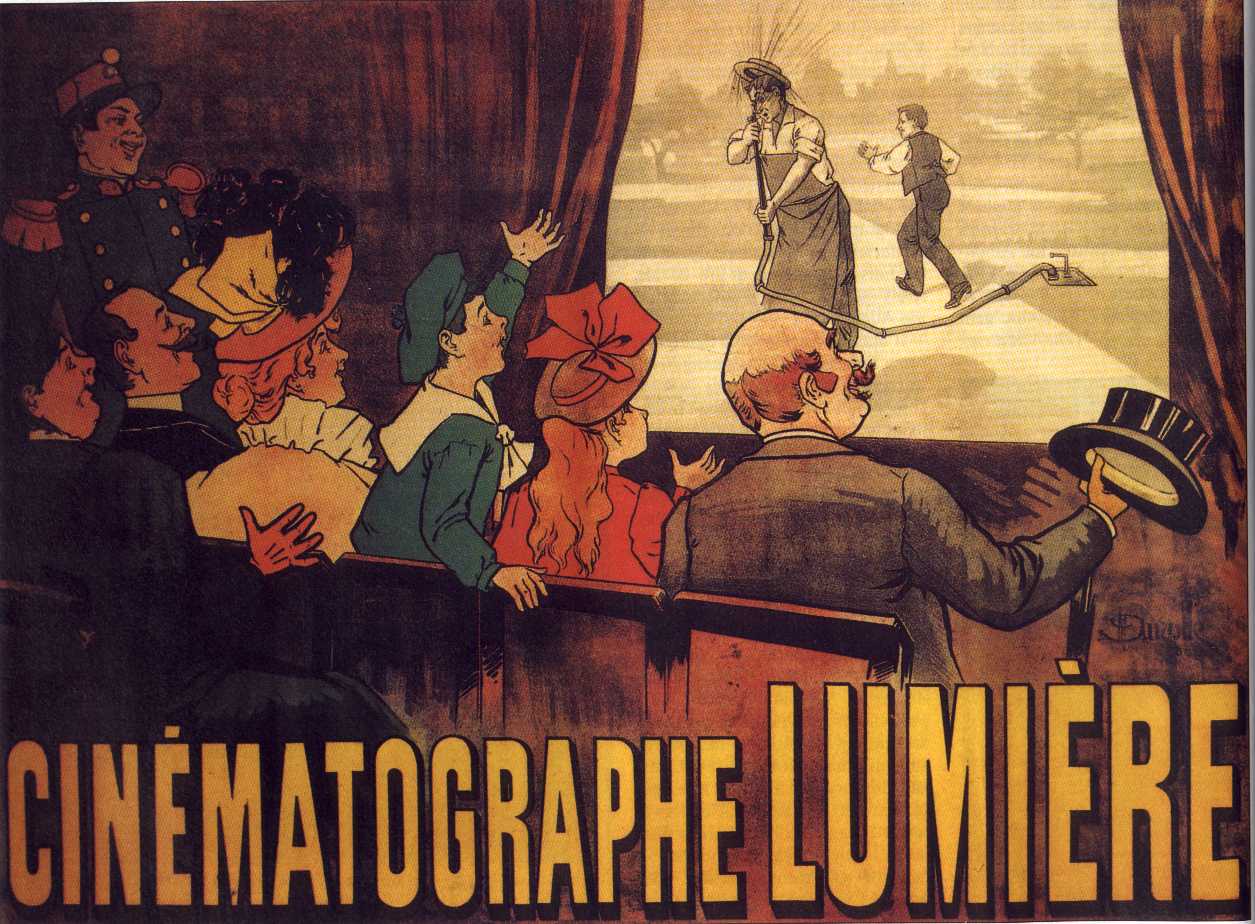
On this day in 1895, Auguste Marie Louis Nicolas and Louis Jean Lumière screen the first commercial films:
The Lumières held their first private screening of projected motion pictures in 1895.[7] Their first public screening of films at which admission was charged was held on December 28, 1895, at Salon Indien du Grand Café in Paris.[8] This history-making presentation featured ten short films, including their first film, Sortie des Usines Lumière à Lyon (Workers Leaving the Lumière Factory).[9] Each film is 17 meters long, which, when hand cranked through a projector, runs approximately 50 seconds.
The world’s first film poster, for 1895’s L’Arroseur arrosé
It is believed their first film was actually recorded that same year (1895)[10] with Léon Bouly’s cinématographe device, which was patented the previous year. The cinématographe — a three-in-one device that could record, develop, and project motion pictures — was further developed by the Lumières.The public debut at the Grand Café came a few months later and consisted of the following ten short films (in order of presentation):[11]
La Sortie de l’Usine Lumière à Lyon (literally, “the exit from the Lumière factory in Lyon”, or, under its more common English title, Workers Leaving the Lumiere Factory), 46 seconds
Le Jardinier (l’Arroseur Arrosé) (“The Gardener”, or “The Sprinkler Sprinkled”), 49 seconds
Le Débarquement du Congrès de Photographie à Lyon (“the disembarkment of the Congress of Photographers in Lyon”), 48 seconds
La Voltige (“Horse Trick Riders”), 46 seconds
La Pêche aux poissons rouges (“fishing for goldfish”), 42 seconds
Les Forgerons (“Blacksmiths”), 49 seconds
Repas de bébé (“Baby’s Breakfast” (lit. “baby’s meal”)), 41 seconds
Le Saut à la couverture (“Jumping Onto the Blanket”), 41 seconds
La Places des Cordeliers à Lyon (“Cordeliers Square in Lyon”—a street scene), 44 seconds
La Mer (Baignade en mer) (“the sea [bathing in the sea]”), 38 seconds
Daily Bread
Daily Bread for 12.27.14
by JOHN ADAMS •
Good morning, Whitewater.
Saturday will be mild, with a high of forty-five. Sunrise is 7:24 AM and sunset 4:27 PM, for 9h 03m 14s of daytime. The moon is a waxing crescent with 37.3% of its visible disk illuminated.
In case you’ll one day have the need to turn a baseball park into a hockey rink, here’s a video to show you how its done:
On this day in 1979, the Soviets seize Afghanistan:
Washington, Dec. 27–President Hafizullah Amin of Afghanistan was ousted from power and executed today in a coup reportedly supported by Soviet troops.
The Afghan radio announced in a broadcast monitored here that Mr. Amin had been sentenced to death at a revolutionary trial for “crimes against the state” and that the sentence had been carried out.
The broadcast said that Babrak Karmal, a former Deputy Prime Minister who had been living in exile in Eastern Europe, was the new President and Secretary General of the ruling People’s Democratic Party.
Mr. Amin was the third Afghan President to be toppled in the last 20 months. All three were slain.
The Afghan broadcast was the first authoritative word received in Washington that tended to confirm earlier reports from Teheran and Moscow about the political change in Kabul.
On this day in 1831, Wisconsin governor and solider Lucius Fairchild is born:
On this date Lucius Fairchild was born in Kent, Ohio. Soldier, diplomat, and Wisconsin Governor, Fairchild arrived in Madison with his family in 1846. After a trip to California in search of gold, Fairchild returned to Madison and studied law. He was a soldier in the “Iron Brigade” and lost an arm at the Battle of Gettysburg in 1863. He was elected as a Republican to the post of secretary of state and in 1865 was elected governor. He served for three terms. As governor and as a private citizen, Fairchild was active in promoting soldiers’ aid.
Drink, Weird Tales
The Perils of Eggnog
by JOHN ADAMS •
In a recent FW poll, I asked if readers would say yes or no to eggnog. (Most supported the holiday beverage, and I was among them, favoring it in my case in small doses.)
It is, however, always possible to have too much of a good thing, as Ryan Roche of Utah learned, after he admitted that he “pretty much just opened [his] throat and just poured it down”:
Utah man hospitalized after winning eggnog chugging contest. http://t.co/K18UKNvTIc pic.twitter.com/gAmbGelpA3
— Talking Points Memo (@TPM) December 26, 2014
Cats
Friday Catblogging: Going Ice Fishing
by JOHN ADAMS •
Poll, Weird Tales
Friday Poll: Dogs as Pandas?
by JOHN ADAMS •
A circus in Italy now finds itself on the wrong side of the law after dyeing Chow Chow dogs to look like pandas, and trying to pass them off as such.
From the video below, what do you think: very convincing or are you kidding?
Daily Bread
Daily Bread for 12.26.14
by JOHN ADAMS •
Good morning, Whitewater.
We’ll have a mostly cloudy but mild day in Whitewater today, with a high of forty-six, and a likelihood of evening showers. Sunrise today in 7:24 AM and sunset is 4:27 PM, for 9h 02m 47s of daytime. The moon is a waxing crescent with 25.5% of its visible disk illuminated.
On this day in 1776, Washington’s crossing of the Delaware brings victory against Hessians at Trenton:
The Battle of Trenton took place on the morning of December 26, 1776, during the American Revolutionary War, after General George Washington’s crossing of the Delaware River north of Trenton, New Jersey. The hazardous crossing in adverse weather made it possible for Washington to lead the main body of the Continental Army against Hessian soldiers garrisoned at Trenton. After a brief battle, nearly the entire Hessian force was captured, with negligible losses to the Americans. The battle significantly boosted the Continental Army’s flagging morale, and inspired reenlistments.
The Continental Army had previously suffered several defeats in New York and had been forced to retreat through New Jersey to Pennsylvania. Morale in the army was low; to end the year on a positive note, George Washington—Commander-in-Chief of the Continental Army—devised a plan to cross the Delaware River on the night of December 25–26 and surround the Hessian garrison.
Because the river was icy and the weather severe, the crossing proved dangerous. Two detachments were unable to cross the river, leaving Washington with only 2,400 men under his command in the assault. The army marched 9 miles (14 km) south to Trenton. The Hessians had lowered their guard, thinking they were safe from the American army, and had no long-distance outposts or patrols. Washington’s forces caught them off guard and, after a short but fierce resistance, most of the Hessians surrendered. Almost two thirds of the 1,500-man garrison was captured, and only a few troops escaped across Assunpink Creek.
Despite the battle’s small numbers, the American victory inspired rebels in the colonies. With the success of the revolution in doubt a week earlier, the army had seemed on the verge of collapse. The dramatic victory inspired soldiers to serve longer and attracted new recruits to the ranks.
Google-Day asks a geography question:
The Indian river basin that includes approximately 25% of the country’s area is bound by what mountain range to the south?
Daily Bread
Daily Bread for 12.25.14
by JOHN ADAMS •
Merry Christmas, Whitewater.
Christmas Day in Whitewater will be a mixture of clouds and sunshine, with a mild high of thirty-eight. Sunrise is 7:27 AM and sunset 4:26 PM, for 9h 02m 24s of daytime. The moon is a waxing crescent with 16.1% of its visible disk illuminated.
On this day in 1914, with war bringing death to Europe (and fated to bring much more), a Christmas truce:
The Christmas truce (German: Weihnachtsfrieden; French: Trêve de Noël) was a series of widespread but unofficial ceasefires along the Western Front around Christmas 1914. In the week leading up to the holiday, German and British soldiers crossed trenches to exchange seasonal greetings and talk. In areas, men from both sides ventured into no man’s land on Christmas Eve and Christmas Day to mingle and exchange food and souvenirs. There were joint burial ceremonies and prisoner swaps, while several meetings ended in carol-singing. Men played games of football with one another, giving one of the most enduring images of the truce. However, the peaceful behaviour was not ubiquitous; fighting continued in some sectors, while in others the sides settled on little more than arrangements to recover bodies. The following year, a few units arranged ceasefires, but the truces were not nearly as widespread as in 1914; this was, in part, due to strongly worded orders from the high commands of both sides prohibiting fraternisation. Soldiers were no longer amenable to truce by 1916. The war had become increasingly bitter after devastating human losses suffered during the battles of the Somme and Verdun, and the incorporation of poison gas.
The truces were not unique to the Christmas period, and reflected a growing mood of “live and let live”, where infantry in close proximity would stop overtly aggressive behaviour, and often engage in small-scale fraternisation, engaging in conversation or bartering for cigarettes. In some sectors, there would be occasional ceasefires to allow soldiers to go between the lines and recover wounded or dead comrades, while in others, there would be a tacit agreement not to shoot while men rested, exercised, or worked in full view of the enemy. The Christmas truces were particularly significant due to the number of men involved and the level of their participation – even in very peaceful sectors, dozens of men openly congregating in daylight was remarkable – and are often seen as a symbolic moment of peace and humanity amidst one of the most violent events of human history.
Anderson, Cartoons & Comics
Reminders
by JOHN ADAMS •

Daily Bread
Daily Bread for 12.24.14
by JOHN ADAMS •
Good morning, Whitewater.
Christmas Eve in Whitewater will be mild, with a high of thirty-seven, and a one-in-three chance of evening snow showers. Sunrise is 7:23 AM and sunset 4:25 PM, for 9h 02m 07s of daytime. The moon is a waxing crescent with 8.6% of its visible disk illuminated.
On this day in 1814, American and British diplomats sign a peace treaty, later to be ratified by both nations’ governments, to end the War of 1812:
….With the majority of its land and naval forces tied down in Europe fighting the Napoleonic Wars, the British used a defensive strategy in the Provinces of Upper and Lower Canada, repelling initial American invasions. This demonstrated that the conquest of the Canadas would prove more difficult than anticipated. However, the Americans gained control of Lake Erie in 1813, seized parts of western Ontario, and ended the prospect of an Indian confederacy and an independent Indian state in the Midwest under British sponsorship. In April, 1814, with the defeat of Napoleon, the British adopted a more aggressive strategy, sending larger invasion armies. In September 1814, the British invaded and occupied eastern Maine. In the south-west, General Andrew Jackson destroyed the military strength of the Creek nation at the Battle of Horseshoe Bend. The British victory at the Battle of Bladensburg in August 1814 allowed them to capture and burn Washington, D.C, but they were repulsed in an attempt to take Baltimore. American victories in September 1814 at the Battle of Plattsburgh repulsed the British invasions of New York, which along with pressure from merchants on the British government prompted British diplomats to drop their demands at Ghent for an independent native buffer state and territorial claims that London previously sought. Both sides agreed to a peace that restored the situation before the war began. However, it took six weeks for ships to cross the Atlantic so news of the peace treaty did not arrive before the British suffered a major defeat at New Orleans in January 1815.[4]
In the United States, late victories over invading British armies at the battles of Plattsburg, Baltimore (inspiring their national anthem, “The Star-Spangled Banner”) and New Orleans produced a sense of euphoria over a “second war of independence” against Britain.[5] The Federalist Party had strongly opposed the war effort and prevented New England from providing much in the way of soldiers and troops; it now virtually collapsed. The war ended on a high note for Americans, bringing an “Era of Good Feelings” in which partisan animosity nearly vanished in the face of strengthened U.S. nationalism. Spain played a small role; some Spanish forces fought alongside the British during the Occupation of Pensacola. The U.S. took permanent ownership of Spain’s Mobile District….
On this day in 1857, Wisconsin graduates her first high schoolers:
1857 – First Wisconsin High School Graduates
On this date the first graduating high school class in the State of Wisconsin consisted of ten scholars graduating from Racine High School. [Source: Racine History Timeline]
Google-a-Day asks a question about geography:
Silphion, a spice which became known after the foundation of Kyrene in the 7th century, has its origin on what continent?
Television
Television: Pilot for “The Orson Welles Show”
by JOHN ADAMS •
What might have been, and even now, what’s compelling:
The Fountain of Youth is a 1956 TV pilot for a proposed Desilu TV series (with a tentative title, The Orson Welles Show) which was never produced, and was subsequently televised once, on September 16, 1958 for NBC’s Colgate Theatre. The short film was directed by Orson Welles,based on the short story “Youth from Vienna” by John Collier, and stars Joi Lansing and Rick Jason as a couple faced with an unavoidable temptation concocted by a scientist (Dan Tobin). Welles himself is also much in evidence as onscreen narrator. The show won the prestigious Peabody Award in 1958 after its single broadcast.
Daily Bread
Daily Bread for 12.23.14
by JOHN ADAMS •
Good morning, Whitewater.
Tuesday in the Whippet City will be mild, with a high of forty-four, and only a one-in-ten chance of rain. Sunrise is 7:23 AM and sunset 4:25 PM, for 9h 01m 53s of daytime. That’s nine seconds more daylight than yesterday – winter has just begun, but the days are already getting longer. The moon is a waxing crescent with just 3.1% of its visible disk illuminated.
On this day in 1783, having successfully won the independence of his country from the greatest military power in all the world, Gen. Washington resigns his commission:
ADDRESS TO CONGRESS ON RESIGNING HIS COMMISSION
[Annapolis, December 23, 1783.]Mr. President: The great events on which my resignation depended having at length taken place; I have now the honor of offering my sincere Congratulations to Congress and of presenting myself before them to surrender into their hands the trust committed to me, and to claim the indulgence of retiring from the Service of my Country.
Happy in the confirmation of our Independence and Sovereignty, and pleased with the opportunity afforded the United States of becoming a respectable Nation, I resign with satisfaction the Appointment I accepted with diffidence. A diffidence in my abilities to accomplish so arduous a task, which however was superseded by a confidence in the rectitude of our Cause, the support of the supreme Power of the Union, and the patronage of Heaven.
The Successful termination of the War has verified the most sanguine expectations, and my gratitude for the interposition of Providence, and the assistance I have received from my Countrymen, encreases with every review of the momentous Contest.
While I repeat my obligations to the Army in general, I should do injustice to my own feelings not to acknowledge in this place the peculiar Services and distinguished merits of the Gentlemen who have been attached to my person during the War. It was impossible the choice of confidential Officers to compose my family should have been more fortunate. Permit me Sir, to recommend in particular those, who have continued in Service to the present moment, as worthy of the favorable notice and patronage of Congress.
I consider it an indispensable duty to close this last solemn act of my Official life, by commending the Interests of our dearest Country to the protection of Almighty God, and those who have the superintendence of them, to his holy keeping.
Having now finished the work assigned to me, I retire form the great theatre of Action; and bidding an Affectionate farewell to this August body under whose orders I have so long acted, I here offer my Commission, and take my leave of all the employments of public life.68
Taken from The Writings of George Washington John C. Fitzpatrick, Editor (Washington, D.C.: United States Government Printing Office, 1938), Volume 27, pp. 284-285.
Google-a-Day asks a question about racing:
What 2009 Formula One race, in the nation that invented motor racing, was canceled due to a financial crisis?