
FREE WHITEWATER

Daily Bread for 10.27.14

Good morning, Whitewater.

Our week in town begins with partly sunny skies and a high of seventy-four. There’s an even chance of rain later in the day.

Posts this week will include commentary on the schools referendum (two on politics for Tuesday, the curriculum apart from the referendum on Wednesday), videos for Halloween, and on Friday FREE WHITEWATER’s annual Scariest Things in Whitewater. (This year will be the eight annual edition of that post).

It’s Theodore Roosevelt’s birthday:

Theodore “T.R.” Roosevelt, Jr. … [a] (October 27, 1858 – January 6, 1919) was an American politician, author, naturalist, soldier, explorer, and historian who served as the 26th President of the United States.[3] He was a leader of the Republican Party (GOP) and founder of the Progressive Party insurgency of 1912. He is known for his exuberant personality, range of interests and achievements, and his leadership of the Progressive Movement, as well as his “cowboy” persona and robust masculinity.[4] Born into a wealthy family in New York City, Roosevelt was a sickly child who suffered from asthma. To overcome his physical weakness, he embraced a strenuous life. He was home-schooled and became an eager student of nature. He attended Harvard College where he studied biology, boxed, and developed an interest in naval affairs. He quickly entered politics, determined to become a member of the ruling class. In 1881 he was elected to the New York State Assembly, where he became a leader of the reform faction of the GOP. His book The Naval War of 1812 (1882) established him as a learned historian and writer.

On this day in 1864, a solider from Waukesha sinks a confederate ship:

On this date William Cushing led an expedition to sink the Confederate ram, the Albermarle, which had imposed a blockade near Plymouth, North Carolina and had been sinking Union ships. Cushing’s plan was extremely dangerous and only he and one other soldier escaped drowning or capture. Cushing pulled very close to the Confederate ironclad and exploded a torpedo under it while under heavy fire. Cushing’s crew abandonded ship as it began to sink. The Albemarle also sunk. Cushing received a “letter of thanks” from Congress and was promoted to Lieutenant Commander. He died in 1874 due to ill health and is buried in the Naval Cemetery at Annapolis, Maryland. [Source: Badger Saints and Sinners by Fred L. Holmes, p.274-285]

Google-a-Day asks a sports trivia question:

What is the name of the twin of the wife of the Super Bowl XXXVI MVP?

How ’bout a 3D animation, from the Emmy-winning artists and directors at The Saline Project, to start our Halloween week? For today, a vampire:
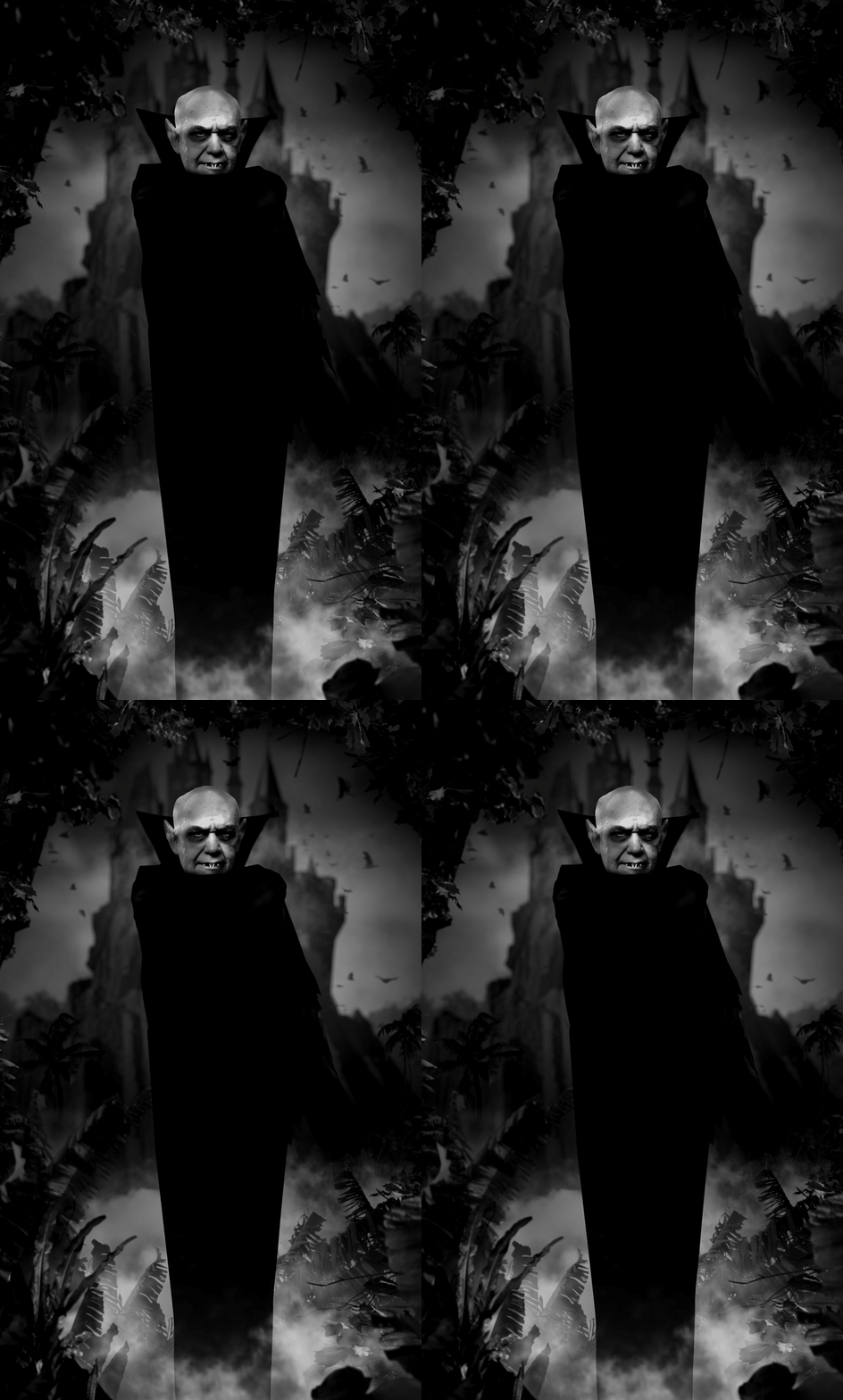
006_the_vampire_mvhv 2

Daily Bread for 10.26.14

Good morning, Whitewater.

We’ve a beautiful Sunday ahead, with sunny skies and a high of sixty-two. Sunrise today is 7:22 AM and sunset 5:56 PM. The moon is a waxing crescent with eight-percent of its visible disk illuminated.

Friday’s FW poll asked if a woman who became stuck in a former boyfriend’s chimney tried to climb down from true love or nuttiness. Over seventy-seven percent of respondents said Genoveva Nunez-Figueroa’s actions were evidence of nuttiness.

On this day in 1881, a there’s a gunfight at the O.K. Corral:

The Gunfight at the O.K. Corral was a 30-second gunfight between outlaw Cowboys and lawmen that is generally regarded as the most famous gunfight in the history of the American Wild West. The gunfight took place at about 3:00 p.m. on Wednesday, October 26, 1881, in Tombstone, Arizona Territory. It was the result of a long-simmering feud between Cowboys Billy Claiborne, Ike and Billy Clanton, and Tom and Frank McLaury, and opposing lawmen: town Marshal Virgil Earp, Assistant Town Marshal Morgan Earp, and temporary deputy marshals Wyatt Earp and Doc Holliday. Ike Clanton and Billy Claiborne ran from the fight unharmed, but Billy Clanton and both McLaury brothers were killed. Virgil, Morgan, and Doc Holliday were wounded, but Wyatt Earp was unharmed. The fight has come to represent a period in American Old West when the frontier was virtually an open range for outlaws, largely unopposed by law enforcement who were spread thin over vast territories, leaving some areas unprotected.

The gunfight was not well known to the American public until 1931, when author Stuart Lake published a largely fictionalized biography, Wyatt Earp: Frontier Marshal, two years after Earp’s death.[1] Published during the Great Depression, the book captured American imaginations. It was also the basis for the 1946 film, My Darling Clementine, by director John Ford.[1] After the film Gunfight at the O.K. Corral was released in 1957, the shootout became known by that name. Since then, the conflict has been portrayed with varying degrees of accuracy in numerous Western films and books.

On this day in 1818, Wisconsin gets her first counties:

1818 – First Counties in Wisconsin Declared
On this date Lewis Cass, governor of the Michigan Territory, declared the first counties in Wisconsin. The counties included Michilimackinac (all areas drained by Lake Superior tributaries), Brown, and Crawford counties, which were separated through Portage. Michilimackinac County is now part of the state of Michigan. Governor Cass later became the Secretary of War under President Andrew Jackson, as well as the Minister to France and a Michigan Senator. Cass, a Democrat, also ran for president in 1848, but lost to Whig Zachary Taylor due to factions within the Democratic Party and the formation of the Free Soil Party. [Source: Historic Elmwood Cemetery and Foundation]

Daily Bread for 10.25.14

Good morning, Whitewater.

Saturday in Whitewater will be lovely, with sunny skies and a high of sixty-five.

Even the most extraordinary records are susceptible of being surpassed. Not long ago, Felix Baumgartner amazed the world with a high-altitude skydive. Now, an executive from Google has broken Baumgartner’s record.

Here’s video of Alan Eustace’s jump:

See, for more information, Parachutist’s Record Fall: Over 25 Miles in 15 Minutes Alan Eustace Jumps From Stratosphere, Breaking Felix Baumgartner’s World Record.

On this day in 1909, a brewery explosion claims a life:

1909 – Explosion at Pabst Brewing Company
On this date a major boiler house explosion devastated three stories at Pabst Brewing Company early in the morning. The damage was estimated at about $250,000, one worker was killed and another was injured. Pabst Brewing Company filed a claim with its insurer, the Hartford Steam Boiler Inspection and Insurance Company, to recover damages from the explosion. [Source: Hartford Steam Boiler Inspection and Insurance Company]

Friday Catblogging: Nuttiness or True Love?


In California, Genoveva Nunez-Figueroa became stuck in the chimney of a former boyfriend’s house, all part of a failed attempt to become reacquainted with him:

The county Fire Department’s urban search and rescue team was called to the scene. Photos posted on Twitter by the department showed firefighters on the roof of the house as they worked to reach the woman, who was conscious during the rescue.

The flue was lubricated with dish soap before she was lifted out of the chimney, placed in a Stokes basket and hoisted from the roof by a ladder truck, according to VCFD Capt. Mike Lindbery.

There’s some good in all this, however. The former boyfriend offered sage advice for all humanity:

The home’s resident, who did not wish to be identified, said he had met Nunez-Figueroa online and they had gone on about six dates.

He cautioned other people about allowing acquaintances into their homes.

“Before you have somebody come in your house really check them out … really give it some time before you let somebody in, because they might want to stay,” he told KTLA.

See, Woman Arrested After Becoming Trapped in Chimney at Thousand Oaks Home @ KTLA.

Daily Bread for 10.24.14

Good morning, Whitewater.

Friday will be mild and increasingly sunny, with a high of sixty-five.

On this day in 1945, the United Nations comes into force:

On April 25, 1945, the United Nations Conference on International Organization convened in San Francisco with 50 nations represented. Three months later, during which time Germany had surrendered, the final Charter of the United Nations was unanimously adopted and signed by the delegates. The Charter called for the U.N. to maintain international peace and security, promote social progress and better standards of life, strengthen international law, and promote the expansion of human rights.

On October 24, 1945, the U.N. Charter came into force upon its ratification by the five permanent members of the Security Council and a majority of other signatories. The first U.N. General Assembly, with 51 nations represented, opened in London on January 10, 1946. On October 24, 1949, exactly four years after the United Nations Charter went into effect, the cornerstone was laid for the present United Nations headquarters, located in New York City. Since 1945, the Nobel Peace Prize has been awarded five times to the United Nations and its organizations and five times to individual U.N. officials.

On this day in 1933, Janesville has a visitor:

1933 – Amelia Earhart Visits Janesville
On this date Amelia Earhart spoke to the Janesville Woman’s History Club as part of the group’s 57th anniversary celebration. Four years later, Earhart disappeared as she attempted to fly across the Pacific Ocean. [Source: Janesville Gazette 10/24/1933, p.2]

Google-a-Day asks about art:

In what kind of building will you find the 15 x 29 ft. mural created for the husband of Beatrice d’Este?

Daily Bread for 10.23.14

Good morning, Whitewater.

We’ll have a partly cloudy day, with a high of fifty-nine, and about an even chance of afternoon showers today.

If cloud cover doesn’t obscure the view, we’ve a chance tonight to see a partial solar eclipse:

On this day in 1921, a first:

1921 – Green Bay Packers First NFL Game
On this date the Green Bay Packers played their first NFL game. The Packers defeated the Minneapolis Marines 7-6, for a crowd of 6,000 fans and completed their inaugural season with 3 wins, 2 losses, and 2 ties.[Source: Packers.com]

Google has a technology question for Thursday:

Of the five NASA space shuttles, which one flew the most missions?

Two Topics from the Proposed City Budget

At last night’s Council session, City Manager Clapper mentioned two upcoming budget topics of particular interest: funding for Downtown Whitewater and for the Janesville Transit Bus. 

The two items could not be more different: expenditures for Downtown Whitewater support local merchants, while the Janesville Bus supports a bumbling, dissembling Janesville bureaucrat’s ambition for his town at the expense of our own.

I’ve mentioned the budget as one of the four big public policy topics of the fall, and look forward to both discussions (October 28th for Downtown Whitewater, November 6th for the Janesville Bus.)

In some ways, I’m sorry even to mention the two requests in the same post. Downtown Whitewater doesn’t deserve the taint of being discussed in the same post as the bus (a project that, if it were ever successful on its own terms, would undermine local shopping in favor of Janesville’s merchants). 

We don’t do enough for brick and mortar, and certainly not compared with the amounts we waste on taxpayer-subsidized, bottom-shelf tech ventures in a futile effort to make the Innovation Center look innovative

(I sometimes think some of these gentlemen would stick an iPhone in a pig’s mouth and call it a mobile communications platform if they thought anyone would marvel at it.) 

But for brick and mortar here in town – well, that’s slipped from fashion these last few years.  That’s too bad – there’s more to be done there, if it’s to be done anywhere. 

A renewed commitment to existing, conventional merchants and new ones over sketchy tech ventures is a better direction for this city. 

Even in the busiest of times, these are two projects worth watching.  I’ll write about each before their scheduled discussions at Council. 

Bad Policy’s Like Low-Level Radiation Exposure

It’s seldom true that a single misstep ruins an official.  With the exception of criminal conduct, most mistakes are ones from which a politician or bureaucrat can recover. 

And yet, and yet, some mistakes take their toll.  They do so, however, with a cumulative effect – one after another debilitates as does cumulative radiation exposure.   

Look at Whitewater over the last decade, and consider those officials who departed with a limp, so to speak: Boden, Coan, Steinhaus, Brunner.  With the exception of Steinhaus, each was celebrated (if only by his own account) as a great or visionary leader sometime during his respective tenure. 

They each had kerfuffles during their time in local office, and perhaps thought that getting past them was a sign of success.   At the moment, perhaps; over time, not at all.

Written criticism played no meaningful role in their respective departures; it was their own poor choices that undermined their roles in the community. 

They all seemed strong, at least for a bit, until they weren’t strong at all.  Some of them saw this coming (and so in each case did a growing number of residents), but for others it was a surprise. 

It’s not day-in, day-out that makes a difference: it’s the years-long, cumulative effect of poor choices. 

The way to avoid accumulated injury is to avoid the same harmful, repetitive motions.

It’s the long-run, and not the sort-term, matters.