Saturday in Whitewater will be sunny with a high of 68. Sunrise is 6:13 and sunset 7:36 for 13h 22m 11s of daytime. The moon is a waxing crescent with 27.4 percent of its visible disk illuminated.
Guide dogs from The Seeing Eye are specially bred, trained, and matched with people with blindness and low vision all over the US and Canada. These dogs are essential to the people that they guide. It costs about $75,000 to prepare each Seeing Eye dog for its career, and only 60% of dogs make it all the way through the training program. So what makes a successful Seeing Eye dog, and why are they so expensive? This video is audio described.
Friday in Whitewater will be windy with a high of 58. Sunrise is 6:15 and sunset 7:34 for 13h 19m 24s of daytime. The moon is a waxing crescent with 18.9 percent of its visible disk illuminated.
With the support of former President Donald Trump, former gas station owner Tony Wied of De Pere entered the race this week for Wisconsin’s open 8th Congressional District — making him the third Republican candidate to announce.
Wied, who owned six Dino Stop gas stations and convenience stores in Wisconsin until he sold them in 2022, is positioning himself as an outsider, who would look to deliver the “America First change this country needs” in Congress. He officially launched his campaign at an event in Green Bay on Monday evening.
“Wisconsin’s 8th Congressional District is hungry for an America First outsider,” Wied said in a statement announcing his campaign on Tuesday morning. “For too long, career politicians have failed to deliver the results we desperately need.”
“I look forward to earning the trust of Wisconsin voters and taking the lessons I’ve learned from three decades of operating businesses in Northeast Wisconsin to Washington, DC,” Wied added.
Conservative populism is roughly synonymous with MAGA, but only up to the moment the MAGA leader decides otherwise. Afterward, as Jacque and Roth have now learned, past tenure as an ideological stalwart melts before the MAGA leader’s personal preferences.
Thursday in Whitewater will be cloudy with a high of 59. Sunrise is 6:17 and sunset 7:33 for 13h 16m 36s of daytime. The moon is a waxing crescent with 10.6 percent of its visible disk illuminated.
Wisconsin Elections Commission staff have confirmed that conservative activists trying to recall Republican Assembly Speaker Robin Vos didn’t gather enough signatures from the right places to trigger an election.
But as one recall wraps up, those organizers say they’re already working to recall Vos again.
WEC staff vetted thousands of signatures submitted by Burlington resident Matt Snorek in March. To initiate a recall election, Snorek and others in the Recall Vos campaign needed a number of signatures totaling at least “25 percent of the number of electors who cast a vote for governor” in the district two years ago.
No reason to stop now. Inspiration for the work ahead: Quitters never prosper — If at first you don’t succeed, try, try again — I think I can, I think I can.
Wednesday in Whitewater will be mostly sunny with a high of 66. Sunrise is 6:18 and sunset 7:32 for 13h 13m 48s of daytime. The moon is a waxing crescent with 4.4 percent of its visible disk illuminated.
On this day in 1872, the first Arbor Day (in America) is celebrated in Nebraska.
A closely watched measure of inflation remained stronger than expected in March, worrying news for Federal Reserve officials who have become increasingly concerned that their progress on lowering prices increases might be stalling.
The surprisingly stubborn inflation reading could raise doubts about when the Fed will be able to start cutting interest rates, and how much they will be able to reduce borrowing costs this year.
The Consumer Price Index climbed 3.8 percent on an annual basis after stripping out food and fuel prices, which economists do in order to get a better sense of the underlying inflation trend. That was stronger than the 3.7 percent increase economists expected, and unchanged from 3.8 percent in February. The monthly reading was also stronger than what economists had forecast.
On an overall basis, the inflation measure climbed 3.5 percent in March from a year earlier, up from 3.2 percent in February and faster than what economists have anticipated. A rise in gas prices contributed to that inflation number.
Lower than it was a year ago, higher than consumers (and the Federal Reserve) would like.
Tuesday in Whitewater will be sunny with a high of 60. Sunrise is 6:20 and sunset 7:31 for 13h 10m 59s of daytime. The moon is a waxing crescent with 1 percent of its visible disk illuminated.
Whitewater’s Public Works Committee meets at 6 PM.
Wisconsin has new legislative maps, and although maps do not elect candiates, there’s reason to believe that the extreme gerrymandering begun in the Walker years will give way to a more representative set of legislative districts. In the New York Times, Julie Bosman reports (open link) Fierce Races Loom With Wisconsin’s New Political Maps (‘The new legislative maps reflect a near split between Republican- and Democratic-leaning districts. For more than a decade, earlier maps had helped Republicans hold power’:
Yee Leng Xiong, a 29-year-old nonprofit executive, has been an elected official in Wisconsin since he was a teenager. From a north central county known for ginseng farming and downhill skiing, he has served on the local school board, the Marathon County Board and the village board of trustees in Weston, population 15,000.
But he is a Democrat, and running for a seat in the State Legislature in a solidly Republican district had always seemed a little outlandish.
Until this year.
In February, new legislative maps in Wisconsin were signed into law after more than a decade of partisan wrangling and legal battles. The new maps undid the gerrymander that had helped Republicans keep control of both state legislative chambers since 2012. The 85th Assembly District in Marathon County, where Mr. Xiong lives, is no longer a Republican-leaning seat: It is a tossup.
“This idea came to reality when the maps changed,” Mr. Xiong said in an interview last month.
….
The state’s residents have long been a close mix of Democrats and Republicans, which makes Wisconsin a crucial swing state in presidential elections and means statewide races are often fiercely contested. The reshaping of the maps is expected to suddenly return many legislative races to the realm of true competition as well.
After more than a decade of languishing in the minority in the State Legislature, Democrats are now in a position to vie for political power with the Republicans, who currently hold about two-thirds of the seats in both the Senate and the Assembly.
Competitive races do not assure outcomes — they are, after all, competitive not prohibitive races. And yet, and yet, competitive races can work their will on candidates, forcing them (if they wish to win) to take positions acceptable to the more balanced electorates in their districts.
It’s been a long time since most WISGOP legislative candidates had to compete earnestly in their districts. They’re going to have to learn compromise and persuasion all over again.
Not so easy for those legislators who’ve lived a troll’s life for a decade.
Monday in Whitewater will be sunny with a high of 64. Sunrise is 6:22 and sunset 7:30 for 13h 08m 9s of daytime. The moon is new with .1 percent of its visible disk illuminated.
The Whitewater Unified School District holds an electoral canvass at 4:30 PM. Whitewater’s Planning Commission meets at 6 PM.
On this day in 1959, a team of computer manufacturers, users, and university people led by Grace Hopper meets to discuss the creation of a new programming language that would be called COBOL.
For today, a practical consideration of closed-session meetings in Whitewater. (This leaves aside for now the role of closed sessions as a matter of law. That’s a topic for another time.)
There are two practical reasons to have a closed session: for elected or appointed officeholders (1) to conceal permanently information from public or (2) to conceal information temporarily while discussing action that may become public later.
Both cases have obvious practical limits, for the same reason: as the community is factionalized, and goverment in Whitewater often lacks a strong public consensus, the officials’ closed sessions will lack broad support (or even respect).
In a community where residents are skeptical of officials’ motives, let’s-go-to-closed session looks like officials’ self-protective action. (‘We’re doing it for the community’ isn’t often compelling; ‘we have the right to do it’ falls flat without community support.)
In a community where residents are skeptical (or unaware) of officials’ motives, major announcements upon returning to open session turn skepticism into cyncism. For both the city since last summer, and the district in December, major discussions in closed session have had almost no prior public foundation by those public boards. (Residents, yes, but not boardmembers themselves.) Boardmembers and councilmembers cannot expect that their concerns will resonate with residents unless those officials, themselves, build a compelling public case, open session after open session.
Coming out of closed session with an announcment without building a predicate foundation with the commmunity makes only a faint sound. It doesn’t matter how much some officials think of themselves (and oh, brother, do some of them think highly of themselves) most residents aren’t impressed. A generation ago more residents might have been deferential to officials’ claims. That was then, this is now.
For better or worse, benefit of the doubt doesn’t appertain in Whitewater’s politics. Elected or appointed officials looking for that benefit will not find it here.
If, for example, someone is sitting in her district office wondering why others aren’t persuaded (let alone obedient!), the answer will be found by looking first to herself. One won’t be persuaded by detailed arguments someone else won’t make, or thoughtful words someone else won’t speak.
If, for example, a long effort council is mostly a closed-session effort, then the lack of a sequential public explanation leaves the closed effort as little more than an exercise in private catharsis.
No one is required to come to table and make a public case. Those who are not at table, however, cannot expect to be among those who enjoy the meal.
Sunday in Whitewater will be cloudy with scattered showers and a high of 49. Sunrise is 6:23 and sunset 7:29 for 13h 05m 18s of daytime. The moon is a waning crescent with 2.2 percent of its visible disk illuminated.
On this day in 1945, the Imperial Japanese Navy battleship Yamato, one of the two largest ever constructed, is sunk by United States Navy aircraft during Operation Ten-Go.
The Dutch Cycling Embassy is a public-private network for sustainable mobility. We facilitate cycling worldwide as the most modern, efficient, bicycle-inclusive and sustainable method of transport by sharing our expertise and technology as the world’s number one cycling country.
Who are we?
The Dutch Cycling Embassy is a comprehensive network of private companies, NGO’s, universities, research institutions, national and local governments.
Saturday in Whitewater will be sunny with a high of 53. Sunrise is 6:25 and sunset 7:28 for 13h 02m 27s of daytime. The moon is a waning crescent with 7.4 percent of its visible disk illuminated.
On this day in 1965, Early Bird, the first commercial communications satellite to be placed in geosynchronous orbit, is launched.
Friday in Whitewater will be partly sunny with a high of 46. Sunrise is 6:27 and sunset 7:26 for 12h 59m 36s of daytime. The moon is a waning crescent with 14.2 percent of its visible disk illuminated.
On this day in 1792, President Washington exercises his authority to veto a bill, the first time this power is used in the United States.
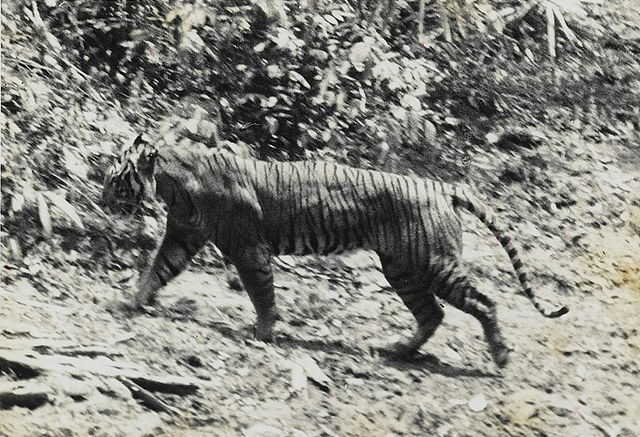
By Andries Hoogerwerf (29 August 1906 – 5 February 1977) – http://www.petermaas.nl/extinct/speciesinfo/images/javant3.gif, Public Domain, https://commons.wikimedia.org/w/index.php?curid=1889781
Five years ago, Kalih Raksasewu was getting his car tuned when his mechanic shared a curious tidbit: He had stumbled upon a tiger near his home. The startled creature jumped a fence and vanished, the man said.
Strange encounter, thought Raksasewu. Not least because the men live on Indonesia’s most populous island, Java, and especially because Javan tigers have long been believed extinct. The last confirmed sighting dates back nearly half a century, to 1976.
Raksasewu took out his phone and showed the mechanic images of leopards, which can sometimes be confused for tigers. No sir, came the reply. The cat had stripes.
Raksasewu found himself getting excited. A researcher involved in local conservation work, he had grown up hearing tales of the giant felines, including from his mother, who once saw one while driving. “In my heart I’ve always been greatly interested in this creature, and I was very sad when it was declared extinct,” he said.
….
Then they saw it: a single strand of hair that lay on the low wooden fence the animal had allegedly jumped. “I had this hope that the tiger had a hair snagged when he leapt,” said Raksasewu. “It turned out to be true.”
….
Two weeks ago, DNA analysis suggested a match: Javan tiger. In an article in Oryx, a peer-reviewed journal published by Cambridge University Press, researchers said they compared DNA from the lone hair with that of its nearest living relative, Sumatran tigers—close but no cigar.
Same for the DNA of a Javan leopard. The best match: the DNA of a Javan tiger from the 1930s preserved at an Indonesian museum.
Tuesday, April 9th at 1:00 PM, there will be a showing of Indiana Jones and the Dial of Destiny@ Seniors in the Park, in the Starin Community Building:
Adventure/Action
Rated PG-13
2 hours, 34 minutes (2023)
In this fifth installment, Indy (Harrison Ford) now a college professor approaching retirement, is forced to re-enter the fray in the battle between good and evil: a dial that can change time and reverse the outcome of World War 2! Also starring Antonio Banderas, Karen Allen, and John Rhys-Davies.
Thursday in Whitewater will see scattered morning snow showers with a high of 41. Sunrise is 6:29 and sunset 7:25 for 12h 56m 44s of daytime. The moon is a waning crescent with 23.6 percent of its visible disk illuminated.
The Whitewater Common Council meets tonight at 6:30 PM.
Consider the claim, in a comment at FREE WHITEWATER from two days ago, that some in the retail and service sector in the city (and other area communities) would find lack of confidence akin to low confidence “not in the height of the 2008 recession but certainly in its lingering aftermath.”
What to make of the claim?
It’s accurate, that’s what.
The Great Recession (2007-2009), more even than the pandemic, was and remains the most important economic event of our time. (The pandemic had immediate and tragic consequences for many lives, but it was the failure to address the Great Recession’s effects that set Whitewater and other places on their economic and socio-economic course.)
Whitewater, in particular, could not have had worse leaders than the ones from that time in grasping and responding to the Great Recession. A few are still around, as feckless and ineffectual as they were then.
How to think of that time: like a man with a disease untreated, or a broken bone left unset: other maladies or deformities have sprung from the failure to treat effectively the original condition.
Some of us have, of course, done well even in hard times for others, as an earlier generation did even during the Great Depression.
Can we who have done well not see that, in our very community, there are longtime residents who through necessity now barter for diapers, baby food, and small appliances?
That’s hardship for them and policy failure for us. (For advocates of free markets, like this libertarian blogger, these questions arise: did markets reach everyone, if they did not why not, and if they did why were they ineffective in specific cases?)
Greatly simplified (as these are not wholly separate forces): Economic loss leads to socio-economic dysfunction and socio-economic dysfunction leads to community fragmentation, strife, and chronic hardship.