
Daily Bread
Daily Bread for 7.5.14
by JOHN ADAMS •
Good morning, Whitewater.
We’ll have another beautiful day today, with a partly sunny day, winds of ten to fifteen mph, and a high of seventy-nine.
The Tour de France begins today, and Engadget reports that Sony has a new viewing angle for the occasion:
When watching a gang of cyclists chase someone in a yellow jersey (aka, the Tour de France) we’re used to seeing the action from bike- or car-mounted cameras. But we’ve all come away disappointed, never truly knowing the tournament from the ovine point of view (some say, the only point of view for cycling). To tackle this, Sony has kitted out a flock of five from Harewell Hall, Harrogate with Action Cams so they can grab grass-roots scenes of the race. The publicity stunt might not result in world-class footage, but it does mean we get to tick “gallery of camera-wearing sheep” off the Engadget bucket list.
It’s the anniversary, from 1946, of the bikini:
On July 5, 1946, French designer Louis Reard unveils a daring two-piece swimsuit at the Piscine Molitor, a popular swimming pool in Paris. Parisian showgirl Micheline Bernardini modeled the new fashion, which Reard dubbed “bikini,” inspired by a news-making U.S. atomic test that took place off the Bikini Atoll in the Pacific Ocean earlier that week.
European women first began wearing two-piece bathing suits that consisted of a halter top and shorts in the 1930s, but only a sliver of the midriff was revealed and the navel was vigilantly covered. In the United States, the modest two-piece made its appearance during World War II, when wartime rationing of fabric saw the removal of the skirt panel and other superfluous material. Meanwhile, in Europe, fortified coastlines and Allied invasions curtailed beach life during the war, and swimsuit development, like everything else non-military, came to a standstill.
In 1946, Western Europeans joyously greeted the first war-free summer in years, and French designers came up with fashions to match the liberated mood of the people. Two French designers, Jacques Heim and Louis Reard, developed competing prototypes of the bikini. Heim called his the “atom” and advertised it as “the world’s smallest bathing suit.” Reard’s swimsuit, which was basically a bra top and two inverted triangles of cloth connected by string, was in fact significantly smaller. Made out of a scant 30 inches of fabric, Reard promoted his creation as “smaller than the world’s smallest bathing suit.” Reard called his creation the bikini, named after the Bikini Atoll.
Popular, but lacking the elegance of a one-piece suit.
On this day in 1932, Gen. Atkinson encounters difficult terrain:
1832 – Atkinson enters the Trembling Lands
On this date, General Atkinson and his troops entered the area known by the Native Americans as “trembling lands” in their pursuit of Black Hawk. The area was some 10 square miles and contained a large bog. Although the land appeared safe, it would undulate or tremble for yards when pressure was applied. Many of the militiamen were on horses, which plunged to their bellies in the swamp. The “trembling lands” forced Atkinson to retrace his steps back toward the Rock River, in the process losing days in his pursuit of Black Hawk. [Source: Along the Black Hawk Trail by William G. Stark]
Holiday
Happy Independence Day
by JOHN ADAMS •

Daily Bread
Daily Bread for 7.4.14
by JOHN ADAMS •
Good morning, Whitewater.
We’ll have a beautiful Independence Day with a high of seventy-seven. Sunrise is 5:22 AM and sunset 8:37 PM. The moon is a waxing crescent with forty-two percent of its visible disk illuminated.
Literally thousands of flights travel across the North Atlantic each day. The British National Air Traffic Services (Nats) recently produced an animation to make visual what that many flight paths would look like:
Here’s the final game in Puzability‘s C to Shining C series:
|
This Week’s Game — June 30-July 4
|
|||||
|
From C to Shining C
|
|||||
|
Some words are declaring their independence this July Fourth week. For each day, we started with a word or phrase that contains two C’s and in which the letters between the C’s spell a word or phrase. The answer phrase, described by each day’s clue, is the longer two-C piece followed by the shorter word or phrase.
|
|||||
|
Example:
|
|||||
|
Romantic flower that lasts for a tiny fraction of time
|
|||||
|
Answer:
|
|||||
|
Microsecond rose
|
|||||
|
What to Submit:
|
|||||
|
Submit the phrase, with the longer piece first (as “Microsecond rose” in the example), for your answer.
|
|||||
 |
|||||
|
Friday, July 4
|
|||||
|


Cartoons & Comics
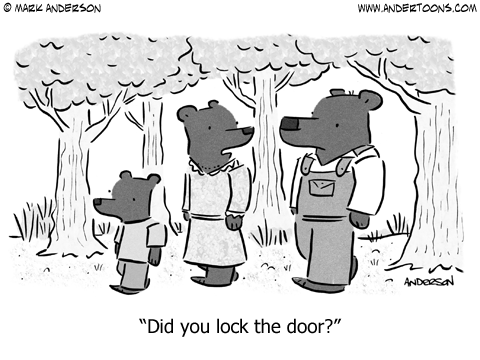
Door
by JOHN ADAMS •
Daily Bread
Daily Bread for 7.3.14
by JOHN ADAMS •
Good morning, Whitewater.
Our Independence Holiday events begin today, on a day of sunny skies, a high of seventy-four, and winds of ten to fifteen mph.
Lightning stikes…Manhattan:
The Battle of Gettysburg ended on this day in 1863. Thereafter, the New York Times published reports between leading Union commanders, including this message from Maj. Gen. George Meade, the Union’s commanding general at Gettysburg:
July 4 — Noon
Maj.-Gen. Halleck:
The position of affairs is not materially changed since my last dispatch of 7 A.M.
We now hold Gettysburgh.
The enemy has abandoned large numbers of his killed and wounded on the field.
I shall probably be able to give you a return of my captures and losses before night, and a return of the enemy’s killed and wounded in our hands.
George G. Meade, Major-General
Here’s Puzzability‘s Thursday game in its C to Shining C series:
|
This Week’s Game — June 30-July 4
|
|||||
|
From C to Shining C
|
|||||
|
Some words are declaring their independence this July Fourth week. For each day, we started with a word or phrase that contains two C’s and in which the letters between the C’s spell a word or phrase. The answer phrase, described by each day’s clue, is the longer two-C piece followed by the shorter word or phrase.
|
|||||
|
Example:
|
|||||
|
Romantic flower that lasts for a tiny fraction of time
|
|||||
|
Answer:
|
|||||
|
Microsecond rose
|
|||||
|
What to Submit:
|
|||||
|
Submit the phrase, with the longer piece first (as “Microsecond rose” in the example), for your answer.
|
|||||
|
|||||
|
Thursday, July 3
|
|||||
|

Holiday, Science/Nature
So how do fireworks work?
by JOHN ADAMS •
Here’s how:
Anderson, Cartoons & Comics
Content aside
by JOHN ADAMS •

Daily Bread
Daily Bread for 7.2.14
by JOHN ADAMS •
Good morning, Whitewater.
We have an even chance of scattered showers this Wednesday, with a crisp high temperature of sixty-five. Sunrise today is 5:21 AM and sunset is 8:37 PM. The moon is a waxing crescent with twenty-four percent of its visible disk illuminated.
It turns out, perhaps, that some animals have set musical preferences. Chimpanzees, it seems, are among those animals:
…researchers found that while chimpanzees shun the steadily strong beats common in Western genres, they like Indian ragas and Akan tunes from West Africa.
“Our objective was not to find a preference for different cultures’ music,” study co-author Frans de Waal, a primatologist at Emory University in Atlanta, said in a statement. Rather, the researchers used music from Africa, India and Japan to test how the primates reacted to specific acoustic characteristics, such as the ratio of strong to weak beats (or stressed to unstressed beats).
De Waal and colleagues said that similar studies in the past only tested how chimpanzees reacted to Western music. But even though the sounds of Western pop and classical might seem different to the casual listener, they share similar rhythmic patterns and intervals. Musical traditions from other cultures, however, may have fundamentally different properties. While a typical Western song might have one strong beat for every one to three weak beats, an Indian raga (or series of notes in a classical composition) might have one strong beat for every 31 weak beats in a long rhythmic cycle.
Previous studies that focused on Western tunes found that primates preferred silence over any kind of human music. One study, published in the journal Cognition in 2007, found that marmosets and tamarins would rather listen to no music than Mozart or a lullaby.
For the new study, the researchers looked outside the Western canon and used Indian ragas, Japanese taiko, and music from the Akan culture in West Africa…
On this day in 1964, Pres. Johnson signs the Civil Rights Act.
Here’s the Wednesday game in Puzzability‘s C to Shining C series:
|
This Week’s Game — June 30-July 4
|
|||||
|
From C to Shining C
|
|||||
|
Some words are declaring their independence this July Fourth week. For each day, we started with a word or phrase that contains two C’s and in which the letters between the C’s spell a word or phrase. The answer phrase, described by each day’s clue, is the longer two-C piece followed by the shorter word or phrase.
|
|||||
|
Example:
|
|||||
|
Romantic flower that lasts for a tiny fraction of time
|
|||||
|
Answer:
|
|||||
|
Microsecond rose
|
|||||
|
What to Submit:
|
|||||
|
Submit the phrase, with the longer piece first (as “Microsecond rose” in the example), for your answer.
|
|||||
|
|||||
|
Wednesday, July 2
|
|||||
|

Culture, Sports
Becoming Sumo
by JOHN ADAMS •
Business, City, Development, Government Spending, Local Government, Planning
Local Government’s Vendor Problem
by JOHN ADAMS •
The risk of reliance on a big outside vendor for a big project in a small town is easily described:
The vendor will be everywhere initially, will purr contentedly during work, but disappear quickly after the final check clears.
It will want the money, will say anything to get it, but without any respect for those paying the bill.
The vendor will – falsely – assume a superiority over those local officials with whom it deals. Those local officials will – falsely – assume the vendor’s genuine respect and partnership, and so will lazily forgo due diligence over the project’s terms, work provided, and consequences thereafter.
It shouldn’t be this way; it often is.
Film
Film: The Man Who Turned Paper Into Pixels
by JOHN ADAMS •
Daily Bread
Daily Bread for 7.1.14
by JOHN ADAMS •
Good morning, Whitewater.
Tuesday in Whitewater will be partly sunny with a high of seventy-seven.
Common Council i scheduled to meet tonight for a planning session @ 6 PM.
On this day in 1863, the Battle of Gettysburg begins:
The Battle of Gettysburg … was fought July 1–3, 1863, in and around the town of Gettysburg, Pennsylvania between Union and Confederate forces during the American Civil War. The battle involved the largest number of casualties of the entire war[7] and is often described as the war’s turning point.[8] Union Maj. Gen.George Meade‘s Army of the Potomac defeated attacks by Confederate Gen.Robert E. Lee‘s Army of Northern Virginia, ending Lee’s attempt to invade the North.
Here’s Puzzability‘s Tuesday game:
|
This Week’s Game — June 30-July 4
|
|||||
|
From C to Shining C
|
|||||
|
Some words are declaring their independence this July Fourth week. For each day, we started with a word or phrase that contains two C’s and in which the letters between the C’s spell a word or phrase. The answer phrase, described by each day’s clue, is the longer two-C piece followed by the shorter word or phrase.
|
|||||
|
Example:
|
|||||
|
Romantic flower that lasts for a tiny fraction of time
|
|||||
|
Answer:
|
|||||
|
Microsecond rose
|
|||||
|
What to Submit:
|
|||||
|
Submit the phrase, with the longer piece first (as “Microsecond rose” in the example), for your answer.
|
|||||
|
|||||
|
Tuesday, July 1
|
|||||
|
