
FREE WHITEWATER

Daily Bread for 8.13.14

Good morning, Whitewater.

Wednesday brings a slight chance of afternoon showers, but otherwise a partly sunny day with a high of seventy-eight.

The Fire & Rescue Task Force meets tonight at 7:30 PM.

On this day in 1961, Communist East Germany began construction of the Berlin Wall:

On 15 June 1961, First Secretary of the Socialist Unity Party and GDR State Council chairman Walter Ulbricht stated in an international press conference, “Niemand hat die Absicht, eine Mauer zu errichten!” (No one has the intention of erecting a wall!). It was the first time the colloquial term Mauer (wall) had been used in this context.

The record of a telephone call between Nikita Khrushchev and Ulbricht on 1 August in the same year, suggests that it was from Khrushchev that the initiative for the construction of the wall came.[40][41] However, other sources suggest that Khrushchev had initially been wary about building a wall, fearing negative Western reaction. What is beyond dispute, though, is that Ulbricht had pushed for a border closure for quite some time, arguing that East Germany’s very existence was at stake.[42]

Khrushchev had been emboldened by US President John F. Kennedy’s tacit indication[how?] that the US would not actively oppose this action in the Soviet sector of Berlin.[43] On Saturday, 12 August 1961, the leaders of the GDR attended a garden party at a government guesthouse in Döllnsee, in a wooded area to the north of East Berlin. There Ulbricht signed the order to close the border and erect a wall.

At midnight, the police and units of the East German army began to close the border and, by Sunday morning, 13 August, the border with West Berlin was closed. East German troops and workers had begun to tear up streets running alongside the border to make them impassable to most vehicles and to install barbed wire entanglements and fences along the 156 kilometres (97 mi) around the three western sectors, and the 43 kilometres (27 mi) that divided West and East Berlin.

The barrier was built slightly inside East Berlin or East German territory to ensure that it did not encroach on West Berlin at any point. Later, it was built up into the Wall proper, the first concrete elements and large blocks being put in place on 17 August. During the construction of the Wall, National People’s Army (NVA) and Combat Groups of the Working Class (KdA) soldiers stood in front of it with orders to shoot anyone who attempted to defect. Additionally, chain fences, walls, minefields and other obstacles were installed along the length of East Germany’s western border with West Germany proper. A huge no man’s land was cleared to provide a clear line of fire at fleeing refugees.[44]

Google-a-Day poses a question from its Art & Literature category:

What was the name of the pet that often traveled with the artist of “Tuna Fishing”?
Why ‘This Woman’ Over and Over?

At the Gazette, that paper’s editorialist has a new editorial entitled, Our Views: Support K. Andreah Briarmoon and her ramblings at your own risk (subscription req’d).

Readers may recall that I’m opposed to Ms. Briarmoon’s light and trivial discussion of litigation – it’s a serious matter, worthy of careful reflection.  Ms. Briarmoon takes a more casual approach, but casual has no place in litigation; I reject her method. 

See, on this point, A Game It’s Not.

(I’ve also felt that the Gazette probably uses stories about Ms. Briarmoon to make municipal critics, generally, look silly.)  

Still, why does the editorialist begin, in each of five consecutive paragraphs, with a description of her as ‘this woman’? 

This woman suggested….

This woman lost….

This woman keeps….

This woman has lost….

This woman wants….

I often wonder, after reading a Gazette editorial: Can this be the product of an editorial board?  Could more than one person possibly have thought this was any good? 

As a rhetorical effort, the editorial is another failure, and the repeated emphasis on her gender is simply overdone. 

A more insightful writer would also have understood that there’s a context to ‘this man’ and ‘this woman’ that’s different, as women have not had the same opportunities in society.   One might wish that the context were the same, but we do not yet live in the conditions of gender equality.

The Gazette‘s editorials are often deficient, in reasoning and composition, but here I think we find a worse perspective, whether by ignorance or intention.  

Ms. Briarmoon, it seems, isn’t the only one with a problem of understanding.

August 12 Primary Questions

Here are a few results I’ll be looking at tonight, in the August primary:

1. Governor’s Race.  How do Walker, Burke (and even Hulsey, Burke’s eccentric challenger) fare in Whitewater?  Statewide and locally, how many votes do they get in a summer primary? 

2.  The 15th Senate District Primary.  For the Democrats, will it be a competitive Democrat (Ringhand or Scieszinski) or Sheridan (who is the only Democrat who would make this race competitive for the Republicans in November)? 

3.  Blackhawk Technical College Referendum.  Four million a year in taxes, backed by business interests and the Gazette in Janesville. 

(‘Business interests and the Gazette in Janesville’ are related in the way a screwdriver’s related to a screw.) 

Some in Janesville, as I cited yesterday in a quote from Rock Netroots, worry that one should

[n]ever underestimate the power of Forward Janesville, Rock County five-o or their Janesville Gazette media flacks. They’re a big “connected” club with a political agenda and operatives in every part of local government.

I’m curious how the referendum fares, and whether the Gazette (so proud as a self-declared ‘mover and shaker’) can push a bad idea to success. 

4.  Democrats’ AG Race.  Assemblyman Jon Richards, Jefferson County DA Susan Happ, and Dane County DA Ismael Ozanne are the candidates. 

Republican  Brad Schimel will be the GOP candidate in November. 

Richards is favored tonight, but statewide in November it might be that Susan Happ (with more prosecutorial experience than Richards) would prove a stronger match against Schimel. more >>

Daily Bread for 8.12.14

Good morning, Whitewater.

Election day brings a one-third chance of morning showers, with gradual clearing into a mostly sunny day, with a high of seventy-three.

The city’s Parks & Recreation Board meets at 5:30 PM today.

On this day in 1939, the Wizard of Oz premieres in Oconomowoc:

1939 – Wizard of Oz World Premier — in Oconomowoc

According to the fan site, thewizardofoz.info, “The first publicized showing of the final, edited film was at the Strand Theatre in Oconomowoc, Wisconsin on August 12, 1939. No one is sure exactly why a small town in the Midwest received that honor.” It showed the next day in Sheboygan, Appleton and Rhinelander, according to local newspapers. “The official premiere was at Grauman’s Chinese Theatre in Hollywood on August 15, attended by most of the cast and crew and a number of Hollywood celebrities.” [Source: thewizardofoz.info/, link fixed from WHS site]

Google-a-Day has a baseball question:

As of 2012, of the 65 living members of the “National Baseball Hall of Fame,” twenty of them played what position?

On the Blackhawk Technical College Referendum

Over at Rock Netroots, Lou Kaye’s published a post with observations about Rock County’s politics, entitled, Community Quotes #3.  (It’s in the syle of a similar Gazette feature, but thankfully without that newspaper’s ceaseless fronting of white-collar welfare.)  

On the Blackhawk Technical College referendum (four-million more annually, forever…), Kaye has three comments that sum it all up, nicely:

On Local Power Players Dishonesty and Deception:
* So typical. How self-serving business groups like Forward Janesville have claimed higher taxes, wages and benefits are a burden on local economic development and then lobby for tax breaks for themselves. But here they are endorsing a local tax hike on everyone else to pay for employee training at a technical college. The keyword: self-serving.

* I think members of the business chambers in Beloit including Forward Janesville are completely dishonest for supporting Scott Walker’s budget cuts on schools/technical colleges. Cutting revenue that came from a much larger tax base but now spin around promoting local tax hikes to restore those funding cuts. They’ll use the same strategy to promote raising local taxes for Janesville streets. Lots of people blind to the politics, fall for it every time.

* Never underestimate the power of Forward Janesville, Rock County five-o or their Janesville Gazette media flacks. They’re a big “connected” club with a political agenda and operatives in every part of local government.

It’s funny how in Whitewater some on the Left might think that supporting BHTC is an imperative, but Kaye and others in Rock County (themselves liberals, by the way) see the issue more clearly.

Regardless of Walker or Doyle, etc., in office, here’s one libertarian opposed to a perpetual referendum like this.  Republican or Democrat, it’s overreaching, either way.

The referendum is a money-grab pushed by so-called conservatives who have never met public spending for their private interests that they didn’t like.  They’re not, in fact, true conservatives at all. 

These sort of polices have wrecked the Right in Whitewater, but that won’t stop a few elsewhere from hoping they can dupe their own voters.  (See, along these lines, How Conservatives Ruined Conservatism in Whitewater.)   

Meteorology

Meteorology’s just the study of the atmosphere.  Along the way toward of a better explanation of the atmosphere, however, comes the hope that an understanding will improve prediction: that we’ll not simply know, but know beforehand. 

Writing about a place like Whitewater – if one really tries – should be a mixture of both principled declaration (what one believes) but also of forecasting, as of the weather (where the city is heading, regardless of one’s beliefs).

When one looks at Whitewater’s stodgiest insiders, it’s quickly evident that those declining few will advocate for what they want, but that they have little or no understanding of where the city’s heading.

Some of this ilk would prefer Whitewater didn’t change, and so they avoid the topic.  Others tout supposed improvements of no practical value, pretending they’ve brought about changes to their credit, even though no one outside their circle thinks they’ve done so. 

Big changes have come to Whitewater, and almost without exception the biggest of them have been the cultural, economic, social, and technological changes sweeping all America.

Our local, insular clique, however, has no feel for meteorology, so to speak, and often doesn’t see this dynamic.  It’s as though they believe Whitewater’s weather is separate from places beyond the city limits.   

For the most part, they’ve ignored a broader perspective, think and react only to events of the moment, and are surprised when their short-sighted efforts come out badly. 

There’s one more thing, too: as they confront change that demands a broader perspective, they’ll actually turn ever more inward, to like-minded people who are as myopic as they are.

Counter-productive, to be sure, but that’s the only direction in which they’ll feel comfortable, nonetheless. 
 

Daily Bread for 8.11.14

Good morning, Whitewater.

There’s a seventy-percent chance of afternoon thunderstorms today, with a high of eighty, in the Whippet City.

Whitewater Planning Commission meets at 6 PM tonight.

In Friday’s FW poll, on whether it would be advisable to pet a zoo lion, 81.82% of respondents would say No, but thanks for asking.

To start off the week, here’s Veritasium‘s presentation of 5 Fun Physics Phenomena:

On this day in 1965, the Watts Riots begin.

On 8.11.1919, a great team is born:

1919 – Green Bay Packers Founded

On this date the Green Bay Packers professional football team was founded during a meeting in the editorial rooms of Green Bay Press-Gazette. On this evening, a score or more of young athletes, called together by Curly Lambeau and George Calhoun, gathered in the editorial room on Cherry Street and organized a football team. [Source: Packers.com]

Google-a-Day asks a geography question:

What mountain in Switzerland includes three types of glacial erosion, and resembles an ancient Egyptian structure with four specific sides?

Daily Bread for 8.10.14

Good morning, Whitewater.

Sunday in the city will be partly sunny with a high of eighty. Sunrise is 5:56 AM and sunset is 8:04 PM. It’s a full moon today, at 1:10 p.m. Central Daylight Time.

NASA tests a saucer-shaped vehicle using a high-altitude balloon:

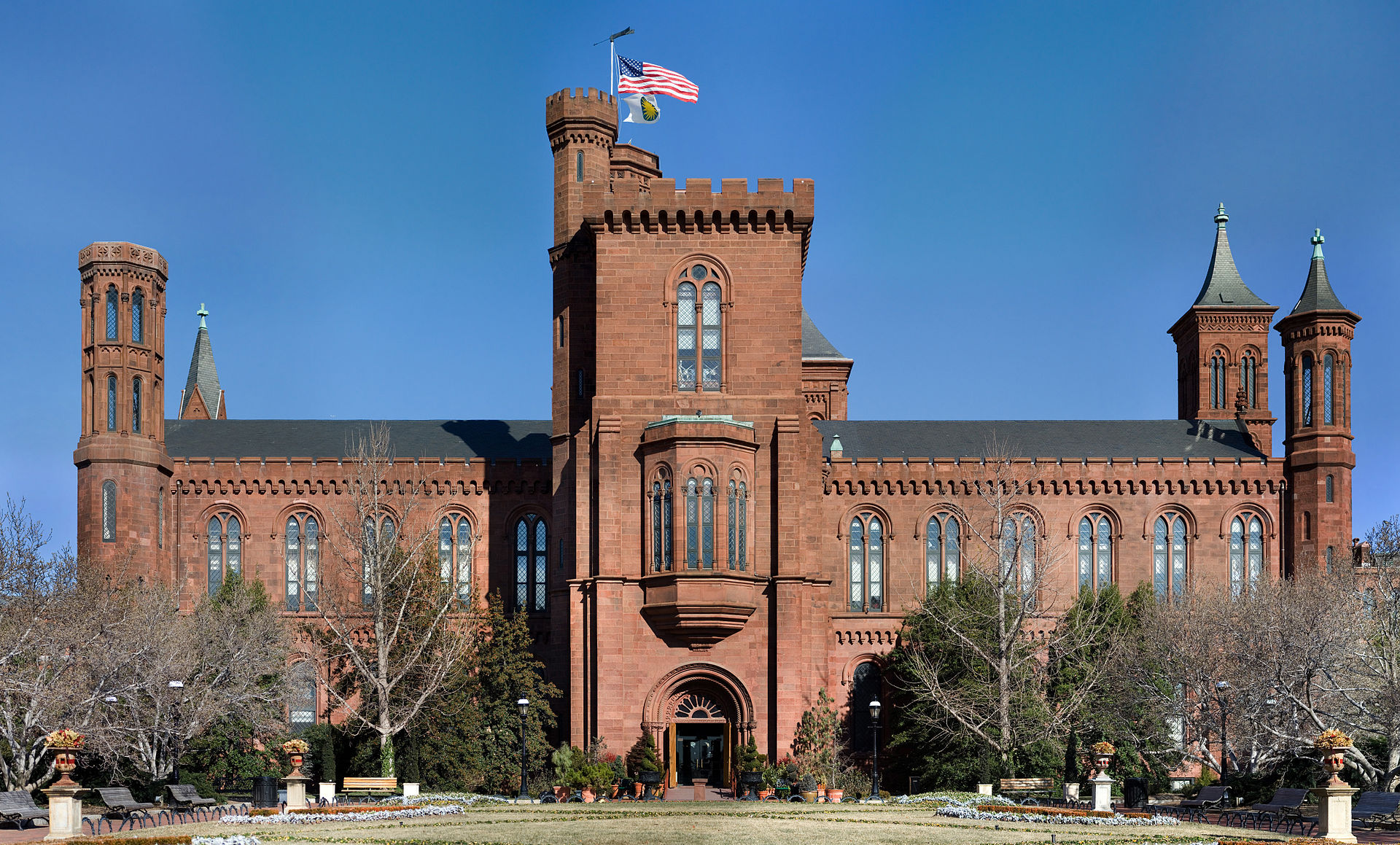
On this day in 1946, Pres. Polk signs a bill creating the Smithsonian Institution:

Smithsonian_Building_NR
The “Castle” (1847), the Institution’s first building and still its headquarters

The Smithsonian Institution ….  smith-soe-nee-?n), established in 1846 “for the increase and diffusion of knowledge,” is a group of museums and research centers administered by the United States government. Originally organized as the “United States National Museum,” that name ceased to exist as an administrative entity in 1967.[1] Termed “the nation’s attic”[2] for its eclectic holdings of 137 million items,[3] the Institution’s Washington, D.C. nucleus of nineteen museums, nine research centers, and zoo—many of them historical or architectural landmarks—is the largest such complex in the world. Additional facilities are located in Arizona, Maryland, New York City, Virginia, Panama and elsewhere, and 168 other museums are Smithsonian affiliates. The Institution’s thirty million annual visitors[4]are admitted without charge; funding comes from the Institution’s own endowment, private and corporate contributions, membership dues, government support, and retail, concession and licensing revenues.[3] Institution publications include Smithsonian and Air & Space magazines….

British scientist James Smithson (d. 1829) left most of his wealth to his nephew Henry James Hungerford; however, when Hungerford died childless in 1835,[5] the estate passed “to the United States of America, to found at Washington, under the name of the Smithsonian Institution, an Establishment for the increase & diffusion of knowledge among men.”, in accordance with Smithson’s will.[6] Congress officially accepted the legacy bequeathed to the nation, and pledged the faith of the United States to the charitable trust on July 1, 1836.[7] The American diplomat Richard Rush was dispatched to England by President Andrew Jackson to collect the bequest; Rush returned in August 1838 with 105 sacks containing 104,960 gold sovereigns (about $500,000 at the time).[8][9]

Once the money was in hand, eight years of Congressional haggling ensued over how to interpret Smithson’s rather vague mandate “for the increase and diffusion of knowledge.”[7][9] Unfortunately the money was invested by the US Treasury in bonds issued by the state of Arkansas which soon defaulted. After heated debate, Massachusetts Representative (and ex-President) John Quincy Adams persuaded Congress to restore the lost funds with interest[10] and, despite designs on the money for other purposes, convinced his colleagues to preserve it for an institution of science and learning.[11] Finally, on August 10, 1846, President James K. Polk signed the legislation that established the Smithsonian Institution as a trust instrumentality of the United States, to be administered by a Board of Regents and a Secretary of the Smithsonian.[7]

Daily Bread for 8.9.14

Good morning, Whitewater.

Saturday in town will be mostly sunny, with a high of around eighty, and east winds of five to ten mph.

On this day in 1974, Gerald Ford becomes president:

In accordance with his statement of resignation the previous evening, Richard M. Nixon officially ends his term as the 37th president of the United States at noon. Before departing with his family in a helicopter from the White House lawn, he smiled farewell and enigmatically raised his arms in a victory or peace salute. The helicopter door was then closed, and the Nixon family began their journey home to San Clemente, California. Richard Nixon was the first U.S. president to resign from office.

Minutes later, Vice President Gerald R. Ford was sworn in as the 38th president of the United States in the East Room of the White House. After taking the oath of office, President Ford spoke to the nation in a television address, declaring, “My fellow Americans, our long national nightmare is over.”

Ford, the first president who came to the office through appointment rather than election, had replaced Spiro Agnew as vice president only eight months before. In a political scandal independent of the Nixon administration’s wrongdoings in the Watergate affair, Agnew had been forced to resign in disgrace after he was charged with income tax evasion and political corruption. In September 1974, Ford pardoned Nixon for any crimes he may have committed while in office, explaining that he wanted to end the national divisions created by the Watergate scandal.

On this day in 1793, a pioneer is born:

1793 – Milwaukee Pioneer Solomon Juneau Born

On this date Laurent Salomon Juneau was born in Repentigny, Quebec, Canada. Known as the founder of Milwaukee, Juneau was a fur trader with John Jacob Astor’s American Fur Company. He built the first log house in Milwaukee in 1822 and followed with the first frame house in 1824. In October 1833 he formed a partnership with Morgan L. Martin to develop a village on the east side of the Milwaukee River. Juneau was elected commissioner of roads and director of the poor in September 1835. He was also appointed postmaster, a position he held until 1843. In 1837 he began publishing the Milwaukee Sentinel. He was elected first mayor of Milwaukee in 1846. Juneau died on November 14, 1856. [Source: Dictionary of Wisconsin Biography, p.198]