FREE WHITEWATER

Daily Bread for 6.26.14

Good morning, Whitewater.

Thursday will be mostly cloudy, with a high in the upper seventies, and winds from the east at 5 mph.
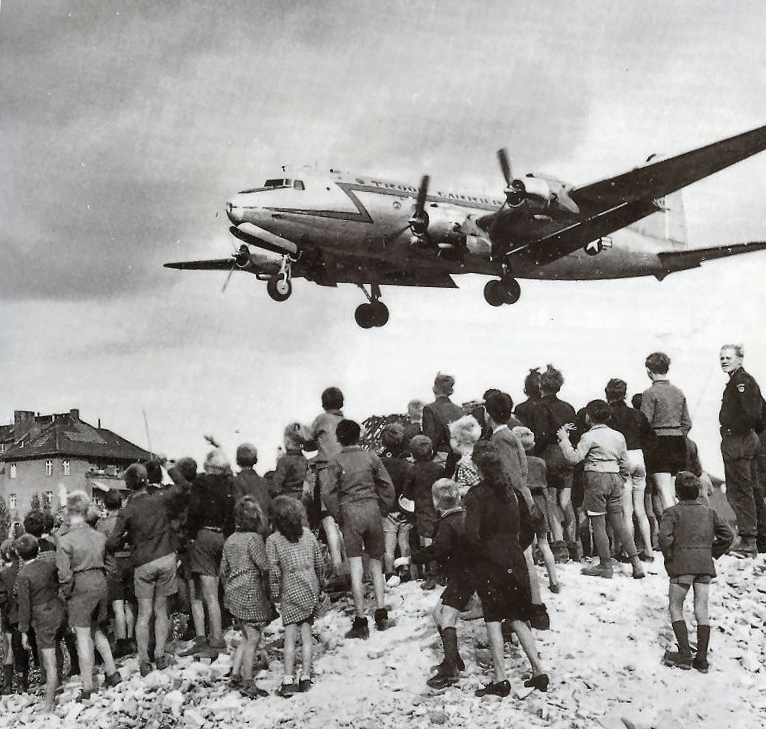
C-54landingattemplehof
Berliners watch a C-54 Skymaster land at Tempelhof Airport, 1948.
Via Wikipedia.

On this day in 1948, the United States and her allies begin the Berlin Airlift in response to a Soviet blockade of West Berlin:

The Berlin blockade (24 June 1948 – 12 May 1949) was one of the first major international crises of the Cold War. During the multinational occupation of post–World War II Germany, the Soviet Union blocked the Western Allies‘ railway, road, and canal access to the sectors of Berlin under allied control. Their aim was to force the western powers to allow the Soviet zone to start supplying Berlin with food, fuel, and aid, thereby giving the Soviets practical control over the entire city.

In response, the Western Allies organized the Berlin airlift to carry supplies to the people in West Berlin.[1][2] Aircrews from the United States Air Force, the British Royal Air Force, the Royal Canadian Air Force, the Royal Australian Air Force, the Royal New Zealand Air Force, and the South African Air Force[3]:338 flew over 200,000 flights in one year, providing up to 4700 tons of necessities daily, such as fuel and food, to the Berliners.[4]

By the spring of 1949 the airlift was clearly succeeding, and by April it was delivering more cargo than had previously been transported into the city by rail. The success of the Berlin Airlift brought embarrassment to the Soviets who had refused to believe it could make a difference. The blockade was lifted in May 1949 and resulted in the creation of two separate German states.[4] The Federal Republic of Germany (West Germany) and the German Democratic Republic (East Germany) split up Berlin.[4] Following the airlift, three airports in the former western zones of the city served as the primary gateways to Germany for another fifty years.[5]

Here’s Thursday’s Puzzability game:

This Week’s Game — June 23-27
Camp Out
Hey, take a hike! For each day this first week of summer, we started with a phrase, removed the four letters in CAMP, and rearranged all the letters to get a new word or phrase. Both pieces are described in each day’s clue, with the longer one first.
Example:
Automobile that your employer lets you use; preschool writing implement
Answer:
Company car; crayon
What to Submit:
Submit both pieces, with the longer one first (as “Company car; crayon” in the example), for your answer.
Thursday, June 26
Performer at The Punch Line or Carolines; price cut

Feasting on Wholly Unjustified Insecurities

I don’t know – truly – what need or desire causes a few people to yearn for the mere things of other places. 

Whitewater’s goal should be not a collection of objects, but an embrace of standards.  This should be so very clear: we don’t need to build new buildings, we need to assure sound institutions in conformity with America’s highest standards. 

What do you have, how do you look? 

No, and no again — a different question matters: What do you believe? 

(See, along these lines, How Many Rights for Whitewater?, What Standards for Whitewater?, and Why Whitewater?)

These local men who prey on the unjustified insecurities of others, or suffer an insatiable need to exaggerate to satisfy their own pride, are ignorant of what makes our city, state, and country exceptional: our liberties and the sound institutions flourishing through them. 

I think, sometimes, that such hucksters would try to sell ice to an Inuit if they had the chance.

We don’t need the buildings of Los Angeles; we need the best practices of America.

In any event, there is no fashion, no striking beauty of Los Angeles, and few objects therefrom that would not fade in our Wisconsin climate. 

We may be grateful for it. 

So much of policy here depends on convincing people that they need a particular project, all the while neglecting both those truly distressed and the higher standards that are the sound foundation of a better, more prosperous life.

We can and will do better.  One may be very sure of it.

Why Not Build Another Los Angeles (by the Bridge to Nowhere)?

image

Typical Los Angeles Resident

Los Angeles is America’s second-largest city, and is world-renowned for her diverse economy and global role in commerce, entertainment, and art.  All its people are reputed to be exceptionally beautiful, talented, and clever (at least by their own, uniform accounts).

If Los Angeles should be so valuable – and it is – why not build a second Los Angeles just outside Whitewater?  We could start the gateway to the project at the very spot where the Bridge to Nowhere ends.

If one city of the angels is good, wouldn’t two be far better

What if, since this project would be pricey, the U.S. Government would lend us the money?  Let’s say Uncle Sam would lend us a trillion dollars ($1,000,000,000,000.00) to start.  After all, America spent well over a trillion dollars in Iraq over the last decade. 

Should we start a Los Angeles 2.0?

If we build it, will they (super-smart, trendy people) not come to us in wave after wave?

There’s the big-talking developers’ problem: it’s only worthwhile if the gain (accurately measured) is more than the expense (fully calculated) of L.A. Part Deux. 

If simply building more of an expensive thing brought prosperity, every Whitewater resident would be building Phantoms, Ghosts, and Wraiths – and every resident would be prosperous by consequence.  

The climate of these times is filled with ‘if you build it, they will come’ projects. 

It’s so easy to say, so simple to talk up, and so few people press for details.

So, why not, big talkers? 

Just apply for some federal money.

If you don’t try to build another Los Angeles on the taxpayers’ tab, some other community might get that money.

Hurry now, there’s no time to lose…

Daily Bread for 6.25.14

Good morning, Whitewater.

Midweek brings an even chance of thunderstorms with a high of seventy-six.

Whitewater’s Community Development Authority Board meets today at 5 PM.

Today is the anniversary, from 1876, of the Battle of the Little Bighorn:

The Battle of the Little Bighorn, previously referred to as Custer’s Last Stand, and observed by Lakota tribes as Lakota Victory Day[1], was an armed engagement between combined forces of the LakotaNorthern Cheyenne, and Arapaho tribes, against the7th Cavalry Regiment of the United States Army. The battle, which occurred June 25–26, 1876, near the Little Bighorn River in eastern Montana Territory, was the most prominent action of the Great Sioux War of 1876. It was an overwhelming victory for the Lakota, Northern Cheyenne, and Arapaho, led by several major war leaders, including Crazy Horse and Chief Gall, inspired by the visions of Sitting Bull (T?at?á?ka Íyotake). The U.S. 7th Cavalry, including the Custer Battalion, a force of 700 men led by George Armstrong Custer, suffered a severe defeat. Five of the 7th Cavalry’s twelve companies were annihilated; Custer was killed, as were two of his brothers, a nephew, and a brother-in-law. The total U.S. casualty count, including scouts, was 268 dead and 55 injured.

Public response to the Great Sioux War varied at the time. The battle, and Custer’s actions in particular, have been studied extensively by historians.[2]

Although he was celebrated by many at the time,  I’d say we’ve come to see Custer today, correctly, as reckless and undisciplined.

Here’s the Wednesday game in the Camp Out series from Puzzability:

This Week’s Game — June 23-27
Camp Out
Hey, take a hike! For each day this first week of summer, we started with a phrase, removed the four letters in CAMP, and rearranged all the letters to get a new word or phrase. Both pieces are described in each day’s clue, with the longer one first.
Example:
Automobile that your employer lets you use; preschool writing implement
Answer:
Company car; crayon
What to Submit:
Submit both pieces, with the longer one first (as “Company car; crayon” in the example), for your answer.
Wednesday, June 25
Major French news and pop culture magazine; Warren Beatty and Dustin Hoffman bomb


‘There’s Somebody for Everybody’

Former Sen. Neal Kedzie, a Republican from Elkhorn, will become the new president of the Wisconsin Motor Carriers Association on July 1. The move to the commercial motor carriers association had been rumored since Kedzie resigned from the Senate earlier this month.

Kedzie, 58, in April told his constituents he would run for re-election, but only a few months later said he would not seek another term after all. He said then he wanted to explore opportunities outside of government after serving more than 17 years in the Senate and Assembly.

Via Kedzie, former senator, to head trucking group @ JS All Politics Blog.

See, earlier, State Sen. Kedzie Rushes the Exits

Looking to Rehabilitate Someone Politically? You’re Going to Need a Better Patient

I’ve written previously of one of my favorite political quotes, from Franklin Roosevelt. Roosevelt was asked if, somehow, Herbert Hoover might play a role after Pearl Harbor.  Roosevelt accurately assessed the impossibility of political rehabilitation:

Not even the Japanese attack on Pearl Harbor could bring Hoover back into the mainstream of official Washington, D.C. Within days of the attack, Roosevelt summoned Bernard Baruch to the White House for a discussion of how best to organize the home front for victory.

Courageously, Baruch said that the best man for such an effort was Herbert Hoover. What’s more, Baruch knew him to be available. FDR shot down the idea with devastating sangfroid. According to one who was there, the president said, “I’m not Jesus Christ. I’m not raising him from the dead.”

A few gentlemen of this city are free to tout the last municipal administration’s record of wasteful projects and serial mendacity, so much as they should like.  It’s their right, after all. 

But if Franklin Roosevelt wouldn’t (knowing he couldn’t) rehabilitate Hebert Hoover, how well will these few do with their local version of that task? 

Public Spending on Infrastructure

A simple rule about public spending on infrastructure, that some forget, and others would prefer remained that way: adding infrastructure is only beneficial if a resulting economic gain (should there be one) is greater than the cost of its acquisition (capital, labor, etc.).

There is no way around this. 

Just about everything one hears about local pump-priming, sparking investment, getting things going, etc., ignores this truth, or rests on shoddy, inadequate reasoning to justify the expenditure. 

If this were not so, Whitewater would already be, after all, far better off than the Lost City of Gold legendarily was.

She’s not.

One of the reasons that she’s not is that what passes for economic policy, business policy, and marketing is erroneous.

Not just erroneous, but erroneous in a silly, superstitious way.  Nothing else worked, so this must be the thing.

We’ve poured a fortune into the ground, and yet we do not have any meaningful results. 

These tired gentlemen cannot enumerate their supposed gains, lest the city see that they’re not truly gains at all. 

Time’s running out, across America and in Whitewater, on a generation of puffery and self-promotion. 

Daily Bread for 6.24.14

Good morning, Whitewater.

Tuesday brings partly sunny skies, a one-third chance of afternoon thunderstorms, and a high of eighty to Whitewater.

There are three public meetings scheduled in the city today. The Urban Forestry Commission meets at 4:30 PM, a Fiber Optic Feasibility discussion takes place at 6 PM, and the Fire & Rescue Task Force meets at 7:30 PM.

On this day in 1997, the U.S. Air Force dismisses claims of an extraterrestrial crash in 1947 New Mexico:

On this day in 1997, U.S. Air Force officials release a 231-page report dismissing long-standing claims of an alien spacecraft crash in Roswell, New Mexico, almost exactly 50 years earlier….

On July 24, 1997, barely a week before the extravagant 50th anniversary celebration of the incident, the Air Force released yet another report on the controversial subject. Titled “The Roswell Report, Case Closed,” the document stated definitively that there was no Pentagon evidence that any kind of life form was found in the Roswell area in connection with the reported UFO sightings, and that the “bodies” recovered were not aliens but dummies used in parachute tests conducted in the region. Any hopes that this would put an end to the cover-up debate were in vain, as furious ufologists rushed to point out the report’s inconsistencies. With conspiracy theories still alive and well on the Internet, Roswell continues to thrive as a tourist destination for UFO enthusiasts far and wide, hosting the annual UFO Encounter Festival each July and welcoming visitors year-round to its International UFO Museum and Research Center.

Yet, for it all, there are still conspiracy theorists who claim something happened, trying to bolster their claims using videos like this supposed alien autopsy footage:

(Really like the somber, portentous music…)

Here’s Puzzability‘s Tuesday game:

This Week’s Game — June 23-27
Camp Out
Hey, take a hike! For each day this first week of summer, we started with a phrase, removed the four letters in CAMP, and rearranged all the letters to get a new word or phrase. Both pieces are described in each day’s clue, with the longer one first.
Example:
Automobile that your employer lets you use; preschool writing implement
Answer:
Company car; crayon
What to Submit:
Submit both pieces, with the longer one first (as “Company car; crayon” in the example), for your answer.
Tuesday, June 24
World’s oldest yachting competition; more impertinent

‘The Future Writes the History of the Present’

It’s an oft-repeated truism that the future writes the history of the present.

That’s true in Whitewater as much as anywhere.  It is a truth (like the most important truths) apart from both independent present-day commentary and contrasting, mendacious marketing and press-flacking. 

All the marketing in the world cannot shield against this simple question from the future:

Who, did what, for whom, at what cost?

If that should be the question from our future – and it will be – then what shall we say about so many projects now touted? 

That they’re doomed to irrelevancy or scorn; they’ll not be able to answer these simple questions adequately.   

Marketing to sugar-coat the present serves only the present; it has no hope of winning the future. 

There’s a distinction to be made, though, between news and commentary.  In an blog post at the Gazette, VP of News Operations Scott Angus writes that Editor’s views: Despite objections, media must reflect societal changes (subscription req’d).

That’s very true: for news, there’s an inescapable need to be honest about the present.  I don’t write this as a newsman (needless to say), but simply as someone who grew up in a newspaper-reading family. 

That’s no easy spot for Mr. Angus and the Gazette: much is changing, and some readers are surely angry that the paper’s writing about those changes, not simply reporting happy news, or feature stories, etc. 

But if news demands an attention to the actual present, then commentary demands both that present-focus and an eye to the future. 

That’s the Gazette‘s great problem: its editorial position is weak, and its exposition of those positions poor.  An editorial position that involves deal-making among tiny factions will be in disrepute, and error-prone editorial descriptions and analyses will not be able to answer satisfactorily the future’s question, Who, did what, for whom, at what cost?

So there’s the Gazette‘s dilemma: keep the editorial focus it has, bow to present-day demands for bowdlerized news, and lose the future.  Alternatively, they can risk a truly hard slog now, but at the prospect of a more secure future. 

For the risk-adverse, I’d guess, that’s no easy decision. 

There’s a contrast with Whitewater, though.  Reading his work, I’ve no doubt that Mr. Angus sees this choice, sees more than one path. (I have no idea if the Gazette‘s editorialist, Greg Peck, sees any of this.)

Locally, in Whitewater, a waning faction of town squires shows no (outward) understanding of a choice. 

They must know that their marketing efforts over these last several years have amounted to little, all their endless headlines and crowing brought few genuine gains, and that despite representing institutions fueled with millions in taxpayer dollars, they can’t get a crowd – let alone a majority – for their political agenda. 

They’ve no sense, though, of a viable alternative, so they’ll just double their efforts for more of the same, to an audience smaller and less believing with each passing season. 

I don’t know if the Gazette will make a change to answer the future’s questions adequately; Whitewater’s aging town squires simply can’t.