FREE WHITEWATER

Daily Bread for 10.24.13

Good morning.

Thursday offers a high of forty and northwest winds at 15 to 15 mph. Sunrise will be 7:20 AM and sunset 5:58 PM. The moon is in a waning gibbous phase with 71% of its visible disk illuminated. Moon rise was 9:27 PM last night, and moonset will be 12:23 PM today.

On this day in 1945, the United Nations charter took effect:

Washington, Oct. 24–The United Nations World Security Organization came into being when the Soviet Government in mid-afternoon deposited its instrument of ratification, the twenty-ninth necessary to bring this about, and James F. Byrnes, Secretary of State, then signed the protocol at 4:50 o’clock, Eastern standard time, formally attesting that the Charter of the United Nations has come into force.

In signing the protocol Mr. Byrnes said the Charter was now a “part of the law of nations” and that it was “a memorable day for the peace-loving peoples of all nations.” But he warned that peace depended upon the will of the peoples for peace rather than upon documents.

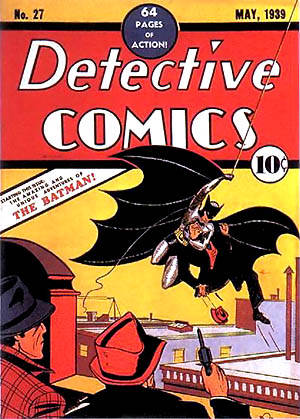
October 24th is also the birthday of Bob Kane, creator of Batman.

Detective_Comics_27
Detective Comics #27 (May 1939). The first appearance of Batman.
Art by Bob Kane.

Scientific American‘s daily trivia question asks about close genetic relationships. (Clicking on the question leads to its answer.)

800px-Montastrea_cavernosa

What animals are corals most closely related to?

What’s Whitewater’s Economy?

Like many others, I read the news each day, about our city, online and in print.  When one reads about Whitewater, of its local government, one likely reads about one of two topics: (1) the city or public schools budgets, or (2) municipal development projects.

They’re both important, sometimes very much so, but they’re only a part of Whitewater’s actual, economic life.  In fact, the tens of millions spent on our city and schools budget, and the millions more spent on development, are only meaningful in context.

That context is not — never was, and never will be — the headlines that a few boosters and cheerleaders push forward as proof of their ability, command, and insight.

The condition of common residents, thousands of them, is a fuller economic picture. 

The city’s economy comprises thousands of people and their daily production, consumption, and savings – that is, their material condition and prospects.  That a few are comfortable, or that a few projects are large, barely describes Whitewater’s genuine economic condition.      

When the Gazette or Daily Union talk about the city budget, the schools budget, or big projects, they do two things, simultaneously.  First, they push the ideas and topics that insiders think are politically valuable.  Second, these newspapers omit consideration of the full economy and the condition of thousands in Whitewater.

(About Janesville, the stark gap between the Gazette‘s hesitant description of the city they serve and the actual economic and political performance of Janesville is striking.  When nationally-recognized writers or filmmakers look at Janesville, they describe the city honestly in a way that that city’s own newspaper is too cautious to do, lest they seem ‘too critical’ and lest they unsettle advertisers or incumbent politicians.  The paper is hesitant, in the end, about the economic truth of its own town.)  

In some ways, a discussion about a budget is an easier discussion – and less unsettling – than the truth about a municipality’s poorly performing economy.

Whitewater’s town squires, self-designated notables, etc., would very much prefer a conventional discussion of the budget, or even of their big-ticket proposals (however hollow), than a discussion of the city’s actual economic conditions.

Candidate Bill Clinton’s team famously insisted that it was, after all, “the economy, stupid.”  The Clinton team was only partly right: it was and is the economy that matters greatly, but people aren’t stupid.

On contrary, it’s simply true that most people are clever and knowledgeable.  Groups of leaders may be sharp or dull, but the overwhelming majority of residents in our community are smart and capable.  We couldn’t have a functioning society otherwise. 

I posted the full city budget proposal on Monday – over a hundred pages, and millions of dollars in taxes and spending – but that’s not the starting place for a discussion. 

It’s the economy, not our city’s fiscal account, that underlies any meaningful discussion. 

Tomorrow: A City’s Most Important Economic Measure.

 

Daily Bread for 10.23.13

Good morning.

Wednesday will bring a high of forty-three, and a one-third chance of light rain or snow showers in the afternoon. The low tonight will be around twenty-six.

In the city today, there will be three public meetings: Downtown Whitewater’s board at 8 AM, the CDA at 5 PM, and the Cable Commission at 6 PM.

Throughout the day, as in every day in the city’s history, there will be innumerable private encounters, transactions, and experiences that will be the true substance of Whitewater’s civic life. They’ll not be listed as bold, red-letter events, but for it all they’ll have the distinction of being the true ingredients and foundation of life here.

On this day in 1777, America scores a victory over the British navy:

…a British Royal Navy fleet of ships, trying to open up supply lines along the Delaware River and the occupying British army in Philadelphia, is bombarded by American cannon fire and artillery from Fort Mifflin, Pennsylvania.

Six British ships were severely damaged, including the 64-gun battleship HMS Augusta and the 20-gun sloop Merlin, which both suffered direct hits before they were run aground and subsequently destroyed. More than 60 British troops aboard the Augusta were killed, while the crewmembers aboard the Merlin abandoned ship, narrowly avoiding a similar fate.

Although the American forces defending Fort Mifflin were undoubtedly victorious on October 23, 1777, the battle continued throughout the month of October and into November. With much of the fort destroyed and under continuous artillery and cannon fire, the American forces abandoned Fort Mifflin on November 16, 1777.

Today is an anniversary day for the Packers:

1921 – Green Bay Packers First NFL Game
On this date the Green Bay Packers played their first NFL game. The Packers defeated the Minneapolis Marines 7-6, for a crowd of 6,000 fans and completed their inaugural season with 3 wins, 2 losses, and 2 ties.[Source: Packers.com]

Scientific American‘s daily trivia question asks about water. (Clicking on the question leads to its answer.)

What fraction of the freshwater that falls on our planet is used by people?

Daily Bread for 10.22.13

Good morning.

We’ll have a partly sunny Tuesday with a high of forty-four.

Whitewater’s Urban Forestry Commission meets this afternoon at 4:30 PM, and her Common Council at 7 PM.

On this day in 1797, a first – a successful parachute jump:

googleDoodle_2709293b

Google Doodle link.

Google has changed the design of its homepage to celebrate Andre-Jacque Garnerin’s jump on October 22 1797 from a balloon above Parc Monceau in Paris.

The Frenchman used a seven-meter silk parachute resembling an umbrella to ease his path to the ground.

When Garnerin’s balloon reached 3,000 feet above the park, he cut his basket loose and opened the parachute.

Visitors to Google’s homepage can now recreate that leap using their right and left arrow keys to guide the path of their parachutist safely towards the ground.

The French daredevil emerged from the basked unscathed, despite it jerking in the air and a violent landing.

Garnerin became an international celebrity following the leap and was awarded the title of Official Aeronaut of France.

His wife, Jeanne Genevieve Labrosse, was also a balloonist and the first ever female parachutist. The couple visited England in the early 1800s and took part in several balloon flights while in the country.

On October 22, 1935, a Footville man wins again:

1938 – Footville Man Wins Husking Title
On this date Dick Post of Footville won his sixth county title by husking a record 24.5 bushels of corn in 80 minutes. Two days later, he husked 1,868 pounds in 80 minutes to win the state championship. Post finished fourth in the nationals at Sioux Falls, S.D. [Source: Janesville Gazette October 22, 1938, p.4]

Scientific American‘s daily trivia question asks about tourism. (Clicking on the question leads to its answer.)

What is a Heisenbug?

A proposal for renaming the Washington Redskins

Law professor David Bernstein has a suggestion for renaming the Washington Redskins. I like it.

Bernstein writes:

I agree with Charles Krauthammer that the Redskins should be renamed out of common courtesy. I also think the name should reflect something unique or at least prominent about the team’s metropolitan area. You can call the team the “Lobbyists,” the “Government Contractors,” the “Domestic Spies,” the “Corrupt City Officials,” the “Partisans,” the “Thirtysomething Housemates,” the “Pork Barrels,” the “Unpaid Interns,” the “Tax Collectors,” the “Washington Waste, Fraud and Abuse,” the “Permanent Bureaucracy,” the “Red Tape” or the “Washington Gridlock.”

See, Renaming the Washington Redskins.

Daily Bread for 10.21.13

Good morning.

In Whitewater, we’ll have a mostly cloudy day with a high of forty-four. Sunrise today is 7:16 AM and sunset will be 6:03 PM. The moon is in a waning gibbous phase with 92% of its visible disk illuminated.

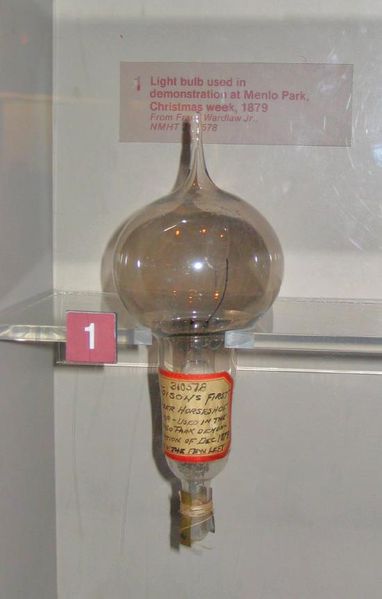
On this day in 1879, Thomas Edison invents the incandescent bulb. The New York Times later reported on Edison’s achievement, after a visit to Edison’s laboratory:

There was no lack of enthusiasm or of confidence about Mr. Edison as he greeted the Times reporter who entered his laboratory at Menlo Park, N. J., yesterday. The inventor, a short, thick-set man, with grimy hands, led the way through his workshop, and willingly explained the distinctive features of what he and many others look upon as an apparatus which will soon cause gas-light to be a thing of the past.

The lamp which Mr. Edison regards as a crowning triumph is a model of simplicity and economy.

In the lamp the light is emitted by a horseshoe of carbonized paper about two and a half inches long and the width of a thread. This horseshoe is in a glass globe, from which the air has been as thoroughly exhausted as science is able to do. So good a vacuum is produced that it is estimated that at the utmost no more than a one-millionth part of the air remains. The operation of pumping lasts one hour and a quarter.

At the ends of the carbon horseshoe are two platinum clamps, from which platinum wires run outwardly through a small glass tube contained within a larger one leading out of the glass globe. The small tube contains air. Within it the platinum wires are met by two copper wires connecting with the conductors of the electricity. The air is left in the small tube, because otherwise the copper wires would be fused by the electric current. The carbonized paper is capable of being made incandescent by a current of electricity, and while it allows the current to pass over it, its resistance to the heat is strong enough to prevent it from fusing.

On this day in Wisconsin history, a dedication:

1897 – Yerkes Observatory Dedicated
On this date the Yerkes Observatory was dedicated. Founded by astronomer George Hale and located in Williams Bay, the Yerkes Observatory houses the world’s largest refracting optical telescope, with a lens of diameter 102 cm/40 inches. It was built through the largess of the tycoon Charles Tyson Yerkes, who rebuilt important parts of the Chicago transportation system after the fire. Situated in a 77-acre park on the shore of Lake Geneva, this observatory was the center for world astronomy in the early 20th century and invited a number of astronomers from around the world, including Japan, for scientific exchange. [Source: Yerkes Observatory Virtual Museum]

Scientific American‘s daily trivia question asks about tourism. (Clicking on the question leads to its answer.)

Who was the first paying space tourist?