
Animation
Sunday Morning Animation: Paper Plane
by JOHN ADAMS •
Daily Bread
Daily Bread for 10.20.13
by JOHN ADAMS •
Good morning.
We’ll have a high of fifty-six today, with a twenty-percent chance of afternoon showers.
We are far from the Atlantic Ocean, and so among the many immediate concerns of Wisconsinites, the lionfish, fortunately, is not one:
The clear waters around Bermuda are as picturesque as you can imagine, and the brilliantly colored fish swimming around are like something from a crayon box. But a serious problem lurks behind the beautiful facade: the lionfish.
Lionfish are not native to the Atlantic Ocean. The venomous, fast reproducing fish are aggressive eaters and will consume anything and everything, gorging so much they are actually getting liver disease. With no known predators — except human beings — they can wipe out 90% of a reef.
“The lionfish invasion is probably the worst environmental disaster the Atlantic will ever face,” said Graham Maddocks, president and founder of Ocean Support Foundation, which works with the government and research agencies to help reduce the lionfish population in Bermuda.
While the problem is only beginning to escalate, many in the marine preservation field are already concerned for the marine life that surrounds the lionfish.
How did this happen, that a non-native species got there?
Ask Florida.
Florida pet owners are blamed for their release into unfamiliar waters. Believe it or not, DNA evidence traces all lionfish in the Atlantic back to only six to eight female lionfish.
In Wisconsin’s experience, Frederick Douglass speaks to a Beaver Dam audience on 10.20.1856:
1856 – Frederick Douglass Speaks in Beaver Dam
On this date Frederick Douglass arrived in Beaver Dam and spoke about the brutality and immorality of slavery. His speech was also intended to generate support for the abolitionist movement in Dodge Co. and Wisconsin. A former runaway slave and leading orator and author of the abolitionist movement, Douglass is regarded as one of the most influential Americans of the 19th century. [Source: Wisconsin Local History Network]
Animals, Nature
The Turkey Vultures of Devil’s Lake
by JOHN ADAMS •
Clicking a thumbnail opens a larger, full-size image.
Daily Bread
Daily Bread for 10.19.13
by JOHN ADAMS •
Good morning.
We’ll have a Saturday of probable (60%), late afternoon showers and a high of fifty-one.
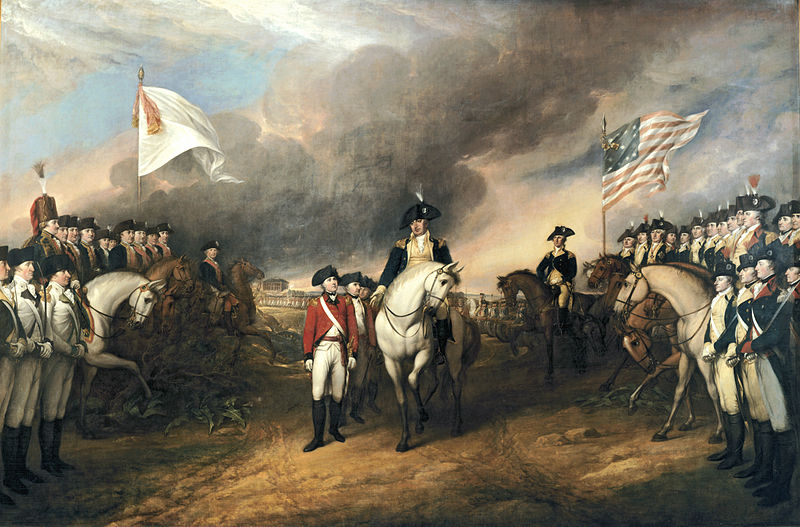
On October 19, 1781, an American and French victory over Britain truly and without overstatement changes world history profoundly:
Hopelessly trapped at Yorktown, Virginia, British General Lord Cornwallis surrenders 8,000 British soldiers and seamen to a larger Franco-American force, effectively bringing an end to the American Revolution.
Lord Cornwallis was one of the most capable British generals of the American Revolution. In 1776, he drove General George Washington’s Patriots forces out of New Jersey, and in 1780 he won a stunning victory over General Horatio Gates’ Patriot army at Camden, South Carolina. Cornwallis’ subsequent invasion of North Carolina was less successful, however, and in April 1781 he led his weary and battered troops toward the Virginia coast, where he could maintain seaborne lines of communication with the large British army of General Henry Clinton in New York City. After conducting a series of raids against towns and plantations in Virginia, Cornwallis settled in the tidewater town of Yorktown in August. The British immediately began fortifying the town and the adjacent promontory of Gloucester Point across the York River.
General George Washington instructed the Marquis de Lafayette, who was in Virginia with an American army of around 5,000 men, to block Cornwallis’ escape from Yorktown by land. In the meantime, Washington’s 2,500 troops in New York were joined by a French army of 4,000 men under the Count de Rochambeau. Washington and Rochambeau made plans to attack Cornwallis with the assistance of a large French fleet under the Count de Grasse, and on August 21 they crossed the Hudson River to march south to Yorktown. Covering 200 miles in 15 days, the allied force reached the head of Chesapeake Bay in early September.
Meanwhile, a British fleet under Admiral Thomas Graves failed to break French naval superiority at the Battle of Virginia Capes on September 5, denying Cornwallis his expected reinforcements. Beginning September 14, de Grasse transported Washington and Rochambeau’s men down the Chesapeake to Virginia, where they joined Lafayette and completed the encirclement of Yorktown on September 28. De Grasse landed another 3,000 French troops carried by his fleet. During the first two weeks of October, the 14,000 Franco-American troops gradually overcame the fortified British positions with the aid of de Grasse’s warships. A large British fleet carrying 7,000 men set out to rescue Cornwallis, but it was too late.
On October 19, General Cornwallis surrendered 7,087 officers and men, 900 seamen, 144 cannons, 15 galleys, a frigate, and 30 transport ships. Pleading illness, he did not attend the surrender ceremony, but his second-in-command, General Charles O’Hara, carried Cornwallis’ sword to the American and French commanders. As the British and Hessian troops marched out to surrender, the British bands played the song “The World Turned Upside Down.”
Although the war persisted on the high seas and in other theaters, the Patriot victory at Yorktown effectively ended fighting in the American colonies. Peace negotiations began in 1782, and on September 3, 1783, the Treaty of Paris was signed, formally recognizing the United States as a free and independent nation after eight years of war.
A genuinely good, hard-in-coming day.
Cats
Friday Catblogging: Dog-Bed Stealin’ Cats
by JOHN ADAMS •
Poll
Friday Poll: Fitness Mom’s Photo
by JOHN ADAMS •
So, Maria Kang, a mother of three who exercises almost every day, posted a photo of herself on Facebook, and it’s caused a stir. She’s obviously fit, but some Facebookers contend that she’s guilty of shaming them, of insulting them with her picture:

(CNN) — Maria Kang likes a good workout. And she is getting one after a bunch of angry women turned her into a punching bag.
The 32-year-old Californian fitness enthusiast is under attack for posing for a cheeky photo and posting it on Facebook. The picture shows Kang — who works out for 30 to 60 minutes per day, six days a week — dressed in a workout bra and shorts that reveal an extremely toned body. She’s surrounded by her three young sons — now 1, 3 and 4. Plastered overhead is a simple but loaded question: “What’s your excuse?”
The photo went viral. It has more than 16 million views on Facebook and more than 12,000 comments. Most of the reaction has been positive; Kang estimates that the negative comments are outnumbered by the
The photo is provocative. And it was meant to be.
But a lot of women out there were absolutely furious with Kang.
“You, as a woman, should be ashamed that you are furthering the downward spiral of how society views women, and how we women view ourselves,” scolded one blogger.
Some call her obnoxious, a showoff, a bully shaming other women and worse.
What’s worse? How about getting accused of being a “bad mother”? That’s right. Some women had the nerve to insist that no one gets into this kind of shape without neglecting their children.
Oh, don’t go there. The last thing we need is another skirmish in the “mommy wars” where women compete to see whose maternal instincts are stronger.
“I did it because I knew it would wake people up,” Kang told me in an interview while her sons clamored for their mom’s attention in the background. “My intention was to inspire and motivate people to get healthy.”
Her point: If a mom with three children can work out, eat healthy and stay fit, what excuse is there for the rest of us?
“It takes a lot of time to raise kids, but you have to also make time to take care of yourself,” she said.
That isn’t easy with Kang’s schedule. She said she cares for her three boys without a nanny in addition to creating and running a nonprofit organization dedicated to helping people get fit.
So here’s my question: insulting or motivational? I think it’s meant to be provocative, but that it’s not insulting – it’s merely motivational. What do you think?
Daily Bread
Daily Bread for 10.18.13
by JOHN ADAMS •
Good morning.
Friday in Whitewater will be mostly cloudy with a high of forty-nine.
If you happen to enjoy a polite, turn-taking conversation today, you’ll not be alone. A marmoset may be having a similar experience. Asif Ghazanfar, a neurobiologist at Princeton University, finds that other than humans, marmosets are the only known species to take turns that way:

Marmosets are very friendly with one another and very talkative, including when they’re out of sight of each other. Given these cooperative traits, which marmosets share with humans, Ghazanfar and his colleagues wondered if the monkeys also engage in vocal turn-taking (as humans also do) to enhance their cooperation.
To find out, the researchers placed dyads (pairs) of adult common marmoset monkeys (Callithrix jacchus) at opposite corners of a room, which had a visually opaque but acoustically transparent curtain splitting the room in half, diagonally. Over the course of the experiment, they paired the 10 non-related monkeys in various combinations — five cagemate pairs and 22 non-cagemate pairs.
The team recorded 1,415 “phee” calls in 54 sessions. These calls, Ghazanfar explained, are very loud, high-pitched, long-distance vocalizations that marmosets use when separated from other group members.
Ghazanfar and his colleagues discovered that the dyads wouldn’t call out at the same time. Instead, the monkeys would take turns — about five seconds after one monkey called out, the other would respond. Not once did the dyads ever interrupt one another.
This vocal turn-taking is especially remarkable considering that some sessions lasted 30 to 40 minutes. Ghazanfar also noted that the phee calls between the dyads didn’t always alternate one-to-one. “If I am talking to someone, I could make a couple of statements before I get a response,” Ghazanfar said. “It was similar with the marmosets: They do take turns, but not every single call that one marmoset produces gets a response.”
On this day in 1967 Update: 1867!, America takes possession of Alaska:
…the U.S. formally takes possession of Alaska after purchasing the territory from Russia for $7.2 million, or less than two cents an acre. The Alaska purchase comprised 586,412 square miles, about twice the size of Texas, and was championed by William Henry Seward, the enthusiastically expansionist secretary of state under President Andrew Johnson.
Scientific American‘s daily trivia question asks about offspring, lots of them. (Clicking on the question leads to its answer.)
Business, Free Markets, Laws/Regulations, Liberty
Update: Victory for the Entrepreneurial Monks of Saint Joseph Abbey in Louisiana
by JOHN ADAMS •
Over three years ago, I posted about Louisiana’s attempt to prevent the monks of Saint Joseph Abbey from making and selling handmade caskets. Their products were of fine craftsmanship and durability, and so sought-after. Despite the quality of their work, Louisiana insisted that only a state-licensed funeral director could sell caskets, and that it was a crime for the monks to do so.
This year, a federal appellate court (the Fifth Circuit) overturned Louisiana’s regulatory requirement, and now the United States Supreme Court has declined to hear an appeal from Louisiana. This assures that the lower court decision will stand, and so the abbey has, at last, its long-sought vindication.
See, from 2010, Institute for Justice: Free the Monks and Free Enterprise.
(Licensing requirements like this have the obvious consequence of protecting incumbent manufacturers or sellers from competitors who, despite the quality of their products, find themselves denied licenses or burdened with heavy regulatory fees.)
I’ve republished a video from the Institute for Justice, a non-profit law firm that represented the monks, and also the IJ’s latest press release about their win.
A case like this isn’t just important for Louisiana, or Saint Joseph Abbey, or the abbey’s customers. It’s encouraging for small and independent artisans from one side of the country to another, who’d like a chance to offer good and valued products to willing, satisfied purchasers.
Arlington, Va.—Today, the Benedictine monks of Saint Joseph Abbey won the final battle of their five-year confrontation with the State of Louisiana when the U.S. Supreme Court rejected the petition of the Louisiana State Board of Embalmers and Funeral Directors seeking to overturn the brothers’ landmark constitutional victory. In March, the 5th U.S. Circuit Court of Appeals struck down Louisiana’s law requiring a funeral director’s license to sell a casket, affirming the constitutional right to earn an honest living without unreasonable government interference.
This case arose when the brothers of Saint Joseph Abbey, a century-old Benedictine monastery in Covington, La., began to sell their handmade caskets in late 2007 to support the monks’ educational and healthcare expenses. The Louisiana State Board of Embalmers and Funeral Directors moved to shut down the fledgling business before it sold even one casket because it was a crime in Louisiana for anyone but a government-licensed funeral director to sell caskets to the public. The monks brought suit in federal court on the ground that this arbitrary restriction served no legitimate public purpose and existed only to funnel money to the funeral-director cartel.
“The U.S. Supreme Court’s denial of review puts the final nail in the coffin for the state board’s protectionist and outrageous campaign against the monks,” said Institute for Justice Senior Attorney Scott Bullock. “The Abbey’s victory in this case will not only protect their right to sell caskets, but the rights of entrepreneurs throughout the country.”
The monks’ victory is one of only a handful of cases since the 1930s in which federal courts have enforced the constitutional right to economic liberty.
Abbot Justin Brown, who heads the monastic community said, “Today is a good day for us at the Abbey. Knowing that not only has our economic liberty been protected forever, but that we also helped secure the same rights for others makes this years-long battle worth it.”
“Back in March, the 5th Circuit rejected economic protectionism as a legitimate state interest,” explained Jeff Rowes, an IJ senior attorney. “With the Supreme Court’s denial of the funeral board’s appeal, the 5th Circuit’s ruling becomes final.”
“The government cannot require individuals to go through onerous licensing requirements just to sell a box,” said IJ Attorney Darpana Sheth. “This victory opens the door to strike down other irrational licensing restrictions that really serve to protect industry insiders.”
“Arbitrary licensing laws crush the dreams of countless aspiring entrepreneurs across the nation,” said Institute President and General Counsel William Mellor. “This precedent gives them hope that the day will soon come when government no longer stands in the way of honest enterprise.”
Read the Fifth Circuit Decision:
http://iam.ij.org/LACasketsDecision.
Daily Bread
Daily Bread for 10.17.13
by JOHN ADAMS •
Good morning.
We’ll have a Thursday that brings morning showers and a high of fifty-six.
On this day in 1931 Al Capone goes to prison:
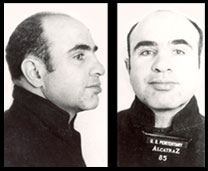
…gangster Al Capone is sentenced to 11 years in prison for tax evasion and fined $80,000, signaling the downfall of one of the most notorious criminals of the 1920s and 1930s.
Alphonse Gabriel Capone was born in Brooklyn, New York, in 1899 to Italian immigrants. He was expelled from school at 14, joined a gang and earned his nickname “Scarface” after being sliced across the cheek during a fight. By 1920, Capone had moved to Chicago, where he was soon helping to run crime boss Johnny Torrio’s illegal enterprises, which included alcohol-smuggling, gambling and prostitution. Torrio retired in 1925 after an attempt on his life and Capone, known for his cunning and brutality, was put in charge of the organization….
Among Capone’s enemies was federal agent Elliot Ness, who led a team of officers known as “The Untouchables” because they couldn’t be corrupted. Ness and his men routinely broke up Capone’s bootlegging businesses, but it was tax-evasion charges that finally stuck and landed Capone in prison in 1931. Capone began serving his time at the U.S. Penitentiary in Atlanta, but amid accusations that he was manipulating the system and receiving cushy treatment, he was transferred to the maximum-security lockup at Alcatraz Island, in California’s San Francisco Bay. He got out early in 1939 for good behavior, after spending his final year in prison in a hospital, suffering from syphilis.
Plagued by health problems for the rest of his life, Capone died in 1947 at age 48 at his home in Palm Island, Florida.
Scientific American‘s daily trivia question asks about a date. (Clicking on the question leads to its answer.)

University
UW-Whitewater Chancellor Telfer to serve as interim UW System President
by JOHN ADAMS •
UW-Whitewater Chancellor Richard J. Telfer will serve as the University of Wisconsin System president when Kevin Reilly leaves the post at the end of the year.
Michael Falbo, president of the UW System Board of Regents, made the announcement in a news release Wednesday.
Telfer, chancellor at UW-Whitewater since 2008, will serve as interim president starting Jan. 1, and will stay in the post until a new president takes over.
I’m well aware of the irony that FREE WHITEWATER is the first local publication to post this news (FW is mostly a site of commentary, not breaking stories).
Overall, though, I’d say that the chancellor’s work elsewhere won’t alter the policies or conditions here appreciably – I’d guess the university will implement as it has, with no major policy changes during this interim period.
Via UW-Whitewater chancellor to serve as interim UW System president @ Wisconsin State Journal.
University
UW-Whitewater Chancellor Telfer to serve as interim UW System President
by JOHN ADAMS •
UW-Whitewater Chancellor Richard J. Telfer will serve as the University of Wisconsin System president when Kevin Reilly leaves the post at the end of the year.
Michael Falbo, president of the UW System Board of Regents, made the announcement in a news release Wednesday.
Telfer, chancellor at UW-Whitewater since 2008, will serve as interim president starting Jan. 1, and will stay in the post until a new president takes over.
I’m well aware of the irony that FREE WHITEWATER is the first local publication to post this news (FW is mostly a site of commentary, not breaking stories).
Overall, though, I’d say that the chancellor’s work elsewhere won’t alter the policies or conditions here appreciably – I’d guess the university will implement as it has, with no major policy changes during this interim period.
Via UW-Whitewater chancellor to serve as interim UW System president @ Wisconsin State Journal.
Business, City, Development, Free Markets, Hip & Prosperous, New Whitewater
Whitewater’s Common Council Meeting for 10.15.13 (Downtown Whitewater and Whitewater’s Merchant Class)
by JOHN ADAMS •
Municipal funding for local business groups, including Downtown Whitewater, Inc., lies ahead. I’ll not discuss those line items today. Instead, I’ll offer a simple observation about local merchants.
Whitewater has spent too much time and money on failed big-ticket, white-collar projects and too little time on her local, merchant class.
I’ve no particular interest in favoring local retailers over national ones; I’ve every reason to cheer local merchants (1) generally as part of true entrepreneurship, and (2) as against empty and laughable ‘investment’ schemes that merely transfer public money from common people to preening, glib-talking men.
The antidote to the florid, phony press releases for these schemes is to read something insightful; the cure for enduring some prattling fool’s attempt at sophistication is to visit a merchant.
For reading I’ll always choose the early Jane Jacobs; for visits one should talk to a local businessperson in town. One reads with an open mind; one visits as an ordinary customer.
When I walk through the city, through its downtown, I’m both happy and concerned. I’m happy for what we have; worried that our focus isn’t on a true, productive, merchant class, but instead is on big schemes.
Last night, Downtown Whitewater’s director, Tamara Brodnicki, spoke to Common Council, in a quarterly presentation about her members’ and organization’s progress. Few presentations interest me more – better a simple discussion about merchants than a day about grand ideas.
She spoke about actual developments and upcoming events. That’s as it should be here, from all groups, always: a list of progress and of concrete plans.
Here’s what should weigh on us, long beyond the fall budget season: nothing good will come to a city that doesn’t support an open, vibrant, market culture. No one will move and invest here if the downtown isn’t a success.
Structures, plans, organizations, budgets, re-zoning – all that awaits, and may have more than one outcome.
It’s well past time, though, for this city to look away from the big-but-futile, toward the small-but-hopeful.
City, Government Spending, Local Government, Politics
Whitewater’s Common Council Meeting for 10.15.13 (City Manager, Budget Perspective)
by JOHN ADAMS •
It’s budget season for local governments across Wisconsin, including Whitewater. Presentations beginning in October will conclude with a vote in November.
A few introductory remarks on that process follow.
City Manager, Cameron Clapper. City Manager Clapper has two tasks, not one: daily management the city’s local government, and normalizing the way his administration describes local government’s functions.
In a city with a normal and mature politics, he’d have only the former task; it’s his particular circumstance that Whitewater has not had that kind of local government, particularly in the years immediately before Mr. Clapper’s appointment.
That’s not been Whitewater: this city has had the (wholly unnecessary) small-town disease of insecurity, of ridiculously describing every action in the grandest terms, of exaggerating accomplishments beyond the point of lying, and of hiding municipal mistakes rather than honestly admitting them.
I’ve neither respect nor sympathy for that way of speaking. It’s unbecoming and unworthy of capable, mature American men and women.
Many from among the generation of city notables before Mr. Clapper has lived this way and come up in the city this way, and prefers people who – regardless of their origins – talk that same way.
That way – of that generation – has no demographic future. They’ll either decline with a bang or a whimper, but decline they will.
As much as running the city government, Mr. Clapper has the chance and obligation to help to normalize politics in this city, to speak (as he typically does) in a matter-of-fact, conventional way. To do so has been, and will be, all to the good.
That’s no small, back-handed compliment – after what we’ve seen of those who came before him, Mr. Clapper’s way can make a big improvement.
The pressure to adopt the bad and embarrassing habits of others will be intense, of course; people like that prefer their own kind, or those who become like them.
What has been said, famously, of Ancient Israel is probably good advice for a leader in this city: Israel’s excellence lay not in how she was like the other nations around her, but in how she was different from them.
Whitewater doesn’t need puffery – we are a place worth loving, contending over, and building, as we are, and hope to be, without exaggeration or manipulation.
One wishes him the best, truly – success here would be of great benefit to the city’s future. We’ve gone on far too long the wrong way, and should delay the inevitable right way no longer.
Budgets & the Economy. We’ve a city budget, and a school district budget, but it’s the environment in which officials propose those budgets that matters even more.
The economy comes first, and fiscal accounts (that is, public budgets for cities, counties, schools) come second.
Knowing whether a flock of condors will survive requires knowing something of the environment in which they live. One could study their anatomy endlessly and still have no definite answer without an adequate environmental understanding.
So, here seems to be a reasonable plan for thinking about budgets:
1. A survey of our city’s economy.
2. A look at our long-term fiscal outlook.
3. Review of the 2014 budget proposal for the city.
(The same plan applies for our public school budget, county budget, etc.)
It’s economic, long-term fiscal, and short-term fiscal, in that order, I think.
When thinking about 2014’s budget, for city or schools, that’s how I’ll proceed over the weeks ahead.
Next: Downtown Whitewater and Whitewater’s Merchant Class