
FREE WHITEWATER

Daily Bread for 10.29.13

Good morning.

We’ll have a mostly cloudy Tuesday in Whitewater, with a high of fifty-two, and winds of 5 to 10 mph.

Whitewater’s Fire and Rescue Task Force meets at 6 PM.

On this day in 1929, the stock market crashes:

Black Tuesday hits Wall Street as investors trade 16,410,030 shares on the New York Stock Exchange in a single day. Billions of dollars were lost, wiping out thousands of investors, and stock tickers ran hours behind because the machinery could not handle the tremendous volume of trading. In the aftermath of Black Tuesday, America and the rest of the industrialized world spiraled downward into the Great Depression.

During the 1920s, the U.S. stock market underwent rapid expansion, reaching its peak in August 1929, a period of wild speculation. By then, production had already declined and unemployment had risen, leaving stocks in great excess of their real value. Among the other causes of the eventual market collapse were low wages, the proliferation of debt, a weak agriculture, and an excess of large bank loans that could not be liquidated.

Stock prices began to decline in September and early October 1929, and on October 18 the fall began. Panic set in, and on October 24—Black Thursday—a record 12,894,650 shares were traded. Investment companies and leading bankers attempted to stabilize the market by buying up great blocks of stock, producing a moderate rally on Friday. On Monday, however, the storm broke anew, and the market went into free fall. Black Monday was followed by Black Tuesday, in which stock prices collapsed completely.

After October 29, 1929, stock prices had nowhere to go but up, so there was considerable recovery during succeeding weeks. Overall, however, prices continued to drop as the United States slumped into the Great Depression, and by 1932 stocks were worth only about 20 percent of their value in the summer of 1929. The stock market crash of 1929 was not the sole cause of the Great Depression, but it did act to accelerate the global economic collapse of which it was also a symptom. By 1933, nearly half of America’s banks had failed, and unemployment was approaching 15 million people, or 30 percent of the workforce. It would take World War II, and the massive level of armaments production taken on by the United States, to finally bring the country out of the Depression after a decade of suffering.

800px-RGB_laser

Scientific American‘s daily trivia question asks about light. (Clicking on the question leads to its answer.)
The word “laser” is an acronym, What does it stand for?

Assessing the Poverty Data for Our Area

On Friday, I posted on child poverty in our area.  The Great Recession took a toll on many cities, but undeniably so in ours: from 2007 to 2011, the number of children aged 5 to 17 in families in poverty rose from 9.89 to 17.9%. 
 
The number nearly doubled.  Beyond that group, state measures classify an astounding 44% of all school-age children in our area (the city and other towns in our school district) as economically disadvantaged. 
 
A few remarks on the data.
 
1.  These numbers involve only school-age children; they do not include non-working college students. 
 
2.  Of nearby communities, the Whitewater area has the second-highest level of child poverty, and the second-highest rate of increase, from 2007-2011 (81%).  She’s also the only community whose poverty rate does not abate as the Great Recession ends.  Instead, it rises year over year.
 
3.  I’ve picked 2007-2011 for a reason – all communities during this time felt the impact of recession, but in these years Whitewater was also a place of grandiose claims of innovation, development, the exceptional, the unrivaled, etc.
 
And yet, and yet, for all these many headlines and pronouncements about progress, groundbreaking accomplishments, and world-class achievements, the actual material condition of children in the city grew worse, year over year. 
 
4.  Not a single project during these years, not a single government-funded ‘partnership’ with the university or major corporations stopped the rise in our area’s child poverty – the rate rose anyway.
 
5.  ‘Poverty alleviated or prevented.’ As with much spending, one is sure to hear that the situation would have been worse had we not spent on buildings for white-collar projects, or extended tax-breaks and public money to thriving corporations.  
 
There’s neither evidence nor even any compelling analysis for such claims – it’s just airy speculation.  The only concrete result of which one can be confident is that Whitewater spent public money for big development projects but the material condition of many residents grew worse. 
 
6.  Optimism, in spite of these last several years.  For it all, I’m convinced that Whitewater can and will do far better, and that greater prosperity for greater numbers lies ahead.  It’s going to take a rejection of ‘if-you-build-it-they-will-come’ thinking and a refocus on projects that make small gains, including for small businesses over corporate and white-collar welfare projects that haven’t produced results for those most in need.
 
7.  Solutions.  I’ll write at length In November about solutions that have worked elsewhere, to turn other towns around.  (There’s still more to consider before then about Whitewater’s long-term fiscal account, and about particular budget items for the coming fiscal year.)    
 
It won’t be easy, but I believe we’ll make the transition away from big-but-empty in the coming decade.  In part, we’ll do so because we’ll embrace new ideas, and in part because we’ll have reached the end of the pretend, with tired, flamboyant claims no longer able to convince anyone.        
 
For tomorrow, though, a story about how desperation (something we certainly needn’t feel about our own situation) clouds judgment. 
 
Tomorrow:  What a Film About Janesville Really Says.

Daily Bread for 10.28.13

Good morning.

Whitewater’s week begins with sprinkles and a high of forty-six. Sunrise is 7:23 AM and sunset will be 5:54 PM.

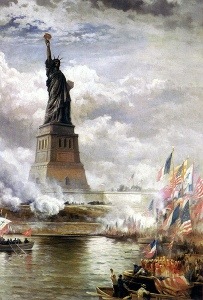
On this day in 1886, Pres. Cleveland dedicates the Statue of Liberty. The New York Times covered the ceremony:

The statue of Liberty yesterday was seen through a mist darkly. Piercing winds blew around Bedlow’s Island, and the numerous workmen, who were not in any way protected from the weather, worked uncomfortably. The speakers’ stand, and that for the use of musicians above it, were in readiness yesterday. Planks were removed and a semblance of tidiness was given to the island. A big barge, which looked extremely dismal, with its legend in red characters, “Eat, drink, and be merry,” stood at the Bedlow’s Island dock to land visitors. It will be used for that purpose this afternoon.

20131027-210709.jpg
Statue of Liberty unveiled, by Edward Moran.

Sadly, the public could not attend the event on the island:

No members of the general public were permitted on the island during the ceremonies, which were reserved entirely for dignitaries. The only females granted access were Bartholdi’s wife and de Lesseps’s granddaughter; officials stated that they feared women might be injured in the crush of people. The restriction offended area suffragists, who chartered a boat and got as close as they could to the island. The group’s leaders made speeches applauding the embodiment of Liberty as a woman and advocating women’s right to vote.[98] A scheduled fireworks display was postponed until November 1 because of poor weather.[100]

On this day in 1936, a vice-presidential candidate argues against the practices of his era:

1936 – Vice Presidential Candidate Stumps in Janesville
On this date, during a whistlestop speech in Janesville, Republican Vice Presidential candidate Frank W. Knox charged the FDR Administration with corruption and cronyism in an impassioned campaign speech to approximately 1,100 residents. [Source: Janesville Gazette 10/28/1936, p.1]

Scientific American‘s daily trivia question asks about hurricanes. (Clicking on the question leads to its answer.)

During what months does the North Atlantic hurricane season run?

Daily Bread for 10.27.13

Good morning.

We’ll have a sunny day with a high of fifty-six, and southwest winds of 5 to 15 mph.

Sometimes a hard call is still a correct and right one. Last night, in Game 3 of the World Series, third-base umpire Jim Joyce called Obstruction (Official Rules of Major League Baseball, Section 2.00 Definition of Terms) of on Boston’s Will Middlebrooks, and since Allen Craig was close at home anyway, the obstruction call gave the win to St. Louis, 5-4. So, for the first time in World Series history, a game was decided on an obstruction call.

There’s general agreement – although perhaps not as much in Boston – that the call was the right one. It was:

It ended on an obstruction call, and what appears, pretty much indisputably, to be a correct obstruction call, made by third-base umpire Jim Joyce on Red Sox third baseman Will Middlebrooks.

And here’s the most important thing you need to know about that call: It doesn’t matter if Middlebrooks intended to interfere with the Cardinals’ Allen Craig or not. Got that?

It. Doesn’t. Matter.

It doesn’t matter that Middlebrooks was just doing everything he could to catch an uncatchable throw to third by catcher Jarrod Saltalamacchia.

It doesn’t matter that that throw led Middlebrooks right into the runner, and that it was basically unavoidable that he found himself lying in the dirt, flat on his belly, as Craig was trying to scramble to his feet and race home.

Here, the umpires explain the call:

Baseball is an old and established sport, but that doesn’t mean there aren’t new things to see. There are – every night, and especially on a night like last night.

Daily Bread for 10.26.13

Good morning.

Saturday in Whitewater will be a day of partly sunny skies, a high of fifty, and winds of 15 to 20 mph.

Perhaps, for Halloween, you’d like to design some unusual graphics, of strange and imaginary creatures. Mashable has tips on how to Photoshop ordinary animal photos into ones of imaginary animals: How to Photoshop Hybrid Animals. (One doesn’t need Photoshop; other photo-editing programs have similar features. They’ve an accompanying link to the 9 Best Free Image Editors.)

When you’re done, you could have hybrid like this Corgi-Sloth from Mashable:

sloth-corgi

It’s the anniversary of a famous gunfight:

On this day in 1881, the Earp brothers face off against the Clanton-McLaury gang in a legendary shootout at the OK Corral in Tombstone, Arizona…

Around 3 p.m., the Earps and Holliday spotted the five members of the Clanton-McLaury gang in a vacant lot behind the OK Corral, at the end of Fremont Street. The famous gunfight that ensued lasted all of 30 seconds, and around 30 shots were fired. Though it’s still debated who fired the first shot, most reports say that the shootout began when Virgil Earp pulled out his revolver and shot Billy Clanton point-blank in the chest, while Doc Holliday fired a shotgun blast at Tom McLaury’s chest. Though Wyatt Earp wounded Frank McLaury with a shot in the stomach, Frank managed to get off a few shots before collapsing, as did Billy Clanton. When the dust cleared, Billy Clanton and the McLaury brothers were dead, and Virgil and Morgan Earp and Doc Holliday were wounded. Ike Clanton and Claiborne had run for the hills.

Sheriff John Behan of Cochise County, who witnessed the shootout, charged the Earps and Holliday with murder. A month later, however, a Tombstone judge found the men not guilty, ruling that they were “fully justified in committing these homicides.” The famous shootout has been immortalized in many movies, including Frontier Marshal (1939), Gunfight at the OK Corral (1957), Tombstone (1993) and Wyatt Earp (1994).

Poverty in Our Area

Using data from the U.S. Census Bureau’s Small Area Income and Poverty Estimates, for children aged 5 to 17 in families in poverty, rate as a percentage of all children that age:

Delavan-Darien Edgerton Elkhorn Area Fort Atkinson Jefferson Milton Whitewater Area
2007 10.98 7.10 11.60 7.01 8.05 5.4 9.89
2008 11.90 8.22 15.28 8.78 8.62 5.71 10.54
2009 15.43 9.29 15.21 11.39 10.1 6.65 14.22
2010 22.17 9.62 9.71 13.79 12.28 8.94 16.29
2011 19.46 9.33 10.80 13.52 12.13 7.83 17.9
Change +77.2% +31.4% -9.31% +92.8% +50.7% +45% +81%

Quick Notes:

  1. Communities measured are school districts.
  2. Same standard is applied to each community, for each year.
  3. 2011 is latest year available.
  4. Date range immediately precedes and follows the Great Recession.
  5. All communities but two see a rate decline from 2010 to 2011 (even if slight) in child poverty after the recession ends.  Only Elkhorn and Whitewater do not see a lessening in the rate; of those two cities,  Whitewater is higher in 2011 over 2007 while Elkhorn’s 2011 rate is lower than her 2007 rate.  Only Whitewater increases each year.
  6. The data above are poverty data (that is, a dire category of deprivation). The same Whitewater area also suffers, among children aged 5 to 17, economic disadvantage amounting to 44% of all such school-age children.

Monday: Assessing the Poverty Data for Our Area.

Daily Bread for 10.25.13

Good morning.

The works week ends with a sunny Friday and a high of forty-six.

On October 25, 1774, America tries to be reasonable:

On this day in 1774, the First Continental Congress sends a respectful petition to King George III to inform his majesty that if it had not been for the acts of oppression forced upon the colonies by the British Parliament, the American people would be standing behind British rule.

Despite the anger that the American public felt towards the United Kingdom after the British Parliament established the Coercive Acts—called the Intolerable Acts by the colonists—Congress was still willing to assert its loyalty to the king. In return for this loyalty, Congress asked the king to address and resolve the specific grievances of the colonies. The petition, written by Continental Congressman John Dickinson, laid out what Congress felt was undo oppression of the colonies by the British Parliament. Their grievances mainly had to do with the Coercive Acts, a series of four acts that were established to punish colonists and to restore order in Massachusetts following the Boston Tea Party.

On October 25, 1836, a first for the Wisconsin territory:

1836 – Belmont-Wisconsin Territory 1836 Established
On this date the first legislative session of the Wisconsin territory convened in Belmont, Wisconsin. During this first session, forty-two laws were put in the statute books. At this time, the Territory of Wisconsin included all of present-day Wisconsin, Minnesota, Iowa, and part of the two Dakotas.

Scientific American‘s daily trivia question asks about tornadoes. (Clicking on the question leads to its answer.)
How many categories of tornado exist, according to the Fujita Scale?

The Secret Features of OS X Mavericks

Most Mac users have available to them a free update to OS X, named Mavericks. (Inexplicably, they’ve stopped naming new versions of OS X after cats.)

Lifehacker offers a video with information on features of Mavericks about which OS X users might not otherwise be aware.