
Contre temps from Contre temps Team on Vimeo.
Daily Bread
Daily Bread for 8.6.13
by JOHN ADAMS •
Good morning.
We’ll have a partly sunny day with a high of eighty-three.
Common Council meets today at 6:30 PM.
On this day in 1945, fewer than fours years after the Japanese attack on Pearl Harbor, America bombs Hiroshima:
…at 8:16 a.m. Japanese time, an American B-29 bomber, the Enola Gay, drops the world’s first atom bomb, over the city of Hiroshima. Approximately 80,000 people are killed as a direct result of the blast, and another 35,000 are injured. At least another 60,000 would be dead by the end of the year from the effects of the fallout.
U.S. President Harry S. Truman, discouraged by the Japanese response to the Potsdam Conference’s demand for unconditional surrender, made the decision to use the atom bomb to end the war in order to prevent what he predicted would be a much greater loss of life were the United States to invade the Japanese mainland. And so on August 5, while a “conventional” bombing of Japan was underway, “Little Boy,” (the nickname for one of two atom bombs available for use against Japan), was loaded onto Lt. Col. Paul W. Tibbets’ plane on Tinian Island in the Marianas. Tibbets’ B-29, named the Enola Gay after his mother, left the island at 2:45 a.m. on August 6. Five and a half hours later, “Little Boy” was dropped, exploding 1,900 feet over a hospital and unleashing the equivalent of 12,500 tons of TNT. The bomb had several inscriptions scribbled on its shell, one of which read “Greetings to the Emperor from the men of the Indianapolis” (the ship that transported the bomb to the Marianas).
Puzzability‘s new series this week is about mythology:
Myth Takes
For this week of freaks and Greeks, we started each day with a mythical creature. Then we hid it in a sentence, with spaces added as necessary. The answer spans at least two words in the sentence and starts and ends in the middle of words. The day’s clue gives the sentence with a Greek column in place of the creature.
Example:
I am not rising from this comfortable so til I’ve finished this fascinating myth about the early days of Mt. Olympus.
Answer:
Faun (sofa until)
What to Submit:
Submit the mythical creature (as “Faun” in the example) for your answer.
Tuesday, August 6:
The preac
Music
Monday Music: Bebel Gilberto, August Day Song
by JOHN ADAMS •
Recent Tweets, 7.28 to 8.3
by JOHN ADAMS •
Sounding the alarm: Vocal NSA critic Sen. Ron Wyden | Ars Technica http://t.co/5VCwqiAH5I
— John Adams (@DailyAdams) August 2, 2013
FBI Taps Hacker Tactics to Spy on Suspects – http://t.co/IUaAdAoWUG http://t.co/WNIBr6uPP1
— John Adams (@DailyAdams) August 2, 2013
"Traffic Camera Firms Crop Photos, Reposition Cameras to Make Appeals More Difficult" http://t.co/ZlN6S0dOxS
— John Adams (@DailyAdams) August 1, 2013
XKeyscore: NSA tool collects 'nearly everything a user does on the internet' | http://t.co/K1OyFre7eP http://t.co/Py72z0WQ7s
— John Adams (@DailyAdams) August 1, 2013
Perhaps they'll stay – “@TheAtlanticWire: Obama Would Like McCain and Graham to Go to Egypt http://t.co/f2SEcGSAba”
— John Adams (@DailyAdams) July 31, 2013
William Gibson!! What science fiction author best describes the world we live in now? http://t.co/wsiVmtnHBt
— John Adams (@DailyAdams) July 31, 2013
Feral cats attack French woman and her poodle – The Independent http://t.co/Oio0PIN3a8
— John Adams (@DailyAdams) July 28, 2013
Public Meetings
School Board
by JOHN ADAMS •
Daily Bread
Daily Bread for 8.5.13
by JOHN ADAMS •
Good morning.
Whitewater will have a Monday of showers with a high of seventy-one.
The School Board meets tonight, first in closed session at 6 PM and later to open session.
On this day in 1914, a new method of traffic regulation:
The world’s first electric traffic signal is put into place on the corner of Euclid Avenue and East 105th Street in Cleveland, Ohio, on this day in 1914….
Various competing claims exist as to who was responsible for the world’s first traffic signal. A device installed in London in 1868 featured two semaphore arms that extended horizontally to signal “stop” and at a 45-degree angle to signal “caution.” In 1912, a Salt Lake City, Utah, police officer named Lester Wire mounted a handmade wooden box with colored red and green lights on a pole, with the wires attached to overhead trolley and light wires. Most prominently, the inventor Garrett Morgan has been given credit for having invented the traffic signal based on his T-shaped design, patented in 1923 and later reportedly sold to General Electric.
Despite Morgan’s greater visibility, the system installed in Cleveland on August 5, 1914, is widely regarded as the first electric traffic signal. Based on a design by James Hoge, who received U.S. patent 1,251,666 for his “Municipal Traffic Control System” in 1918, it consisted of four pairs of red and green lights that served as stop-go indicators, each mounted on a corner post. Wired to a manually operated switch inside a control booth, the system was configured so that conflicting signals were impossible. According to an article in The Motorist, published by the Cleveland Automobile Club in August 1914: “This system is, perhaps, destined to revolutionize the handling of traffic in congested city streets and should be seriously considered by traffic committees for general adoption.”
On this day in 1850, Wisconsin gets a new fraternal organization:
1850 – Order of the Druids Organized in Milwaukee
On this date the Order of the Druids was organized in Milwaukee. One of the oldest fraternal organizations in Wisconsin, Wisconsin Grove No. 1 was organized by charter members A.F. Hausemann, H.M. Brietz, Joseph Lachner, and G.F. Becker. The order offered benefits and insurance for its members. [Source: History of Milwaukee, Vol.II, by William George Bruce, p.285]
Puzzability‘s new series this week is about mythology:
Myth Takes
For this week of freaks and Greeks, we started each day with a mythical creature. Then we hid it in a sentence, with spaces added as necessary. The answer spans at least two words in the sentence and starts and ends in the middle of words. The day’s clue gives the sentence with a Greek column in place of the creature.
Example:
I am not rising from this comfortable sotil I’ve finished this fascinating myth about the early days of Mt. Olympus.
Answer:
Faun (sofa until)
What to Submit:
Submit the mythical creature (as “Faun” in the example) for your answer.
Monday, August 5:
Some people called Zeu
Cartoons & Comics
Sunday Morning Cartoon: The Origins of Daffy Duck
by JOHN ADAMS •
Daily Bread
Daily Bread for 8.4.13
by JOHN ADAMS •
Good morning.
We’ll have a mostly sunny day in Whitewater, with a high of seventy-five.
NASA’s Jet Propulsion Laboratory offers a video if the Mars Curiosity lander’s first year on that planet, distilled into two minutes’ time:
On this day in 1753, George Washington advances in Freemasonry:
…21-year-old Virginian George Washington is declared a Master Mason in a Masonic ritual performed by his fellow Freemasons during a secret ceremony in Fredericksburg, Virginia. Washington, who belonged to Alexandria Lodge No. 22, had been initiated into the Masons at age 20 on November 4, 1752. The following year, on March 3, 1753, he passed as a “Fellow Craft.” Five months later, Washington was raised to the rank of Master Mason.
On August 4, 1862, Wisconsin sees riots against a federal order:
1862 – War Department Order Prompts Riot
On this date the War Department issued General Order No.99, requesting by draft 300,000 troops to reinforce the Union armies in the Civil War. This action reinforced public sentiment against the draft and prompted the citizens in Port Washington, Ozaukee County to riot in protest.
Daily Bread
Daily Bread for 8.3.13
by JOHN ADAMS •
Good morning.
Whitewater will have a sunny Saturday, with a high of seventy-six and northwest winds at 5 to 10 MPH.
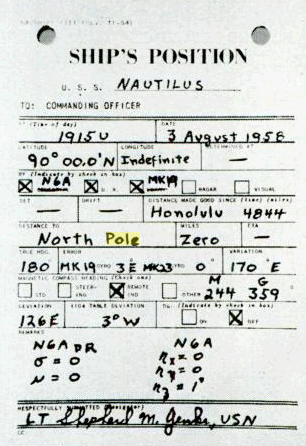
On this day in 1958, a remarkable vessel takes a remarkable trip:
On August 3, 1958, the U.S. nuclear submarine Nautilus accomplishes the first undersea voyage to the geographic North Pole. The world’s first nuclear submarine, the Nautilus dived at Point Barrow, Alaska, and traveled nearly 1,000 miles under the Arctic ice cap to reach the top of the world. It then steamed on to Iceland, pioneering a new and shorter route from the Pacific to the Atlantic and Europe.
The USS Nautilus was constructed under the direction of U.S. Navy Captain Hyman G. Rickover, a brilliant Russian-born engineer who joined the U.S. atomic program in 1946. In 1947, he was put in charge of the navy’s nuclear-propulsion program and began work on an atomic submarine. Regarded as a fanatic by his detractors, Rickover succeeded in developing and delivering the world’s first nuclear submarine years ahead of schedule. In 1952, the Nautilus’ keel was laid by President Harry S. Truman, and on January 21, 1954, first lady Mamie Eisenhower broke a bottle of champagne across its bow as it was launched into the Thames River at Groton, Connecticut. Commissioned on September 30, 1954, it first ran under nuclear power on the morning of January 17, 1955.
Public Meetings
Common Council
by JOHN ADAMS •
City, Development, Government Spending, Local Government, New Whitewater, Planning, Politics, Taxes/Taxation
A Review of Whitewater’s Economy is Like Peeling an Artichoke
by JOHN ADAMS •

Artichokes, of course, symbolize the idea of multi-layered things, of peeling back an exterior to discover an interior truth.
Whitewater’s economy is like that – one needs to peel away layer upon layer of happy-talk headlines to address the truth of our present condition. (In a way, the only indubitable success those headlines assure is the continued employment of press-agent reporters and incumbent bureaucrats.)
A traditional presentation in town might start with how wonderful something might be, but place costs, difficulties, etc., only deeper inside, where those critical facts would be obscured and (it might be hoped) forever ignored.
There’s a more reasonable order through which to consider policy in town: begin with our actual conditions, assess previous policies designed to address those conditions, assess whether those policies have been effective, thereafter suggesting either more of the same or, if necessary, something different.
It’s quite the task, both because a good amount of policy in Whitewater seems to end with headlines themselves, deeper and disappointing layers of the municipal artichoke being obscured, and because actual policies are less often self-contradictory or jumbled in odd ways.
It’s a worthwhile project this August to consider (1) the economy of the city, (2) the policies meant to advance that economy, (3) a how those policies have fared (a comparison of claims and results), and (4) what that comparison suggests about effective future policies.
Working though an outline for a series of posts along these lines, one point seems to stand out: major municipal projects in this city often depend on the fiscal account rather than as truly shared public-private ventures.
(An approach like this might seem to be the same as the principle behind tax incremental financing, but it differs in relative public-private share, guarantees of private investment, and suitability for areas outside of those truly blighted parts of the city. If anything, I think one can show that it’s a misunderstanding writ large of the supposed principles underlying tax incremental financing).
This underlying misunderstanding also explains the operative motivation behind a land sale from the city to the Community Development Authority.
Lots to consider, but easily worth pondering. I’m an optimist about the longterm future of the city, and am convinced that looking closely advances good policy.
Cats
Friday Catblogging: Bandit!
by JOHN ADAMS •
Poll
Friday Poll – Restaurant Whistleblowing: Good or Bad Tactic?
by JOHN ADAMS •
Yesterday I posted about a worker at a Golden Corral who recorded and published to YouTube a video with accusations about conditions at his Florida employer’s restaurant. I wrote that videos of this kind were a force for good. The video and a poll appear below. What do you think?
Two quick notes: 1. I’ve never eaten at a Golden Corral and wouldn’t have been inclined to do so, even before the video. 2. Today’s poll is simply about this incidents like this, generally – I neither have nor would expect a similar video to appear about a local establishment. Today’s poll doesn’t imply a local revelation.
Daily Bread
Daily Bread for 8.2.13
by JOHN ADAMS •
Good morning.
Whitewater will have a partly cloudy day with a slight chance of thunderstorms and a high of eighty.
On this day in 1990, Iraq invades Kuwait:
At about 2 a.m. local time, Iraqi forces invade Kuwait, Iraq’s tiny, oil-rich neighbor. Kuwait’s defense forces were rapidly overwhelmed, and those that were not destroyed retreated to Saudi Arabia. The emir of Kuwait, his family, and other government leaders fled to Saudi Arabia, and within hours Kuwait City had been captured and the Iraqis had established a provincial government. By annexing Kuwait, Iraq gained control of 20 percent of the world’s oil reserves and, for the first time, a substantial coastline on the Persian Gulf. The same day, the United Nations Security Council unanimously denounced the invasion and demanded Iraq’s immediate withdrawal from Kuwait. On August 6, the Security Council imposed a worldwide ban on trade with Iraq.
On this day in 1832, the Black Hawk War ends:
1832 – Black Hawk War Ends
On this date the defeat of Black Hawk and his followers at the Battle of Bad Axe, ended the Black Hawk War. Black Hawk led the American troops northward while the rest of the Indians constructed rafts and canoes to facilitate an escape over the Mississippi river. The plan was successful initially but eventually General Atkinson realized the ruse. In the battle, women, children and the elderly hid behind rocks and logs and American soldiers often could not or did not differentiate between warriors and the women and children. Atkinson sent Wabasha and his Sioux warriors, enemies of the Sauk, after the approximately 150 members of the British Band that made it to the Western bank of the Mississippi. The Sauk, “escaped the best they could, and dispersed”, but only 22 women and childern were spared. Black Hawk escaped, but the Battle of Bad Axe marked the end of the war. [Source: Along the Black Hawk Trail by William F. Stark, p.142-153]
Puzzability‘s Last Laughs series ends today:
Last Laughs
For your amusement this week, we started each day with the name of a TV star who won an Emmy for his or her lead performance in a comedy series. Then we replaced all the letters in each word—except the last letter—with asterisks.
Example:
***Y ****R ****E
Answer:
Mary Tyler Moore
Here’s Friday’s puzzle:
******Y ***G