FREE WHITEWATER

A Different Kind of (Restaurant) Review

Earlier this month, an employee of a Florida Golden Corral named Brandon Huber posted a video in which he contends that his restaurant was improperly storing food. (The restaurant owner, Eric Holm, has disputed many of the contentions against his establishment, and derided Huber’s motivation as a mercenary one.)

Huber’s video (one of several he recorded) appears below. Setting aside the veracity of his claims, one is still left with a question about these means: one can use YouTube to take a complaint, literally, to millions of viewers.

Whistleblower tactics have this advantage: more people learn of a contention, arguably more quickly, without the need to trust that a health inspector will act or act quickly on the public’s behalf.

Disappointment over public officials’ laziness, indifference, or coziness toward the vendors to whom they should be impartial matters less when one can bypass those unworthy officials and take one’s case directly to a community.

Foul establishments cannot assume that simply hiding misconduct from patrons, or greasing a health inspector’s palm, will conceal their misconduct when any of the employees on whom the business depends may become a whistleblower.

Daily Bread for 8.1.13

Good morning.

We’ll have a sunny Thursday in Whitewater, with a high of eighty.

Whitewater’s Landmarks Commission meets this evening at 6 PM.

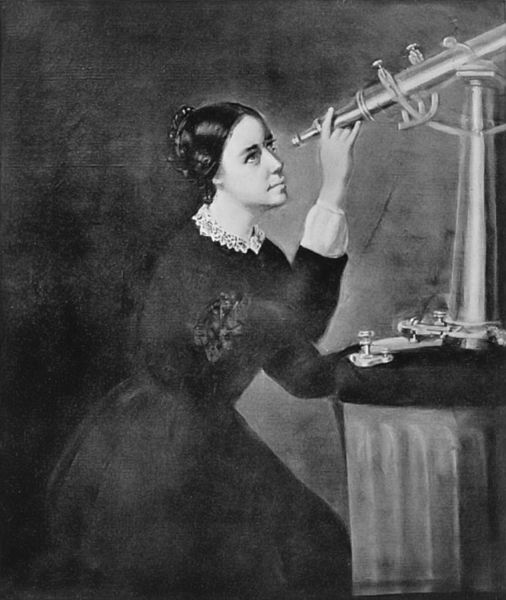
506px-Maria_Mitchell

Maria Mitchell, painting by H. Dasell, 1851

It’s the anniversary today, from 1818, of the birthday of America’s first professional woman in astronomy, Maria Mitchell:

Maria Mitchell (August 1, 1818 – June 28, 1889)…was an American astronomer, who in 1847, by using a telescope, discovered a comet which as a result became known as “Miss Mitchell’s Comet”. She won a gold medal prize for her discovery which was presented to her by King Frederick VII of Denmark. The medal said “Not in vain do we watch the setting and rising of the stars”. Mitchell was the first American woman to work as a professional astronomer.

On this day in 1832, Black Hawk’s escape fails:

1832 – Black Hawk’s Escape Across Mississippi Blocked
On this date the armed steamboat the Warrior reached the British Band on the Mississippi where they hoped to cross the river and escape the American troops. After being guided by a Sioux Indian, the ship which held an artillery piece, dropped anchor, making the Sauk escape virtually impossible. Black Hawk attempted to surrender to the Warrior, waving a white cloth, but the crew either did not understand or did not accept the message. The ship and its men opened fire, killing a number of unprepared Indians. [Source: Along the Black Hawk Trail by William F. Stark, p. 140-141]

Puzzability has a series this week, from 7.29 to 8.2, entitled Last Laughs:

Last Laughs

For your amusement this week, we started each day with the name of a TV star who won an Emmy for his or her lead performance in a comedy series. Then we replaced all the letters in each word—except the last letter—with asterisks.

Example:
***Y ****R ****E

Answer:
Mary Tyler Moore

Here’s Thursday’s puzzle:

**A *****R

Daily Bread for 7.31.13

Good morning.

We’ll have a one-third chance of afternoon thunderstorms this Wednesday, and a high of seventy-seven.

July 31, 1777, a young French aristocrat begins serving America without compensation:

On this day in 1777, a 19-year-old French aristocrat, Marie-Joseph Paul Roch Yves Gilbert du Motier, Marquis de Lafayette, accepts a commission as a major-general in the Continental Army—without pay.

Lafayette served at Brandywine in 1777, as well as Barren Hill, Monmouth and Rhode Island in 1778. Following the formal treaty of alliance with Lafayette’s native France in February 1778 and Britain’s subsequent declaration of war, Lafayette asked to return to Paris and consult the king as to his future service. Washington was willing to spare Lafayette, who departed in January 1779. By March, Franklin reported from Paris that Lafayette had become an excellent advocate for the American cause at the French court. Following his six-month respite in France, Lafayette returned to aid the American war effort in Virginia, where he participated in the successful siege of Yorktown in 1781, before returning to France and the further service of his own country.

On this day in 1967, Lake Geneva’s local government, having no more immediate work before them, decided to strike a blow in defense of Western Civilization:

1967 – Lake Geneva Bans Go-Go Girls
On this date the Lake Geneva city government passed an ordinance banning go-go girls, dancers in bikinis, and swimsuit-clad waitresses from working in establishments that served alcohol. [Source: Janesville Gazette]

Puzzability has a series this week, from 7.29 to 8.2, entitled Last Laughs:

Last Laughs

For your amusement this week, we started each day with the name of a TV star who won an Emmy for his or her lead performance in a comedy series. Then we replaced all the letters in each word—except the last letter—with asterisks.

Example:
***Y ****R ****E

Answer:
Mary Tyler Moore

Here’s Wednesday’s puzzle:

***N ***A

Local News

There’s a paywall up at Janesville’s GazetteXtra.com, with some content available for free, but much more local news now behind a paywall. I’ve no idea whether their effort will be a success, and the best one can say is that it will be tough going. Everyone at the paper surely sees that.

In the end, though, it’s not ‘local news,’ but local news in which the press scrutinizes local government, that truly matters. Print’s dying, and is so ill that it believes itself even too weak to reach for restorative medicine.

That medicine, of course, is news that scrutinizes politics and politicians, that speaks truth to political power.

News should mean more than reworked press releases, government-drafted announcements, dull recitations of facts, and obituaries.

Perhaps someone from print will summon the strength and will to extend an atrophied arm toward the nightstand, and grasp the medicine that offers, as it always has during centuries of liberty on this continent, a dependable cure.

But if not, and if every established print publication (and similar online ones) should succumb to the malady of servility, then the rest of us will go on, using new media to express and defend that centuries-long heritage (each in our own small, but sincere, way).

America will be just fine, with her best yet ahead.

Daily Bread for 7.30.13

Good morning.

We’ll have a high of seventy-four with a thirty percent chance of showers today.

On this day in 1863, Henry Ford is born. Upon his death eighty-three years later, the New York Times wrote of him that

Henry Ford was the founder of modern American industrial mass production methods, built on the assembly line and the belt conveyor system, which no less an authority than Marshal Josef Stalin testified were the indispensable foundation for an Allied military victory in the Second World War.

Mr. Ford had many other distinctions. As the founder and unchallenged master of an industrial empire with assets of more than a billion dollars, he was one of the richest men in the world. He was the apostle of an economic philosophy of high wages and short hours that had immense repercussions on American thinking. He was a patron of American folkways and in later years acquired a reputation as a shrewd, kindly sage. But these were all relatively minor compared with the revolutionary importance of his contribution to modern productive processes.

In Wisconsin history, economist Thorstein Veblen is born:

1857 – Thorstein Veblen Born
On this date economist and social commentator Thorstein Bunde Veblen was born in Cato, although some sources place his birth in Valders. He is best known for his book The Theory of The Leisure Class (1899), a classic of social theory that introduced the concept of “conspicuous consumption.” [Source: The Radical Academy]

Puzzability has a series this week, from 7.29 to 8.2, entitled Last Laughs:

Last Laughs

For your amusement this week, we started each day with the name of a TV star who won an Emmy for his or her lead performance in a comedy series. Then we replaced all the letters in each word—except the last letter—with asterisks.

Example:
***Y ****R ****E

Answer:
Mary Tyler Moore

Here’s Tuesday’s puzzle:

***A **Y

The Rolled-Up Newspaper

I was in a Whitewater establishment on Saturday, one that has hundreds of customers a day. On a counter easily visible to patrons sat a two-day-old newspaper, still unrolled and fastened with a rubber band just as when it had been first delivered.

Perhaps someone only delivered Thursday’s paper on Saturday, or – alternatively – no one cared to open Thursday’s paper as it sat unread for two days’ time.

Neither possibility is comforting for print publishing, but I’d guess the worse one is true: the paper sat ignored for forty-eight hours.

There’s the state of print journalism (particularly for an afternoon daily).

Whatever the reason, this is where we are.

Daily Bread for 7.29.13

Good morning.

Monday in Whitewater will be mostly sunny with a high of seventy-five.

Whitewater’s Park & Rec Board meets at 4:30 PM this afternoon.

They’ve seen better days, and I think that the future of space travel will be mostly private flight, but it’s still a memorable date:

On this day in 1958, the U.S. Congress passes legislation establishing the National Aeronautics and Space Administration (NASA), a civilian agency responsible for coordinating America’s activities in space. NASA has since sponsored space expeditions, both human and mechanical, that have yielded vital information about the solar system and universe. It has also launched numerous earth-orbiting satellites that have been instrumental in everything from weather forecasting to navigation to global communications.

NASA was created in response to the Soviet Union’s October 4, 1957 launch of its first satellite, Sputnik I. The 183-pound, basketball-sized satellite orbited the earth in 98 minutes. The Sputnik launch caught Americans by surprise and sparked fears that the Soviets might also be capable of sending missiles with nuclear weapons from Europe to America. The United States prided itself on being at the forefront of technology, and, embarrassed, immediately began developing a response, signaling the start of the U.S.-Soviet space race.

Puzzability starts a new series this week, from 7.29 to 8.2, entitled Last Laughs:

Last Laughs

For your amusement this week, we started each day with the name of a TV star who won an Emmy for his or her lead performance in a comedy series. Then we replaced all the letters in each word—except the last letter—with asterisks.

Example:
***Y ****R ****E

Answer:
Mary Tyler Moore

Here’s Monday’s puzzle:

**Y *****O

Recent Tweets, 7.21 to 7.27

Daily Bread for 7.28.13

Good morning.

We’ve a high of sixty-four ahead today, with a forty-percent chance of morning showers.

On this day in 1914, Austria declares war on Serbia, a month after a Serbian nationalist killed Archduke Franz Ferdinand of Austria and his wife in Sarajevo. The New York Times reports the declaration:

VIENNA, July 28- Upon the issue of the formal declaration of war against Servia today Emperor Franz Josef gave orders for the removal of the Summer Court from Ischl to the capital. His entourage tried to persuade him that Vienna air would not suit him, but the aged Emperor replied:

“I do not want the air of Vienna. I want the atmosphere of headquarters.” The opening of the war has caused the imposition of all kinds of restrictions upon public business. All the railways, of course, are under military control, and the telegraphs are being reserved entirely for the service of the State. The hope is still entertained here that the war will be confined to Austria-Hungary and Servia. The report that Russia and France have intervened in Vienna is incorrect. In official circles here it is maintained that any action by those powers must be supported by the third party to the Triple Entente, namely, Great Britain. It is known that Great Britain and France do not want a European war. Peace among the great powers or war among the great powers must depend on the action of St. Petersburg.

In 1934, a riot kills two in a so-called model Wisconsin village:

1934 – Two killed, 40 hurt in Kohler riot; National Guard occupies town

On this day, the “model industrial village” of Kohler became an armed camp of National Guard cavalrymen after deadly strike-related rioting. The July 27th violence, which killed two Sheboygan men and injured 40 others, prompted the summoning of 250 Guardsmen to join the 200 special deputy village marshals already present.

After striking workers became agitated and began to destroy company property, deputies turned to tear gas, rifles, and shotguns to quell the stone-throwing crowd, resulting in the deaths and injuries. Owner Walter Kohler blamed Communists and outside agitators for the violence, while union leaders blamed Kohler exclusively.

Workers at the Kohler plant were demanding better hours, higher wages, and recognition of the American Federation of Labor as their collective bargaining agent. Not settled until 1941, the strike marked the beginning of what was to become a prolonged struggle between the Kohler Company and organized labor in Wisconsin; a second Kohler strike lasted from 1954 to 1965. [Source: Capital Times 7/28/1934, p.1]