
A shivering blue bird wants to get some heat from a sleepy porcupine…
Pig Box from David Chao on Vimeo.
A shivering blue bird wants to get some heat from a sleepy porcupine…
Pig Box from David Chao on Vimeo.
Good morning.
Sunday brings partly cloudy skies, and a high of sixty-seven, to Whitewater.
On this day in 1927, it’s the last day of a production run (1908-1927) at Ford Motor Company:
…Henry Ford and his son Edsel drive the 15 millionth Model T Ford out of their factory, marking the famous automobile’s official last day of production.
More than any other vehicle, the relatively affordable and efficient Model T was responsible for accelerating the automobile’s introduction into American society during the first quarter of the 20th century. Introduced in October 1908, the Model T—also known as the “Tin Lizzie”—weighed some 1,200 pounds, with a 20-horsepower, four-cylinder engine. It got about 13 to 21 miles per gallon of gasoline and could travel up to 45 mph. Initially selling for around $850 (around $20,000 in today’s dollars), the Model T would later sell for as little as $260 (around $6,000 today) for the basic no-extras model.
Google’s daily question asks about mythology: “Ancient myth believed that beneath Mount Etna a mighty giant was buried. Who was believed to have hurled this giant from heaven?”
Good morning.
We’ll have a high of fifty-nine and a one-third chance of showers for Saturday. Sunrise was at 5:23 AM, and sunset will be at 8:21 PM. Moonrise is at 9:08 PM, with a waning gibbous moon having 100% of the its visible disk illuminated.
On this day in 1977, Star Wars opens:
The incredible success of Star Wars–it received seven Oscars, and earned $461 million in U.S. ticket sales and a gross of close to $800 million worldwide–began with an extensive, coordinated marketing push by Lucas and his studio, 20th Century Fox, months before the movie’s release date. “It wasn’t like a movie opening,” actress Carrie Fisher, who played rebel leader Princess Leia, later told Time magazine. “It was like an earthquake.” Beginning with–in Fisher’s words–“a new order of geeks, enthusiastic young people with sleeping bags,” the anticipation of a revolutionary movie-watching experience spread like wildfire, causing long lines in front of movie theaters across the country and around the world.
The trailer’s a true curiosity, but it’s stilted compared to the film, and misstates the setting of the film’s events, ones that took place “A long time ago in a galaxy far, far away….”
Google-a-Day asks about a musical: “What musical made its world premiere in October 1986, at 57 Haymarket, London SW1Y 4QL?”
Robert Krulwich compares the drinking techniques of cats, dogs, and pigeons. Looking at high-speed videos of dogs and cats, he concludes that cats drink more efficiently than dogs, but that a group of pigeons beats both mammals:
Say what you will about sloppy dogs or elegant cats, these three [pigeons of Brisbane, Australia] are the Plato, Aristotle and Socrates of the drinking world. Send them to a diner. I bet they’d soon be sucking on straws.
See, Who’s The Best Drinker? Dogs? Cats? Or Pigeons? : Krulwich Wonders… : NPR. (Videos of canine & feline drinking techniques included.)
Singer Jacqueline Simpson is suing McDonald’s for injury to her voice after eating a McChicken sandwich that she claims had a piece of glass in it. She now alleges that the glass damaged her voice, and her singing voice now sounds like a man’s, affecting her musical ambitions.
She’s upset:
“Now when I sing, I have a hoarse, rattly voice,” said Jacqueline Simpson, 52, who yesterday filed suit in Brooklyn Supreme Court. “I still sing alto, but I can’t sing soprano like I used to.”
Needless to say, a comedy news site quickly picked up on Simpson’s supposed injury:
Is Simpson a sympathetic victim, or gold-digging whiner? Admittedly, we don’t know what was in that McChicken sandwich, but then, does anyone really know what’s in one of them?
Go ahead: speculate away! My take — I’m suspicious that Simpson’s condition may actually be the result of one too many packs of unfiltered Lucky Strikes.
Good morning.
The end of the week, and beginning of our holiday weekend, brings sunny skies and a high of fifty-nine. It’s sunset at 8:20 p.m. and the end of twilight at 8:54 p.m. We’ll have a full moon tonight at 11:26 p.m.
On this day in 1883, the Brooklyn Bridge was first opened to traffic.
Still beautiful:
Brooklyn Bridge from Danariza on Vimeo.
Google has a musical question for us: “What musical period is best described as an era of contrasts; e.g., between loud and soft, fast and slow?”

Good morning.
We’ll have a Thursday of morning showers and cool temperatures, with a high of fifty-nine, and north winds of 10 to 20 mph.
Whitewater’s Community Development Association meets today at 4:30 PM.
Google’s announced the winner of their Doodle 4 Google contest, and she’s Sarah Brady of Wisconsin, whose creation depicts a reunion during wartime:
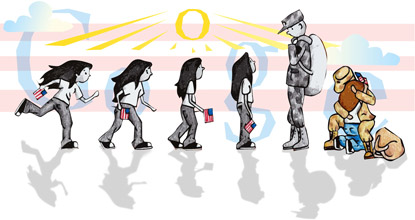
We’ll be far better off when American schoolchildren in Wisconsin or elsewhere no longer need to depict a parent’s return from combat as an answer to the theme, ‘My Best Day Ever.’
On 5.23.1934, two killers meet their end:
On this day in 1934, notorious criminals Bonnie Parker and Clyde Barrow are shot to death by Texas and Louisiana state police while driving a stolen car near Sailes, Louisiana….
Texan prison officials hired a retired Texas police officer, Captain Frank Hamer, as a special investigator to track down Parker and Barrow. After a three-month search, Hamer traced the couple to Louisiana, where Henry Methvin’s family lived. Before dawn on May 23, Hamer and a group of Louisiana and Texas lawmen hid in the bushes along a country road outside Sailes. When Parker and Barrow appeared, the officers opened fire, killing the couple instantly in a hail of bullets.
All told, the Barrow Gang was believed responsible for the deaths of 13 people, including nine police officers.
In 1854, a Wisconsin milestone:
1854 – First Railroad Reaches Madison
On this date the Milwaukee and Mississippi railroad reached Madison, connecting the city with Milwaukee. When the cars pulled into the depot, thousands of people gathered to witness the ceremonial arrival of the first train, and an enormous picnic was held on the Capitol grounds for all the passengers who’d made the seven-hour trip from Milwaukee to inaugurate the line. [Source: Waukesha Chronicle, May 24, 1854; Wisconsin State Journal, June 1, 1924]
Google-a-Day asks a science (and crime) question: “What new malware hacked 45,000 Facebook accounts early in January 2012?”
Good morning.
Midweek in Whitewater brings a near certainty of showers, and a high near 65. Rainfall will amount to between a quarter and half of an inch.
Downtown Whitewater meets this morning at 8 AM in the Discover Whitewater Conference Room (150 W. Main Street). Here’s that agenda:
Downtown Whitewater Inc. NEXT STEPS
Board of Director’s Meeting Wednesday, May 22, 2013, 8:00 am Discover Whitewater, Conference Room 150 W. Main Street, Whitewater, WI 53190
Agenda
- DTWW will offer thoughts on downtown first floor housing; ideally May 8
- Dave will draft an opinion on no first floor and circulate with board for approval. Pete will take survey back to ER.
- Pete will bring farmer’s market idea to ER.
- Tami will forward farmer’s market email to Pete, rest of board.
ACTION ITEMS
- Approval of agenda
- Approval of minutes from April 24, 2012
- DTWW checking accounts (Nate)
- Tax-free status (Dave)
DISCUSSION ITEMS
- President’s report
- Treasurer’s report
- Director’s report
- Update from strategic planning session (Roni)
- Pangea project (Tami)
- BID update (Nate)
- Main Street visit (Tami)
- Open Meetings Act (Dave)
COMMITTEE REPORTS
- Design (Dave)
- Organization (Kristine)
- Promotions (Tami)
- Economic Restructuring (Pete)
FUTURE AGENDA ITEMS
Next Board meeting: June 26, 2012, 8:00 am, Discover Whitewater, Conference Room
On this day in 1859, Sir Arthur Conan Doyle is born. He passed away in 1930 of a heart attack, and the New York Times published an obituary upon his death, seventy-one years later.
On 5.22.1968, the Milwaukee Bucks became the Milwaukee Bucks:
1968 – Milwaukee Bucks Named
On this date “Milwaukee Bucks” was selected as the franchise name after 14,000 fans participated in a team-naming contest. 45 people suggested the name, one of whom, R.D. Trebilcox, won a car for his efforts. [Source: NBA.com]
Google-a-Day asks a question about warfare: “What tactics did Germany use in France, forcing a desperate British withdrawal at Dunkirk?”
Good morning.
Tuesday in Whitewater will be partly sunny, with a slight chance of afternoon thunderstorms, and a high of eighty.
In the city today, the Bicycle & Pedestrian Committee meets at 5 PM, and Common Council at 6:30 PM.
On this day in 1881, the Red Cross comes to life:
In Washington, D.C., humanitarians Clara Barton and Adolphus Solomons found the American National Red Cross, an organization established to provide humanitarian aid to victims of wars and natural disasters in congruence with the International Red Cross.
Barton, born in Massachusetts in 1821, worked with the sick and wounded during the American Civil War and became known as the “Angel of the Battlefield” for her tireless dedication. In 1865, President Abraham Lincoln commissioned her to search for lost prisoners of war, and with the extensive records she had compiled during the war she succeeded in identifying thousands of the Union dead at the Andersonville prisoner-of-war camp.
She was in Europe in 1870 when the Franco-Prussian War broke out, and she went behind the German lines to work for the International Red Cross. In 1873, she returned to the United States, and four years later she organized an American branch of the International Red Cross. The American Red Cross received its first U.S. federal charter in 1900. Barton headed the organization into her 80s and died in 1912.
On this day in 1673, intrepid explorers push on:
1673 – Marquette and Joliet Reach the Menominee
On or about May 21, 1673, Fr. Jacques Marquette, fur-trader Louis Joliet, and five French voyageurs pulled into a Menominee community near modern Marinette, Mich. Marquette wrote that when the Menominee learned that he and Joliet intended to try to descend the Mississippi River all the way to the sea, “They were greatly surprised to hear it, and did their best to dissuade me. They represented to me that I should meet nations who never show mercy to strangers, but break their heads without any cause; and that war was kindled between various peoples who dwelt upon our route, which exposed us to the further manifest danger of being killed by the bands of warriors who are ever in the field. They also said that the great river was very dangerous, when one does not know the difficult places; that it was full of horrible monsters, which devoured men and canoes together; that there was even a demon, who was heard from a great distance, who barred the way, and swallowed up all who ventured to approach him; finally that the heat was so excessive in those countries that it would inevitably cause our death.”Read what Fr. Marquette said in reply, and follow the explorers down the Mississippi and back again on our pages devoted to Historic Diaries.
Google-a-Day asks about the inspiration behind a literary creation: “What was the middle name of the individual upon whom the fictional character Atticus Finch is based?”
One reads now and again of unruly, uncontrolled – dare one say raucous? – young people. Consider this heartfelt lament:
Furthermore, during the last thirty years customs have changed; now when young…get together, if there is not just talk about money matters, loss and gain, secrets, clothing styles, or matters of sex, there is no reason to gather together at all. Customs are going to pieces. One can say that formerly, when a man reached the age of twenty or thirty, he did not carry despicable things in his heart, and thus neither did such words appear. If an elder unwittingly said something of that sort, he thought of it as a sort of injury.
This new custom probably appears because people attach importance to being beautiful before society and to household finances. What things a person should be able to accomplish if he had no haughtiness concerning his place in society! It is a wretched thing that the young men of today are so contriving and so proud of their material possessions. Men with contriving hearts are lacking in duty. Lacking in duty, they will have no self-respect.
Do you find any of this a compelling description of our times? I’m not in the least convinced this applies to us, but then I’ve omitted one word from this complaint: samurai. The first line begins, in full, “Furthermore, during the last thirty years customs have changed; now when young samurai get together….” (Emphasis mine.)
Samurai’s in the original because the passage is one of the sayings of Yamamoto Tsunetomo, an early 18th century samurai (and later Buddhist priest). Hundreds of his observations form the Hagakure (Completed 1716).
If Tsunetomo’s concerns were somehow contemporary to you, then you’d be a three-centuries old Japanese man. If young people were truly that bad, back then, we’d have descended into utter ruin by now.
I well understand that young people might have been horrible three hundred years ago, improved since, and then regressed more recently, but I’m wholly unconvinced.
More likely, in each age, elderly and increasingly cranky men conclude, falsely, that the younger generation is going to seed, and there’s nothing to be done about it except complain.
The next time someone complains about youth run amok, and all society going to pot, remember that you’ve heard all this before…at least as far back as early eighteen-century Japan.
Cross-posted at Daily Adams.
Good morning.
Whitewater’s week begins with scattered showers and thunderstorms, partly sunny otherwise, with a high near 84, and south winds at 10 to 15 mph. There’s an even chance of rain.
The weather west of us has been far worse:
On 5.20.1873, a famous garment’s inventors receive a patent for their creation: “San Francisco businessman Levi Strauss and Reno, Nevada, tailor Jacob Davis are given a patent to create work pants reinforced with metal rivets, marking the birth of one of the world’s most famous garments: blue jeans.”
On this day in 1991, a treaty dispute between the Ojibwe and Wisconsin ends:
On this day, the 17-year legal battle between Ojibwe Indians and the State of Wisconsin over 19th-century treaties involving rights to hunt, fish, and gather timber was put to rest. Dating from 1974, the suit originated after two Ojibwa were cited for spearfishing in off-reservation waters, and led to numerous racially-charged confrontations when subsequent court decisions validated Ojibwe spearfishing rights.
The court rulings split resources evenly between the Ojibwe and non-Indians, and rejected Ojibwe claims for money to compensate them for years of denial of their treaty rights. The chairmen of six Lake Superior Ojibwe bands explained the decision not to appeal as “a gesture of peace and friendship toward the people of Wisconsin,” while Wisconsin Attorney General James Doyle cited the risk of jeopardizing the state’s “many significant victories” in the battle if the state were to press forward. The history of treaty negotiations in Wisconsin, including the texts of all treaties and contemporary accounts by both Indian and white participants, are on the Treaty Councils page of Turning Points in Wisconsin History.[Source: Capital Times 5/20/1991, p.1]
Google’s looking for a name: “What is another name for the hourly time signal or GTS first broadcast by the RGO in 1924?”