FREE WHITEWATER

Daily Bread for 5.31.13

Good morning.

Whitewater’s month ends with a likelihood of afternoon thunderstorms and a high of eighty.

On this day in 1859, a prominent part of the British architectural scene goes into operation:

The famous tower clock known as Big Ben, located at the top of the 320-foot-high St. Stephen’s Tower, rings out over the Houses of Parliament in Westminster, London, for the first time on this day in 1859.

After a fire destroyed much of the Palace of Westminster–the headquarters of the British Parliament–in October 1834, a standout feature of the design for the new palace was a large clock atop a tower. The royal astronomer, Sir George Airy, wanted the clock to have pinpoint accuracy, including twice-a-day checks with the Royal Greenwich Observatory. While many clockmakers dismissed this goal as impossible, Airy counted on the help of Edmund Beckett Denison, a formidable barrister known for his expertise in horology, or the science of measuring time.

Denison’s design, built by the company E.J. Dent & Co., was completed in 1854; five years later, St. Stephen’s Tower itself was finished. Weighing in at more than 13 tons, its massive bell was dragged to the tower through the streets of London by a team of 16 horses, to the cheers of onlookers. Once it was installed, Big Ben struck its first chimes on May 31, 1859….

The name “Big Ben” originally just applied to the bell but later came to refer to the clock itself. Two main stories exist about how Big Ben got its name. Many claim it was named after the famously long-winded Sir Benjamin Hall, the London commissioner of works at the time it was built. Another famous story argues that the bell was named for the popular heavyweight boxer Benjamin Caunt, because it was the largest of its kind.

On this day in 1899, the Gideons begin:

1899 – The Gideons International Founded
On this night two salesmen, John H. Nicholson and Samuel E. Hill, crossed paths a second time, in Beaver Dam. The pair had first met eight months before in the Central Hotel in Boscobel and discussed the need for some way to provide Christian support to traveling businessmen. During this second meeting in Beaver Dam the two decided to “get right at it. Start the ball rolling and follow it up.” They invited their professional contacts to an organizational meeting to be held in Janesville on July 1, 1899, at which the organization was formally named and chartered. By 1948, The Gideons had distributed over 15 million bibles world-wide. View more information about the founding of the Gideons elsewhere at wisconsinhistory.org [Source: Wisconsin Local History & Biography Articles]

Here’s today’s puzzle from Puzzability. This week’s theme is “The Beginning of the End” and “the answer to each day’s question is the name of a famous person in which the last two letters of the first name are the same letters as the first two letters of the last name, but in reverse order.” For Friday, May 31st:

Whose 25-year record as the youngest winner of a Best Actor Oscar was broken by Adrien Brody in 2003?


More about ‘Scenes from Whitewater’s Failing Drug War’

I’ve had both emails and a conversation with a journalist about yesterday’s post, Scenes from Whitewater’s Failing Drug War. I’ll summarize some of the topics of those messages and my replies.

Shouldn’t the UW-Whitewater chancellor receive deference? I’m not sure what to make of this. It’s all-too-clear that Chancellor Telfer receives ample deference, and from my way of thinking, too much. Far from being overly-criticized, there’s not enough critical review of arguments from the Telfer Administration. I’d say these arguments are often below the quality that residents of our city deserve.

Second, it’s an enduring principle that to whom much is given, much is expected of him (or her). Pres. Truman was right about heat and kitchens. The privilege of being a prominent chef in a fine restaurant requires that one be comfortable with hot stoves and demanding recipes. No one is required to be a chef – there are other, less difficult jobs for the taking.

I’m convinced that people are, generally, very smart and capable. It’s false – and often an expression of self-flattery – to contend that there are only a few smart people in Whitewater. No, and no again: the city’s teeming with clever people.

Whitewater deserves leaders at least as capable as her many sharp residents.

Finally, on deference, I mentioned to a journalist this morning that there have only been two chancellors about whom one need be particularly concerned:

20130530-123613.jpg 20130530-123533.jpg

Chancellor Angela Merkel formidably governs a nation of eighty million; Chancellor Palpatine went on to rule a vast, galactic empire. Accomplishments of that kind deserve caution, if not deference. Otherwise, deference is earned from quality of argument.

Hasn’t Chancellor Telfer’s incrementalism been effective (or at least the best anyone can do)? The question assumes that Chancellor Telfer has adopted an incremental approach of better town-gown relations. Perhaps he has: if so, it’s been ineffective.

Telling someone who has been consigned to the back of the bus that she can sit closer to the middle does represent a kind of incrementalism, but it’s also an inadequate, unfair half-measure. Any part of it, at any time, forward: nothing less will suffice.

Is it possible that City Manager Clapper understood that the UW-Whitewater presentation would be tough, and that’s exactly what he wanted the city to hear? Yes, that’s possible. If that should be so, then City Manager Clapper isn’t looking for an end to town-gown conflict, but to enduring ongoing strife. He’d also be choosing the wrong side in that conflict – unreconstructed opposition to the campus doesn’t have a long-term future in Whitewater.

Why do local discussions suck [the writer’s word] so much? Not all of them do, but when they do, they do so because leaders don’t trouble themselves with the same, high-quality standards that many residents meet every day.

Hyper-localism has its charms, but strength of argument comes from striving for a national (or international) standard. (Quick note: touting bogus international awards doesn’t meet a high standard; such creation meets only the low standard of laughable self-aggrandizement.)

When residents use national products, watch national programs, and enjoy the fruits of others’ creation from across this vast continent, they’re meeting a standard far in excess of some local official’s flimsy arguments and string of fallacies.

When will local discussions get better? When all leaders try harder than third-tier arguments.

It’s vital to observe that some leaders do meet this standard, now — more need to try to do so. Everyone can; if they don’t try, it’s not for lack of ability.

Who do you think was a good leader? Over time, I have come to see that Dr. Suzanne Zentner was a fine leader with a national focus. It took me too long to see that; the fault was wholly mine. There was much one could have learned from Dr. Zentner. Regrettable, truly, that I didn’t see this sooner.

(My remarks aren’t intended as a specific comparison to any other leader; it’s a general answer only.)

I well understand (and have heard from those who have complained) that she was hard-driving. No doubt, but then a day of hard-driving is preferable to a month of self-promotion from town notables or lazy employees.

Here’s how to understand critics of a hard-driving approach in a professional setting: as those who would sell others (and themselves) short.

Daily Bread for 5.30.13

Good morning.

We’ve a sixty percent chance of afternoon thundershowers this Thursday, on an otherwise partly sunny, with a of eighty-one. Winds will be from the south at 10 to 15 mph increasing to 15 to 20 mph in the afternoon.

On this day in 1593, an English playwright dies an untimely death:

Playwright Christopher Marlowe, 29, is killed in a brawl over a bar tab on this day.

Marlowe, born two months before William Shakespeare, was the son of a Canterbury shoemaker. A bright student, he won scholarships to prestigious schools and earned his B.A. from Cambridge in 1584. He was nearly denied his master’s degree in 1587, until advisers to Queen Elizabeth intervened, recommending he receive the degree, referring obliquely to his services for the state. Marlowe’s activities as a spy for Queen Elizabeth were later documented by historians.

While still in school, Marlowe wrote his play Tamburlaine the Great, about a 14th century shepherd who became an emperor. The blank verse drama caught on with the public, and Marlowe wrote five more plays before his death in 1593, including The Jew of Malta and Dr. Faustus. He also published a translation of Ovid’s Elegies.

In May of 1593, Marlowe’s former roommate, playwright Thomas Kyd, was arrested and tortured for treason. He told authorities that “heretical” papers found in his room belonged to Marlowe, who was subsequently arrested. While out on bail, Marlowe became involved in a fight over a tavern bill and was stabbed to death.

I’ll try a new puzzle series, from Puzzability. They’ve a daily puzzle that runs Monday to Friday, each day’s puzzle being a part of a five-day, weekly theme. This week’s theme is “The Beginning of the End” and “the answer to each day’s question is the name of a famous person in which the last two letters of the first name are the same letters as the first two letters of the last name, but in reverse order.” For Thursday, May 30th:

Who responded to a 1950s interviewer’s question about the patent for his lifesaving vaccine, ‘There is no patent. Could you patent the sun?’

Wild Peacocks Terrorize Timid Residents of Crybaby Town

CNN reports from Union Gap, Washington, where the hypersensitive genteel residents of that six-thousand-person town are sweating out a few wild peacocks. I’m not sure what to make of it — when I look at a map, Union Gap, Washington is plainly part of America.

And yet, and yet, America’s the place that confronted and defeated Kaiser Wilhelm, Hitler, Mussolini, the Japanese Empire, and won the Cold War.

Either we’ve devolved considerably, or those are some ferocious peacocks.

Here’s the clip:

Posted also at Daily Adams.

Scenes from Whitewater’s Failing Drug War

Less than a week ago, at Whitewater’s Common Council session of 5.21.13, the city heard a presentation supposedly on university policies ‘to educate young adults’ about the dangers of substance abuse.

It was anything but that: after brief introductions from City Manager Clapper and Chancellor Richard Telfer, UW-Whitewater Police Chief Matt Kiederlen delivered scripted, doctrinaire, mostly punitive, and begrudging remarks on the university’s approach to drug policy. Chief Matt Kiederlen may hold whatever views he wishes, but it’s more than odd that anyone would watch these remarks and conclude that they would represent, as City Manager Clapper promised, something involving education.

Readers will find this portion of the meeting from 6:00 to 13:00 on the video below. (City Manager Clapper speaks from 6:00 to 7:09, Chancellor Telfer from 7:10 to 8:00, and Chief Matt Kiederlen from 8:00 to 13:00.)

Common Council Meeting 05/21/2013 from Whitewater Community TV on Vimeo.

Chief Matt Kiederlen. Of the three gentlemen speaking, Chief Kiederlen remarks were the most to be expected; Whitewater will be one of the last places in America to abandon the Drug War. America will end that so-called war, and the huge expense for the sham gain it has provided, but a mostly punitive approach will linger here after the majority of our fellow citizens have turned away. (When that majority has turned away, it won’t be because of rejection from the left, but from the right, having grown tired of undelivered promises.)

For now, it’s an ‘education’ that’s a mostly coerced re-education under threat of greater punishment.

Instead of seeking a genuine transformation in someone’s thinking, we’ve a touted policy of overwhelming young people with possible sanction after sanction, with the assertion that all those possible punishments, both criminal and civil, a compulsory education class, and community service will somehow work a transformation in one’s thinking.

There’s a profound difference between permanently rejecting substance abuse as a matter of good health and temporarily renouncing substance abuse as a way to avoid harsher punishment.

If even the Soviets, with all the force of the state, couldn’t eradicate alcohol abuse by punitive means – and they couldn’t – then there’s nothing any punitive measure in small-town Whitewater will do to work a permanent and meaningful solution.

Chancellor Telfer. I’m not sure why the Chancellor bothered to speak at all, his remarks being both merely introductory and wholly inconsequential. His dean of students couldn’t attend, and his campus police chief did all the meaningful talking. Perhaps someone had the idea that Chancellor Telfer’s imprimatur gave Chief Matt Kiederlen’s remarks a certain boost, but then one would have to believe that the Telfer Administration had an imprimatur to offer.

It doesn’t; the big issues of town-gown relations haven’t been solved. Another chancellor will have to tackle the problems that Chancellor Telfer either can’t or won’t address. In the end, his administration will be mostly forgettable, having substituted a crony-capitalist building program for a genuine transformation in city-university relations.

(Money from then-Gov. Doyle or Gov. Walker is no substitute for a change in attitudes.)

The university’s influence in the city has been often wasted, as the administration’s courage extends no further than the first encounter with a complaining, unreconstructed resident.

Thousands of students enrich the city, but this administration’s advocacy of their interests dutifully stops when Whitewater’s stodgy town squires become upset.

City Manager Clapper. The most puzzling person in this is surely City Manager Clapper. Either his prior conversations duped him into misunderstanding what kind of presentation he’d receive at Council, or he can’t tell the difference between a punitive policy and a truly rehabilitative one.

Neither possibility is reassuring.

It’s not that one minds hearing how policymakers truly think. Better to see and hear official’s reactionary positions than have them hidden from public view. It’s advantageous to know.

Simultaneously, it’s disconcerting: these leaders within the city are, respectively, less reasonable, less effectual, and less insightful than Whitewater deserves.

Daily Bread for 5.29.13

Good morning.

Wednesday will bring an even chance of thunderstorms and a high of eighty to Whitewater. Sunrise was at 5:21 a.m. and sunset will be at 8:25 p.m. We’ll have a waning gibbous moon with 73% of its visible disk illuminated.

On this day in 1953, an exploration triumph:

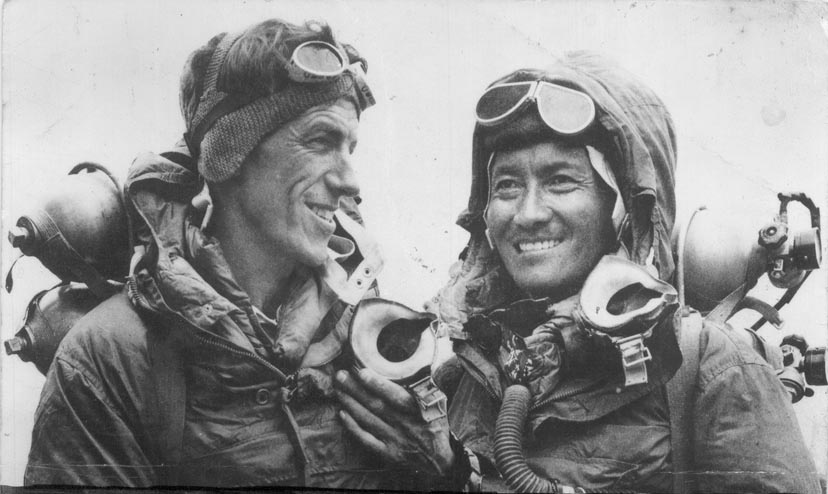
Hillary_and_tenzing

At 11:30 a.m. on May 29, 1953, Edmund Hillary of New Zealand and Tenzing Norgay, a Sherpa of Nepal, become the first explorers to reach the summit of Mount Everest, which at 29,035 feet above sea level is the highest point on earth. The two, part of a British expedition, made their final assault on the summit after spending a fitful night at 27,900 feet. News of their achievement broke around the world on June 2, the day of Queen Elizabeth II’s coronation, and Britons hailed it as a good omen for their country’s future….

On May 28, Tenzing and Hillary set out, setting up high camp at 27,900 feet. After a freezing, sleepless night, the pair plodded on, reaching the South Summit by 9 a.m. and a steep rocky step, some 40 feet high, about an hour later. Wedging himself in a crack in the face, Hillary inched himself up what was thereafter known as the Hillary Step. Hillary threw down a rope, and Norgay followed. At about 11:30 a.m., the climbers arrived at the top of the world.

On this day in 1848, America adds another state:

1848 – Wisconsin Enters the Union
On this date Wisconsin became the 30th state to enter the Union with an area of 56,154 square miles, comprising 1/56 of the United States at the time. Its nickname, the “Badger State,” was not in reference to the fierce animal but miners who spent their winters in the state, living in dugouts and burrowing much like a badger. [Source: “B” Book I, Beer Bottles, Brawls, Boards, Brothels, Bibles, Battles & Brownstone by Tony Woiak, pg. 37]

Google-a-Day asks a question of religion (and politics): “What entity appointed the 11th Panchen Lama, the second-ranked religious leader to Tibetans?”

Daily Bread for 5.28.13

Good morning.

Tuesday will be a day of thunderstorms and a high of seventy for Whitewater. We’ll have rainfall accumulations between a quarter and half of an inch.

On this day in 1754, Lt. Col. George Washington finds himself at the beginning of the Seven Years’ War:

…a 22-year-old lieutenant colonel of the Virginia militia named George Washington successfully defeats a party of French and Indian scouts in southwest Pennsylvania as Virginia attempts to lay claim to the territory for its own settlers. The action snowballed into a world war and began the military career of the first American commander in chief.

The Ohio Valley had long been a contested territory among French Canadians, various Indian groups and the British colonies of Pennsylvania and Virginia. When the French began to establish fortifications along the river and refused Virginia’s written demand that they depart, Virginia’s governor, Robert Dinwiddie, dispatched Washington to complete and defend a Virginian fort at the forks of the Ohio.

Upon their arrival, Washington discovered that a scouting party led by the French ensign, Joseph Coulon de Jumonville was nearby. Fearing that Jumonville was planning an attack, Washington struck first, successfully ambushing the small party. In one of history’s murkier moments, Jumonville was murdered by Washington’s Indian ally, Tanaghrisson, while the monolingual Washington struggled to interrogate the French-speaking Canadian….

Google-a-Day poses a history question: “What was the title of the father of the first child born to the sister of the British monarch who ascended the throne in February 1952?”

Daily Bread for 5.27.13

Good morning.

Memorial Day holds an even chance of showers for Whitewater, primarily in the afternoon. The holiday will be otherwise cloudy with a high of sixty-one.

On this day in 1703, Peter the Great founds St. Petersburg:

After winning access to the Baltic Sea through his victories in the Great Northern War, Czar Peter I founds the city of St. Petersburg as the new Russian capital.

The reign of Peter, who became sole czar in 1696, was characterized by a series of sweeping military, political, economic, and cultural reforms based on Western European models. Peter the Great, as he became known, led his country into major conflicts with Persia, the Ottoman Empire, and Sweden. Russian victories in these wars greatly expanded Peter’s empire, and the defeat of Sweden won Russia direct access to the Baltic Sea, a lifelong obsession of the Russian leader. With the founding of St. Petersburg, Russia was now a major European power–politically, culturally, and geographically. In 1721, Peter abandoned the traditional Russian title of czar in favor of the European-influenced title of emperor. Four years later, he died and was succeeded by his wife, Catherine.

On 5.27.13, explorers Marquette & Joliet reach Green Bay:

Towards the end of May, 1673, the two explorers reached the site of modern Green Bay. “Embarking then in our canoes,” Marquette wrote in his journal, “we arrived shortly afterward at the bottom of the Bay des Puants, where our Fathers labor successfully for the conversion of these peoples, over two thousand of whom they have baptized while they have been there.” Read what they encountered there, as well as what the old French name “Puants” means, in our [Wisconsin Historical Society] pages devoted to Historic Diaries.

Google-a-Day asks about architecture: “Of what type of architecture is the Paris Cathedral that in 1970 was the site of Charles de Gaulle’s funeral?”

Recent Tweets, 5.19 to 5.25