FREE WHITEWATER

Daily Bread for 9.16.13

Good morning.

The week begins with sunny skies and a high of sixty-four, with north winds of 5 to 10 mph.

The Whitewater School Board meets tonight at 6 PM.

On this day in 1908, a major car company is born:

On September 16, 1908, Buick Motor Company head William Crapo Durant spends $2,000 to incorporate General Motors in New Jersey. Durant, a high-school dropout, had made his fortune building horse-drawn carriages, and in fact he hated cars–he thought they were noisy, smelly, and dangerous. Nevertheless, the giant company he built would dominate the American auto industry for decades.

Here’s a trivia question, and its answer, for today: Do any animals use mechanical gears for locomotion?

Amazingly, there’s at least one:

To the best of our knowledge, the mechanical gear—evenly-sized teeth cut into two different rotating surfaces to lock them together as they turn—was invented sometime around 300 B.C. by Greek mechanics who lived in Alexandria. In the centuries since, the simple concept has become a keystone of modern technology, enabling all sorts of machinery and vehicles, including cars and bicycles.

As it turns out, though, a three-millimeter long hopping insect known as Issus coleoptratus beat us to this invention. Malcolm Burrows and Gregory Sutton, a pair of biologists from the University of Cambridge in the U.K., discovered that juveniles of the species have an intricate gearing system that locks their back legs together, allowing both appendages to rotate at the exact same instant, causing the tiny creatures jump forward.

burrows2HR

burrows5HR

The small hopping insect Issus coleoptratus uses toothed gears (magnified above with an electron microscope) to precisely synchronize the kicks of its hind legs as it jumps forward. All images courtesy of Malcom Burrows.

Recent Tweets, 9.8 to 9.14

Daily Bread for 9.15.13

Good morning.

We’ll have rain today in the Whippet City, with a high of fifty-nine. We can expect between a quarter and a half inch of rain.

Server upgrade: Over the night, my sites saw their second server upgrade in a year, to keep up with traffic. FREE WHITEWATER, Daily Wisconsin, and Daily Adams now have a spiffy new server, replacing an earlier upgrade from 2012.

Everything’s working properly. I owe it all to the very fine people who host these sites, who have always provided the best care one could find. They’ve stood behind me for years, and I with them. Many thanks, Annette.

On this day in 1914, combatants begin digging trenches along the front lines during World War I:

In the wake of the Battle of the Marne—during which Allied troops halted the steady German push through Belgium and France that had proceeded over the first month of World War I—a conflict both sides had expected to be short and decisive turns longer and bloodier, as Allied and German forces begin digging the first trenches on the Western Front on September 15, 1914.

The trench system on the Western Front in World War I—fixed from the winter of 1914 to the spring of 1918—eventually stretched from the North Sea coast of Belgium southward through France, with a bulge outwards to contain the much-contested Ypres salient. Running in front of such French towns as Soissons, Reims, Verdun, St. Mihiel and Nancy, the system finally reached its southernmost point in Alsace, at the Swiss border. In total the trenches built during World War I, laid end-to-end, would stretch some 25,000 miles—12,000 of those miles occupied by the Allies, and the rest by the Central Powers.

On this day in 1832, a treaty with the Ho Chunk is inked:

1832 – Ho-Chunk Treaty Signed
On this date a a treaty was signed between the Ho-Chunk and the United States that stipulated that the Ho-Chunk cede lands lying to the south and east of the Wisconsin river as well as lands around the Fox river of Green Bay. [Source:Oklahoma State University Library]

Daily Bread for 9.14.13

Good morning.

We’ll have a sunny Saturday with a high near seventy and southwest winds of 5 to 10 mph.

On this day in 1875, one of Wisconsin’s finest scientists passes away:

1875 – Increase Lapham Dies While Fishing
On this date Increase Lapham died of a heart attack while fishing in Oconomowoc. Lapham served Wisconsin as a geologist, meteorologist, historian, archivist, anthropologist, and scientist.He helped found the State Historical Society and served on its board for 22 years. He helped establish the National Weather Service and worked to preserve Native American burial mounds, as well as the forests and prairies of Wisconsin. He also helped establish hospitals for the blind, deaf, and mentally ill in Milwaukee and to start two women’s colleges, Carroll College and Milwaukee-Downer College. [Source: Badger Saints and Sinners; by Fred L. Holmes, p.330-344]

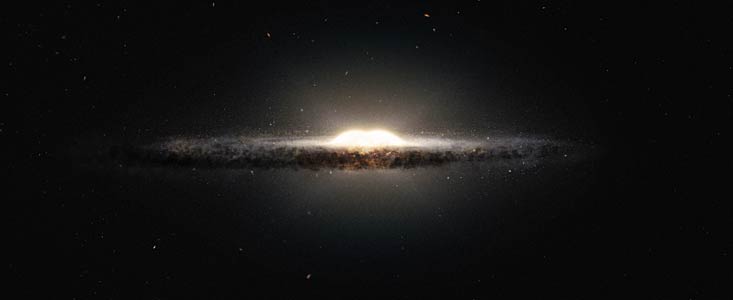
Of science, one reads that an artist, using data from the European Southern Observatory and NASA, has created a rendering of the Milky Way galaxy:

eso1339a

ESO artist’s rendering

“We find that the inner region of our Galaxy has the shape of a peanut in its shell from the side, and of a highly elongated bar from above”, adds Ortwin Gerhard, the coauthor of the first paper and leader of the Dynamics Group at MPE [3]. “It is the first time that we can see this clearly in our own Milky Way, and simulations in our group and by others show that this shape is characteristic of a barred galaxy that started out as a pure disc of stars.”

Beautiful, almost hauntingly so.

Friday Poll: World’s Smallest Dog? I’m not so sure about that….

One reads that Milly is the world’s smallest dog by the Guinness Record Book’s estimation:

ay_118282851

Milly via Guinness Record Book photo

SAN JUAN, Puerto Rico — Puerto Rico can now boast it is home to the world’s smallest dog – at least when it comes to height.

The brown Chihuahua named Miracle Milly is shorter than a soup can, standing at 3.8 inches (9.65 centimeters) tall when measured from backbone to paw, Guinness World Records announced Thursday.

She is nearly 2 years old, weighs roughly 1 pound (half a kilogram) and is known for often sticking out her tiny tongue when someone takes her picture.

“She knows how to pose,” owner Vanesa Semler told The Associated Press.

Miracle Milly dethroned Boo Boo, a long-haired Chihuahua from Kentucky that stands 4 inches (10.16 centimeters) tall.

Guinness also has a second category for world’s smallest dog when measured by length. That title is held by Heaven Sent Brandy, a Chihuahua in Largo, Florida, that measures 6 inches (15.24 centimeters) long.

So, here’s the question (and my second-consecutive dog-related poll): Is Milly really a dog, or do you think she’s actually some kind of smaller animal merely posing as a dog (e.g., rat, hairless squirrel, extraterrestrial creature, Russian science experiment gone wrong)? I’m going with extraterrestrial creature.

What do you think?


Daily Bread for 9.13.13

Good morning.

It’s a beautiful and sunny Friday for Whitewater, with a high of sixty-three. Lovely.

On this day in 1814, during the War of 1812, Francis SCott Key writes a poem later that becomes our national anthem:

…Francis Scott Key pens a poem which is later set to music and in 1931 becomes America’s national anthem, “The Star-Spangled Banner.” The poem, originally titled “The Defence of Fort McHenry,” was written after Key witnessed the Maryland fort being bombarded by the British during the War of 1812. Key was inspired by the sight of a lone U.S. flag still flying over Fort McHenry at daybreak, as reflected in the now-famous words of the “Star-Spangled Banner”: “And the rocket’s red glare, the bombs bursting in air, Gave proof through the night that our flag was still there.”

After one of Key’s friends, Dr. William Beanes, was taken prisoner by the British, Key went to Baltimore, located the ship where Beanes was being held and negotiated his release. However, Key and Beanes weren’t allowed to leave until after the British bombardment of Fort McHenry. Key watched the bombing campaign unfold from aboard a ship located about eight miles away. After a day, the British were unable to destroy the fort and gave up. Key was relieved to see the American flag still flying over Fort McHenry and quickly penned a few lines in tribute to what he had witnessed….

Branford Marsalis offers a jazz version of the anthem:

Scientific American offers a trivia question about sound, whether of jazz or anthems or anything else (clicking the question link leads to the answer):

Does sound travel faster in water or air?