
FREE WHITEWATER

Daily Bread for 5.14.13

Good morning.

It’s a warm and sunny Tuesday for Whitewater, with a high near 85, and southwest winds at 5 to 15 mph. We’ll enjoy 14h 36m of sunlight, 15h 41m of daylight, and a waxing crescent moon.

The Parks & Rec Board meets this afternoon at 5 PM.

On this day in 1804, Lewis & Clark depart for points west:

One year after the United States doubled its territory with the Louisiana Purchase, the Lewis and Clark expedition leaves St. Louis, Missouri, on a mission to explore the Northwest from the Mississippi River to the Pacific Ocean.

Even before the U.S. government concluded purchase negotiations with France, President Thomas Jefferson commissioned his private secretary Meriwether Lewis and William Clark, an army captain, to lead an expedition into what is now the U.S. Northwest. On May 14, the “Corps of Discovery”–featuring approximately 45 men (although only an approximate 33 men would make the full journey)–left St. Louis for the American interior.

The expedition traveled up the Missouri River in a 55-foot long keelboat and two smaller boats. In November, Toussaint Charbonneau, a French-Canadian fur trader accompanied by his young Native American wife Sacagawea, joined the expedition as an interpreter. The group wintered in present-day North Dakota before crossing into present-day Montana, where they first saw the Rocky Mountains. On the other side of the Continental Divide, they were met by Sacagawea’s tribe, the Shoshone Indians, who sold them horses for their journey down through the Bitterroot Mountains. After passing through the dangerous rapids of the Clearwater and Snake rivers in canoes, the explorers reached the calm of the Columbia River, which led them to the sea. On November 8, 1805, the expedition arrived at the Pacific Ocean, the first European explorers to do so by an overland route from the east. After pausing there for the winter, the explorers began their long journey back to St. Louis.

On September 23, 1806, after almost two and a half years, the expedition returned to the city, bringing back a wealth of information about the largely unexplored region, as well as valuable U.S. claims to Oregon Territory.

On 5.14.1953, Milwaukee beer workers go on strike:

Milwaukee brewery workers begin a 10-week strike, demanding contracts comparable to those of East and West coast workers. The strike was won when Blatz Brewery accepted their demands, but Blatz was ousted from the Brewers Association for “unethical” business methods as a result. The following year Schlitz president Erwin C. Uihlein told guests at Schlitz’ annual Christmas party that “Irreparable harm was done to the Milwaukee brewery industry during the 76-day strike of 1953, and unemployed brewery workers must endure ‘continued suffering’ before the prestige of Milwaukee beer is re-established on the world market.”

Google-a-Day asks about the twin of a wife of an athlete: “What is the name of the twin of the wife of the Super Bowl XXXVI MVP?”
Daily Bread for 5.13.13

Good morning.

An increasingly cloudy Monday, with a high of fifty-nine, lies ahead for Whitewater.

Whitewater’s Planning Commission meets this evening at 6 PM.

On 5.13.1846, Congress votes to declare war against Mexico:

…Congress overwhelmingly votes in favor of President James K. Polk’s request to declare war on Mexico in a dispute over Texas.

Under the threat of war, the United States had refrained from annexing Texas after the latter won independence from Mexico in 1836. But in 1844, President John Tyler restarted negotiations with the Republic of Texas, culminating with a Treaty of Annexation….

After nearly two years of fighting, peace was established by the Treaty of Guadalupe Hidalgo, signed on February 2, 1848. The Rio Grande was made the southern boundary of Texas, and California and New Mexico were ceded to the United States. In return, the United States paid Mexico the sum of $15 million and agreed to settle all claims of U.S. citizens against Mexico.

On 5.13.1918, a sensational murder trial begins:

1918 – Lusk Murder Trial Begins in Waukesha
On this day Grace Lusk, a Waukesha high school teacher, began her trial for the murder of Mary Roberts. Prosecutors alleged a tragic love triangle had resulted in the murder after Lusk’s pleas for Roberts to give up her husband were rebuffed. The trial, a national sensation in the early days of mass media, resulted in a guilty verdict on May 29, 1918. Lusk was sentenced to 19 years in prison but served only five before being pardoned by the Governor. After her release she jealously guarded her privacy; the identity of her husband, known only as “Mr. Brown,” was never determined. [Source: Capital Times 5/13/1918, p.1]

Google has a question about a career: “What was the profession of the pioneer of ‘The Great Silk Road?'”

Recent Tweets, 5.5 to 5.11

Daily Bread for 5.12.13

Good morning.

It’s a lovely Mother’s Day ahead for Whitewater, with sunny skies, a high of fifty-one, and moderate winds at 10 to 15 mph. We’ll have 14h 32m of sunlight, 15h 36m of daylight, and a Waxing crescent moon.

On this day in 1903, Pres. Roosevelt becomes the first president recorded on film:

A cameraman named H.J. Miles filmed the president while riding in a parade in his honor. The resulting short move was titled The President’s Carriage and was later played on “nickelodeons” in arcades across America. The film showed Roosevelt riding in a carriage and escorted by the Ninth U.S. Cavalry Regiment, which was unusual for the time, according to the Library of Congress and contemporary newspapers, because it was an all-black company.

Roosevelt was the first president to take advantage of the impact motion pictures could have on the presidency. The photogenic president encouraged filmmakers to document his official duties and post-presidential personal activities until his death in 1919. He purposely played directly to the camera with huge gestures and thundering speeches. The Library of Congress holds much of the original film footage, including that of his second inaugural ceremony in 1905, a visit to Panama in 1906 and an African safari in 1909….

Here’s that film, that the Library of Congress placed on YouTube:

Also available online from the Library of Congress on its own YouTube Channel channel are over one-thousand other videos.

Google-a-Day asks about an editor: “Who was the editor who worked with the author to polish the novel that won the Pulitzer Prize for Fiction in 1961?”

Daily Bread for 5.11.13

Good morning.

Clouds today will yield to mostly sunny skies, a high of fifty-six, and winds from 15 to 25 mph (with gusts even higher).

On this day in 1973, a federal judge dismisses charges against Daniel Ellsberg in the Pentagon Papers case (although other issues were yet unresolved):

Los Angeles, May 11 — Citing what he called “improper Government conduct shielded so long from public view,” the judge in the Pentagon papers trial dismissed today all charges against Dr. Daniel Ellsberg and Anthony J. Russo Jr.

And he made it clear in his ruling that the two men would not be tried again on charges of stealing and copying the Pentagon papers.

“The conduct of the Government has placed the case in such a posture that it precludes the fair, dispassionate resolution of these issues by a jury,” he said.

David R. Nissen, the chief prosecutor, said, “It appears that the posture is such that no appeal will be possible.”

Defendants Not Vindicated

But the decision by United States District Court Judge William Matthew Byrne Jr. did not vindicate the defendants; it chastised the Government. Nor did it resolve the important constitutional issues that the case had raised.

Tee original Pentagon Papers (United States – Vietnam Relations, 1945–1967: A Study Prepared by the Department of Defense) are now available online.

On this day in 1955, Wisconsin loses an NBA team:

1955 – Milwaukee Hawks Relocate to St. Louis
On this date the NBA approved transferring the financially strapped Milwaukee Hawks to St. Louis. The Hawks stayed in St. Louis until 1968, then moved to Atlanta. [Source: Milwaukee Journal Sentinel Online]

A geography question from Google’s daily question: “The cities of Amsterdam, including Rotterdam, The Hague and Utrecht make up what area that is home to more than 40% of the population of The Netherlands?”

Friday Poll: Flying Cars at Last?

All one’s life one has probably heard stories about the possibility of flying cars, with some of those accounts insisting that the flying car would be just around the corner. CNN has a story about another company, Terrafugia, that claims it’s now got flying automobiles.

At CNN, Dan Gross writes about Terrafugia in a post entitled, “Is this (finally) our flying car?”:

The company has a promotional video for their product, of course:

Dan Gross’s post, though, is more cautious than its bold title. He explains that “the Woburn, Massachussetts-based aerospace company announced it has begun feasibility studies on a car capable of vertical takeoffs and landings. The TF-X would be a four-seat, plug-in hybrid electric vehicle, according to the company.”

That sugests to me that a flying car is farther away than a bold headline would suggest, and that flying out of one’s driveway is much further away, still.

But what do you think? Is Terrafugia’s design at last the car for which so many have hoped?


Daily Bread for 5.10.13

Good morning.

Whitewater will end her work week with scattered showers, north winds at 10 mph, and a high of fifty-five.

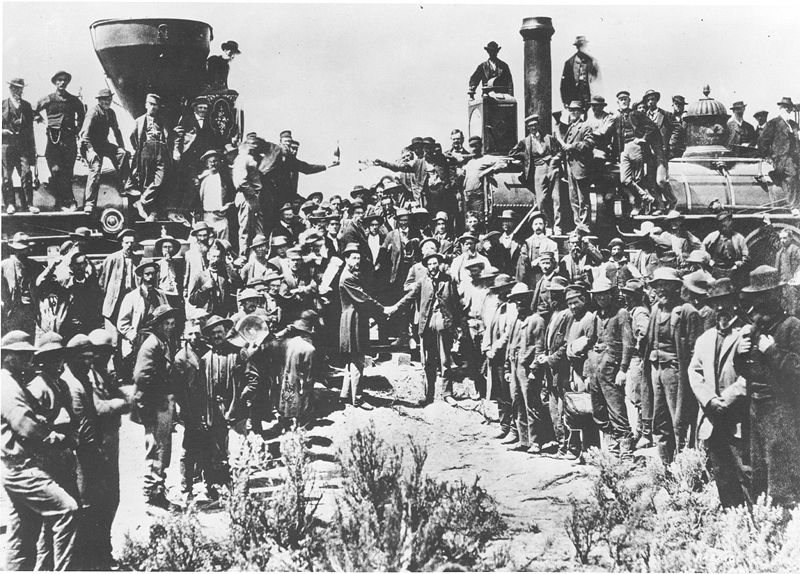
800px-1869-Golden_Spike

On this day in 1869, America has a transcontinental railroad:

…the presidents of the Union Pacific and Central Pacific railroads meet in Promontory, Utah, and drive a ceremonial last spike into a rail line that connects their railroads. This made transcontinental railroad travel possible for the first time in U.S. history. No longer would western-bound travelers need to take the long and dangerous journey by wagon train, and the West would surely lose some of its wild charm with the new connection to the civilized East.

Since at least 1832, both Eastern and frontier statesmen realized a need to connect the two coasts. It was not until 1853, though, that Congress appropriated funds to survey several routes for the transcontinental railroad. The actual building of the railroad would have to wait even longer, as North-South tensions prevented Congress from reaching an agreement on where the line would begin.

One year into the Civil War, a Republican-controlled Congress passed the Pacific Railroad Act (1862), guaranteeing public land grants and loans to the two railroads it chose to build the transcontinental line, the Union Pacific and the Central Pacific. With these in hand, the railroads began work in 1866 from Omaha and Sacramento, forging a northern route across the country. In their eagerness for land, the two lines built right past each other, and the final meeting place had to be renegotiated….

On this day in 1865, the Wisconsin 1st Cavalry helps capture Jefferson Davis:

1865 – (Civil War) Confederacy President Jefferson Davis Captured
The 1st Wisconsin Cavalry was one of the first units sent to search for Jefferson Davis, the president of the Confederacy, after the surrender of General Robert E. Lee. A Michigan unit, also sent to find Davis, accidentally attacked the cavalry before dawn. A few hours later, both units captured the Confederate president in Irwinville, Georgia.

Google asks today about a nation’s father: “Who is known as the “father” of the country whose national drink is a strong alcoholic beverage made from pomace?

Daily Bread for 5.9.13

Good morning.

We’ll have showers and thunderstorms this afternoon in Whitewater, with a high of sixty-eight. New rainfall may amount range from a quarter to half of an inch.

On this day in 1874, Howard Carter, the British archaeologist who discovered the Egyptian tomb of King Tutankhamen, is born.

On 5.9.1950, a first for then-Milwaukee Arena:

1950 – First Sporting Event Held at Milwaukee Arena
On this date, in the first sporting event at the new Milwaukee Arena, Rocky Graziano scored a fourth-round TKO over Vinnie Cidone in a middleweight fight that drew 12,813 fans. The new Milwaukee Arena actually opened on April 9, 1950, but with a civic celebration rather than a sports event. [Source: Milwaukee Journal]

For today’s daily question from Google, something about naval tradition: “What is the term for the traditional ritual by which officers in the UK’s Royal Navy are retired?”