FREE WHITEWATER

Recent Tweets, 1.20 to 1.26

Daily Bread for 1.27.13

Good morning.

So, we’ve a near-certainty of a wintry mix for Whitewater today, with freezing rain and sleet, and a high of thirty-three.

On this day in 1967, a tragic setback struck the Apollo program, as “Astronauts Virgil I. ”Gus” Grissom, Edward H. White and Roger B. Chaffee died in a flash fire during a test aboard their Apollo I spacecraft at Cape Kennedy, Fla.”

On this day in 1888, the National Geographic Society comes to life for “the increase and diffusion of geographical knowledge”:

The 33 men who originally met and formed the National Geographic Society were a diverse group of geographers, explorers, teachers, lawyers, cartographers, military officers and financiers. All shared an interest in scientific and geographical knowledge, as well as an opinion that in a time of discovery, invention, change and mass communication, Americans were becoming more curious about the world around them. With this in mind, the men drafted a constitution and elected as the Society’s president a lawyer and philanthropist named Gardiner Greene Hubbard. Neither a scientist nor a geographer, Hubbard represented the Society’s desire to reach out to the layman.

Nine months after its inception, the Society published its first issue of National Geographic magazine. Readership did not grow, however, until Gilbert H. Grosvenor took over as editor in 1899. In only a few years, Grosvenor boosted circulation from 1,000 to 2 million by discarding the magazine’s format of short, overly technical articles for articles of general interest accompanied by photographs. National Geographic quickly became known for its stunning and pioneering photography, being the first to print natural-color photos of sky, sea and the North and South Poles.

The Society used its revenues from the magazine to sponsor expeditions and research projects that furthered humanity’s understanding of natural phenomena. In this role, the National Geographic Society has been instrumental in making possible some of the great achievements in exploration and science. To date, it has given out more than 1,400 grants, funding that helped Robert Peary journey to the North Pole, Richard Byrd fly over the South Pole, Jacques Cousteau delve into the sea and Jane Goodall observe wild chimpanzees, among many other projects.

Here’s a Society clip describing a possible discovery about parrotlets:

Google-a-Day asks about someone who gave a gift: “Who presented Tonga’s royal family with the animal that, when he died, was believed to be one of the longest-living animals on record?”

Daily Bread for 1.26.13

Good morning.

It’s a mostly sunny day with a high of twenty-three for Whitewater.

On 1.26.1788, a founding that led to Australia Day:

On January 26, 1788, Captain Arthur Phillip guides a fleet of 11 British ships carrying convicts to the colony of New South Wales, effectively founding Australia. After overcoming a period of hardship, the fledgling colony began to celebrate the anniversary of this date with great fanfare.

Australia, once known as New South Wales, was originally planned as a penal colony. In October 1786, the British government appointed Arthur Phillip captain of the HMS Sirius, and commissioned him to establish an agricultural work camp there for British convicts. With little idea of what he could expect from the mysterious and distant land, Phillip had great difficulty assembling the fleet that was to make the journey. His requests for more experienced farmers to assist the penal colony were repeatedly denied, and he was both poorly funded and outfitted. Nonetheless, accompanied by a small contingent of Marines and other officers, Phillip led his 1,000-strong party, of whom more than 700 were convicts, around Africa to the eastern side of Australia. In all, the voyage lasted eight months, claiming the deaths of some 30 men.

The first years of settlement were nearly disastrous. Cursed with poor soil, an unfamiliar climate and workers who were ignorant of farming, Phillip had great difficulty keeping the men alive. The colony was on the verge of outright starvation for several years, and the marines sent to keep order were not up to the task. Phillip, who proved to be a tough but fair-minded leader, persevered by appointing convicts to positions of responsibility and oversight. Floggings and hangings were commonplace, but so was egalitarianism. As Phillip said before leaving England: “In a new country there will be no slavery and hence no slaves.”

Though Phillip returned to England in 1792, the colony became prosperous by the turn of the 19th century. Feeling a new sense of patriotism, the men began to rally around January 26 as their founding day. Historian Manning Clarke noted that in 1808 the men observed the “anniversary of the foundation of the colony” with “drinking and merriment.”

Finally, in 1818, January 26 became an official holiday, marking the 30th anniversary of British settlement in Australia. And, as Australia became a sovereign nation, it became the national holiday known as Australia Day. Today, Australia Day serves both as a day of celebration for the founding of the white British settlement, and as a day of mourning for the Aborigines who were slowly dispossessed of their land as white colonization spread across the continent.

Also on this day, in 1925, fire destroys the Whitewater Hospital:

1925 – Fire Destroys Whitewater Hospital
On this date a fire destroyed the Whitewater Hospital. Monetary losses were estimated at $20,000, but no deaths were reported. [Source: Janesville Gazette]

Google-a-Day has a combined  sports and film question for us: “In what year did the manager and team depicted in the blockbuster film “Moneyball” finally win their first playoff series?”

Friday Poll: Snow or Cold?

Let’s assume you’ve a choice of the weather in your town, between very cold with no snow, or thirty degrees with snow (say, a few inches at least).

Which would you pick?

I don’t mind the cold, but I’d take the milder temperature with snow, as there’s winter fun to be had in the snow.

How ’bout you?


Daily Bread for 1.25.13

Good morning.

Friday brings snowfall to Whitewater, in the morning, with only a slight accumulation likely. We’ll have a high of twenty-six, with 9h 42m of sunlight, 10h 44m of daylight, and a waxing gibbous moon.

url

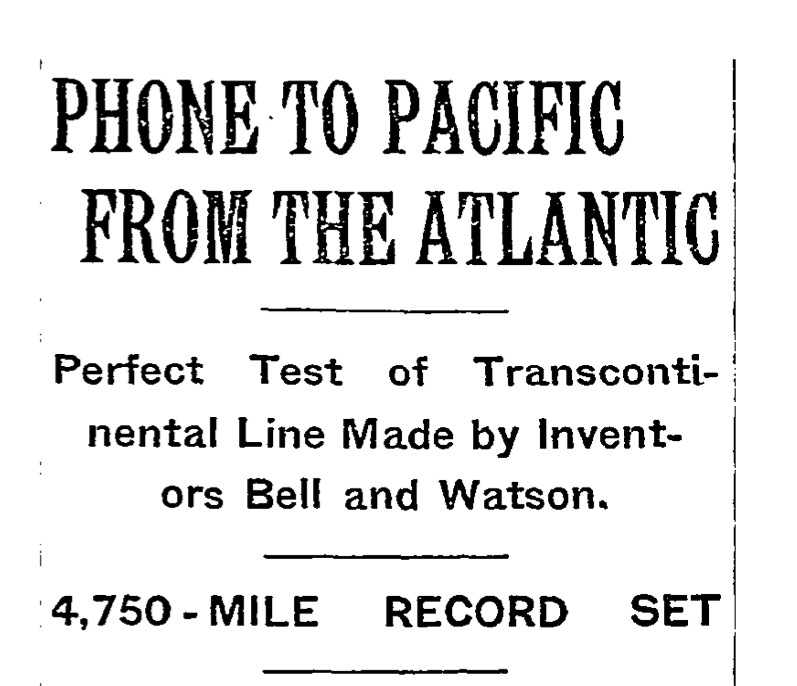
On this day in 1915, a milestone of telephony, as Alexander Graham Bell tests a transcontinental phone line:

On October 9, 1876, Alexander Graham Bell and Thomas A. Watson talked by telephone to each other over a two-mile wire stretched between Cambridge and Boston. It was the first wire conversation ever held. Yesterday afternoon the same two men talked by telephone to each other over a 3,400-mile wire between New York and San Francisco. Dr. Bell, the veteran inventor of the telephone, was in New York, and Mr. Watson, his former associate, was on the other side of the continent. They heard each other much more distinctly than they did in their first talk thirty-eight years ago.

Impressive, even now.

Google-a-Day offers a history question: “What Frankish ruler is associated with the Carolingian Renaissance?”

Why Williamsburg, Brooklyn?

I’ve written before about Williamsburg, a neighborhood within Brooklyn. (See, TNIW, The Williamsburg Neighborhood in Brooklyn, and The Pickleback.)

It’s not because Whitewater will one-day look like just like that neighborhood. There are at least two reasons Williamsburg is relevant.

First, that neighborhood shows how very different ethnicities (Italian, Puerto Rican, Dominican, Hasidic) can live near each other (albeit with the occasional kerfuffle). If Williamsburg can make a go of it, so can Whitewater, with a smaller and less diverse demographic.

All the town-gown issues, for example, that Whitewater has ever seen are mere minnows compared to Williamsburg’s possible – but successfully met – challenges.

If you’re at our university, or in our city, and you’ve not bridged our own gaps, then you’ve only yourself (and those like you) to blame. If Williamsburg can do it, so can we. We’re no less American than residents of this Brooklyn neighborhood – we can deliver on the promise of a diverse city as well as they can.

Quick note, so that we’re all very clear: smearing the memory of a deceased college student for the act-utilitarian purpose of assuring others that we’ve no greater crime problem isn’t bridging the town-gown gap. See, along these lines, The True Measure of Institutional Greatness.

There’s a second reason I’ve written about Williamsburg. Although Whitewater will never look like Williamsburg (and certainly doesn’t need to do so), she will one day look almost as different from how she looks today as she does today from contemporary Williamsburg.

We’re at the beginning of this transformation now, one that has over ten years to go. There’s no one Williamsburg culture now, and they’ll be no one Whitewater culture then. There is, however, an ethos there are will take hold here: that there’s no one way, no one set of expectations, no one narrow standard that all must meet.

We have the beginnings of this New Whitewater, but they’re still small shoots. Creative ideas in art and culture are slowly emerging, but they’re still tightly controlled, and often used to advance an single, doctrinaire message (one group, one way, one city, all exceptional and flawless).

It’s a message all right, it’s just an insecure and laughable one. We’ll know we’ve progressed when art isn’t a mere handmaiden of that message.

That narrow vision reached its high-water mark sometime between 2004-2012, yet all the king’s horses and all the king’s men can’t make Whitewater’s politics so simple-minded again.

We’re slowly on our way.