
Caught on film.
Edsquirrel from Tynan on Vimeo.
Good morning.
It’s a mostly sunny day with a high of twenty-three for Whitewater.
On January 26, 1788, Captain Arthur Phillip guides a fleet of 11 British ships carrying convicts to the colony of New South Wales, effectively founding Australia. After overcoming a period of hardship, the fledgling colony began to celebrate the anniversary of this date with great fanfare.
Australia, once known as New South Wales, was originally planned as a penal colony. In October 1786, the British government appointed Arthur Phillip captain of the HMS Sirius, and commissioned him to establish an agricultural work camp there for British convicts. With little idea of what he could expect from the mysterious and distant land, Phillip had great difficulty assembling the fleet that was to make the journey. His requests for more experienced farmers to assist the penal colony were repeatedly denied, and he was both poorly funded and outfitted. Nonetheless, accompanied by a small contingent of Marines and other officers, Phillip led his 1,000-strong party, of whom more than 700 were convicts, around Africa to the eastern side of Australia. In all, the voyage lasted eight months, claiming the deaths of some 30 men.
The first years of settlement were nearly disastrous. Cursed with poor soil, an unfamiliar climate and workers who were ignorant of farming, Phillip had great difficulty keeping the men alive. The colony was on the verge of outright starvation for several years, and the marines sent to keep order were not up to the task. Phillip, who proved to be a tough but fair-minded leader, persevered by appointing convicts to positions of responsibility and oversight. Floggings and hangings were commonplace, but so was egalitarianism. As Phillip said before leaving England: “In a new country there will be no slavery and hence no slaves.”
Though Phillip returned to England in 1792, the colony became prosperous by the turn of the 19th century. Feeling a new sense of patriotism, the men began to rally around January 26 as their founding day. Historian Manning Clarke noted that in 1808 the men observed the “anniversary of the foundation of the colony” with “drinking and merriment.”
Finally, in 1818, January 26 became an official holiday, marking the 30th anniversary of British settlement in Australia. And, as Australia became a sovereign nation, it became the national holiday known as Australia Day. Today, Australia Day serves both as a day of celebration for the founding of the white British settlement, and as a day of mourning for the Aborigines who were slowly dispossessed of their land as white colonization spread across the continent.
Also on this day, in 1925, fire destroys the Whitewater Hospital:
1925 – Fire Destroys Whitewater Hospital
On this date a fire destroyed the Whitewater Hospital. Monetary losses were estimated at $20,000, but no deaths were reported. [Source: Janesville Gazette]
Google-a-Day has a combined sports and film question for us: “In what year did the manager and team depicted in the blockbuster film “Moneyball” finally win their first playoff series?”
Some cat owners might live their whole lives without thinking about dressing up their cats as Ewoks from Star Wars.
Some cat owners; others would hit upon the idea, and then bring it into being.
For those so inclined, CNET offers DIY Ewok cat hat: May the feline be with you, based on an Instructables project from carlsonbryant.
Let’s assume you’ve a choice of the weather in your town, between very cold with no snow, or thirty degrees with snow (say, a few inches at least).
Which would you pick?
I don’t mind the cold, but I’d take the milder temperature with snow, as there’s winter fun to be had in the snow.
How ’bout you?
Good morning.
Friday brings snowfall to Whitewater, in the morning, with only a slight accumulation likely. We’ll have a high of twenty-six, with 9h 42m of sunlight, 10h 44m of daylight, and a waxing gibbous moon.
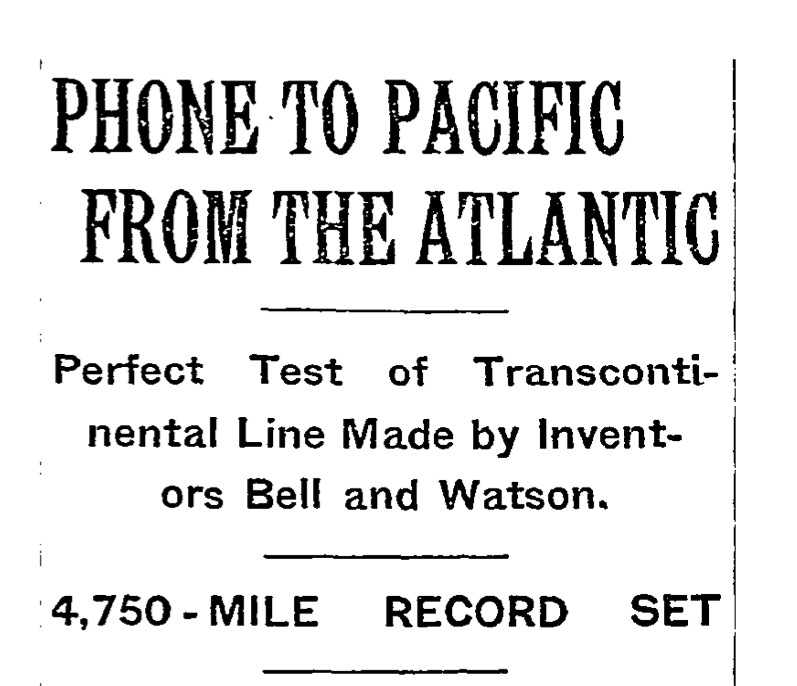
On this day in 1915, a milestone of telephony, as Alexander Graham Bell tests a transcontinental phone line:
On October 9, 1876, Alexander Graham Bell and Thomas A. Watson talked by telephone to each other over a two-mile wire stretched between Cambridge and Boston. It was the first wire conversation ever held. Yesterday afternoon the same two men talked by telephone to each other over a 3,400-mile wire between New York and San Francisco. Dr. Bell, the veteran inventor of the telephone, was in New York, and Mr. Watson, his former associate, was on the other side of the continent. They heard each other much more distinctly than they did in their first talk thirty-eight years ago.
Impressive, even now.
Google-a-Day offers a history question: “What Frankish ruler is associated with the Carolingian Renaissance?”
An improvisational dance, perhaps.
I’ve written before about Williamsburg, a neighborhood within Brooklyn. (See, TNIW, The Williamsburg Neighborhood in Brooklyn, and The Pickleback.)
It’s not because Whitewater will one-day look like just like that neighborhood. There are at least two reasons Williamsburg is relevant.
First, that neighborhood shows how very different ethnicities (Italian, Puerto Rican, Dominican, Hasidic) can live near each other (albeit with the occasional kerfuffle). If Williamsburg can make a go of it, so can Whitewater, with a smaller and less diverse demographic.
All the town-gown issues, for example, that Whitewater has ever seen are mere minnows compared to Williamsburg’s possible – but successfully met – challenges.
If you’re at our university, or in our city, and you’ve not bridged our own gaps, then you’ve only yourself (and those like you) to blame. If Williamsburg can do it, so can we. We’re no less American than residents of this Brooklyn neighborhood – we can deliver on the promise of a diverse city as well as they can.
Quick note, so that we’re all very clear: smearing the memory of a deceased college student for the act-utilitarian purpose of assuring others that we’ve no greater crime problem isn’t bridging the town-gown gap. See, along these lines, The True Measure of Institutional Greatness.
There’s a second reason I’ve written about Williamsburg. Although Whitewater will never look like Williamsburg (and certainly doesn’t need to do so), she will one day look almost as different from how she looks today as she does today from contemporary Williamsburg.
We’re at the beginning of this transformation now, one that has over ten years to go. There’s no one Williamsburg culture now, and they’ll be no one Whitewater culture then. There is, however, an ethos there are will take hold here: that there’s no one way, no one set of expectations, no one narrow standard that all must meet.
We have the beginnings of this New Whitewater, but they’re still small shoots. Creative ideas in art and culture are slowly emerging, but they’re still tightly controlled, and often used to advance an single, doctrinaire message (one group, one way, one city, all exceptional and flawless).
It’s a message all right, it’s just an insecure and laughable one. We’ll know we’ve progressed when art isn’t a mere handmaiden of that message.
That narrow vision reached its high-water mark sometime between 2004-2012, yet all the king’s horses and all the king’s men can’t make Whitewater’s politics so simple-minded again.
We’re slowly on our way.

Good morning.
Thursday brings an increasingly cloudy day, with a high of sixteen, to Whitewater.
Can’t say I much care for canned products, but it’s a milestone of sorts:
Jan 24, 1935
First canned beer goes on saleCanned beer makes its debut on this day in 1935. In partnership with the American Can Company, the Gottfried Krueger Brewing Company delivered 2,000 cans of Krueger’s Finest Beer and Krueger’s Cream Ale to faithful Krueger drinkers in Richmond, Virginia. Ninety-one percent of the drinkers approved of the canned beer, driving Krueger to give the green light to further production.
By the late 19th century, cans were instrumental in the mass distribution of foodstuffs, but it wasn’t until 1909 that the American Can Company made its first attempt to can beer. This was unsuccessful, and the American Can Company would have to wait for the end of Prohibition in the United States before it tried again. Finally in 1933, after two years of research, American Can developed a can that was pressurized and had a special coating to prevent the fizzy beer from chemically reacting with the tin.
The concept of canned beer proved to be a hard sell, but Krueger’s overcame its initial reservations and became the first brewer to sell canned beer in the United States. The response was overwhelming. Within three months, over 80 percent of distributors were handling Krueger’s canned beer, and Krueger’s was eating into the market share of the “big three” national brewers–Anheuser-Busch, Pabst and Schlitz. Competitors soon followed suit, and by the end of 1935, over 200 million cans had been produced and sold.
The purchase of cans, unlike bottles, did not require the consumer to pay a deposit. Cans were also easier to stack, more durable and took less time to chill. As a result, their popularity continued to grow throughout the 1930s, and then exploded during World War II, when U.S. brewers shipped millions of cans of beer to soldiers overseas. After the war, national brewing companies began to take advantage of the mass distribution that cans made possible, and were able to consolidate their power over the once-dominant local breweries, which could not control costs and operations as efficiently as their national counterparts.
Google-a-Day asks an aerospace question: “Who commanded the crew of seven of the Columbia on the 38th flight of the Shuttle on STS-35 in December 1990?”
Another of the countless reasons to love America, to find this creative country endearing: a 1976 film adaptation of H.G. Wells’s Food of the Gods and How It Came to Earth.
Tempted? The whole film is available online, for instant streaming free of additional charge with an existing Amazon Prime membership.
Enjoy.
Like many towns, Whitewater has a downtown, and a merchants’ association, in our case Downtown Whitewater, Inc. (DTWW). I’ve written occasionally about DTWW, and not long ago in support of continued municipal funding for that organization. See, The City of Whitewater’s 2013 Budget: Downtown Whitewater, Inc.
There’s been a wider effort to reorganize and consolidate the work of DTWW, the local Chamber of Commerce, and the city’s tourism effort. As we’re a town of only about fifteen-thousand, it’s sensible that we could sharing between groups whenever possible.
Also, as with other towns, the City of Whitewater subsidizes DTWW, in an amount of $20,000 for 2013. It’s a moderate expenditure, but offered in the context of a former municipal administration that budgeted poorly in the last decade, and wrecked one of its own tax incremental districts.
There’s no money to waste. More important still, there are needs throughout the city, of poverty and hunger, that could well use additional funding.
There’s a hard path ahead, to keep the city’s downtown from cratering, to hold out until broader forces outside the city transform both the downtown and all the community.
They will. In the meantime, there’s no swimming back to shore, and treading water will only lead to going under. It’s a steady Australian crawl, from now until better times.
A successful effort will require merchant-centric proposals, diligent cooperation from the city government to justify and make good existing taxpayer-funding, and a limit on people who want to run things as though the downtown were a society organization. There are many good charities worth joining, for those with that impulse.
A simple goal: More stores, fewer empty spaces. Either we move in that direction or we don’t.
If all this were accomplished, and fully, there’d be time to look backward to anniversaries, reminiscences of earlier times, etc.
It’s not finished, and until it is, there’s no good point to any of that. One should acknowledge and reward a year’s hard work, from those who have actually done that work.
Beyond that, efforts should concentrate on producing evident signs of a healthier downtown at year’s end. It’s a simple goal, one that I’m sure our city can meet.
Clear skies of cold air
Actress admires her image
Others look away
Posted also at Daily Adams.
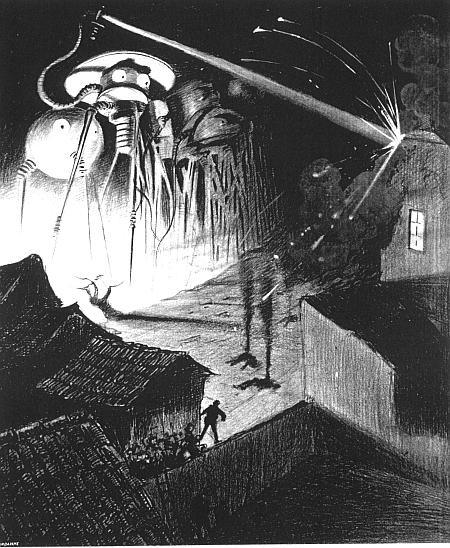
Stories, even short, science-fiction stories, offer lessons beyond their pages.
Near the final pages of Wells’s War of the Worlds, the narrator ponders his future, months after the Martians succumbed on our world. He considers the possibility of another invasion:
A question of graver and universal interest is the possibility of another attack from the Martians. I do not think that nearly enough attention is being given to this aspect of the matter. At present the planet Mars is in conjunction, but with every return to opposition I, for one, anticipate a renewal of their adventure.
But as a leading scientist looks out into the skies, that scholar supposes that the Martians might have already begun a new campaign, not against Earth, but against Venus:
Lessing has advanced excellent reasons for supposing that the Martians have actually succeeded in effecting a landing on the planet Venus. Seven months ago now, Venus and Mars were in alignment with the sun; that is to say, Mars was in opposition from the point of view of an observer on Venus. Subsequently a peculiar luminous and sinuous marking appeared on the unillumined half of the inner planet, and almost simultaneously a faint dark mark of a similar sinuous character was detected upon a photograph of the Martian disk. One needs to see the drawings of these appearances in order to appreciate fully their remarkable resemblance in character.
The book ends without readers knowing with certainty whether the Martians went elsewhere, or whether they might attempt a second invasion of Earth. Humanity would be better off if they went somewhere else, if they were to go somewhere at all.
All is not lost, however, as the narrator wisely concludes. To be forewarned is to be forearmed:
In any case, we should be prepared. It seems to me that it should be possible to define the position of the gun from which the shots are discharged, to keep a sustained watch upon this part of the planet, and to anticipate the arrival of the next attack.
In that case the cylinder might be destroyed with dynamite or artillery before it was sufficiently cool for the Martians to emerge….It seems to me that they have lost a vast advantage in the failure of their first surprise. Possibly they see it in the same light.
I read this story as a child, and its hauntingly beautiful scenes have remained in my memory so many years later.
So, too, its hopeful message, not of creatures but of people: that having had a disappointing time of it, one may through that experience learn to act more skillfully and decisively should there be subsequent, similar challenges.
That’s why, despite the devastation of the Martians’ attack, I’ve always thought the book was a hopeful one, with an encouraging message.
One would have the advantage, and seize it to the fullest, the second time around.