
Daily Bread
Daily Bread for 10.22.12
by JOHN ADAMS •
Good morning.
Whitewater’s new week begins with showers and a high of sixty-six.
In Whitewater today, the Emerald Ash Borer Ad Hoc Committee meets at 5 PM, The Planning Commission at 6 PM, and the Whitewater School Board at 7 PM.
On this day in 1962, Pres. Kennedy announced an air and naval blockade of Cuba, following the discovery of Soviet missiles on that island:
Google’s daily puzzle asks about geography: “What famous route originally terminated at Oregon’s first capital city?”
Recent Tweets, 10.14 to 10.20
by JOHN ADAMS •
http://storify.com/DailyAdams/recent-tweets-10-14-to-10-2o
Cartoons & Comics
Sunday Morning Cartoon: Intro to Disney’s ‘Halloween Treat’
by JOHN ADAMS •
Daily Bread
Daily Bread for 10.21.12
by JOHN ADAMS •
Good morning.
Sunday in Whitewater will be mostly sunny, with south winds five to ten mph, and a high of sixty-six.
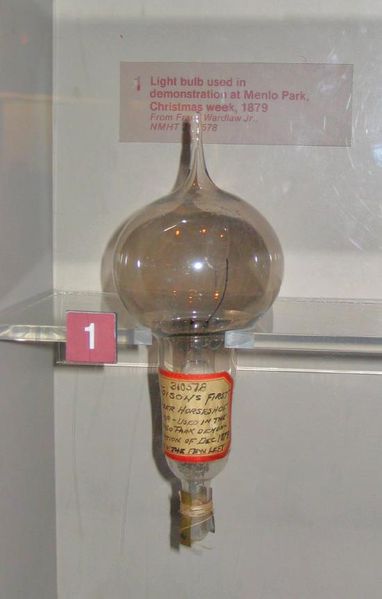
On this day in 1879, Thomas Edison created a working electric light. The New York Times reported his triumph:
There was no lack of enthusiasm or of confidence about Mr. Edison as he greeted the Times reporter who entered his laboratory at Menlo Park, N. J., yesterday. The inventor, a short, thick-set man, with grimy hands, led the way through his workshop, and willingly explained the distinctive features of what he and many others look upon as an apparatus which will soon cause gas-light to be a thing of the past.
The lamp which Mr. Edison regards as a crowning triumph is a model of simplicity and economy. In the lamp the light is emitted by a horseshoe of carbonized paper about two and a half inches long and the width of a thread. This horseshoe is in a glass globe, from which the air has been as thoroughly exhausted as science is able to do. So good a vacuum is produced that it is estimated that at the utmost no more than a one-millionth part of the air remains. The operation of pumping lasts one hour and a quarter.
At the ends of the carbon horseshoe are two platinum clamps, from which platinum wires run outwardly through a small glass tube contained within a larger one leading out of the glass globe. The small tube contains air. Within it the platinum wires are met by two copper wires connecting with the conductors of the electricity. The air is left in the small tube, because otherwise the copper wires would be fused by the electric current. The carbonized paper is capable of being made incandescent by a current of electricity, and while it allows the current to pass over it, its resistance to the heat is strong enough to prevent it from fusing.

Google’s daily puzzle ask about a place in New York: “What is the nickname of the area located east of Coney Island Beach and west of Manhattan Beach in Brooklyn?”
City, Corporate Welfare, Government Spending, Local Government, Taxes/Taxation
The City of Whitewater’s 2013 Draft Budget: Crony Capitalism
by JOHN ADAMS •
So a multi-billion-dollar corporation (market cap $1.77 billion) wants thousands of taxpayer-dollars from a small city to fund a bus the corporation uses to shuttle her workers to and from other towns where they actually live. The city being imposed upon is Whitewater, Wisconsin, a tiny municipality, like many others, struggling just to balance her annual operating budget.
Whitewater’s situation involves juggling to find ways to support her small downtown merchants and to defend against an infestation of pernicious insects that threaten her many ash trees. Finding the money to do these things while balancing her budget (as she must) requires hard choices.
About taxpayer funding for multi-billion-dollar Generac Power Systems, I’ve written before. See, for example, A Local Flavor of Crony Capitalism, A little consistency would be in order, A Generac bus by any other name, The Generac Bus and Bottom-Shelf Messaging, and The Innovation Express Generac Bus: ‘Public Transit Is Not Expected to Make Money.’
The City of Whitewater’s entire municipal operating budget is about $9 million, but for Generac Power Systems, that entire city budget is merely a small fraction of corporate quarterly revenue. Generac’s annual net income in 2011: $324 million. Everything the City of Whitewater spends, in a place of fourteen-thousand people, is a tiny part of Generac’s revenue.
How well is Generac doing lately? Better than ever. One knows this because her President and CEO, Aaron Jagdfeld, announced Generac’s better-than-ever success in a recent press release:
We initiated our Powering Ahead strategic plan in 2010 that focused on growing the residential standby market, increasing our share of the commercial and industrial market, diversifying our demand, and expanding into new geographies. As a result of our team’s efforts, we have consistently exceeded our own performance goals associated with Powering Ahead and in fact reached many of those targets a year earlier than we had originally planned. We are currently resetting our goals for the next three years and we intend to share those updated growth rates in the near future when we finalize our long-term strategic plan.”
Generac’s stock has since been upgraded.
Congratulations, Mr. Jagdfeld. Well done.
I’ve just one question: Why in the world would you think our small city – with real needs of struggling people – owes your cash-rich, multi-billion-dollar corporation even a dime of taxpayer’s money for a bus to shuttle your private workers?
I’ve a proposal. Here in Whitewater, it’s traditional for applicants for city funds to appear before our common council, during an open session, and explain their need for public money. These sessions are televised and recorded, and applicants speak into an open microphone to the elected representatives of the city, explaining why they want city funds.
Surely you could do the same: if you’ve time to give statements about the better-than-ever performance of your corporation, you’ve time enough to speak to our common council of your ongoing, aching need for taxpayer money.
I’ll do my part, too. I will post on my websites, and on YouTube, your remarks, along with a transcription of them.
My pleasure, I’m sure.
Until then, we’re left with this: neither your corporation nor anyone else has offered a satisfactory justification for this request. It remains as it has been, unworthy of both American private enterprise and municipal finance.
Daily Bread
Daily Bread for 10.20.12
by JOHN ADAMS •
Good morning.
It’s a partly sunny Saturday for Whitewater, with a high of fifty-five, and northwest winds at 5 miles per hour.
On this day in 1973, it was a Saturday Night Massacre in Washington: “in the so-called Saturday Night Massacre, President Nixon abolished the office of special Watergate prosecutor Archibald Cox, accepted the resignation of Attorney General Elliot L. Richardson and fired Deputy Attorney General William B. Ruckelshaus.”
In Wisconsin history on this day, a fish tale turned out to be true:
1949 – Really Huge Fish Caught
On this date a record-breaking muskellunge (“muskie”) was caught on the Chippewa Flowage near Hayward. The fish weighed 69 pounds, 11 ounces. The muskie became the official state fish of Wisconsin in 1955. [Source: American Profile Note: Linked picture is not the record breaking fish]
Google’s daily puzzle asks about presidential history: “Who married the grandson of the man to whom her father had served two terms as Vice President of the United States?”
Business, City, Laws/Regulations, New Whitewater, Planning
The City of Whitewater’s 2013 Draft Budget: Downtown Whitewater
by JOHN ADAMS •
Under the 2013 draft budget, there’s the possibility of the City of Whitewater increasing the contribution for Downtown Whitewater, Inc., to compensate for the loss of funding via Tax Incremental District 4.
While I’d surely rather the city didn’t prop up businesses, and I’d rather it didn’t fund just one area at that, I candidly think additional funding for the next year is necessary until a combination of zoning and enforcement changes takes hold.
(There’s no good reason whatever to support even temporary funding for a large corporation – that’s not implicated here. These are small merchants.)
If the downtown goes under, the gaping hole will take years to fill, and would make any mere marketing effort on behalf of the city impossible to succeed.
The Importance of a Downtown. Our city has a small downtown, with another retail district on the west beyond the university. There were plans for residential expansion elsewhere (via the Bridge to Nowhere, a local monument to bad planning), but it’s really these two areas for retail.
Here’s Whitewater’s challenge: she’ll attract no one if the downtown goes under. I’ve traveled about this last year, through Wisconsin and places far beyond, but I’ve not once seen a successful small town without a thriving district of quaint shops.
If anyone else has, I’d be happy to hear of it. There are suburbs, naturally, without identifiable downtowns, but I’ve never seen a successful rural community without one. Struggling, half-dead communities, surely; successful vibrant ones, not yet.
Our downtown survived the last recession (no small feat), but it’s hardly thriving. It took considerable work to keep it going even as it is.
The Futility of Marketing (without a Thriving Downtown). You may have seen a marketing video, in the syle of a school’s NCAA promotional announcement, encouraging prospective newcomers to Choose Whitewater. It’s hard to over-emphasize how backwards it is to tout the features of a city if the city’s downtown descends into rows of empty storefronts and discarded beer bottles. One block from Main Street, on Center, we’ve problems even now.
No one will choose this city from a video over his or her personal impressions on a visit. No one will choose this city on a guided tour over his or her own explorations. People who think otherwise are mistaken. The best a marketing effort can do is encourage a visit, and (it’s to be hoped) bolster a positive impression a visitor has after his or her own explorations.
No one will choose from a video, story, or pamphlet alone.
The Longterm Solution. A combination of zoning changes and enforcement changes (different but complementary actions) can lift this city far beyond any marketing effort. Just as the best policy is a sound argument, so the best marketing is an open, dynamic city.
Unfortunately, the benefits of that approach will not take hold by January 2013. The zoning re-write is still in process, and improvements and modernization of enforcement policy will take hold gradually.
When those changes do take hold — and through strenuous promotion of actual policy improvements they will – we’ll have a thriving downtown without the need for municpal subsidies. The City of Whitewater should look ahead, and tentatively propose a tapering level of municipal funding for out years.
Who should promote and advertise these genuine improvements? It should be the business people and city officials who have benefitted from the changes or are responsible for enforcing them. A merchant considering a town cares little what someone unconnected to his immediate work thinks about something – he or she cares about the disposition and policies of those who will be directly connected to his or her own work.
In this way, the best advocates will be those who can say that they’ve made zoning or enforcement better, show how that’s been useful to actual merchants, and how it can be helpful to new ones.
Funding Downtown Whitewater in 2013 to include replacement funding lost via TID 4 is a reasonable bridge toward a place of reformed regulations and requirements.
One might even consider it, just perhaps, a Bridge to Somewhere.
Tomorrow: About funding for the Generac Bus.
Cats
Friday Catblogging: Cat Eludes Dog
by JOHN ADAMS •
Film, Poll
Friday Poll: Favorite Horror Film?
by JOHN ADAMS •
Over at IGN, there’s a list of the top 25 horror films of all time. I’ve put the top five of that list on this poll, with a sixth choice for ‘other.’
They’ve The Exorcist at the top-spot, and that’s my favorite. There’s a version on DVD that has a director’s commentary voiceover that’s interesting for William Friedkin’s insights.
What’s your favorite?
Daily Bread
Daily Bread for 10.19.12
by JOHN ADAMS •
Good morning.
Whitewater’s work week ends with a likelihood of showers and a high of forty-nine.
On this day in 1987, the stock market fell after the Dow Jones Industrial Average dropped 508 points – 22.6% – its second biggest percentage drop.
On this day in 1781, America achieved a decisive victory over Britain at Yorktown:
Hopelessly trapped at Yorktown, Virginia, British General Lord Cornwallis surrenders 8,000 British soldiers and seamen to a larger Franco-American force, effectively bringing an end to the American Revolution….On October 19, General Cornwallis surrendered 7,087 officers and men, 900 seamen, 144 cannons, 15 galleys, a frigate, and 30 transport ships. Pleading illness, he did not attend the surrender ceremony, but his second-in-command, General Charles O’Hara, carried Cornwallis’ sword to the American and French commanders. As the British and Hessian troops marched out to surrender, the British bands played the song “The World Turned Upside Down.”
Google’s daily puzzle asks about a physicist, with a sitcom hint: “Who, by virtue of his discovery of the Red Shift, set forth the foundation for the theory that has the same name as a sitcom that stars Jim Parsons?”
City, Government Spending
The City of Whitewater’s 2013 Draft Budget (Tax Incremental Financing)
by JOHN ADAMS •
What’s tax incremental financing? It’s the creation of a tax district where a municipality spends public funds for improvements in roads, etc., to encourage private investment in that blighted area. The hoped-for revenue from that additional – incremental – new private investment goes to pay for the municipal spending on roads, etc.
It’s an if-you-build-it-they-will-come strategy for developed but struggling (blighted) areas. But for it’s been a pay-upfront-hope-it works-out scheme.
What’s key about this strategy is that it’s very clear that it’s intended for blighted areas — that is, rundown areas – and not as a means to develop vacant areas or ordinary places within a city. Over the years, communities have used it more expansively, often to their regret.
It’s as though one used bandages not exclusively for wounds, but as fashion accessories. They’re not made for that purpose. Bandages are for the truly injured. Using them for other purposes leaves them unavailable when they’re most needed.
I recall hearing years ago someone on Council (now retired) insist that tax incremental financing presented no risks to the city, because municipal spending would only happen if it were prudent to do so.
Consider that: there’d be no reason to worry about municipal over-spending, waste, or failed incentives because one would only request spending if it were prudent.
Years later, it’s clear that we did authorize imprudent spending.
About TID 4: it didn’t fail because of the Great Recession (very few TIDs across the state did), but because profligate municipal spending as incentives was not backed by adequate private guarantees. TID 4 failed as a result of public managerial incompetency, not bad economic conditions.
There’s a technical term for a public proposal that does not have adequate contractual guarantees in return. I came upon that term once, I think, in a financial journal, or while watching CNBC, or perhaps while skimming the Wall Street Journal. I tend to avoid technical terms, but in this case I’ll make an exception.
A public-private partnership without adequate private guarantees is called a dog-crap deal.
Payment in 2013 of principal for TID 4 is $1.3 million, and for interest alone over $450 thousand.
As longtime readers can guess, I’ve no particular inclination to ingratiate myself with politicians or full-time leaders of the city. (There’s my idea of subtle understatement.) Even so, I have a particular sympathy for the new municipal manager and those now in office on this issue: they’ve been saddled with a mess. I’m quite sincere about that.
Our situation is so odd — the very reverse of normal – that we’re actually forced to allocate outside-district funds to prop up TID 6, as it doesn’t generate enough income to meet its expenses. Four other TIDs (#s 5, 7, 8, 9) generate almost no incremental revenue (less than a thousand dollars between the four!).
Getting past this TID fiasco will take time and hard work.
Any future outlays – where that’s still possible – will require far better guarantees than in the past. The sooner we get past reliance on tax incremental financing schemes the better.
City, Food, Free Markets, Laws/Regulations, Liberty
Whitewater’s ‘Transient Merchant’ Ordinance is Only Half That
by JOHN ADAMS •
Whitewater has a Transient Merchant Ordinance, at Chapter 5.28, et seq., of her Municipal Code, but the ordinance’s title is only half right. It’s not merely an ordinance that restricts food trucks’ sales, but also and necessarily consumers’ purchases. It’s part Transient Merchant Ordinance and part Consumer Restriction Ordinance.
Each and every time a city limits what, where, and when someone may sell, it also limits what, where, and when consumers may buy.
Fewer sellers means fewer consumer choices, of tasty and competitively-priced food. The emphasis on regulating merchants obscures the true nature of an ordinance like ours.
After all, why are there restrictions on hours of sale now? It’s because regulators know that if there were no hourly restrictions, consumer demand would spur vendors to establish food trucks to satisfy residents’ preferences.
When the times or places of food sales are restricted, a city is telling adults that no matter what their tastes and preferences, they may not purchase a certain kind of food at a certain time. It’s also, as one can guess, the case of a municipality rigging the game to favor incumbent brick-and-mortar merchants over food trucks.
It’s not the place of city government to put its finger on the scale, so to speak, between kinds of private offerings.
(There’s an irony in this: The State of Wisconsin allows beer sales from 6 AM, but the City of Whitewater will not allow sales of breakfast sandwiches from food trucks in her business district until 9 AM.)
It makes sense to look at other cities’ ordinances, and we’d do well to follow the simplest method of collecting any fees, for example, if we are to adopt that kind of burden for merchants who might sell within our parks. One should be practical: revenue collection of this kind is hardly the mainstay of municipal income, and we’d be foolish to make collection complicated for either vendors or the city.
About practicality, nothing I’ve said prevents local government from conducting fair and reasonable health inspections, etc., on food trucks, just as can be done now with restaurants.
But doubt not what all these time and location restrictions really are: a decision of a municipal government to limit what adult men and women can buy and eat, regardless of their preferences or ability to pay.
Daily Bread
Daily Bread for 10.18.12
by JOHN ADAMS •
Good morning.
Whitewater’s Thursday will be a day of likely showers in the afternoon, a high of fifty, and southwest winds of ten to fifteen miles per hour.
On this day in 1867, the United States took possession of Alaska:
On this day in 1867, the U.S. formally takes possession of Alaska after purchasing the territory from Russia for $7.2 million, or less than two cents an acre. The Alaska purchase comprised 586,412 square miles, about twice the size of Texas, and was championed by William Henry Seward, the enthusiastically expansionist secretary of state under President Andrew Johnson.
Russia wanted to sell its Alaska territory, which was remote, sparsely populated and difficult to defend, to the U.S. rather than risk losing it in battle with a rival such as Great Britain. Negotiations between Seward (1801-1872) and the Russian minister to the U.S., Eduard de Stoeckl, began in March 1867. However, the American public believed the land to be barren and worthless and dubbed the purchase “Seward’s Folly” and “Andrew Johnson’s Polar Bear Garden,” among other derogatory names….Public opinion of the purchase turned more favorable when gold was discovered in a tributary of Alaska’s Klondike River in 1896, sparking a gold rush. Alaska became the 49th state on January 3, 1959, and is now recognized for its vast natural resources….The name Alaska is derived from the Aleut word alyeska, which means “great land.” Alaska has two official state holidays to commemorate its origins: Seward’s Day, observed the last Monday in March, celebrates the March 30, 1867, signing of the land treaty between the U.S. and Russia, and Alaska Day, observed every October 18, marks the anniversary of the formal land transfer.
In Wisconsin history on October 18th, 1967, a violent confrontation:
1967 – Police and Student Activists Clash in Madison
On this date club-wielding Madison police joined campus police to break up a large anti-war demonstration on the UW-Madison campus. Sixty-five people, including several officers, were treated for injuries. Thirteen student leaders were ordered expelled from school. State Attorney General Bronson La Follettecriticized the police for using excessive brutality. [Source: They Marched Into Sunlight]
From a GO Comics TrivQuiz earlier this year, here’s a question about singer-songwriter Stephen Demetri Georgiou: “Name two of the albums he released as Cat Stevens before his “retirement” in the late 1970s (excluding compilations).”