
FREE WHITEWATER

The Tragedy of Urban Renewal

There are few worse tragedies than ones that come about by our own hands. New York City has seen more than her share of tragedies, of all sorts, and so-called urban renewal has been one of them. These experiments are mostly over for major cities, but the impulse behind them still persists, plaguing others as it once plagued New Yorkers.

Below is part of the description accompanying the embedded video:

In 1949, President Harry Truman signed the Housing Act, which gave federal, state, and local governments unprecedented power to shape residential life. One of the Housing Act’s main initiatives – “urban renewal” – destroyed about 2,000 communities in the 1950s and ’60s and forced more than 300,000 families from their homes….

New York City’s Manhattantown (1951) was one of the first projects authorized under urban renewal and it set the model not only for hundreds of urban renewal projects but for the next 60 years of eminent domain abuse at places such as Poletown, New London, and Atlantic Yards. The Manhattantown project destroyed six blocks on New York City’s Upper West Side, including an African-American community that dated to the turn of the century.

The city sold the land for a token sum to a group of well-connected Democratic pols to build a middle-class housing development. Then came the often repeated bulldoze-and-abandon phenomenon: With little financial skin in the game, the developers let the demolished land sit vacant for years….

Daily Bread for 10.10.11

Good morning.

It’s a mostly sunny day for Whitewater, with a high temperature of seventy-seven degrees.

Whitewater’s Park and Rec Board meets tonight at 5 p.m. The agenda, with the only principal item being the 2012 budget, is available online.

The Wisconsin Historical Society recalls a Brewers victory for this day in 1982:

1982 – Brewers Win the Pennant

On this date the Brewers won the American League Pennant, securing their spot in the 79th World Series against the National League’s St. Louis Cardinals. The Brewers bounced back from a poor start in the series to become the first team ever to win the League Championship Series after being down 0-2 in the five day series. [Source: Milwaukee Brewers]

These twenty-nine years later, the league’s different, but the goal’s the same.

Recent Tweets, 10.2 – 10.8

Beast Mode: Brewers to NLCS after dramatic victory in 10th –bit.ly/ovW5GF

Roenicke rejects ‘do or die’ label for Game 4 He’s right: it’s more like do or get really sick #BeatAZ – bit.ly/nC6xnE

The war on small farmers: Raw Milk Raids and Court Cases Enter New Territory bit.ly/pkblnh

Bernanke Says Economic Recovery Close to Faltering – ABC Newsabcn.ws/qfYbAL

Because it’s private sector that produces: State jobs hotline for businesses produces few leads so far bit.ly/qjHe3q

Secret inquiry gets closer to Walker bit.ly/oWlAil

Going to a Protest? Tips to Prepare Your Digital Camera

From Wired‘s How-To Wiki, here are some good tips for photographers. (These tips work just as well for protests on the right or left, by the way!)

One key reminder, for those who take pictures with a smartphone: there’s a lot of risk in losing all your contacts and email if someone takes the phone from you, or if you drop it in a crowd.

I’d only recommend a smartphone for spur-of-the-moment pictures.  If you have time to prepare before going to a protest, don’t take a device that has important information on it.

If you must use a smartphone, look around for a program that remotely locks or erases the phone should you lose it.  There are programs like this for both Android and Apple smartphones.

A simple digital camera is a much better, cheaper choice.

Wired‘s tips include preparing the camera’s settings and memory card, and adding a ‘return if found photo,’ among other good ideas.

See, Wired How-To Wiki.

Friday Poll and Comment Forum: Is Home Ownership Still Part of the American Dream?

If fewer Americans by percentage own homes, is owning a home still part of the American Dream?

Three quick assumptions: (1) there is an American Dream, a set of goals most people in this society have, (2) that set of goals includes (or included) home ownership, and (3) those goals may be common even if they don’t matter to everyone. (Some people will decide against homes or cars, for example, even if they could buy one.)

So, what do you think?

I’ve a poll and forum for comments below. The post will remain open until Sunday morning. Comments will be moderated against profanity and trolls; otherwise, have at it.


Census: Housing bust worst since Great Depression

Nationwide, the homeownership rate fell to 65.1 percent – or 76 million occupied housing units that were owned by their residents – from 66.2 percent in 2000. That drop-off of 1.1 percentage points is the largest since 1940, when homeownership plummeted 4.2 percentage points during the Great Depression to a low of 43.6 percent. Since 1940, the number of Americans owning homes had steadily increased in each decennial census due to a mostly booming economy, favorable tax laws and easier financing. The one exception had been 1980-1990, when ownership remained unchanged at 64.2 percent.

Despite declines everywhere, one sees a bright spot: our part of the country is still stronger in percentage of residents owning a home than other regions:

Homeownership rates decreased in each region of the country over the last decade. Midwesterners were most likely to own a house, at 69.2 percent, followed by Southerners at 66.7 percent, Northeasterners at 62.2 percent and Westerners at 60.5 percent.

Via Associated Press.

For an earlier post on the housing crisis, see The Mortgage Meltdown, Robo-Signing, and Foreclosures. As a people, we have always prided ourselves on a high rate of homeownership, and declines in the number of homeowners by percentage are (generally, I think) a bad thing.

Perhaps that makes me seem old-fashioned: the AP story on the census includes the  view that many Americans no longer look on home ownership favorably (“The changes now taking place are mind-boggling: the housing market has completely crashed and attitudes toward housing are shifting from owning to renting,” said Patrick Newport, economist with IHS Global Insight. “While 10 years ago owning a home was the American Dream, I’m not sure a lot of people still think that way”).

Case by case, homeownership may not make sense for some people, but I find it troubling that our society might shift from a strong property-owning model (and just as troubling that there’s so great a gap between the races in homeownership).

Daily Bread for 10.7.11

Good morning.

It’s a mostly sunny day, with a high temperature of eighty degrees, as Whitewater eases into the weekend.

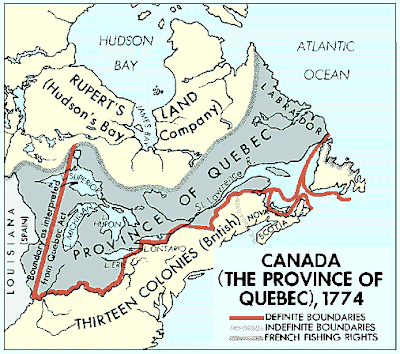
The Wisconsin Historical Society recalls that briefly, although now nearly forgotten, was Wisconsin’s time as part of Quebec:

On this date B[in 1774] Britain passed the Quebec Act, making Wisconsin part of the province of Quebec. Enacted by George III, the act restored the French form of civil law to the region. The Thirteen Colonies considered the Quebec Act as one of the “Intolerable Acts,” as it nullified Western claims of the coast colonies by extending the boundaries of the province of Quebec to the Ohio River on the south and to the Mississippi River on the west. [Source: Avalon Project at the Yale Law School

Philosopher Matt Zwolinski on ‘Bleeding-Heart Libertarians,’ The Poor, and Social Justice

I’ve posted before on libertarian professor Matt Zwolinski’s left-of-center libertarianism (see, from the Daily Caller, Seven reasons progressives should be more libertarian).

Here’s a video where he discusses so-called ‘bleeding heart’ libertarianism. Although I don’t think of myself as more of a left or more of a right-of-center libertarian, there’s nothing in Zwolinski’s emphasis on social justice that I wouldn’t support. (I think he’s surely mistaken to deprecate natural-law libertarianism, but that’s a different matter.)

In any variety, libertarianism offers genuine hope to the poor and distressed, free from the self-interested schemes and machinations of government officials, each successive scheme only increasing the misery and reducing the liberty of our fellow citizens.

Most libertarians naturally care about social justice, beginning in their steadfast support of the rights and equal opportunities of each and every person. From our concern for individuals comes also our concern for society.

We are not – and we should never be – reticent about our concerns for the poor or disadvantaged.

Daily Bread for 10.6.11

Good morning.

It’s a sunny day ahead for Whitewater today, with a high of seventy-eight.

There’s a Police Commission meeting tonight at 6 p.m.  The agenda is available online.

Well, it’s a game five in the Brewers-Diamondbacks series, although I erroneously thought the Brewers would win in four.   That leaves the 27.03% who answered last week’s poll that they’d win in five, or the 10.81% who answered that this wasn’t their year, with a chance to be right about how the series will go.

Scientists at Duke University are working to create artificial limbs for people so that recipients  will be able to feel the sensation of touch when using those prosthetics.  A step in that research involves testing the technology on primates. The Duke researchers have had preliminary success with animals.  See, Monkeys Control Virtual Limbs With Their Minds:

Although real-life brain-controlled prosthetics that enable a person to, say, pick up a pencil continue to improve for amputees, limbs that can actually feel touch sensations have remained a challenge. Now, by implanting electrodes into both the motor and the sensory areas of the brain, researchers have created a virtual prosthetic hand that monkeys control using only their minds, and that enables them to feel virtual textures.

How’s that new Congress doing?

If the question is how well it’s controlling spending, the answer is that it’s doing great work a terrible job:

Republicans took over the U.S. House last November, and as a result, government spending finally dropped.

Whoops….Government spending actually increased!

They haven’t reported the final numbers yet, but FY 2010 spending was $3.456 trillion, and FY 2011 spending was most recently projected to come in at $3.597 trillion. That’s a 4% increase.

Remember, there was no budget passed last year. That means that most of the FY 2011 spending occurred with the approval of the newly-elected Republicans….

Daily Bread for 10.5.11

Another sunny day, with a high of about seventy-seven, for Whitewater.

Whitewater’s Landmarks Commission meets today, at 5 p.m.  The agenda is available online.

On this day in 1846,

Wisconsin’s first state Constitutional Convention met in Madison. The Convention sat until December 16,1846. The Convention was attended by 103 Democrats and 18 Whigs. The proposed constitution failed when voters refused to accept several controversial issues: an anti-banking article, a homestead exemption (which gave $1000 exemption to any debtor), providing women with property rights, and black suffrage.

The following convention, the Second Constitutional Convention of Wisconsin in 1847-48, produced and passed a constitution that Wisconsin still very much follows today. [Source: The Convention of 1846 edited Milo M. Quaife]

We should have adopted the constitution proposed at the first convention.