
Glenda Moore has a large repository of great information about cats over at CatStuff: Information Library about Domestic Cats.
Enjoy.
Glenda Moore has a large repository of great information about cats over at CatStuff: Information Library about Domestic Cats.
Enjoy.
Good morning.
Whitewater’s forecast for today calls for a mostly cloudy day, with a high temperature of thirty-three degrees.
It’s the last day of spring break, for our school district and campus.
Some of the UW-Whitewater faculty are walking to Madison with message for Gov. Walker. They’re walking the forty-three mile distance over these last few days. That’s news, and it’s campus news, but you’ll only find it in at a legitimate newspaper.
Over at Wired, there’s a video of the coldest and farthest brown dwarf, really a failed star, ever discovered.
Last Friday, there was a protest rally in Whitewater, along Main Street, and over one-hundred fifty people attended. See, Scenes from a Whitewater Rally, 3.18.11.
That’s a large number for Whitewater — especially on a Friday evening as work was ending — and larger in ways worthy of mention.
First, the pro-union gathering was one of two in Whitewater recently, with an earlier one having about ninety attendees. It’s significant that this outdoor rally drew more than the first, indoor meeting — these residents are part of a growing movement.
Second, the March 18th meeting came after Gov. Walker signed his budget repair bill. The signing ceremony didn’t slow protests down; they were larger in Madison and Whitewater after the signing ceremony.
Third, there’s no bureaucratic event that Whitewater’s town squires have backed that’s of this size. When they organize something like a meet-and-greet for someone, the attendance tops out at about fifty. That’s their limit — about 50.
By contrast, a true community event, like a civic or religious holiday, will draw hundreds. Not just a few of the same self-important people, struggling to reach a total of fifty, but hundreds or more. Independence Day, Christmas, Easter, graduation, a science fair, football games — they draw large numbers.
The March 18th rally did, too — far larger than a staged event with only a few silly, so-called dignitaries.
No one told these attendees to gather — they read the news, followed legislation in Madison, talked with others, and decided to turn out. That’s an effort of the people, more than capable of deciding and acting for themselves.
There were a few employers in town who tried to scare their own workers into staying home from the March 18th rally. These employers are predictably small, insecure, and provincial. They think the world begins and ends with Whitewater’s town line.
It doesn’t.
The way of employers like this has no future. The closed, self-promoting, rationalizing habits of these bloated abercrombies will claim fewer victims in the next generation.
It must be disconcerting to them to witness local events they cannot control, or even understand.
There is, however, a good description for events like the March 18th rally:
It’s what democracy looks like.
Whitewater’s tired, stodgy town fathers, and chief bureaucrat, aren’t really conservative or liberal: they’re simply reactionary.
So when a few working people came to town, to protest lawfully near a politician’s house, one read about this as though Whitewater were besieged by barbarians by pickets(!) from Milwaukee.
That’s Milwaukee, Wisconsin and Madison, Wisconsin — as though Madison or Milwaukee were on Mars. Has no one from Whitewater been to Marquette, or Summerfest, or a Bucks game? Has no one from Whitewater been to UW-Madison, or the Kohl and Alliant centers? Intimating that people from these cities are somehow sinister interlopers is too funny.
They are Wisconsinites, as Whitewater’s residents are.
They are working people, as we have in town.
Had they represented the slightest danger, or committed any crimes, they would have been arrested. They didn’t, and so they weren’t.
Like the vast numbers at the Capitol, they were peaceful.
But if one obstinately believes that protesters are thugs, then it leads to all sorts of political mistakes.
When protesters came to Rep. Wynn’s house, he took umbrage, and one saw on the website of a Wynn-supporter pictures of the protesters on one side of the street, and Wynn and his supporters on the other.
This was meant to be clever, to show that Wynn had anticipated the protesters’ arrival.
It might have been far sharper if, in the photo of Wynn’s supporters, one saw a coffee urn and donuts for anyone protesting. Wynn would have shown that he anticipated the protesters’ arrival, but that he was non-plussed about their presence.
Unfortunately, ire overcame a truly sharp photo, and so Wynn stuck to the contention that the very presence of the protesters was illegitimate.
To make the point clear, the supportive website assured nervous, quaking readers that those savages from another city were met with a heavy police presence.
It was a tone-deaf response.
It makes one wonder if result in the last election for the 43rd was simply dumb luck, and that the new incumbent won’t be able to deftly manage the tensions within a narrowly-held district.
Over a month ago, I wrote a first take on the politics of cuts to state shared revenue. See, Cuts to State Shared Revenue: Whitewater’s Politics of It All (First Take).
Much has happened since then.
Of the school district, I noted previously that
There are so many better and higher tasks than labor disputes, but neither the leadership of the district (administrator and board) nor the faculty (union leaders and other teachers) may have the chance to pursue them. Cuts will likely preoccupy the district, and leadership and negotiation will require more tactical skill than vision.
Neither teachers nor administration seem ready for protracted conflict, and they may be so unready that they prove unwilling, and changes come without much fuss.
One can guess that there was fuss, stress, and tension to produce an extended contract for teachers and other employees, but it was the right thing to do. Hard, but right.
Preservation of collectively bargained rights, at least for two more years, was a good decision. These rights should never have been taken away, as an imposition on communities who never asked for this anti-association measure.
Note that those who talk about budgets, rather than limited government, don’t see rights of association as meaningful. For them, it’s simply about balancing a budget, and if unions have to go, then unions have to go.
The right thing isn’t budget repair, but limited government; the right thing isn’t fewer freedoms, but more.
Liberty begets prosperity.
Conditions of liberty permit freedom of association for all workers, public or private.
As for estimates of whether these concessions are enough, I cannot say. It’s worth noting that on a recent swing through northern Wisconsin, Gov. Walker began to hint that if his projections proved wrong, then workers should simply give more. (So much for his earlier, professed certainty that his projections would be enough.)
Status quo incumbents will try to have things both ways — in favor of both Walker’s restrictions on collective bargaining and the extension of these contacts. One can argue for both, but only dishonestly. Gov. Walker doesn’t want contacts extended, and he’s said so more than once.
So, pick one: with Walker, and against the extension of collectively-bargained contracts, or with the extension of contracts as a preservation of freedom of association (and against Walker’s statewide meddling with local matters).
New contracts were the right choice, as they preserve bargained contractual rights, and assure workers more freedom than this governor is willing to permit otherwise. That they involved cuts in compensation was inevitable in these tight times. Workers can – and will – make concessions without the necessity of losing their bargaining rights.
Communities should have come to these decisions without being forced to do so from the state administration.
Incumbents who contend they need the governor’s ‘budget repair’ legislation should admit that they have been incompetently managing employee negotiations previously.
Those who have been managing well don’t need Walker’s professed help; those who have been managing poorly deserve no more authority than the power they now possess.
One wouldn’t give a drunk more alcohol, and incumbents who have misused their existing authority don’t need even more from Gov. Walker.
Good morning.
It’s a mostly sunny day with a high of about thirty-two degrees in store for the Whitewater today.
In Wisconsin history, the Wisconsin Historical Society reports that Wisconsin resident Harry Houdini was born on this day, in 1874:
1874 – Harry Houdini Born
On this date magician Harry Houdini was born in Budapest, though he later claimed to have been born on April 6, 1874, in Appleton, Wisconsin. At the age of 13 he left Appleton, where his family had emigrated, for New York City, and began his career as an escape artist and magician. [Source: Outagamie County Historical Society].
Google marks the occasion of Houdini’s birth with a doodle and a link to a biography.

Good morning.
It’s a rainy and cold day for Whitewater, with a high temperature of thirty-seven.
The Wisconsin Historcal Society recalls that on this day in 1865
the 21st Wisconsin Infantry, made up mostly of soldiers from the Oshkosh area, finished fighting their way through the South during Sherman’s March to the Sea and reached Goldsboro, N.C., where the campaign in the Carolinas ended. Its veterans reunited 40 years later in Manitowoc. [Source: 21st Wisconsin Infantry homepage]
If you’ve been wondering about the physics of burrowing sandfish, ScienceNews has all the information you’ll need. In an article entitled Physics of burrowing sandfish revealed, Daniel Strain writes that
The sandfish lizard wriggles through desert sands like a sci-fi monster. Now, using computer simulations and bendy robots, researchers at Georgia Tech in Atlanta have taken the most complete look yet at the everyday physics of burrowing animals. And, boy, does this reptile wriggle, the team reports online February 23 in the Journal of the Royal Society Interface. “This particular behavior is built for speed,” says physicist Daniel Goldman, one of the study coauthors.
Here are two videos that show the lizards in action —
Quick getaway from Science News on Vimeo.
A desert di. from Science News on Vimeo.
Walworth County Administrator David Bretl writes a column at Walworth County Today. His latest offers this observation on municipal spending —
The public has become desensitized in recent years regarding the true meanings of the words freeze and cuts. Tax rates for counties, for example, have been “frozen” for many years at 1992 levels. While that sounded like fiscal restraint, it meant that taxes were generally allowed to increase at the same rate as property values. During much of the past decade, as property values grew around the state at double-digit annual rates, property taxes escalated, as well.
Over the years, various governors have implemented “freezes” of their own. The latest one limited the annual growth of most municipal levies to 3 percent. Likewise, governments got in the habit of referring to limiting projected increases in spending as cuts. There’s a big difference. If I spent a dollar on something last year and plan to spend 90 cents this year, I have cut spending. If I spent a dollar this year and anticipate that I will need to spend $1.10 next year, but instead spend $1.05, I have not cut spending by a nickel….
My only point is that despite the use of the terms “freeze” and “cuts,” local government spending was generally increasing….
True enough.
Bretl also contends that calling the actual increases of these last years cuts was not meant to be dishonest.
One can’t tell whether it was meant to be dishonest; one can be sure it was false.
In a city like Whitewater, there’s been so much puffery and distortion on municipal finances from its city manager that an encounter with the truth will be like meeting someone for the first time.
Good morning. It’s a rainy day for Whitewater, with showers and a high temperature of thirty-nine degrees.
Today is a proud day in our history. It’s the birthday of Eugene Shepard, of whom the Wisconsin Historical Society offers an account —
On this date Eugene Shepard was born near Green Bay. Although he made his career in the lumbering business near Rhinelander, he was best known for his story-telling and practical jokes. He told many tales of Paul Bunyan, the mythical lumberjack, and drew pictures of the giant at work that became famous. Shepard also started a new legend about a prehistoric monster that roamed the woods of Wisconsin – the hodag. Shepard built the mythical monster out of wood and bull’s horns. He fooled everyone into believing it was alive, allowing it to be viewed only inside a dark tent. The beast was displayed at the Wausau and Antigo county fairs before Shepard admitted it was all a hoax. [Source: Badger saints and sinners, by Fred L. Holmes, p.459-474]
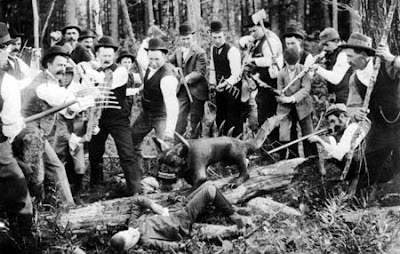
The hodag’s become the mascot for Rhinelander, Wisconsin, and a music festival, the Hodag County Festival, that carries the animal’s name (34th annual festival to be held this July 7-10).
Deranged misfits compare cats to gypsy moths or kudzu.
Via New York Times.
Alzheimer’s Association Introduces In-Depth Training for Family Caregivers
-Six Week Course to Offer Education on Caring for an Older Adult-
The Alzheimer’s Association will be offering “The Savvy Caregiver” a six-week program designed to provide clinical level education and training for family caregivers. The series will be held on consecutive Wednesdays beginning April 13, 2011 through May 18, 2011 from 3:30 to 5:30 p.m. at People’s Bank, 837 N. Wisconsin Street in Elkhorn. This workshop is open to family members who are providing care for a loved one with Alzheimer’s disease or a related dementia.
The Savvy Caregiver training program is a unique approach to family caregiver education. The central concept is the notion of strategy. Throughout the program caregivers are urged to learn, develop and modify strategies to accomplish the goal for their particular caregiving situation. Participants will come away with increased personal knowledge, skills to assess abilities of a loved one with dementia, confidence to set and alter caregiving goals, strategies to manage activities of daily living, and perspective on the course of Alzheimer’s and other related dementias.
Advance registration is required. The cost to attend is $30, which includes a caregiver manual and CD. To register, please contact Bonnie Beam Stratz at 920-728-4088 or send an email to bonnie.beam@alz.org.
The Alzheimer’s Association is the leading voluntary health organization in Alzheimer’s care, support and research. Our mission is to eliminate Alzheimer’s disease through the advancement of research; to provide and enhance care and support for all affected; and to reduce the risk of dementia through the promotion of brain health. Our vision is a world without Alzheimer’s. For more information about Alzheimer’s disease and local services visit www.alz.org/sewi or call the Alzheimer’s Association 24/7 Helpline at 800-272-3900.
Good morning,
It’s the first full day of spring, and Whitewater’s forecast calls for an increasingly sunny day, with a high temperature of fifty-six degrees.
The Wisconsin Historical Society notes that yesterday, March 20th, was the Republican Party’s founding, in Ripon:
1854 – Republican Party Founded
On this date Free Soilers and Whigs outraged by the passage of the Kansas-Nebraska Act, met in Ripon to consider forming a new political party. The meeting’s organizer, Alvan E. Bovay, proposed the name “Republican” which had been suggested by New York editor Horace Greeley. You can see eyewitness accounts of the meeting, early Republican campaign documents, and other original sources on our page devoted to Wisconsin and the Republican Party. Though other places have claimed themselves as the birthplace of the Republican Party, this was the earliest meeting held for the purpose and the first to use the term Republican. [Source: History of Wisconsin, II: 218-219]