FREE WHITEWATER

Daily Bread for 4.5.23: Wisconsin & Whitewater Election Results

Good morning.

Wednesday in Whitewater will be rainy with a high of 65. Sunrise is 6:28 AM and sunset 7:26 PM for 12h 57m 26s of daytime. The moon is a waxing gibbous with 99.6% of its visible disk illuminated.

On this day in 1621, the Mayflower sets sail from Plymouth, Massachusetts on a return trip to England.


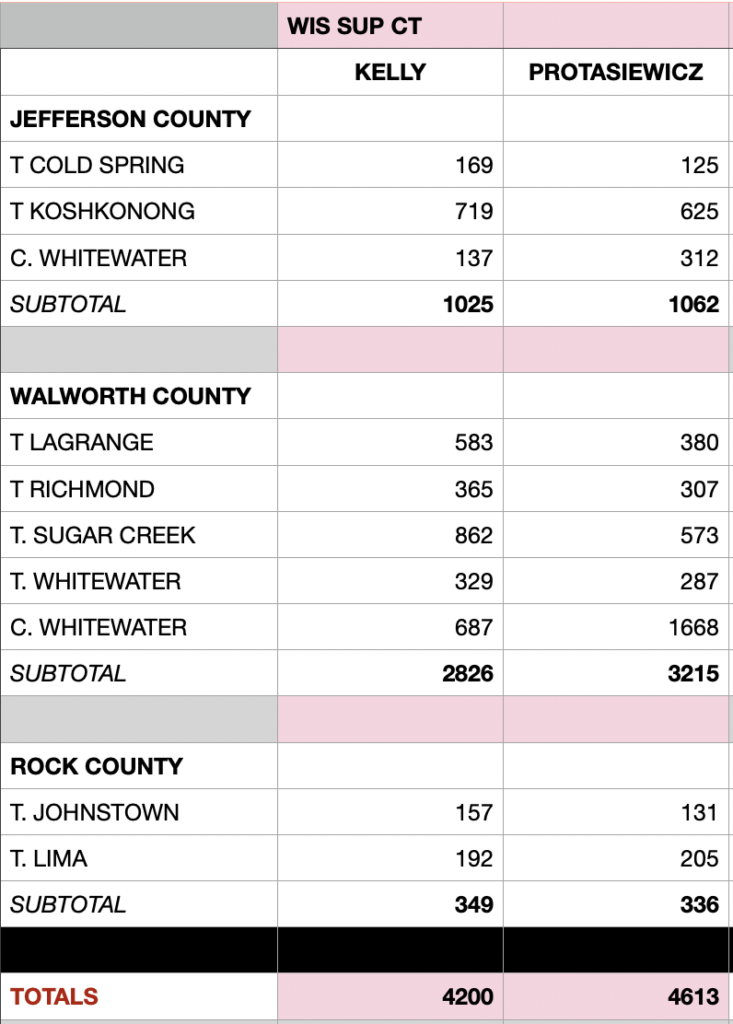
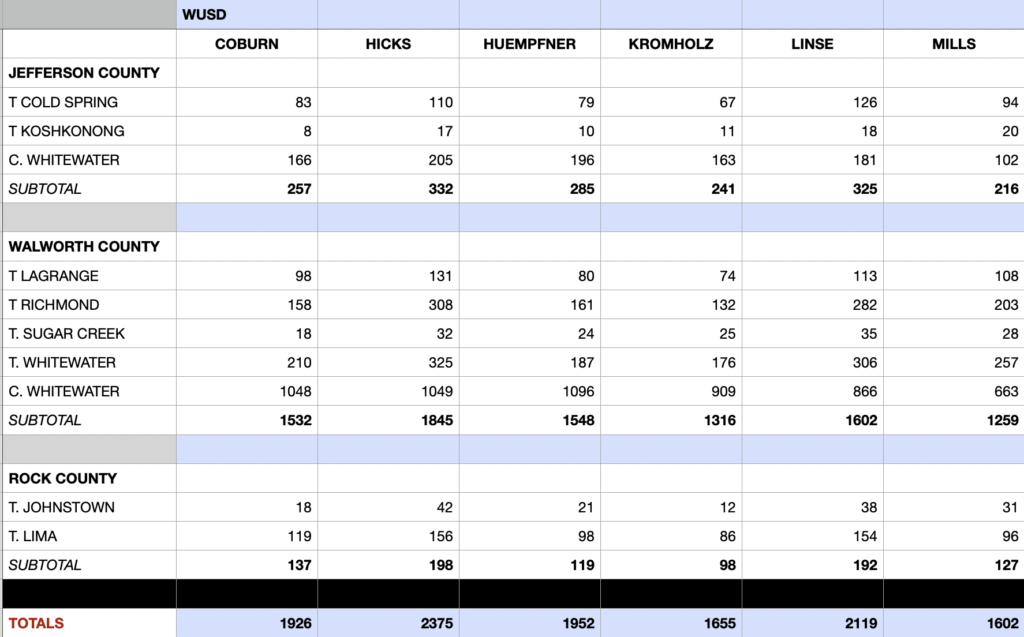
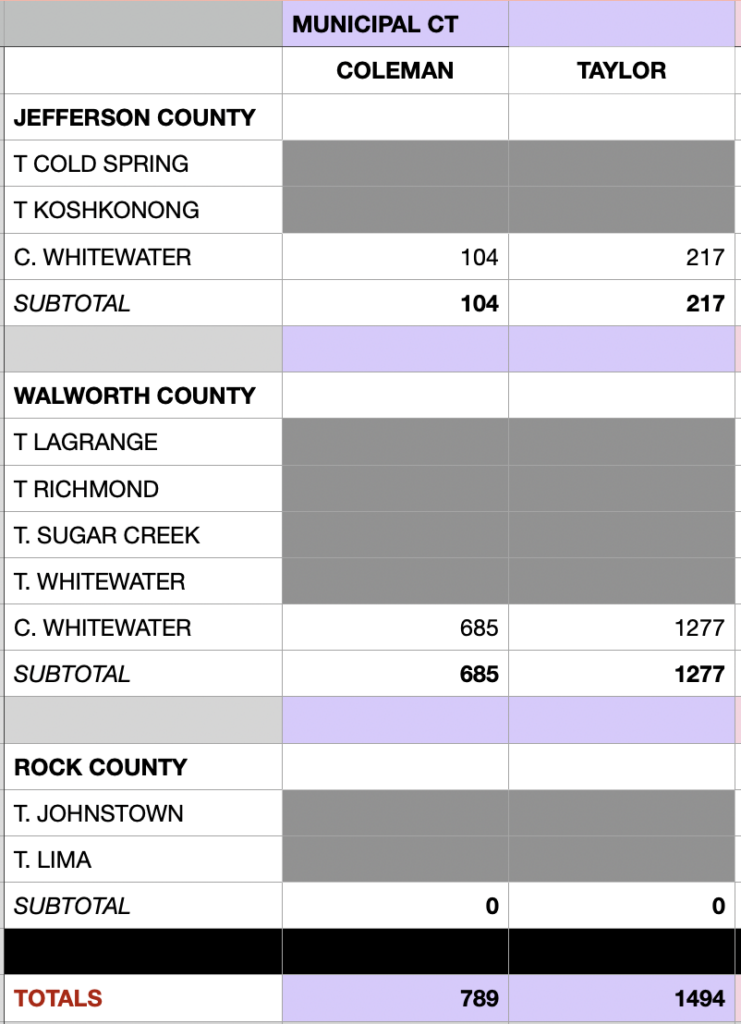
 Results below for Wisconsin statewide and Whitewater. Results only for today, with an assessment on Thursday. Unofficial results are from Jefferson, Rock, and Walworth counties. 

Wisconsin Supreme Court: Statewide, Whitewater, and in the Whitewater Unified School District.

Statewide

Whitewater and in the Whitewater Unified School District:

Whitewater School Board Race:

Whitewater Municipal Court Race:


Hubble captures amazing view of spiral galaxy that is 30 million light-years away:

[spacer height=”200px”]

Daily Bread for 4.4.23: How the National Press Sees the Wisconsin Supreme Court Race

Good morning.

Tuesday in Whitewater will be cloudy with a high of 60. Sunrise is 6:30 AM and sunset 7:24 PM for 12h 54m 34s of daytime. The moon is a waxing gibbous with 97% of its visible disk illuminated.

On this day in 1964, The Beatles occupy the top five positions on the Billboard Hot 100 pop chart.


 How the national press is covering the Wisconsin Supreme Court race:

New York Times: Wisconsin’s High-Stakes Supreme Court Race: What to Watch (‘The election for a swing seat on the court is likely to determine whether abortion remains illegal in Wisconsin, as well as the future of the state’s heavily gerrymandered political maps’).

Washington Post: Expensive court race will decide future of abortion in Wisconsin (‘Voters will decide Tuesday if conservative or liberal judges control the Wisconsin Supreme Court ahead of decisions on abortion and redistricting’).

Politico: Wisconsin’s record-shattering Supreme Court race barrels to an end (‘Voters could decide everything from abortion to the rules of the road for 2024 as they head to the polls for “the most consequential race facing Wisconsin in decades’).

Vox: The most important election of 2023 is for the Wisconsin Supreme Court (‘Why the Wisconsin Supreme Court election could have huge national implications’).


The driving test for driverless cars:

Daily Bread for 4.3.23: Fear & Bravado @ Mar-a-Lago

Good morning.

Monday in Whitewater will be rainy with a high of 57. Sunrise is 6:32 AM and sunset 7:23 PM for 12h 51m 41s of daytime. The moon is a waxing gibbous with 92.9% of its visible disk illuminated.

Whitewater’s Equal Opportunities Commission meets at 5 PM

 On this day in 1865, a day after Union forces capture Richmond, Virginia, President Lincoln visits the Confederate capital.


Inside Trump’s Reaction to Indictment:


US Economy Grows in Fourth Quarter, Despite Consumer Slowdown:

Daily Bread for 4.2.23: Making the Smallest Sculptures in the World

Good morning.

Sunday in Whitewater will be partly sunny with a high of 55. Sunrise is 6:33 AM and sunset 7:22 PM for 12h 48m 48s of daytime. The moon is a waxing gibbous with 87.2% of its visible disk illuminated.

 On this day in 1865, defeat at the Third Battle of Petersburg forces the Army of Northern Virginia and the Confederate government to abandon Richmond, Virginia.


Meet the man making the smallest sculptures in the world:

The artist Willard Wigan has been making sculptures for six decades, and yet his entire body of work could fit in the palm of your hand. His record-breaking micro-sculptures, which take months to complete, are made from fragments of pottery, flecks of gold and grains of sand. And if you think the statues are small, imagine the tools used to make them.

Willard has to craft them all himself, from hypodermic needles, shards of diamond and human eyelashes. Measured in micrometers, and almost invisible to the human eye, Willard has built worlds inside the eye of a needle – Mount Rushmore, the Last Supper, the Moon Landing to name just a few.

He also holds the world record for the smallest sculpture ever made which is the size of a single human blood cell. It’s a sculpture of a fetus carved from Kevlar, and placed within the hollowed hole of a single hair. Truly mind boggling.

When he was 50, Willard was diagnosed with autism, which he credits as his “super power” allowing him to see the world differently. He says he hopes his astonishing pieces will change other people’s understanding of the world too.


 What’s in the Night Sky April 2023:

Daily Bread for 4.1.23: Populism Doesn’t Apologize

Good morning.

Saturday in Whitewater will see morning snow showers with a high of 47. Sunrise is 6:35 AM and sunset 7:21 PM for 12h 45m 55s of daytime. The moon is a waxing gibbous with 80.5% of its visible disk illuminated.

 On this day in 1865, Union troops led by Philip Sheridan decisively defeat Confederate troops led by George Pickett, cutting the Army of Northern Virginia’s last supply line.


 I’ve written about the character of populism. See Defining Populism, Conservative Populism Moves in One Direction Only, and Extreme Populism Presents as TrollingThe populists are forward-moving, always on the attack against perceived enemies, and they seldom reflect or apologize for their own conduct. People are not born as populists; they are taught and socialized into populism.

A story about a WISGOP prank illustrates populists’ unwillingness to apologize for conduct no matter how misguided. Molly Beck reports As Wisconsin braced for tornadoes, Republicans text ‘Wisconsin voter alert’ complete with emergency tones:

As southern Wisconsin braced for a tornado watch Friday afternoon, conservative Wisconsin Supreme Court candidate Dan Kelly and the Republican Party of Wisconsin issued its own emergency alert warning voters not to elect liberal Milwaukee County Circuit Court Judge Janet Protasiewicz on Tuesday.

The text message included a video that used alert tones and a scratchy radio voice found on official emergency alerts aired on television and radio. The screen read, “*** Emergency Alert System ***” and “Wisconsin Voter Alert” on the backdrop of differently colored bars that sometimes appears on screen when TV programming is interrupted. After three beeps, a voice says, “This is a State of Wisconsin voter alert. Attention citizens: our Second Amendment rights are under attack by Judge Janet Protasiewicz.”

….

According to the FCC rules, people and groups are barred from using emergency alert system codes or signals in “advertisements, promotional announcements, or other programming,” if the sounds are being used not in connection with an actual emergency, an emergency system test, or a public service announcement authorized to use such sounds.

The use of sounds intended to “mimic” “or are substantially similar” to the alert sounds so that an average listener could reasonably mistake the sounds for an actual emergency alert are also prohibited, according to the FCC.

Here’s a screenshot of the text the WISGOP sent during the tornado watch: 

Beck reports on the WISGOP response to criticism:

Republican Party of Wisconsin executive director Mark Jefferson said Democrats “need to stop insulting the voters’ intelligence.”

“Democrats should knock off the fake outrage and stop trying to stifle free speech.  It’s not going to paper over Janet Protaseiwicz’s abysmal soft on crime record,” he said.

The populists scavenge from the breaking of norms and the discomfort of perceived enemies. When the populists make a claim, however ill-timed or inappropriate, they’re quick to accuse others of fake outrage, or declare they have a right to say anything, anytime. By contrast, they’re equally fast to have conniptions when someone rightly points out their many errors. 

They’re for speech when it’s their speech. 

[spacer height=”40px”]

Jury to decide if Fox liable for defaming Dominion:

[spacer height=”400px”]

Daily Bread for 3.31.23: Oral Traditions and Modern Traditions

Good morning.

Friday in Whitewater will be rainy with a high of 67. Sunrise is 6:37 AM and sunset 7:20 PM for 12h 43m 01s of daytime. The moon is a waxing gibbous with 71.9% of its visible disk illuminated.

Whitewater’s Finance Committee meets at 4:30 PM

 On this day in 1774, Great Britain orders the port of Boston, Massachusetts closed pursuant to the Boston Port Act.


 Writer Joe Ragazzo recently recommended a link to a story from Elie Dolgin about the accuracy of an oral history. The accuracy of that oral history offers a tale for us, too. Dolgin reports that DNA Confirms Oral History of Swahili People:

A long history of mercantile trade along the eastern shores of Africa left its mark on the DNA of ancient Swahili people.

A new analysis of centuries-old bones and teeth collected from six burial sites across coastal Kenya and Tanzania has found that, around 1,000 years ago, local African women began having children with Persian traders — and that the descendants of these unions gained power and status in the highest levels of pre-colonial Swahili society.

The findings help elucidate the foundations of Swahili civilization, and suggest that long-told origin stories, passed down through generations of Swahili families, may be more truthful than many outsiders have presumed.

“The genetics corroborate the Swahili people’s own history that they tell about themselves, not what others were saying about them,” said Esther Brielle, a geneticist and postdoctoral fellow at Harvard who led the DNA analysis with her adviser, David Reich.

These findings corroborate those of other, ancient oral histories that have proved more accurate than we, today, might have expected.  See also from Stephen Nash, The Underestimated Reliability of Oral Histories (‘Not only written narratives have stood the test of time’). Nash writes:

When I entered graduate school as an archaeologist in the late 1980s, I was told in no uncertain terms to discount the narratives from Native American oral history. Why? Largely because of the children’s game of telephone. (If case you’ve forgotten: Get a bunch of kids in a circle. Tell one a secret. Tell her to tell the person next to her. Repeat until you come all the way around the circle. By the time the secret gets back to you, it’s totally changed, if not unrecognizable.) Though it is a compelling and seductive argument-by-analogy, it’s overly simplistic and belies a fundamental misunderstanding of how oral history actually works in human societies. History is not kept by children playing games. It’s kept by specialists.

If you are the keeper of history in a society that does not have a written language, your job is to preserve the story verbatim. You have to apprentice and train for many years, and you have to go through tests and approval processes before you are deemed qualified to serve as keeper.

(Emphasis added.)

There it is: we sometimes discount other or older traditions because we fail to see the level of skill practitioners of those traditions possessed.

Overestimating some, and underestimating others, it seems, is part of our tradition. 


Sun blasts X1.2-class solar flare – See it in multiple wavelengths:

Friday Catblogging: Cats Film Their Own Stunts

Amelia Nierenberg reports These Cats Do Their Own Stunts. They Film Them, Too. (‘With the help of cameras that attach to collars, a niche style of cat content shows the world from a feline perspective’):

In one video, the athlete pauses, assesses the height and leaps. He tries to free-climb up the side of a building, before jumping back to the ground. In another, he leaps across a roof, his shadow stretching out long in front of him.

This gymnast, though, is a cat. Specifically, he’s Gonzo of @gonzoisacat. He has more than 607,000 followers on TikTok and 178,000 on Instagram.

Gonzo is the star — and the director — of his own shorts. Rather than his owners filming his stunts, Gonzo can capture them himself with the help of a tiny camera that attaches to his collar. The result is an extreme sports cinéma vérité-style documentary from a cat’s perspective. And it’s catching on online.

In Norway, a GoPro-wearing cat roams across snowy meadows or climbs on a roof. One in China also recorded under-the-chin videos. Another catfluencer named Mr. Kitters has 1.5 million followers on TikTok and nearly one million on Instagram, where viewers can watch him meow at a bird or chase a squirrel.

Here, Gonzo and a friend explore the rooftops:


View this post on Instagram


A post shared by Gonzo (@gonzoisacat)

[spacer height=”100px”]

Daily Bread for 3.30.23: The Dictator’s Little Helpers

Good morning.

Thursday in Whitewater will be partly cloudy with a high of 50. Sunrise is 6:39 AM and sunset 7:19 PM for 12h 40m 08s of daytime. The moon is a waxing gibbous with 62.4% of its visible disk illuminated.

 On this day in 1867, Alaska is purchased from Russia for $7.2 million, about two cents/acre ($4.19/km2), under the negotiations of United States Secretary of State William H. Seward.


 Dictators don’t rule their societies on their own. They rely on more than a few oligarchs, and more even than an army or secret police. They are aided immeasurably by the prying eyes of citizens turned informants. Polina Ivanova reports ‘Total distrust’: rise of the Russian informers (‘Teachers, neighbours and even family members are turning to Soviet-style denunciations in wartime Russia’): 

People across the country have been reported to authorities for expressing dissenting views in private or in closed settings. Teachers have reported pupils; students have informed on professors and fellow classmates; neighbours, colleagues and even family members have filed complaints. Although still unusual enough to warrant local media coverage, informing is rapidly becoming commonplace, fuelled by calls from the Kremlin and propaganda outlets to hunt for “domestic traitors” and “saboteurs” of Russia’s war effort. Two weeks after the start of the invasion, Russia’s president Vladimir Putin told the Russian people that they “will always be able to distinguish true patriots from the scum and traitors”, and will “simply spit them out?.?.?.?on to the pavement”.

….

Since the start of the invasion of Ukraine, informers have become a key pillar of support for the Kremlin and a tool of control. With most public critics of the regime now silenced or in exile, denunciations allow the state to identify small-scale, private dissenters. On March 17, a 40-year-old man travelling on the Moscow metro was denounced by a fellow passenger, who oversaw him looking at images that “discredit the army” on his mobile phone. The man was arrested a few stations later. He was sentenced to 14 days in jail. Earlier this year, a couple discussing the war at a restaurant in the southern city of Krasnodar found themselves suddenly handcuffed by masked officers and thrown to the floor. Someone had reported their private conversation to the police. Roskomnadzor, the state censor, said it received 284,000 reports from citizens in 2022, of which “the majority concerned illegal information posted on the internet, including fakes about the special military operation in Ukraine”. That figure does not include reports made to the police or FSB security service.


Drone video released by Ukraine shows Bakhmut in ruins:

Daily Bread for 3.29.23: There Will Be Thirsty Computers, Not Employees, at that Data Center

Good morning.

Wednesday in Whitewater will be partly cloudy with a high of 36. Sunrise is 6:40 AM and sunset 7:17 PM for 12h 37m 14s of daytime. The moon is a waxing gibbous with 53.3% of its visible disk illuminated.

 On this day in 1974, NASA’s Mariner 10 becomes the first space probe to fly by Mercury.


 The Foxconn site hasn’t met its promise in Wisconsin, so various development types are scrounging around to find something to do with that empty space. The latest plan involves a data center from Microsoft. Sounds good, right? Big company, coming to Wisconsin… finally something good after empty promises of billions and billions in investment? No.

Corrinne Hess reports Microsoft is planning a $1 billion data center on Foxconn site. Here’s what we know about jobs, water use at data centers

Microsoft announced plans this week to purchase 315-acres to build a $1 billion data center on the sprawling Foxconn site in Mount Pleasant.

….

Data centers don’t require many workers

For the last 10 years, the Potawatomi Business Development Corp. has quietly operated a 45,000-square-foot data center at the former Concordia College campus on Milwaukee’s west side.

Inside are thousands of computers that store data for large and small private and public companies and the state of Wisconsin.

Despite the $30 million operation, only eight people work at the data center, said Ryan Brooks. vice president and general manager of Data Holdings Data Center, the company that operates the facility for Potawatomi.

“Data centers don’t bring a bunch of fanfair,” Brooks said. “It’s a big building for computers, not a huge number of employees. At the end of the day, the computers are doing the work.”

….

Data centers use as much water as small cities

Tens of thousands of computers in one space are hot.

Large amounts of evaporated water is used to keep computers from overheating and ensure data centers can run 24/7. This includes cooling towers, chillers, pumps, humidifiers and computer room air conditioners.

Venkatesh Uddameri, director of the Water Resources Center at Texas Tech University, told NBC News a typical data center uses three to five million gallons of water a day, the same amount of water as a city of 30,000-50,000 people.

Both Google and Microsoft have pledged to be more climate conscious by 2030.

This is good money after bad. The WEDC is wasting its time trying to convince anyone that the latest plan somehow alleviates past errors. It’s one long, ongoing fiasco, with new errors following old errors. 

See FREE WHITEWATER’s Foxconn category for a dedicated link about the chronic debacle that is Foxconn in Wisconsin.


How ‘Star Wars’ Creatures Come to Life:

Daily Bread for 3.28.23: The Whitewater School Board Election (7)

Good morning.

Tuesday in Whitewater will be partly sunny with a high of 45. Sunrise is 6:42 AM and sunset 7:16 PM for 12h 34m 19s of daytime. The moon is a waxing crescent with 44.2% of its visible disk illuminated.

 On this day in 1862, in the Battle of Glorieta Pass, Union forces stop the Confederate invasion of the New Mexico Territory.  


In one week, Whitewater will choose three school board candidates from among a field of six.

This might have been an election merely about educational fundamentals. So much to the good. 

This might have been an election, also, about the managerial approach of this superintendent and her administrators. There have been oblique references from some of the candidates to these concerns, but nothing so direct as someone who favors candid conversation would have wanted. Last year at FREE WHITEWATER, I wrote that the community needed direct, blunt discussions on managerial policy. See from 8.1.22 Two Postures, Two Approaches and my comments under that post. Everyone would have benefitted from that approach, however uncomfortable at first. It was a road not then taken. 

A discussion of a managerial approach, like one of educational fundamentals, would have been all to the good. Fair, calmly addressed, dispassionately considered.

As a rule, especially of the worst possibilities, it is better to know than to remain ignorant. Therein lies the outlook of the tragic optimist: fundamentally hopeful but expecting that life will present occasional losses and dangers.

Of all that this community did not need, it did not need bad interpretations and vulgar impositions. Those who wish to teach others would do well to first display a fundamental  and moral foundation. It would have been better — indeed, joyous to me — if prior warnings about shoving children into closets and banning books had been false and overwrought. 

They were not. 

Success begins as individual success, and rights are, fundamentally, individual rights. No horde with bad reasoning, bad reading, and bad interpretations has the right to impose a revanchist and retrograde policy on vulnerable and harmless students. No one wants a fight, but so help me this would be a fight worth fighting, for principles worth defending. 

The extreme populists think that a dominance and submission ritual, with repeated conniptions that no well-behaved child would dare exhibit, will cow others. It will not. 

A school board race, on terms of conventional educational and managerial policy? Fair enough, that’s much needed here.

An internecine culture war in this district, with a candidate who calls for regression? Wrong to begin, but right to defend against. Supporters throwing anything and everything at the wall — a torrent of lies, fallacies, and substandard English — to see what sticks? These overwrought men who flinch and squeal at even the slightest critique must think others are made of sugar.

So be it; it doesn’t matter half so much how these men think as how one responds. 

Reform, a new day, a fresh approach, etc.? some candidates are calling for as much. 

Reagan, quoting an old Russian proverb (doveryay, no proveryay) was right: trust, but verify.

This libertarian blogger will wait and assess specific and definite policies & actions, hoping for the best but, like all sensible residents, preparing otherwise. 

Daily Bread for 3.27.23: The Whitewater School Board Election (6)

Good morning.

Monday in Whitewater will be sunny with a high of 43. Sunrise is 6:44 AM and sunset 7:15 PM for 12h 31m 25s of daytime. The moon is a waxing crescent with 33.9% of its visible disk illuminated.

Whitewater’s Urban Forestry Commission meets at 4:30 PM

 On this day in 1915, Typhoid Mary, the first healthy carrier of disease ever identified in the United States, is put in quarantine for the second time, where she would remain for the rest of her life.


Parents reasonably hope that their children receive education in language, mathematics, and science. Determining how much they’ve learned often falls to standardized tests, including the ACT. These standardized tests are imperfect yet useful measures of overall performance. 

In today’s Wisconsin, where the ACT is administered to high school students (almost) universally, the test is not simply a measure of college readiness. That test is, instead, now a measure of high school students’ readiness of graduation. Some test like this, the ACT or another, is important to answer this question: what have high school students learned, and how well have they learned it?

If too much is made of college, then too little is made of high school. Whitewater High School should, regardless of a graduate’s next destination, teach language, mathematics, history, and science so that ‘every graduate [remains] an engaged, lifelong learner.’  (A fine motto the Whitewater district should not have abandoned.)

And so, and so, the community has legitimate concern over test scores. At the March 11th school board candidates’ forum, the second question was about measurement of academic performance: 

Question 2, 30:17: How do you plan to address low ACT scores, and below proficient scores in math and reading?

(Some years ago, when the ACT was not administered universally, a few gentlemen in this town thought that boosting scores among a small number of test takers would reflect well on Whitewater.  Certainly not. The success or failure of a high school program is measured among all, not among a few. Now that larger numbers of high school students are required to take the ACT, opportunities for cherry-picking have thankfully vanished. See Whitewater’s ACT Participation Rate Near the Bottom of Area Schools, The Better, Reasoned Approach on ACT Scores, and Whitewater’s ACT Scores.)

It’s not school board candidates, however, who have the key obligation to assure that students’ understanding of fundamentals is sound. It’s the superintendent, administrators, and faculty members. They are the ones who are employed full-time in our district. Each and every regular school board meeting in this district should have a report on academic progress, and what is being done to improve learning, and support those who are teaching. 

Broken boilers, quotes for new doors, etc. — those are brief discussions. (Someone gets three quotes, the board votes after a quick review, and the matter is settled. Time is irrecuperable.) 

There should be a place at meetings for awards and recognitions, but that place should not be larger or longer than a regular discussion of substantive academic progress. 

When progress toward better scores becomes the centerpiece of each and every regular meeting, leaders in the district will have an unavoidable opportunity to offer improvement plans. The more industrious and creative among them will seize that opportunity. 

Monday Music: NASA Data into Music

Via Here’s how it sounds when you turn NASA spacecraft data into music (‘The process of data sonification can help scientists better identify patterns in complex data and create beautiful music for the public’):

Since NASA’s Voyager 1 spacecraft became the first humanmade object to cross into interstellar space, researchers have poked and prodded at decades of its data beamed back to Earth from billions of miles away, gaining insight into the mysteries of our universe. Now, a particle physicist and professional flutist have transformed the waveform data of interstellar space — that dense soup of particles — into music fit more for a classical concert.

The new space jam, which premiered Thursday at the South by Southwest EDU conference in Austin, charts the moment Voyager 1 left the bubble around our sun and entered bustling interstellar space.

The melody, played by a solo flute, begins with smooth, connected notes (some using a legato) at a lower register to illustrate the data from inside our solar system. A gradual increase in loudness, or a crescendo, follows to indicate the spacecraft crossing the heliopause, or the boundary that leads into interstellar space. Then the melody becomes very high and changes shape, with more jumps to describe the busy interstellar space environment.

Daily Bread for 3.26.23: The Whitewater School Board Election (5)

Good morning.

Sunday in Whitewater will see scattered snow and rain showers with a high of 38. Sunrise is 6:46 AM and sunset 7:14 PM for 12h 28m 30s of daytime. The moon is a waxing crescent with 25% of its visible disk illuminated.

 On this day in 1812, a political cartoon in the Boston-Gazette coins the term “gerrymander” to describe oddly shaped electoral districts designed to help incumbents win reelection.


These recent years have seen discussion after discussion of liberty, of freedom. Liberty has been as misused these last few years as any noun in memory. Liberty is an individual right or it’s no right at all. The liberty of a person that depends on the group, the mob, the horde, is not a right of being free from others’ control. That sort of liberty is a mere chance, a favor from the group to the individual that may be pulled away at the group’s discretion. 

The populists talk much about liberty so long as they describe it in their own exaggerated, group terms. See Defining Populism and Extreme Populism Presents as Trolling. They insist they represent all people, all families, overwhelming majorities, etc., and invert a traditional burden of proof to demand that others disprove them. 

The supposed rights of an exaggerated majority aren’t an expression of individual liberty; they’re a justification of mob rule.

There’s a view in Whitewater that our schools should let students (or their parents) settle disputes about behavior on their own. (That’s not merely the view of one candidate, but of backers of some of the other candidates.) 

Quite plainly: the extreme populists hope that if they can do whatever they want they’ll be able to intimidate others into conformity (students in the hallways, parents in meetings). All the while, these extremists will duplicitously describe themselves and their children as the real victims. 

The plain truth is that they’ve had some success with this approach already. Some of them crave more. So close they can almost taste it: what books can they ban, into what closets can they shove a harmless minority? 

Not everyone sees matters this way, even on the right. 

Consider a portion of the response of candidate Stephanie Hicks to Question 4 from March 11th school board candidates’ forum, video at 1:01:07 (“Minority and LGBT students exist in this community and deserve respect and to not feel ostracized. Can you commit to supporting all Whitewater students and making sure they have a voice? And then how would you work to make sure all students are accepted and supported?”):

Well, of course, my answer is yes. I mean, I think we forget, these are children, these are children 18 years and younger, who are sitting in our schools, who are coming to our educational institutions, wanting to learn, the desire to learn, the desire to be included, the desire to make friends. And of course, we have to, we have to be able to support all of those realms of whatever it is in. And so I always get hung up on the idea of like, we are there still children.

And I mean, no matter what your sexual preferences, your race, your religion, whatever the case is, it still remains the same. Like we have to be welcoming to all that enter our schools, we have no idea what happens outside the walls. And in some we do, what happens the other 20 hours that they’re at home, and all the things that they’re bringing in all those places, they’re bringing all that trauma they’re bringing, we have to be able to acknowledge that and support that.

And I think what I would do, again, I don’t disagree, I think we have to have policies in place that make sure every student that walks through that door is safe, and that they feel supported, and that they feel welcomed. And it is a safe haven. I mean, I’ve said this millions of times, and I’m a teacher, myself, sometimes the only safe haven a child has is school, because when they leave that school, we have no idea what they are facing, and it basing things that no child should have to face. Those are adult issues that most children are facing on a daily basis. And so we need to make sure that there is at least one place that they feel safe.

Stephanie Hicks and this libertarian blogger might have a hundred ideological differences, but there would be no disagreement between her remarks here and my own views. (Note well: education is not my field, and in contrast to her background as a teacher, I approach all this from a different professional perspective,) 

Now consider this portion of the closing remarks from candidate Chuck Mills, video at 1:29:03:

Well, I think that we need to get down to the business of building morale. In our school system, we got to pick it up. You got to make people proud of what they’re doing. You got to make people looking forward to coming to work every day in teaching and learning. We need to reward the exceptional people, students, faculty, administration. We need to celebrate this.

We need to get away from all these distractions. We have a lot of resources, a lot of good teachers and faculty administration and we need to get back to the to a model of simply educating and let’s make it fun. And let’s, let’s not worry about micromanaging every little single thing that’s happening around us or following a narrative, whether it be federal or union or whatever, it all comes down the pipeline, it sounds the same in every community. I don’t know where it came from, it wasn’t here 10 years ago, and all of a sudden, in 10 years, we have all this going on. Could we be the first ones to say, No, we don’t want to do it anymore. That’s kind of where I’m at with this thing. If we could all just get along and get back to the teaching these kids, making them feel comfortable.

These aren’t the same sort of answers. The former accepts that students are as they are; the latter erroneously speculates that students are what external forces have made them.

No and no again: the fundamental natures of these students come from within, not from without. One sees more of their natural expression because they have been, rightly, free to express themselves in their natures.  They’re not made; they’re born.

Now here’s a political truth about these two candidates. If Mills should win, he’ll receive less ongoing criticism for his views from the center-left (as they’ll write him off as out-of-touch) than Hicks will for her views from the extreme populists (as they’ll expect her to conform to their views despite her professional background).  

Upside down.