FREE WHITEWATER

Whitewater’s Planning Commission Meeting from 5/10/10: Residential Overlay

At Item 10 of the May 10th Planning Commission meeting, the Planning Commission considered a residential overlay ordinance, that would place greater restrictions than there would be, for example, in a conventional R-1 zoning district. (Two or fewer unrelated persons living in the single residence, rather than three or fewer persons.) The item stated that the Commission would

[H]old a public hearing to consider a change of the Zoning Ordinance regulations, to enact proposed amendments to the City of Whitewater Municipal Code Chapter 19, by creating Chapter 19.25, R-O Non-family Residential Overlay District. Said District will provide the City of Whitewater with an option to impose a restriction on designated areas of the City, after a public hearing is held, that will limit non-family households to 2 or less [sic] unrelated individuals.

Here are sundry remarks on the discussion of an overlay, a discussion that beings at about 74:00 in the city’s recording of the meeting. (The video recording of the meeting is available at http://blip.tv/file/3624624. The meeting’s agenda is available at Planning Commission Agenda & Attached Documents.)

A Campus Town. Rental housing has been a contentious topic in Whitewater for years, and so it remains. This overlay won’t change that. We’re a campus town. That’s why we have so much rental property relative to single family housing. Single family housing near a campus is susceptible of conversion because of its proximity to campus. When residents of a neighborhood complain about rental housing, they should look out their windows, and think about where they live. It’s next to a university. That’s why their neighborhood is attractive to buyers looking for rental housing, or current owners thinking about renting their homes.

Voluntary Transactions. There are no successful sellers without willing and able buyers. There wouldn’t be any rental housing in some of these neighborhoods without a high demand for it. That demand has continued, and that’s why some residents seek overlay restrictions: they don’t like the voluntary transactions of others, and seek to stop those free and cooperative exchanges.

Instead of restricting the economic liberty of others, they should find a place where they can live without inhibiting the economic opportunities of buyers and sellers.

Rather than decide for their properties alone, they seek an imposed rule to prevent others from free transactions and free association. They may only own one house, but they want to decide for others’ houses, too. Those favoring restrictions haven’t the means to purchase all the houses in a neighborhood themselves, so they want to use government to compel everyone (including those who paid for their own homes) to accept a restrictive policy.

Whitewater’s not talking about the underprivileged needing government services, either. These are property owners who want to use ordinances to restrict the free activities of others. If local government has a place other than public safety, then it should be to provide limited services to the poor, and it might do other things, too, short of telling owners how they can sell the property they bought with their earnings.

(That’s part of what’s absurd and disgraceful about Whitewater’s city manager once saying that these housing issues were the city’s biggest problem. No, and no again. We have above-average child poverty in Whitewater, and that’s a bigger problem than this rental housing issue. It’s morally obtuse to think otherwise. I’m very sure that many proponents of this ordinance would see that there are bigger issues in the city. That our city manager once said otherwise is simply ridiculous, and likely just ignorant pandering.)

These are property owners, using government as a cudgel and crowbar, to get their way, over other owners and prospective owners.

They are very happy with private property for themselves, but quick to interfere through legislation with others’ property.

Short Memories? I know that this proposal might be applied anywhere, but it’s the Starin Park neighborhood that’s been pushing this measure. There’s no secret in that. Only nine months ago, in August, Whitewater’s paid planning consultant proposed, on August 17th, a series of neighborhood preservation zones that would not have included the Starin neighborhood near campus. I find it unpersuasive that that same consultant now contends that the Comprehensive Plan always contemplated this outcome.

Not for the Starin neighborhood, it didn’t — and that’s one reason the neighborhood association is driving this proposal so strongly.

How Whitewater Got Here. I’m not surprised that we’re here, with a neighborhood association wanting an overlay ordinance. (I know that this ordinance might be applied anywhere.) Rental registration, supposedly strict enforcement of existing zone regulations, flyers, education programs, more talk about enforcement, etc.: yet here we are, with a special interest group seeking more restrictions.

They’re back seeking because everything else this city has done, in enforcement or otherwise, has been inadequate. For a municipal administration that once proclaimed this as our greatest problem, they’ve not made much progress. Spending time and wasting taxpayers’ money on marquee projects like the Innovation Center has been a triple waste: of tax funds and debt for the Center, of failure to address housing issues, and (worst of all) of ignoring greater problems of poverty and the inadequate administration of justice.

Applied to One Property? Beginning at 82.10, hears that this overlay could be applied to a single property. I’m sure it could; I’m equally certain how absurd that would be.

Wrong Standard for an Ordinance. There’s much that’s absurd about the contention — from the city of attorney, of all people — that under an ordinance one “could do a lot of crazy things.” I’m not sure whether he should be commended for his accurate assessment of Whitewater’s political culture, or criticized for his inability or unwillingness to help craft an ordinance that couldn’t be used in a “crazy” way. Too funny, all around.

By the way, legisaltion that’s so broad that one has to hope, or expect, that it will be used judiciously is legislation that’s too broad. When a politician says that enforcement will have to be careful, he should ask himself in what town he lives. It was a failure of this administration over many years, of enforcing too loosely and too strictly by turns, that exacerbated this problem. Now one is to hope that this new proposal, should it finally become law, will be enforced carefully?

Careful is not something Whitewater does very well, and it’s laughable to hope for what we have yet to see.

Past is prologue.

“Effectiveness” Breeds Only Failure. Let’s assume that a part of the city, like the Starin neighborhood, does face tremendous pressure to its current character, that can and should be overcome by an overlay. If the pressure is that great, and the ordinance is so effective, then does anyone doubt that the demand for rental housing will simply be diverted elsewhere in the city?

Those neighborhoods feeling demand diverted from another area will want their own overlays. One will beget another, until all the city will have one. After it all, we’ll still have unmet rental demand, and homeowners who will be unable to sell at a good price to meet that demand.

The Dissent Over Individual Rights. Finally, there is a longstanding federal case, that addressed restrictions like this, years ago having been imposed in New York. See, Village of Belle Terre v. Borass, 416 U.S. 1 (1974). The court’s majority opinion held that the residential restrictions under review in that case where legally valid under the United States Constitution. I don’t doubt that this overlay would be lawful, excepting only application to ludicrously small areas.

Still, I find that parts of Justice Marshall’s in dissent in Belle Terre are persuasive, as he wrote about the damage that such restrictions on residential arrangements did to freedom of association:

I am in full agreement with the majority that zoning is a complex and important function of the State. It may indeed be the most essential function performed by local government, for it is one of the primary means by which we protect that sometimes difficult to define concept of quality of life. I therefore continue to adhere to the principle of Euclid v. Ambler Realty Co., 272 U. S. 365 (1926), that deference should be given to governmental judgments concerning proper land-use allocation…..

I would also agree with the majority that local zoning authorities may properly act in furtherance of the objectives asserted to be served by the ordinance at issue here: restricting uncontrolled growth, solving traffic problems, keeping rental costs at a reasonable level, and making the community attractive to families…. But deference does not mean abdication. This Court has an obligation to ensure that zoning ordinances, even when adopted in furtherance of such legitimate aims, do not infringe upon fundamental constitutional rights….

My disagreement with the Court today is based upon my view that the ordinance in this case unnecessarily burdens appellees’ First Amendment freedom of association and their constitutionally guaranteed right to privacy. Our decisions establish that the First and Fourteenth Amendments protect the freedom to choose one’s associates. NAACP v. Button, 371 U. S. 415, 430 (1963). Constitutional protection is extended, not only to modes of association that are political in the usual sense, but also to those that pertain to the social and economic benefit of the members. Id., at 430-431; Brotherhood of Railroad Trainmen v. Virginia Bar, 377 U. S. 1 (1964). See United Transportation Union v. State Bar of Michigan, 401 U. S. 576 (1971); Mine Workers v. Illinois State Bar Assn., 389 U. S. 217 (1967). The selection of one’s living companions involves similar choices as to the emotional, social, or economic benefits to be derived from alternative living arrangements.

The freedom of association is often inextricably entwined with the constitutionally guaranteed right of privacy. The right to “establish a home” is an essential part of the liberty guaranteed by the Fourteenth Amendment. Meyer v. Nebraska, 262 U. S. 390, 399 (1923); Griswold v. Connecticut, 381 U. S. 479, 495 (1965) (Goldberg, J., concurring). And the Constitution secures to an individual a freedom “to satisfy his intellectual and emotional needs in the privacy of his own home.” Stanley v. Georgia, 394 U. S. 557, 565 (1969); see Paris Adult Theatre I v. Slaton, 413 U. S. 49, 66-67 (1973). Constitutionally protected privacy is, in Mr. Justice Brandeis’ words, “as against the Government, the right to be let alone . . . the right most valued by civilized man.” Olmstead v. United States, 277 U. S. 438, 478 (1928) (dissenting opinion). The choice of household companions—of whether a person’s “intellectual and emotional needs” are best met by living with family, friends, professional associates, or others—involves deeply personal considerations as to the kind and quality of intimate relationships within the home. That decision surely falls within the ambit of the right to privacy protected by the Constitution. See Roe v. Wade, 410 U. S. 113, 153 (1973); Eisenstadt v. Baird, 405 U. S. 438, 453 (1972); Stanley v. Georgia, supra, at 564-565; Griswold v. Connecticut, supra, at 483, 486; Olmstead v. United States, supra, at 478 (Brandeis, J., dissenting); Moreno v. Department of Agriculture, 345 F. Supp. 310, 315 (DC 1972), aff’d, 413 U. S. 528 (1973).

The instant ordinance discriminates on the basis of just such a personal lifestyle choice as to household companions. It permits any number of persons related by blood or marriage, be it two or twenty, to live in a single household, but it limits to two the number of unrelated persons bound by profession, love, friendship, religious or political affiliation, or mere economics who can occupy a single home. Belle Terre imposes upon those who deviate from the community norm in their choice of living companions significantly greater restrictions than are applied to residential groups who are related by blood or marriage, and compose the established order within the community.[4] The village has, in effect, acted to fence out those individuals whose choice of lifestyle differs from that of its current residents.[5]
more >>

Whitewater’s Planning Commission Meeting from 5/10/10: Walmart

After a few preliminary items, Whitewater’s 5/10/10 Planning Commission meeting considered Walmart’s proposal for a significant expansion at its present location. A video recording of the meeting is available at http://blip.tv/file/3624624. The agenda with a memo from Vandewalle & Associates about the Walmart expansion is available at Planning Commission Agenda & Attached Documents.

The documents to which I have linked are the only ones that the City of Whitewater uploaded prior to the May 10th meeting, on any topic on the agenda. One agenda, and one consultant’s memo.

City Staff. I’ve teased before about the pretentious way that city bureaucrats refer to ‘staff’ doing this, or ‘staff’ doing that. Perhaps, I’m idiosyncratic in this regard, but it seems stuffy to me, and puffed up. It might just be a consequence of my underlying doubts about bureaucrats…

While city staff is hard at work, I don’t think it would be too much to ask that they assure all the materials distributed at a meeting are placed online. At 21:54, Bruce Parker mentions documents in the Planning Commissioners’ packets. Those documents were not placed online before the meeting, and they should have been, as a matter of good policy. I know that one could request these documents through a records request, but a resident should not have to go to that trouble. As a good policy of open government, the City of Whitewater should upload all documents for the Planning Commission meeting, not just a paltry two (one of which was the agenda).

City manager Kevin Brunner’s stated commitment to “serving our citizens and visitors with excellent customer service” would mean more if he made certain that relevant documents in the possession of city staff were on line, on time, for easy citizen review.

Façade Concerns. In the Vandewalle packet, and at the meeting beginning at 23:30, one hears concerns about the façade of the building being “uninviting, stark, and lacking in architectural details” and “sterile.” I’m not sure if this is serious, or a trivial straw-man complaint that’s designed to distract from bigger issues.

If it’s serious, then it’s just a waste of time. I have no regard for paid consultants, supping on the taxpayers’ money, playing the role of designers and architects. If people want to live their lives as interior designers, decorators, or architects, then they should find private employment — at private compensation — in those fields. Those who want to fuss over design should go out, by a large property, with their own money, and have at it. I’m not convinced — at all — that a few politicians and bureaucrats have any better understanding of aesthetics than Walmart, Walmart’s customers, or anyone pulled out of a phone book. (I know that the Planning Commission includes municipal authority for architectural review. I’d just say that the authority runs ahead of discernible talent.)

(I will also give no credence to any taxpayer-paid consultant, having objected in a memo to Walmart’s aesthetics, who himself shows up at public meeting in a brown shirt, open collar. The City of Whitewater’s municipal building may be many things, but it’s not a third-rate discotheque.)

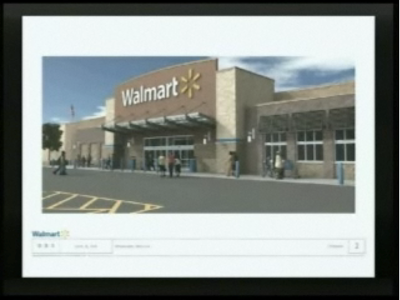
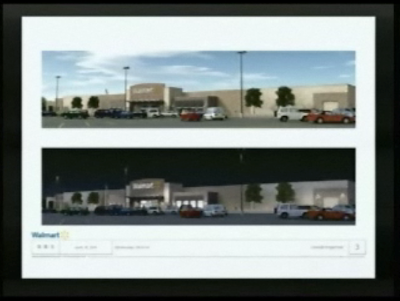
I think, by the way, the design looks good, and better than the existing design. Here are two screenshots of the proposal:

I think these photos show a more attractive façade than the one on the Walmart in Jefferson, Wisconsin, by the way.

Deals for Walmart, Rather than at Walmart. I’d guess Walmart’s thinking about expanding to make money, not as a charitable contribution to the people of Whitewater. Fine by me — prosperity on this continent has come about by private, voluntary mutual exchanges between buyers and sellers. I wouldn’t expect more of Walmart than other businesses, but I wouldn’t want less from them, either. They should accommodate parking adequately, as the City of Whitewater expects in its ordinances. Walmart should be striving to meet a required standard that other businesses have to meet, reflecting the difference only in size.

Some small merchant gets badgered about a sandwich board, or how many square feet something is, and that’s wrong. It’s doubly wrong to let Walmart skirt rules on parking when owners of other, smaller concerns get hit over their heads on that point. If there’s a requirement that in a zoning district like this (B1) for a “minimum of 30 percent of the lot to be landscaped surface area,” the Walmart shouldn’t be given a break that others would likely never get. If Walmart can show a real impact from plantings, etc., as our ordinances allow, only then should they be allowed to go below our the 30% minimum.

To offer breaks would be a kind of corporate care package that Walmart does not need, and smaller merchants wouldn’t get.

There’s a good deal to be had here, setting aside trivial concerns about aesthetics for more important matters of traffic flow and the surface area on the Walmart lot, among others.

Walmart will be back with proposal at a subsequent meeting, and it is on these matters than a serious examination should concern itself, as the basis of a good deal.

Whitewater’s Planning Commission Meeting from 5/10/10: Overview

On May 10th, Whitewater’s Planning Commission held a meeting at 6 p.m., with principal the topics being a possible expansion of our local Walmart, and an overlay to an existing residential zoning ordinance for the Starin Park neighborhood.

Recording of the meeting

Here’s the video of the meeting, which I will be using for my remarks.

(This meeting was televised on our local cable access channel, but I’d rather comment with a posted video to which readers can refer. In cases where the city does not record a video, but someone else does, I will upload and use that video. Note – the caption that appears at the beginning recording says 5/14, but it’s the 5/10 meeting. The video may have been placed online on 5/14.)

Link: http://blip.tv/file/3624624

Agenda of the Meeting and Documents Attached

Planning Commission Agenda & Attached Documents

Press coverage of the meeting, and items on agenda

Residential zoning:

Whitewater plan panel advances R-0 zoning, published May 11th, Daily Union.

Zoning proposal would limit growth of rental housing, published May 9th, GazetteXtra.com.

Neighborhood hopes to limit encroachment of student housing, posted April 9th, Walworth County Today, County Life.

Walmart:

Walmart given expansion input, published April 22nd, Daily Union.

Walmart to expand in Whitewater, published April 20th, Daily Union.

Wal-Mart plans upgrade of Whitewater store, published April 19th, GazetteXtra.com. more >>

WalworthCountyToday.com: Whitewater’s landmark buildings and places

Over at Walworth County Today, there’s a photo gallery of fourteen of Whitewater’s nineteen historic landmarks and places. The galley has photographs of the

  • Birge Fountain, 1903; 402 W. Main St.
  • First United Methodist Church, 1872-73; 145 S. Prairie St.
  • Nelson Salsbury House, 1874; 404 W. Main St.
  • Engebretsen Dorr House, 1895; 622 W. Main St.
  • G.W. Esterly House, 1876; 604 W. Main St.
  • Sanger Marsh House, 1861; 522 W. Main St.
  • J.J. Starin House, 1860; 507 W. Main St.
  • Newton M. Littlejohn House, c. 1859; 428 W. Main St
  • White Memorial Building, 1904; 402 W. Main St.
  • The restored 1890 Whitewater Passenger Depot; 310 W. Whitewater St.
  • Stone Stable, west of the depot, circa 1845
  • Indian Effigy Mounds. These effigy mounds, dating from 400 BC to AD 1500
  • Bassett House, 1857, with additions in 1858; 708 W. Main St.
  • Hamilton House, 1868, remodeled in 1881 and 1887; 328 W. Main St.

Recent Tweets, 5-9 to 5-15

Cato: Republicans unveil bold strategy to cut 0.017% from $3.7 trillion federal budget http://bit.ly/9Yi6mx Maybe they’ll round it to .02%
12:46 PM May 14th via Seesmic

No justification – RT @reasonmag: Another day, another wrong-door drug raid terrorizing an innocent grandmother http://ow.ly/1KCx5
9:44 AM May 13th via Seesmic

Name for movers, Packrat Moving & Storage – packrat.com, sounds good until one realizes it’s just encouraging people to keep, ship junk
12:27 PM May 12th via Seesmic

RT @CatoInstitute: Bailout do not solve the problems. Taxpayers bear the costs rather than banks. Spread the word. http://bit.ly/aJs3Sa
3:25 PM May 11th via Seesmic

RT @IJ: CBS Evening News features IJ clients who are fighting Louisiana’s ridiculous licensing law for florists: http://bit.ly/bfncub
11:50 AM May 11th via Seesmic

World’s finest cough drops: http://bit.ly/9mcw52
11:48 AM May 11th via Seesmic

Conservation in practice: Florida teen bets to wear same sneakers for all of high school http://bit.ly/c3PfpT
12:07 PM May 10th via Seesmic

Wisconsin State Journal: Local officials concerned that Hispanic immigrants will avoid census http://bit.ly/bADGlI
10:49 AM May 10th via Seesmic

FREE WHITEWATER on Twitter

Dodgy Science (Trying to Get) in the Courtroom

We’re an inventive people, but not every invention is reasonable simply because it’s the product of human reasoning. An good example of a bad idea is almost surely fMRI (functional magnetic resonance imaging) brain scans to detect dishonesty. Wired has published a few stories about the procedure, the results of which a defense attorney in New York unsuccessfully attempted to have admitted to show his client’s honesty.

In Lie-Detection Brain Scan Could Be Used in Court for First Time, readers learn that

Laboratory studies using fMRI, which measures blood-oxygen levels in the brain, have suggested that when someone lies, the brain sends more blood to the ventrolateral area of the prefrontal cortex. In a very small number of studies, researchers have identified lying in study subjects (.pdf) with accuracy ranging from 76 percent to over 90 percent. But some scientists and lawyers like New York University neuroscientist Elizabeth Phelps doubts those results can be applied outside the lab.

“The data in their studies don’t appear to be reliable enough to use in a court of law,” Phelps said. “There is just no reason to think that this is going to be a good measure of whether someone is telling the truth.

General fMRI data from research has been used in sentencing, but an individual’s brain scan has yet to be entered as evidence in a civil or criminal trial to help the jury determine whether someone was telling the truth. Individual fMRI evidence was offered in at least one other case by a San Diego attorney defending a father accused of sexual abuse, but the evidence was eventually withdrawn and did not make it into the record….

But even in the best of circumstances, Phelps argues that fMRI evidence should not be allowed in court, even if there are at least two companies peddling the service to the legal profession.

“I always come down hard on these companies that are selling it,” she said. “But these companies are going ahead and making claims already, based on some data that’s not so great, that they can do things that they can’t really do.”

In the New York case, the court excluded the brain scan evidence that plaintiff’s counsel sought to present, and a jury quickly found for the defendant.

Would they have been swayed if they’d heard the results of the brain scan, that purported to show the plaintiff was honest? I don’t know, but I think it better the court rejected a technique that’s based only on a very few studies. Something that’s suggestive of serious and considered science needs more testing than fMRI for lie-detection has yet shown. Much more.

Science unconfirmed under conventional conditions, and unable to be confirmed repeatedly, is no science at all. Speculative devices and techniques, merely suggestive, and unreproducible, have another name.

Witchcraft.

Whitewater-Area League of Women Voters — May 2010 Newsletter

The Whitewater-Area League of Women Voters’ May 2010 Newsletter is now available, and the latest issue includes a calendar of upcoming LWV events. The latest copy of the LWV newsletter is available as a link on my blogroll, and is embedded below, with coding through Google.

Upcoming for the Whitewater-Area League is an annual meeting —

Date: May 22nd (Saturday)
Event: LWV Annual Meeting
Where: Fairhaven, Fellowship Hall 10AM

Friday Open Comments Forum

Here’s the Friday open comments post, following reader responses to a recent poll.

The use of pseudonyms and anonymous postings will be fine.

Although the template has a space for a name, email address, and website, those who want to leave a field blank can do so. Comments will be moderated, against profanity or trolls. Otherwise, have at it.

I’ll keep the post open through Sunday afternoon.

For this week, some suggestions for topics — Whitewater’s possible residential overlay, and a newer, larger Walmart. I’ll post on both topics throughout the weekend.

Quick summaries of my views:

Walmart — fine, and a competitive benefit to the city, so long as neither unusual concessions nor unusual burdens on them. So far, so good.

Overlay for the Starin Park neighborhood — I’m opposed.

Daily Bread for Whitewater, Wisconsin: 5-14-10

Good morning,

The forecast calls for a mostly sunny day, with a high of sixty-five degrees.

Far as I know, there are no municipal, public meetings for the City of Whitewater today. The weekend starts on a sweet note.

Today, it’s Laps for Lakeview at Lakeview School. At the Middle School, there’s an 8th grade Reality Fair in the gym.

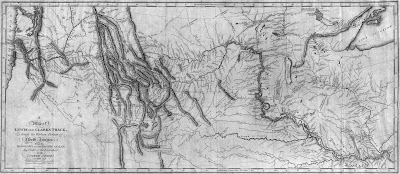
On this day in 1804, Lewis and Clark departed to explore the Northwest, as the History Channel recalls:

One year after the United States doubled its territory with the Louisiana Purchase, the Lewis and Clark expedition leaves St. Louis, Missouri, on a mission to explore the Northwest from the Mississippi River to the Pacific Ocean.

Even before the U.S. government concluded purchase negotiations with France, President Thomas Jefferson commissioned his private secretary Meriwether Lewis and William Clark, an army captain, to lead an expedition into what is now the U.S. Northwest. On May 14, the “Corps of Discovery”–featuring approximately 45 men (although only an approximate 33 men would make the full journey)–left St. Louis for the American interior.

The expedition traveled up the Missouri River in a 55-foot long keelboat and two smaller boats. In November, Toussaint Charbonneau, a French-Canadian fur trader accompanied by his young Native American wife Sacagawea, joined the expedition as an interpreter. The group wintered in present-day North Dakota before crossing into present-day Montana, where they first saw the Rocky Mountains. On the other side of the Continental Divide, they were met by Sacagawea’s tribe, the Shoshone Indians, who sold them horses for their journey down through the Bitterroot Mountains. After passing through the dangerous rapids of the Clearwater and Snake rivers in canoes, the explorers reached the calm of the Columbia River, which led them to the sea. On November 8, 1805, the expedition arrived at the Pacific Ocean, the first European explorers to do so by an overland route from the east. After pausing there for the winter, the explorers began their long journey back to St. Louis.

On September 23, 1806, after almost two and a half years, the expedition returned to the city, bringing back a wealth of information about the largely unexplored region, as well as valuable U.S. claims to Oregon Territory.

Lewis & Clark Expedition Map

(clickable to expand to full size)

Daily Bread for Whitewater, Wisconsin: 5-13-10

Good morning,

It’s a rainy day for Whitewater again today, with a high of sixty-eight degrees.

It’s wild hair day today, at Lakeview School. There will also be a Middle School Band concert at Whitewater High School tonight at 7 p.m.

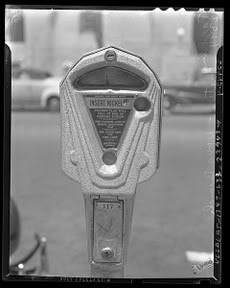
Wired recalls that today is a day of frustration for many, a reduction in congestion for others, and profit for municipalities, in a post entitled, “May 13, 1935: Enter the Parking Meter:”

If it weren’t for Pearl Harbor, FDR might have called May 13 a day that will live in infamy. It was 75 years ago that Carl C. Magee of Oklahoma City sought a patent for the world’s first parking meter. Many will come to see the invention as a bane of urban living.

Soon after Magee filed to protect his intellectual property, the world’s first installed parking meters were put into nickel-gulping service right there in Oklahoma City in July 1935. Your five cents (about $.80 in today’s money) got you anywhere from 15 minutes’ to an hour’s worth of parking, depending on location….

Even back in 1935, U.S. cities were having thoroughly modern problems: Workers parked on downtown streets and stayed all day. That left few spaces for shoppers and others who visited the central business district….

Carl Magee’s new parking meter not only solved Oklahoma City’s parking problems, it also got a new revenue stream flowing in to city coffers. Magee mentioned money in the patent application for “meters for measuring the time of occupancy or use of parking or other space, for the use of which it is desirous an incidental charge be made upon a time basis.”

U.S. Patent No. 2,118,318 was granted for the device May 24, 1938. The idea spread to other cities around the country and the world. Magee managed to make money manufacturing meters and selling them to many municipalities, starting at $23 a pop ($365 in current cash).

Banning Drink Specials: Miscellany

Update, 5-13-10: All of what I write below rests on the idea that the all-you-can-drink ban would lead to some reduction in tavern drinking, as proponents certainly hope. If that’s not true, and their lack of confidence is an inability to reduce tavern drinking, then the ordinance is an exercise in futility, and an embarrassment for being so ineffectual. So there the possibilities before proponents: (1) effective at stopping tavern drinking, but at risk of shifting unmonitored drinking elsewhere, or (2) an ordinance easily circumvented in taverns. This ordinance was ill-considered and foolish, all the way around.

Here’s a bit more on banning all-you-can drink specials. Whitewater’s ordinance is notable for its flimsy justification, and we’re likely to find a similar flimsiness in other ordinances yet to be proposed.

I wrote about two aspects of Whitewater’s ban last week — its bad origins and the false empiricism used to justify the ordinance. See, Whitewater’s Ban on Drink Specials: Bad Origins and False Empiricism. (My two contentions: that the ordinance looks like a shield for the uncompetitive from the competitive, and comparisons of statutes to other statutes are a false empiricism, not assessing properly the relationship between legislation and public health.)

Here are four more points:

1. “Admitting” Harms. Over the weekend, a commenter by the name of For People Not Profit wrote that a bar owner in Whitewater admitted that alcohol kills. I had no idea what he or she meant, but I think I’ve found the supposed admission, from a Gazette story published online on Friday morning. Here’s the statement to which I think the commenter was referring:

Dave Bergman, owner of the Brass Rail, 130 W. Main St., said bars that offer such specials are being irresponsible and putting the community at risk.

“We’re supposed to be responsible servers,” he said. “But when you have $5 all-you-can-drink, and people get so intoxicated and possibly go out and kill themselves or somebody else (in an accident), that’s not responsible. I don’t believe in that.”

This is a remark about what other bar owners may have done, not what the speaker has done. It’s a reference to other owners (left unstated!), not to himself.

That’s not an admission, it’s a vague accusation.

It’s others, somewhere else … This is the kind of connection one makes, to a supposed harm, when one does not want to bother with the concrete, substantial, and verifiable. It’s easy, and as unsound as it is easy.

2. A speculative, inflammatory ordinance. Perhaps, one’s wondering if there was any serious public health research offered behind Whitewater’s ordinance. Stop wondering — there wasn’t. Here’s how the draft ordinance, from the Common Council packet, begins:

(a) Purpose. The City Council hereby recognizes that all you can drink specials and other offers that encourage excessive alcohol consumption can lead to alcohol abuse which causes dangerous and irresponsible behavior by persons, including operating motor vehicles while under the influence of intoxicants, domestic abuse, disorderly conduct, public intoxication, and alcohol-related health problems, and therefore should be discouraged.

It’s all just a chain of what might happen, what could happen, with list of horrors that result from over-drinking. One doesn’t know how likely any of this will be, but it all might happen.

I’ll assume that these ill-consequences of over-drinking are more likely than an asteroid impact or a tsunami in Whitewater. How much more, to produce a concrete assessment of the scare-list provided, I don’t know. No one else in town does either, including those who drafted and those who voted for the ordinance.

I know some will contend that one shouldn’t be flippant about these harms. I’m not. On the contrary, I think the ordinance’s proponents have been cavalier, speculative, inflammatory, and ill-considerded by turns.

They want to discourage a bad thing, yet most people would prefer to discourage the bad, and encourage the good. One need not do it, and may not do it well, through legislation.

3. Ignoring the Consequences of Regulation. Note how proponents of this ordinance imply that there are only two consequences of it: reducing the ill effects of alcohol, or merely being symbolic, merely making a statement.

I will note also how much doubt this reveals. Proponents are hardly confident. It’s all

“There’s clear evidence that shows that all-you-can-drink specials and similar promotions tend to lead to overindulgence in alcohol, and that can result in public safety issues such as injuries and deaths from drunken driving and other crimes,” and

‘”It might help. I’m not saying it’s going to stop (binge drinking), but it’s a step in the right direction,” and making

“a statement.”

If proponents really feel that a statement is the most this ban may yield, then they’ve chosen the wrong method. Desire to make a statement does not justify an ordinance, but rather a resolution.

In any event, to the extent the ordinance reduces drinking in regulated, public taverns, proponents should ask themselves: Will this stop the behavior they seek to stop, or drive even some of it underground into unregulated, less safe environments?

4. Advocates of the ordinance are not sure that it will stop binge drinking, but if they’re not sure, where do they think that drinking might continue? If not taverns, then where?

Even if the amount of binge drinking in total is less, a small amount driven to a less open setting runs dangers in aggregate to public health health. These dangers of notice, access to services, and lack of licensed monitoring are real.

The ban is applied to a definite number of taverns; yet, for it all, it’s the behavior not of businesses but of individuals that presents danger. These individuals can walk or drive to darker and more dangerous venues. Ignoring as much is foolish and reckless, all for making a so-called statement.

That’s why regulations like this are no easy thing, no recourse quickly to be adopted (and certainly not the way this came about).

Note what’s telling — doubt about whether this will stop binge drinking comes from proponents themselves, and their own uncertainty fuels my contention that drinking may be driven underground. Their doubts bolster my position. If they were confident they might still be wrong; as it is, they’re not even confident.

One is reminded of the adage that one who asserts should prove. They’ve not done so, and their stated doubts act as evidence for a counter-argument.

This is more than regulatory over-reach: there’s foolishness to this approach to public heath that’s to no one’s credit.

On Whitewater’s Quarterly Police and Fire Commission Meeting

There’s a quarterly meeting of Whitewater’s Police and Fire Commission scheduled for tonight. The agenda is available online.

One sees that on May 5th, this was the distribution of the agenda:

May 5, 2010 Emailed/mailed to PFC members
Faxed to the Whitewater Register for posting
Faxed to the Library for posting
Emailed to Channel 13 for posting
Emailed to City Clerk’s Office for posting on City Hall bulletin board
Posted on City of Whitewater Website (ci.whitewater.wi.us)

It’s too funny to describe something as “[f]axed to the Whitewater Register for posting.” Perhaps they stuck the notice on the bulletin board of the office that’s not in Whitewater anymore.

More important, of course, is who writes (and thus sets) the agenda. One can see from the .pdf document that the agenda was prepared in city hall; was it written there, too, by a bureaucrat rather than by a PFC member?

I don’t know. I do know that a PFC that acted as Wisconsin statutes require would be more than a lapdog or rubber stamp of a police chief, and would have members who would craft their own agenda items, and make it clear that they had. Nothing in this agenda makes that clear.

The meeting’s in that same, cramped space that’s comfortable only for insiders, and is uninviting for guests. It’s called the City Manager’s Conference Room, but it might just as well be the Insider Sekret Club Hous. A meeting like this, held quarterly, should be held each and every time in a large, spacious room, on the first floor of the building in which the meeting is held. If the Planning Commission and Common Council can meet in a room like that, so can the PFC.

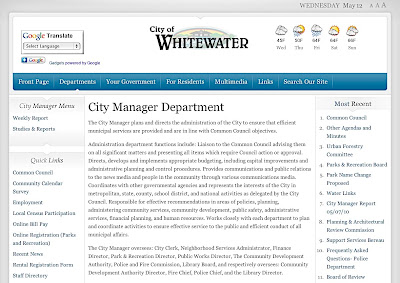
Who’s responsibility is all this? If one reads the city’s website, this morning, one sees a proud declaration of all of City Manager, Kenin Brunner’s many responsibilities, including over the PFC.

Here’s a screen shot:


City Manager Department

The City Manager plans and directs the administration of the City to ensure that efficient municipal services are provided and are in line with Common Council objectives.

Administration department functions include: Liaison to the Common Council advising them on all significant matters and presenting all items which require Council action or approval. Directs, develops and implements appropriate budgeting, including capital improvements and administrative planning and control procedures.

Provides communications and public relations to the news media and people in the community through various communications media. Coordinates with other governmental agencies and represents the interests of the City in metropolitan, state, county, school district, and national activities as delegated by the City Council.

Responsible for effective recommendations in areas of policies, planning, administering community services, community development, public safety, administrative services, financial planning, and human resources. Works closely with each department to plan and coordinate activities to ensure effective service to the public and efficient conduct of all municipal affairs.

The City Manager oversees: City Clerk, Neighborhood Services Administrator, Finance Director, Park & Recreation Director, Public Works Director, The Community Development Authority, Police and Fire Commission, Library Board, and respectively oversees: Community Development Authority Director, Fire Chief, Police Chief, and the Library Director.

That’s an impressive and exhaustive list. I’m just not sure what it means to say that the city manager oversees the police chief, the fire chief, as well as the Police and Fire Commission.

There are two way to consider the city manager’s oversight.

Perhaps it means, literally, that he stands on a step ladder, and looks down on the police chief, fire chief, or PFC from on high. If that’s what oversight means, then it’s possible that Kevin Brunner does oversee these officials and this commission that way. I’ve never heard that he does this, but it’s possible, I suppose.

If, instead, the list of powers and duties means that he has legal oversight over these groups, it’s false. False, as contrary to Wisconsin law. Our laws do not place authority over these groups in the hands of the city manager, and anyone able to read can see as much under Wisconsin’s statutes. See, Police and Fire Commission: Importance and Authority.

Either the city manager has served years and years ignorant of the laws of our state, or he simply writes what he wants on the city website, ignoring that there’s a world (and law) beyond the city limits.

As a practical matter, it’s even more risible to suggest that this city manager exercises oversight, unless that means defending every error and mistake others have made. Even our PFC (astoundingly by local ordinance rather than Wisconsin statute) has no oversight over the fire department!

Is there no one upon whom this city administration relies, in all the city, who can give a city manager with a poor grasp of the law a better understanding? No one? (Here I refer to more than the recourse of the blind leading the blind.)

If, though, he assumes this authority, however presumptuously, the least he could do is exercise it well. As it is, his supposed authority has done no good for the city, mired as we are in third-tier practices.

Tonight’s an organizational meeting of the PFC, and afterward there will be closed-session interviews for a part of the meeting time, and that’s not a date that I’d propose for the introduction of television. That time while come, though, meeting in and meeting out, surely and soon.